Connect with us

Technology

From Grid Constraint to AI Growth: Hitachi Vantara and Duraflow Transform Data Center Energy Management for Greater AI and Compute Capacity

Published

on

Hitachi Vantara pilots one of the world’s largest Phase Change Material installations in its Netherlands data center, demonstrating how organizations can use up to 90% less electricity for thermal managementImplementation requires zero water for cooling, reducing the resources needed to support data center operationsThis generates more computing capacity from existing power infrastructure, rather than diverting power to cooling

ZALTBOMMEL, The Netherlands and SANTA CLARA, Calif., Oct. 27, 2026 /PRNewswire/ — As artificial intelligence (AI) accelerates demand for computing power, data centers face a growing challenge: how to increase AI and compute capacity when access to additional electricity is increasingly constrained.

Hitachi Vantara, the data storage, infrastructure and hybrid cloud management subsidiary of Hitachi Ltd. (TSE: 6501), is demonstrating a new approach to address this challenge by showing how data centers can effectively use their power for AI and compute capacity rather than power and cooling. At its data center in the Netherlands, Hitachi Vantara has deployed one of the world’s largest operational Phase Change Material (PCM) installations, using technology developed by Dutch thermal energy company Duraflow.

For more information about Hitachi Vantara’s approach to AI, please visit: https://www.hitachivantara.com/solutions/ai-analytics

Depending on the application, PCM technology can help reduce electricity consumption related to thermal management by up to 90%, while requiring no water for cooling. By reducing the energy needed to manage power and cooling, a greater share of available electrical capacity can be used for computing – an increasingly important consideration as organizations deploy more energy-intensive AI workloads.

Tackling the energy challenge behind AI
Every watt consumed by AI ultimately becomes heat and managing that heat requires as much as 40% of a data center’s total energy needs. At the same time, as AI workloads continue to grow, the ability to convert available electricity into useful computing capacity will increasingly determine how quickly digital infrastructure can expand. This creates a growing challenge for data center operators seeking to increase computing capacity within constrained power infrastructure. In regions where grid congestion or limited access to additional electricity can constrain data center expansion, improving infrastructure efficiency can help organizations make more computing capacity available within their existing power connection.

Hitachi Vantara faced this challenge as demand for high-density computing and AI infrastructure increased. Rather than assuming that more computing required a greater amount of power, the company explored ways to make its existing electrical capacity work harder. The resulting deployment of Duraflow’s PCM technology provides a real-world proof point for this approach at an operational scale.

Real-world performance: 240 kW of cooling with low electrical consumption
The installed system provides a total cooling capacity of 240 kW across two 120 kW PCM units. According to operational monitoring data, the two units collectively consume just 5–8 kW of electricity, depending on operating conditions. For comparison, a conventional DX cooling system delivering the same 240 kW cooling capacity would require an estimated 60–80 kW of compressor power. These operational figures illustrate how PCM-based thermal management can significantly reduce the electricity required for cooling, freeing up more of the data center’s available power capacity for computing.

“This project started with a very practical challenge: how do we grow our computing capacity when access to additional electricity is limited,” said Simon Ninan, Senior Vice President of Business Strategy, Hitachi Vantara. “We realized that if we could dramatically reduce the amount of power required for thermal management, we could make more of our existing electrical capacity available for computing. By partnering with Duraflow, we are demonstrating how smarter energy management can become an important enabler of AI growth.”

The approach also supports Hitachi Vantara’s broader commitment to operating more efficiently and sustainably, including its goal of becoming carbon neutral in Scope 1 and 2 GHG emissions by FY2030.

Building efficiency across the infrastructure stack
The deployment is part of Hitachi Vantara’s broader focus on helping organizations get more value from their infrastructure while managing the growing energy demands of digital workloads.

That approach extends across the infrastructure stack. Hitachi Vantara’s Virtual Storage Platform One (VSP One) Block includes a 4:1 Data Reduction Guarantee and features Dynamic Carbon Reduction technology, which reduces energy consumption by switching CPUs into eco-mode during periods of low activity. Its always-on compression capability allows the system to switch from inline data reduction to post processing, which further reduces energy consumption and helps reduce a CO2 footprint by as much as 40%.

“Addressing the energy demands of AI isn’t about optimizing one part of the business in isolation,” said Courtney Hadden, Sustainability Director, Hitachi Digital. “It’s about working in concert across the organization and with innovative ecosystem partners to find efficiencies at every stage – from the products we build, how we bring them to market, and everything in between. The answer cannot simply be to consume more power. We need to become smarter about how we use the power we already have.”

Dutch innovation, demonstrated at operational scale
Developed in the Netherlands, Duraflow’s PCM technology absorbs thermal energy during periods of peak demand before releasing it in a controlled manner when demand decreases. Unlike conventional cooling approaches that rely continuously on electrically driven refrigeration to remove heat, PCM technology provides a way to manage and store thermal energy more efficiently. The system requires no water for cooling, helping data centers reduce their reliance on water resources while significantly lowering the electricity needed for thermal management.

“Developing technology is one thing; proving that it can operate at this scale in a live, mission-critical environment is another,” said Simon Loerakker, CEO, Duraflow. “Our collaboration with Hitachi Vantara has allowed us to demonstrate the potential of innovation at an unprecedented scale. Together, we are showing that sustainable innovation and the growth of AI infrastructure can go hand in hand.”

For more information on Hitachi Vantara’s AI-enabled infrastructure, please visit: https://www.hitachivantara.com/en-us/products/storage-platforms.

Additional Resources:

Blog: Raising the Stakes for Sustainable, AI-ready InfrastructureBlog: Five Habits That Cut IT Energy Waste, Without Spending MorePress Release: Hitachi Vantara Releases FY2025 Sustainability Report, Highlighting Leadership in Energy-Efficient Infrastructure for AI-Driven WorkloadsWebinar: Green Data: Sustainable Innovations in Data CentersPress Release: Hitachi Vantara Unveils New Virtual Storage Platform One Capabilities to Enable Stronger Cyber Resilience, Performance and Sustainability

About Duraflow
Duraflow develops advanced thermal energy management technology based on Phase Change Materials (PCM). Its independently developed technology enables organizations to significantly reduce energy consumption for thermal management, maximize the use of existing electrical infrastructure and support the sustainable growth of mission-critical digital environments.

About Hitachi Vantara
Hitachi Vantara is transforming the way data fuels innovation. A wholly owned subsidiary of Hitachi Ltd., Hitachi Vantara provides the data foundation the world’s leading innovators rely on. Through data storage, infrastructure systems, cloud management, and digital expertise, the company helps customers build the foundation for sustainable business growth. To learn more, visit www.hitachivantara.com.

About Hitachi, Ltd. 
Through its Social Innovation Business (SIB) that brings together IT, OT (Operational Technology) and products, Hitachi aims to be a global leader in continuously transforming social infrastructure through digital, contributing to a harmonized society where the environment, wellbeing, and economic growth are in balance. Hitachi operates worldwide across four sectors – Digital Systems & Services, Energy, Mobility, and Connective Industries – as well as a Strategic SIB Business Unit focused on new growth areas. With Lumada at its core, Hitachi creates value by combining data, technology, and domain knowledge to solve customer and social challenges. Revenues for FY2025 (ended March 31, 2026) totaled 10,586.7 billion yen, with 606 consolidated subsidiaries and approximately 290,000 employees worldwide. Visit us at www.hitachi.com.

HITACHI is a trademark or registered trademark of Hitachi, Ltd. All other trademarks, service marks, and company names are properties of their respective owners.

View original content to download multimedia:https://www.prnewswire.com/news-releases/from-grid-constraint-to-ai-growth-hitachi-vantara-and-duraflow-transform-data-center-energy-management-for-greater-ai-and-compute-capacity-302920057.html

SOURCE Hitachi Vantara

Continue Reading

Technology

Vertical IQ Will Expand Industry Intelligence Platform with Small Business Financial Exchange (SBFE) Small Business Credit Data

Published

on

By

RALEIGH, N.C., Oct. 27, 2026 /PRNewswire/ — Small Business Financial Exchange (SBFE), the trusted source for small business lending data and Vertical IQ, a nationally recognized provider of Industry Intelligence, today announced their partnership. Through the partnership, Vertical IQ will incorporate SBFE small business credit insights into its platform, providing financial institutions with deeper context to support commercial lending decisions.

The collaboration enables banks, credit unions, and other commercial lenders using Vertical IQ to gain access to SBFE small business credit insights within the Industry Intelligence platform. Default rates, delinquencies, and credit trends by industries are just a few of the SBFE features that will be included. These insights allow financial services professionals to better understand small business borrowers and support key commercial lending activities.

“At SBFE, we’re committed to helping lenders better understand and support small businesses. Extending access to SBFE insights through Vertical IQ is another way we can deliver value to the lending community and support greater access to capital.”

     – Elisabeth MacDonald, President and CEO, SBFE

“At Vertical IQ, we believe financial institutions make their best decisions when they have access to trusted, Verified Industry Intelligence powered by the highest-quality data available,” said Bobby Martin, co-founder and CEO of Vertical IQ. “Our partnership with SBFE represents another important step in that commitment by bringing highly respected small business credit insights into our platform. By combining SBFE’s credit data with Vertical IQ’s industry expertise, we’re helping lenders gain deeper context to strengthen credit analysis, improve risk assessment, and make more confident decisions throughout the commercial lending lifecycle.”

     – Bobby Martin, Co-founder and CEO, Vertical IQ

About SBFE

SBFE is the trusted data exchange where the small business lending industry comes together to strengthen access to capital for America’s small businesses. For more than 25 years, SBFE has united lenders in a member-driven community built on trust, collaboration, and the responsible use of data. Today, SBFE securely manages one of the nation’s largest repositories of small business credit data, contributed by more than 140 member institutions, including many of the country’s largest commercial banks. This data enables highly predictive credit reporting and portfolio management solutions that help lenders make more informed decisions, manage risk, and support the financial health and growth of small businesses. By transforming shared data into trusted lending intelligence, SBFE helps its members strengthen credit decisioning and promote greater access to capital. Learn more at www.SBFE.org

About Vertical IQ

Headquartered in Raleigh, North Carolina, Vertical IQ is a nationally recognized provider of Industry Intelligence. Whether discussing cash management with a local brewery or evaluating risk for a large manufacturing company, successful banks, credit unions, accounting firms, insurance organizations, and advisory firms use Vertical IQ to better understand a prospect’s or client’s business challenges before, during, and after meetings. Covering 100% of the industries that comprise the U.S. and Canadian economies, as well as more than 3,400 local economic reports, Vertical IQ equips professionals with the confidence and credibility to build stronger client relationships and make more informed decisions. Learn more at www.verticaliq.com

View original content to download multimedia:https://www.prnewswire.com/news-releases/vertical-iq-will-expand-industry-intelligence-platform-with-small-business-financial-exchange-sbfe-small-business-credit-data-302920872.html

SOURCE SBFE

Continue Reading

Technology

CME Group Brazilian Real Futures Set New Daily Volume Record Following Election

Published

on

By

Record $9 billion notional traded, eleven times the year-to-date average daily volume (ADV) as market participants turned to CME Group to manage risk around the clock

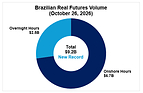
CHICAGO, Oct. 27, 2026 /PRNewswire/ — CME Group, the world’s leading derivatives marketplace, today announced that its Brazilian real (BRL) futures reached a new daily volume record of 498,498 contracts (R$49.8 billion, ~$9.2 billion notional value) on October 26, surpassing the previous record of 191,325 contracts (~$3.7 billion notional value) traded on September 28, 2026.

“Following the results of the Brazilian presidential election, clients turned to our BRL futures market to immediately manage their risk outside of Brazilian trading hours, driving all-time record volume,” said Paul Houston, Global Head of FX Products, CME Group. “Even before the onshore market opened, $2.5 billion in notional value had already traded, roughly three times the year-to-date ADV for BRL futures. With liquidity in all timezones and contracts denominated in USD, our markets are fast becoming the main venue for Brazilian real price discovery and trading outside of onshore hours, giving global participants the liquidity they need around the clock.”

In the first half of 2026, Mexican peso and Brazilian real futures and options saw a record combined average daily volume of $2.94 billion.

For more information on CME Group BRL futures, please visit https://www.cmegroup.com/articles/faqs/latam-fx-futures-frequently-asked-questions.html

As the world’s leading derivatives marketplace, CME Group (www.cmegroup.com) enables clients to trade futures, options, cash and OTC markets, optimize portfolios, and analyze data – empowering market participants worldwide to efficiently manage risk and capture opportunities. CME Group exchanges offer the widest range of global benchmark products across all major asset classes based on interest rates, equity indexes, foreign exchange, cryptocurrencies, energy, agricultural products and metals.  The company offers futures and options on futures trading through the CME Globex platform, fixed income trading via BrokerTec and foreign exchange trading on the EBS platform.  In addition, it operates one of the world’s leading central counterparty clearing providers, CME Clearing. 

CME Group, the Globe logo, CME, Chicago Mercantile Exchange, Globex, and E-mini are trademarks of Chicago Mercantile Exchange Inc.  CBOT and Chicago Board of Trade are trademarks of Board of Trade of the City of Chicago, Inc.  NYMEX, New York Mercantile Exchange and ClearPort are trademarks of New York Mercantile Exchange, Inc.  COMEX is a trademark of Commodity Exchange, Inc. BrokerTec is a trademark of BrokerTec Americas LLC and EBS is a trademark of EBS Group LTD. The S&P 500 Index is a product of S&P Dow Jones Indices LLC (“S&P DJI”). “S&P®”, “S&P 500®”, “SPY®”, “SPX®”, US 500 and The 500 are trademarks of Standard & Poor’s Financial Services LLC; Dow Jones®, DJIA® and Dow Jones Industrial Average are service and/or trademarks of Dow Jones Trademark Holdings LLC. These trademarks have been licensed for use by Chicago Mercantile Exchange Inc. Futures contracts based on the S&P 500 Index are not sponsored, endorsed, marketed, or promoted by S&P DJI, and S&P DJI makes no representation regarding the advisability of investing in such products. All other trademarks are the property of their respective owners. 

CME-G 

View original content to download multimedia:https://www.prnewswire.com/news-releases/cme-group-brazilian-real-futures-set-new-daily-volume-record-following-election-302920902.html

SOURCE CME Group

Continue Reading

Technology

Vera Health Quietly Became One of the World’s Most Used Clinical Tools. Now It Has Raised $32 Million to Give Every Clinician in the World the Best Medical Knowledge in Seconds

Published

on

By

With a team of just 12 employees, the clinical AI company has grown largely through physician referrals, bringing total funding to $32 million

More than 800,000 clinicians across 190 countries use Vera Health, including approximately 1 in 4 physicians in Spain and Italy, with most discovering the platform through recommendations from colleagues.Threshold Ventures led Vera Health’s $28.5 million Series A, with participation from Mantis VC and SV Angel. Existing investors Y Combinator and Gradient tripled down, bringing total funding to $32 million.The investment will accelerate Vera Health’s evidence-focused clinical AI platform, expanding its ability to make global medical knowledge locally relevant and deepening partnerships with medical societies, publishers and health systems.

SAN FRANCISCO, Oct. 27, 2026 /PRNewswire/ — A year ago, a few thousand clinicians were using Vera Health. Today, more than 800,000 are, most having discovered the platform through a colleague. Every month since June, Vera has been the most downloaded clinical app in the world across the App Store and Google Play.¹ In September alone, it was downloaded more times than OpenEvidence and Doximity combined, while monthly downloads had more than tripled since February. With a team of just 12 employees, Vera has reached clinicians in 190 countries, including approximately 1 in 4 physicians in Spain and Italy, largely through word of mouth. Vera Health is a clinical AI search engine that reasons like a clinician, helping physicians find and evaluate medical evidence in seconds.

Today, Vera Health announced a $28.5 million Series A led by Threshold Ventures, with participation from Mantis VC and SV Angel. Existing investors Y Combinator and Gradient, tripled down in the round, bringing the company’s total funding to $32 million. The investment will accelerate Vera Health’s mission to close the gap between what medicine knows and what every patient receives.

Only a few months after raising its Series A, Vera already has more daily active users than it had monthly active users at the time of the raise. Clinicians went from asking Vera a few thousand questions a day to asking hundreds of thousands, every single day.

“Clinicians are the best data scientists I’ve ever met. They make the call in seconds, with more evidence than any human could ever read,” said Taieb Bennani, Co-Founder of Vera Health. “The secret to building for them is to live and breathe the problem like no one else. Everyone on our team is a clinician, or the child or sibling of one, like Maxime and me. That passion translates into every detail of the product, and when you build with that kind of obsession, the product speaks for itself, and clinicians share it with their colleagues. We don’t have the biggest team or the most money. We have the people who care the most about getting it right.”

How does Vera Health differ from general-purpose AI tools?
Clinical AI is increasingly being used to help physicians navigate complex medical questions, but the ability to generate an accurate-sounding answer does not necessarily establish whether the underlying research is reliable. Medicine now publishes a new scientific paper roughly every 20 seconds. Chatbots are built to sound confident. Vera is built to be accurate, and honest when the evidence is thin. Physicians are expected to keep up with an expanding body of research while interpreting guidelines, evaluating treatment options and making decisions for individual patients, sometimes within seconds.

Vera Health finds the evidence first, then writes the answer. Its technology searches more than 60 million peer-reviewed publications, clinical guidelines, consensus statements and drug labels, evaluating sources based on study design, level of evidence, cohort size, recency, journal quality and citation impact. Every claim is linked to its supporting research and color-coded to show the strength of the available evidence. Sometimes that color is red. A rare condition may have no large randomized trial or comprehensive guideline behind it, leaving only a small case series or a report involving a single patient. Vera Health surfaces that research while making its limitations visible, allowing physicians to assess how much weight the findings deserve.

“Medical knowledge moves too quickly for any one clinician to read, and general-purpose AI tools can make uncertain evidence sound settled,” said Maxime Allouch, co-founder, Vera Health. “Unlike other tools, we believe there’s value in making uncertainty visible. The grade shapes what Vera retrieves and writes, while the clinician brings the patient, the context and the judgment.”

Vera Health developed its approach alongside physicians who evaluate medical evidence and help write the guidelines other clinicians follow. Through its partnership with the American College of Emergency Physicians (ACEP), the platform integrates ACEP clinical policies with source attribution, bringing medical society guidance directly into clinical research workflows.

“In medicine, not all evidence is equal,” said Scott M. Silvers, MD, FACEP, Chair of the American College of Emergency Physicians’ Clinical Policies Committee and former Chair of Emergency Medicine at Mayo Clinic. “A large, randomized trial and a case report should never carry the same weight, yet most AI tools blend them into the same confident answer. Level of evidence is the foundation of every guideline we write, and Vera Health is built on it.”

For Dr. Bernard P. Chang, Vera Health’s Chief Scientific Advisor and Vice Chair of Research in the Department of Emergency Medicine at Columbia University, the importance of clinical evidence extends to how physicians evaluate patients.

“On a recent emergency-department shift, I saw a young woman with cough and shortness of breath. The symptoms could easily be attributed to a routine respiratory illness,” said Chang. “Vera Health surfaced evidence that raised my concern for pulmonary embolism, a potentially life-threatening blood clot in the lungs, and led me to broaden my evaluation. What interests me isn’t AI simply providing an answer. It’s whether it can reliably surface evidence that challenges our initial assumptions and improves clinical reasoning. That’s what we’re now evaluating rigorously, inside the academic medical centers where medicine is actually practiced.”

Vera Health’s clinical advisors also include Christopher Baugh, MD, MBA, FACEP, Vice Chair of Clinical Affairs in Emergency Medicine at Brigham and Women’s Hospital and Associate Professor of Emergency Medicine at Harvard Medical School. Its clinical council includes physician leaders affiliated with Mayo Clinic, Yale, Harvard, Columbia and Penn.

Why is Vera Health growing so quickly across international markets?
Bennani and Allouch grew up in families of physicians and initially developed Vera Health for their own fathers. What began with two users has since grown into a platform serving hundreds of thousands of clinicians, with physicians asking hundreds of thousands of questions each day. The company’s international growth reflects an approach built around a central reality of medicine. Medical knowledge is global, but clinical practice is local.

An emergency physician in France may follow different treatment guidelines than a physician in the United States. An oncologist reviewing a complex case may need an exhaustive evaluation of the available research, while an emergency physician needs a concise answer within seconds. Even physicians practicing the same specialty may follow different protocols depending on their institution.

Vera Health accounts for those differences by prioritizing locally relevant guidance while drawing on medical research from around the world. Through Vera Spaces, health systems can also integrate their own clinical protocols and pathways alongside national guidelines and international medical literature.

“Medicine is global, yet most tools in our space were built for a single geography,” said Allouch. “We went international from day one, because only a global view reveals what is truly local.”

The approach has helped Vera Health expand across Europe, where approximately 1 in 4 physicians in Spain and Italy and 1 in 7 in France use the platform, according to company data. Vera Health has achieved that international reach with a small team and a product that clinicians have largely discovered through their peers.

What will Vera Health’s Series A funding support next?
The financing will support further development of Vera Health’s clinical evidence infrastructure, expansion into additional healthcare markets and deeper partnerships with medical societies, publishers and health systems. The company will continue investing in locally relevant clinical guidance and tools that allow healthcare institutions to incorporate their own medical knowledge into the platform.

“In healthcare, trust is earned, not bought. Vera’s adoption among clinicians worldwide speaks to what Taieb and Maxime have built. By combining the most rigorous medical evidence with an understanding of each physician’s specialty, protocols and practice context, Vera makes the world’s medical knowledge relevant to how care is actually delivered. We believe that creates an enormous opportunity to improve global health,” said Andrew Brackin, Partner at Gradient.

“Vera is compelling because it starts with the evidence, not just an answer—helping clinicians find and assess the research behind a decision while making its strengths and limitations visible. By bringing that evidence to the point of care, Vera becomes a trusted clinical intelligence layer, not just another AI tool,” said Emily Melton, co-founder and managing partner of Threshold Ventures.

Vera Health will remain free for licensed clinicians and medical trainees worldwide as it expands access to medical evidence and locally relevant clinical guidance.

New medical knowledge takes an estimated 17 years to reach routine clinical practice, according to research published in the Journal of the Royal Society of Medicine. Vera Health aims to reduce the time physicians spend searching for and evaluating that knowledge, bringing relevant evidence closer to the moment clinical decisions are made.

“Our mission is to close the gap between what medicine knows and what every patient receives,” said Bennani. “Today, that gap is measured in years. We want it measured in seconds.”

About Vera Health
Vera Health is the search engine that reasons like a clinician, finding and grading evidence before showing the source, strength and limits behind every answer. More than 800,000 clinicians in 190 countries use Vera, which is free for licensed clinicians and trainees, never trains on clinicians’ questions, and is HIPAA and GDPR compliant and SOC 2 Type II certified. Founded in 2024 at Y Combinator by MIT graduates and sons of physicians Taieb Bennani and Maxime Allouch, Vera is headquartered in San Francisco and backed by Threshold Ventures, Gradient, Y Combinator, SV Angel and Mantis VC.

Learn more at verahealth.ai.

¹ Download data: Appark, worldwide App Store and Google Play downloads, June through [September] 2026.

Media Contact
Interdependence
(949) 259-6377 x 225
425709@email4pr.com

View original content to download multimedia:https://www.prnewswire.com/news-releases/vera-health-quietly-became-one-of-the-worlds-most-used-clinical-tools-now-it-has-raised-32-million-to-give-every-clinician-in-the-world-the-best-medical-knowledge-in-seconds-302920905.html

SOURCE Vera Health

Continue Reading

Trending