Connect with us

Technology

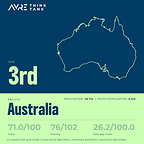
Australia beats Britain and Canada to take THIRD place in major AI study from Ayre Think Tank, as A$80.6 billion opportunity beckons

Published

on

Only Singapore and Malta beat Australia in major new Commonwealth study, showing the country’s strong position to turn AI into new businesses, better jobs and billions in economic growth.

ST JOHN’S, Antigua and Barbuda, Nov. 5, 2026 /PRNewswire/ — Australia has beaten Britain and Canada to claim third place in a major international study of how well young people are prepared for the artificial intelligence revolution, with researchers finding that AI could make the country’s economy A$80.6 billion larger after ten years.

The result places Australia among the Commonwealth’s leaders in preparing young people for AI, reflecting its technological strengths and growing opportunities for innovation, entrepreneurship and employment.

The Ayre Index, a new study covering all 56 Commonwealth countries, gives Australia 71.0 points out of 100. Singapore tops the rankings with 77.6, followed by Malta on 75.0. Britain comes fourth on 70.8 and Canada fifth on 70.2.

Australia’s position reflects strong access to technology and a solid base of digital capabilities. It scores 8.7 out of 10 for access and 7.5 for digital and AI capability, placing it among just 15 Commonwealth nations that meet the study’s readiness benchmark.

Australia’s strong performance also highlights the economic opportunities ahead. Using scenarios developed by the International Monetary Fund, the Index’s researchers calculate that AI could make the country’s economy A$80.6 billion larger after ten years. The estimated gain ranges from A$40.9 billion in the conservative scenario to A$120.3 billion in the most optimistic case.

The Ayre Think Tank, founded by entrepreneur and philanthropist Calvin Ayre, unveiled the study at the Commonwealth Heads of Government Meeting in Antigua and Barbuda.

Mr Ayre told Commonwealth delegates: “I’ve spent my life in businesses where new technology changes everything, and I know you can’t stand still. AI is going to change how we work, how we do business and how wealth is created. What matters is giving young people the skills and the chance to get ahead – whether to start businesses, find jobs or build something for themselves.”

He stressed that nobody can afford to be complacent right now. “Some Commonwealth countries are ahead, others have catching up to do. Nobody can afford to be complacent. That’s why we created this Index. It shows countries where they stand, what they’re getting right and where they need to do better. Governments now have to decide what they’re going to do about it.”

The research brings together 1,128 sources and considers the conditions affecting roughly 732 million young people aged 15 to 29 across the Commonwealth. About 5.4 million live in Australia.

While Australia has established strong foundations for AI, the study highlights that access to technology does not automatically translate into economic success. It says that the real opportunity lies in equipping young Australians to use AI productively, whether by developing new businesses, improving existing industries or creating better employment opportunities. Turning technological advantage into practical skills and commercial success will be essential to unlocking AI’s wider economic benefits.

One telling contrast lies in how Australia scored 8.7 out of 10 for access to technology but 5.3 for conditions supporting decent jobs, business creation and moves into employment. This, the study says, is where training and stronger links to employers can make a difference.

Professor C. Justin Robinson, Pro Vice-Chancellor and Campus Principal at the University of the West Indies’ Five Islands Campus, emphasised the importance of giving young people a greater role in developing AI.

“We need to make sure that the next generation will be able to do more than just consume AI products made elsewhere,” he said.

Despite its impressive international ranking, Australia has further opportunities to strengthen the skills of its next generation. A 2025 national assessment found that 37 per cent of Year 10 students met the national standard for digital literacy, compared with 46 per cent in 2022, showing the need to improve on these foundational skills.

Australia is already investing in the skills needed to build on its international standing. Queensland has begun introducing Corella, an AI platform designed to help teachers and students make practical use of the technology in state schools. Victoria has also launched an A$8.2 million programme to provide specialist AI training for 1,300 workers, with free courses available through eligible businesses.

Australia’s third-place finish confirms its position among the Commonwealth’s leaders in preparing young people for the AI revolution. With strong technological foundations and growing investment Stin education and training, the country is well placed to translate that advantage into greater productivity, new industries and international business opportunities.

The study emphasis that the priority now is to ensure that more young Australians have the skills and opportunities to benefit from that success.

More about the Ayre Index and the Ayre Think Tank can be found at https://calvinayre.com/for-progress-think-tank.

View original content to download multimedia:https://www.prnewswire.co.uk/news-releases/australia-beats-britain-and-canada-to-take-third-place-in-major-ai-study-from-ayre-think-tank-as-a80-6-billion-opportunity-beckons-302929525.html

Continue Reading

Technology

LG ELECTRONICS’ ULTRAVIEW WINDSHIELD DISPLAY WINS 2026 AUTOMOTIVE NEWS PACE PILOT AWARD

Published

on

By

Award Recognizes LG’s Context-Aware Approach to In-Vehicle Information as Company Advances Validation with Global Automakers

News Summary

LG Electronics has won the 2026 Automotive News PACE Pilot Award for its UltraView Windshield Display, a solution that presents driving information and infotainment content across a large area of the windshield.The solution adjusts screen size and information density to suit driving conditions, reducing the need for drivers to shift their gaze between the road and multiple cockpit displays.UltraView Windshield Display combines a compact, focus-free augmented reality head-up display (AR-HUD) with LG’s proprietary Hover HUD, showing information at different virtual distances so drivers can check it with less need to refocus their eyes.LG is conducting vehicle-level proof-of-concept evaluations with global automakers and plans to explore opportunities for future production programs.

SEOUL, South Korea, Nov. 23, 2026 /PRNewswire/ — LG Electronics (LG) has won the 2026 Automotive News PACE Pilot Award for its UltraView Windshield Display, an in-vehicle display solution that shows driving information and infotainment content across a large area of the windshield.

Presented by Automotive News, the PACE Pilot Award recognizes early-stage automotive innovations that are not yet commercialized but have demonstrated their potential through pilot programs. LG’s win highlights its approach to organizing information within the driver’s field of view.

Rethinking In-Vehicle Information Delivery

As vehicles add more digital functions and connected services, the amount of information presented to drivers keeps growing. With driving data, navigation, entertainment and vehicle controls often spread across multiple displays, drivers may need to shift their gaze between the road and different screens more frequently.

Rather than adding more screens or expanding display size, LG developed UltraView Windshield Display to rethink how, when and where information reaches the driver. The solution organizes information by importance and driving context, supporting a more intuitive driving experience. This reflects LG’s broader vision for next generation automotive displays, which shifts the focus from individual display devices to a more integrated and context-aware information experience.

Bringing Context-Aware Information to the Windshield

UltraView Windshield Display combines a compact, focus-free AR-HUD with LG’s proprietary Hover HUD in a single optical system, presenting different types of visual data at distinct virtual distances. The AR-HUD projects driving-critical information, including vehicle speed, advanced driver assistance system (ADAS) alerts, and navigation cues, at a far virtual distance aligned with the road. Its focus-free design reduces the difference in focal distance between the road and the projected image, so drivers can check information more naturally while keeping their eyes on the road. Meanwhile, the Hover HUD displays navigation, vehicle status, climate controls and multimedia content on a large virtual screen that appears closer to the driver.

Together, these two technologies allow UltraView Windshield Display to adjust screen size and information density to driving conditions, helping drivers access relevant information while minimizing unnecessary shifts in visual attention. Its compact design also gives automakers greater flexibility in cockpit design and display configuration.

Advancing Toward Real-World Vehicle Applications

LG has been conducting vehicle-level proof-of-concept evaluations of UltraView Windshield Display with multiple global automakers, including premium brands in Europe and Asia. These collaborations include vehicle-level validation and sourcing discussions, and vehicle demonstrations and technology showcases have drawn further inquiries from automakers. Building on this progress, LG plans to further validate the technology for real-world vehicle applications and explore opportunities for future production programs.

“Winning the Automotive News PACE Pilot Award recognizes our approach to rethinking how information is delivered inside the vehicle,” said Eun Seok-hyun, president of the LG Vehicle Solution Company. “We will build on this recognition by working closely with automakers to bring new display experiences from innovation to real-world mobility.”

About LG Electronics Vehicle Solution Company

The LG Vehicle Solution Company (VS) is bringing LG’s unique mobility innovations to the automotive industry. As a trusted and innovative partner, the company provides intelligent solutions including head units, displays, connectivity, ADAS vision systems, and software solutions integrating human-centered AI and automotive engineering into the modern AI/software-defined vehicle. Committed to “Driving better future mobility,” the company has diversified its portfolio to further strengthen its capabilities, including automotive lighting systems, e-powertrain and cybersecurity. For more information, visit www.LG.com/global/mobility. To stay updated with the latest news, subscribe to the LG mobility newsletter, LG Loop at www.LG.com/global/mobility/newsletter and follow the LG VS Company LinkedIn channel at www.linkedin.com/company/lgvehiclesolution.

View original content to download multimedia:https://www.prnewswire.co.uk/news-releases/lg-electronics-ultraview-windshield-display-wins-2026-automotive-news-pace-pilot-award-302947771.html

Continue Reading

Technology

Southeast Asia’s Research Output Has Grown Almost 20‑Fold Since 2000, and Collaboration Roughly Doubles Its Impact, New Elsevier Report Finds

Published

on

By

ASEAN as a Science Region maps the strengths and gaps of all eleven member states, from industry translation and semiconductors to sustainability and the ASEAN University Network

LONDON, Nov. 23, 2026 /PRNewswire/ — Researchers in Southeast Asia published approximately 228,000 papers in 2025, almost 20 times the 2000 figure, on research and development investment of just 1.03% of GDP, compared with 1.92% worldwide and 2.72% across the OECD, according to ASEAN as a Science Region: The Strength of Diversity and Collaboration, a new report released by Elsevier, a global leader in advanced information and decision support.

The report, launched at the QS Higher Ed Summit: Asia Pacific in Bali, is part of Elsevier’s Science Nations and Regions series. It covers all eleven ASEAN member states, including Timor-Leste, which joined in October 2025, and the 30 core universities of the ASEAN University Network (AUN). It draws on Scopus and SciVal data, mainly for 2021–2025, and on Overton data on policy citations. It arrives as the ASEAN Plan of Action on Science, Technology and Innovation (APASTI) 2026–2035 begins, and offers a baseline against which progress can be tracked.

Key findings

Fast growth, above-average impact. Output grew by about 31% between 2021 and 2025, compared with 14.9% globally, and ten of the eleven member states recorded growth. ASEAN’s field-weighted citation impact (FWCI) is 1.11, meaning its research is cited about 11% more than the world average.Collaboration is the impact multiplier. Around 43% of ASEAN’s output is internationally co-authored. Those papers have an FWCI of 1.61, roughly double the 0.79 of nationally co-authored work. Over 2021–2025, China, the United States and the United Kingdom were ASEAN’s three largest research partners by co-authored output, followed by Australia and India. China alone accounted for the equivalent of 12.4% of ASEAN’s output in 2025. China and India, growing at 19.1% and 16.1% a year since 2021, are the only two of the five largest partners growing faster than ASEAN’s own research base. India passed the United Kingdom in 2024 to become ASEAN’s third-largest partner by annual output.The ASEAN University Network anchors the system. Its 30 core universities produce 42% of ASEAN’s research output, with an FWCI of 1.41. Of about 40,000 co-publication links among them, 63.8% are between institutions in the same country. The cross-border 36.2% is, the report says, where the network adds collaboration that might not otherwise occur. Members in Cambodia, Laos and Myanmar remain lightly connected.Translation into economic value is the gap. Academic–corporate co-authorship stands at 2.5% of output, close to the 2.7% world rate, but only about 1% of ASEAN research is cited in patents, against 1.9% worldwide. Singapore reaches around 4%. Artificial intelligence output nearly tripled between 2020 and 2024 to about 60,000 publications, with an FWCI of 1.87, and clean energy and climate technology research grew by about 50%. Semiconductor and advanced manufacturing output, by contrast, was essentially flat at around 21,000 publications, even as ASEAN plays a major role in chip assembly, testing and packaging.Climate risk is rising, but climate action is less researched. ASEAN is among the world’s most disaster-prone regions, and the number of people killed, missing or affected by climate-related disasters per 100,000 population more than doubled between 2016 and 2023. Of the 68 Sustainable Development Goal (SDG) targets ASEAN tracks, only 15 are on track for 2030. Research is concentrated in good health and well-being (SDG 3), peace, justice and strong institutions (SDG 16) and responsible consumption and production (SDG 12), but is comparatively less concentrated in climate action (SDG 13), life below water (SDG 14) and life on land (SDG 15).

Quotes

Dr. Anders Karlsson, Vice President Asia Pacific, Global Strategic Networks, Elsevier, said: “ASEAN has become one of the world’s fastest-growing research regions on barely 1% of GDP. Collaboration is what doubles the impact of that research, and the next step is to build it deliberately, across borders and with industry. Understanding the diversity is what makes the commonalities actionable.”

Distinguished Professor Tan Sri Dr Zakri Bin Abdul Hamid, Founder Chairman of the International Institute for Science Diplomacy & Sustainability (IISDS) at UCSI University, Malaysia, said: “Co-authored research functions as a powerful instrument of science diplomacy, bridging geopolitical divides […] By synchronizing national policy and establishing deep regional consortia, member states can assert a strong and collective impact.”

Prof. Dr. Thanapan Laiprakobsup, Executive Director of the ASEAN University Network, said: “Together, these findings highlight the value of connecting expertise across institutions and countries, supported by lasting academic relationships.”

The report closes with five observations for the ASEAN Committee on Science, Technology and Innovation (COSTI) and the AUN, including tracking intra-ASEAN co-authorship annually and linking microelectronics research with the region’s fast-growing clean energy research. The full report, with country-level analysis of all eleven member states, is available at: ASEAN as a Science Region: The Strength of Diversity and Collaboration

Notes to editors

In this release, “ASEAN” refers to the collective of all eleven member states of the Association of Southeast Asian Nations, which together make up Southeast Asia. Timor-Leste joined in October 2025 and is included retrospectively across the whole period.

FWCI compares the citations a publication receives with the world average (1.0) for the same field, publication type and year. Collaboration figures use whole counting, so country totals include intra-ASEAN co-authorship and exceed the regional total. Data for the four technology areas (artificial intelligence, biotechnology and health, clean energy and climate technologies, and semiconductors and advanced manufacturing) cover 2020–2024. The report notes that internationally co-authored papers can differ in team size, subject mix and participation in large consortia, and that co-authorship and patent citations capture only some forms of knowledge exchange.

Myanmar was the only member state where output fell between 2021 and 2025 (from 897 to 574 publications). The report notes that publication data alone does not establish the cause.

The ASEAN University Network, established in 1995, comprises 30 core member universities and more than 300 associate members. The analysis covers the 30 core members.

About Elsevier

Elsevier is a global leader in advanced information and decision support. For over a century, we have been helping advance science and healthcare to advance human progress. We support academic and corporate research communities, doctors, nurses, future healthcare professionals and educators across 170 countries in their vital work. We help impact makers achieve better outcomes with research and clinical-grade solutions built on three foundational capabilities: a leading scientific and medical knowledge base of evidence-based content, precision AI designed specifically for the complexities of research and healthcare, and expert human assessment and oversight to ensure accountability at every step. We champion inclusion and sustainability, working with the communities that we serve. The Elsevier Foundation supports research and health partnerships around the world.

Elsevier is part of RELX, a global provider of information-based analytics and decision tools for professional and business customers. For more information, visit www.elsevier.com and follow us on social media@elsevierconnect.

View original content to download multimedia:https://www.prnewswire.co.uk/news-releases/southeast-asias-research-output-has-grown-almost-20fold-since-2000-and-collaboration-roughly-doubles-its-impact-new-elsevier-report-finds-302946900.html

Continue Reading

Technology

UnionPay International and Debia Ink MoU to Explore Agentic Payments in Singapore

Published

on

By

SINGAPORE, Nov. 23, 2026 /PRNewswire/ — UnionPay International and Debia Pte. Ltd. (“Debia”), a Singapore-based merchant acquirer, signed a memorandum of understanding (MoU) to collaborate on advancing agentic payments in Singapore. Signed on 18 November at the Singapore FinTech Festival 2026, the MoU brings together UnionPay International’s payment network and Debia’s AI Agent platform. Chen Yu, Executive Vice President of China UnionPay, Liu Heng, Vice President of UnionPay International and Chen Yi, Chairman of Xingyifu, attended the signing ceremony, with Chen Yi representing Debia’s shareholders.

The collaboration will examine how AI agents could recommend products, support consumers’ purchasing decisions and initiate payments on their behalf.

“As AI changes how people shop, businesses have an opportunity to serve customers in novel ways,” said Derrick Tham, Group CEO & Founder of Debia. “Our collaboration with UnionPay International will help us explore where agentic payments can create value for merchants and use those insights to inform any broader rollout.”

“When AI agents can help consumers choose what to buy, the next step is to make it practical for merchants to accept payments initiated by those agents,” said Jiangtao Jian, Head of Southeast Asia at UnionPay International. “By combining UnionPay’s payment capabilities with Debia’s local acquiring expertise, we aim to help merchants in Singapore integrate agentic payments into their existing payment systems and identify where this capability can make the checkout experience easier for consumers.”

Under the MoU, UnionPay International plans to provide agentic payment products and technical support. Debia plans to use its AI agent platform to help merchants integrate UnionPay’s agentic payment solution and accept transactions initiated by AI agents.

The parties will also consider the operational support merchants need to adopt this new payment model, including transaction tracking, settlement reconciliation and access to assistance with payment or settlement queries.

“We want merchants to feel confident bringing agentic payments into their day-to-day operations,” said Parvathi Annanth, Group Chief Operating Officer of Debia. “As we work with UnionPay International, our aim is to give merchants clear guidance on tracking transactions, reconciling settlements and getting assistance with payment or settlement queries.”

UnionPay International and Debia will assess the solution’s performance and identify further use cases for agentic payments in Singapore, with merchant needs in focus.

About Debia
Founded in 2011, Debia is a Singapore-based payment service provider licensed by the Monetary Authority of Singapore as a Major Payment Institution. It provides point-of-sale (POS), QR code and online payment solutions to merchants, including established Singapore dining brands such as No Signboard Seafood and Founder Bak Kut Teh. Debia has enabled approximately 3,000 merchants to accept UnionPay cards. In October 2026, Debia opened a new office in Malaysia, expanding its presence in Southeast Asia.

For more information, visit Debia’s official website.

View original content to download multimedia:https://www.prnewswire.com/apac/news-releases/unionpay-international-and-debia-ink-mou-to-explore-agentic-payments-in-singapore-302947673.html

SOURCE Debia Pte. Ltd.

Continue Reading

Trending