Connect with us

Technology

Global Launch of MatterSeek: Redefining the Materials R&D Paradigm with a Focus on Industrial Viability

Published

on

Yuyao Technology has opened its AI materials design platform to researchers worldwide, together with a closed loop that links performance targets to synthesis routes, simulation checks and laboratory validation.

LOS ANGELES, Nov. 16, 2026 /PRNewswire/ — Yuyao Technology today announced the global launch of MatterSeek, a general-purpose AI platform for the research, design and development of new materials.

Researchers worldwide can now use the platform through its international website and desktop client, with a simultaneous rollout on Hugging Face, LinkedIn, Facebook and X. A beta version has also opened in China, where users can try the platform online at no cost and explore the full range of MatterSeek’s forward- and reverse-design material models.

Materials R&D remains one of the hardest problems in AI for Science. The difficulty is not predicting a single property, but the deep coupling between composition, microstructure, processing and end-use performance. R&D teams work inside a high-dimensional design space, where they must cope with the “curse of dimensionality” and reconcile metrics that pull against one another to find a Pareto-optimal answer.

Two technical routes dominate the field today. The first is simulation-driven, built on density functional theory (DFT) and interatomic potentials. Starting at the atomic level, it explains microscopic mechanisms convincingly, but error accumulates as the analysis moves from the micro to the meso and macro scales, so it struggles to deliver a process plan anyone can implement. The second is data-driven, with models trained on published literature and public databases. It is strong at high-throughput screening, yet its output generally stops at the level of chemical formula and crystal structure. It takes no account of how a material actually behaves in service, and the candidates it surfaces are frequently difficult to synthesize or verify in the lab.

Yuyao Technology’s response to both gaps is a closed-loop R&D paradigm: work backward from a macroscopic performance target to generate material designs, validate them with multiphysics simulation, close the remaining data gaps through targeted experiments, and resolve complex Pareto trade-offs with multi-objective optimization.

MatterSeek is a non-language physics foundation model developed entirely in-house. It supports both the forward and the inverse design workflow. In forward design, a user enters a material composition and receives high-confidence predictions across the full composition–structure–process–performance chain. In inverse design, a user enters target performance metrics and the platform proposes a new material system: its composition, crystal structure, processing route and expected performance.

The inverse design engine can optimize 190 material metrics, drawing on an industrial-grade performance framework of nearly 200 metrics that covers service performance, manufacturability, interfacial properties and weatherability, among others. Any metric can be set as a primary or secondary objective, or used as a constraint, which lets the engine search for the best solution across multi-parameter ranges. Critically, the platform natively returns an executable synthesis route together with the equipment it requires, the operating steps and an estimate of raw-material cost. It goes beyond judging whether a crystal structure is theoretically feasible and answers the engineering questions that follow: how the material is made, and at what cost.

For high-value candidates, the platform can call on DFT, phase-field and finite-element simulation tools as needed to verify results in detail, raising confidence in a prediction while keeping compute consumption under control. Its training data rests on high-quality structured datasets and several hundred thousand real experimental records. That data was not passively collected: experiments were run specifically to close identified R&D gaps. Performance targets, simulation checks and process plans therefore connect into a single R&D chain built for industrial use.

The physical experiment loop is the heart of that chain. Yuyao’s own automated laboratory provides model-driven validation around the clock. The platform calls specialized sub-models to propose candidate compositions, crystal configurations and process recipes; an automated line carries out synthesis; XRD phase characterization and SEM/EDS morphology and composition analysis produce measured data; and every measurement is compared against the model’s prediction and fed back for retraining. Each round of validation is what drives the model’s next improvement.

MatterSeek is already deployed in embodied-intelligence robotics, semiconductors, new energy and biodegradable materials. It serves dozens of industrial customers and has completed more than one hundred R&D assignments to date.

Users can reach the platform through a web browser or a downloadable client. For enterprise customers, Yuyao offers private deployment and data residency options, with intellectual property in sensitive formulations remaining entirely under the customer’s control to meet confidentiality and compliance requirements.

“MatterSeek does not deliver a static report. It delivers a technical plan that can be put into practice.”

That is what separates MatterSeek from other materials AI platforms, and where the value of the closed-loop paradigm lies. Industrial usability is the benchmark: full-dimensional performance modeling, multiphysics validation, process plans that can be executed and a closed experimental loop combine to turn an industrial requirement into a verified set of material candidates and a manufacturing-ready process.

MatterSeek is AI materials software: a platform that designs a material against a performance target, instead of testing candidates one at a time. What distinguishes it within the category is where it stops. Most tools return a predicted structure. MatterSeek returns the structure and the way to make it — composition, crystal lattice, processing route, required equipment and an estimate of raw-material cost.

Materials development is slow because of the loop, not the idea. A single cycle — propose, synthesize, characterize, adjust — takes months, and most candidates that enter it fail. MatterSeek compresses both ends of that loop. Inverse design generates candidates from the target rather than from intuition, so the search begins closer to a viable answer. The platform then returns a synthesis route with a cost estimate, so the first experiment is one worth running.

Accuracy is settled before anything is made. High-value candidates are checked with DFT, phase-field and finite-element simulation, and any of the 190 material metrics can be weighted as an objective or fixed as a constraint. Confirmation happens in Yuyao’s own automated laboratory, which runs model-driven experiments around the clock, characterizes each result by XRD and SEM/EDS, and returns the measurement for retraining. Every cycle therefore improves the next one instead of merely consuming it.

The effect is a shorter path from specification to a manufacturable material: fewer design–make–test cycles, and a cost figure early enough to change the design.

International website: https://www.yuyaomatterseek.net 

Web access and client download, with access to Yuyao’s in-house laboratory for experimental validation.

China beta site: https://yuyaomatterseek.com 

Free online trial open to users in China.

E-mail: matterseek@gmail.com 

View original content:https://www.prnewswire.com/news-releases/global-launch-of-matterseek-redefining-the-materials-rd-paradigm-with-a-focus-on-industrial-viability-302940318.html

SOURCE Yuyao Technology

Continue Reading

Technology

State Grid Changzhou Power Supply Company Completes Integrated Automation Renovation of the Main Transformer at the 110 kV Wulian Substation

Published

on

By

CHANGZHOU, China, Nov. 23, 2026 /PRNewswire/ — Recently, the No. 1 main transformer at the 110 kV Wulian Substation of State Grid Changzhou Power Supply Company successfully completed startup and energization after its integrated automation renovation (hereinafter referred to as the “IA renovation”), marking the completion of a key milestone in the Wulian Substation IA renovation project.

It is reported that the 110 kV Wulian Substation is an important power hub in the Jintan area of Changzhou. Its original monitoring and control system has been in operation for a long time, with aging equipment, a relatively high failure rate, difficult maintenance, and insufficient reliability of secondary equipment, which has affected the normal operation of the substation to some extent. The IA renovation aims to improve the performance and operational reliability of the substation’s monitoring and control system, protection devices, and integrated power supply system, improve the substation’s health level, enhance its degree of automation, and strengthen operational safety.

During the implementation of the IA renovation project, State Grid Changzhou Power Supply Company advanced various tasks in the order of “equipment replacement—function verification—signal checking—ledger improvement—closed-loop problem resolution.” On site, protection and measurement-control devices and secondary panels were replaced. On this basis, functional acceptance was carried out for the newly installed protection and measurement-control devices, the device status and “three remote” functions were checked, background computer screen information was checked item by item, and the five-prevention interlocking logic of primary equipment after renovation, as well as the functions of handles, pressure plates, and air switches, were verified. At the same time, detailed problems found during acceptance were promptly resolved item by item with professional personnel and equipment manufacturers; closed-loop rectification of historically inherited defects was urged to ensure that the equipment met commissioning conditions.

At present, the Wulian Substation IA renovation has entered the latter half. In the follow-up, in conjunction with outage plans, the company will continue to cooperate with the construction unit in carrying out renovation of the remaining bays, solidly perform equipment acceptance and pre-commissioning verification, strictly guard the project quality gate, and ensure that all renovation links are connected in an orderly manner and advanced steadily.

After the project is put into operation, it will help solve problems such as aging equipment failing to meet operational requirements and the need to improve major technical parameter levels due to the development of smart grids. It will reduce equipment maintenance and operating costs, improve the operating conditions of secondary equipment, enhance the safety, reliability, and economy of the power grid, and lay a solid foundation for the optimization, upgrading, and safe and stable operation of the local power grid system.

View original content:https://www.prnewswire.com/apac/news-releases/state-grid-changzhou-power-supply-company-completes-integrated-automation-renovation-of-the-main-transformer-at-the-110-kv-wulian-substation-302948027.html

SOURCE State Grid Changzhou Power Supply Company

Continue Reading

Technology

New Survey Uncovers an “Aloneware” Crisis: Isolated AI Development Threatens Enterprise Stability and Adds Maintenance Costs

Published

on

By

More than half of UK AI decision-makers and IT leaders say standalone coding assistants lead to “aloneware”: software that’s difficult to support, understand, and maintain

LONDON, Nov. 23, 2026 /PRNewswire/ — Appian (Nasdaq: APPN), an AI automation leader, today released new research asking UK AI decision-makers and IT leaders about AI-assisted development. They found that enterprise investments in fast-tracked AI software development are creating an unexpected drain on corporate innovation capital, with 79% of UK enterprise leaders allocating at least 10% of their current technology innovation funds to test, deploy, maintain, update, integrate and/or repair isolated AI software builds.

In the survey of 200 UK respondents at large enterprises, Appian defines a new term: “aloneware.” These are applications built or modified with AI-assisted development tools outside an approved enterprise platform environment. While these tools accelerate initial code creation, organisations face mounting friction to understand AI-generated applications and keep them functional, secure, and integrated over time.

Upfront speed creates downstream work

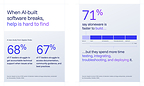
Initial build speed is failing to deliver long-term efficiency. Almost two-thirds (64%) of enterprise leaders surveyed report that while standalone AI tools accelerate development, they are spending more time across testing, system integration, troubleshooting, scaling, and/or deployment.

According to Matt Calkins, CEO of Appian, “Some people get so excited about ‘free’ software that they forget the risks. Enterprises can now create tech debt faster than ever before.”

Aloneware diverts strategic innovation budgets

The operational burden of maintaining software built outside a platform is directly diverting capital away from strategic growth. Almost eight in 10 (79%) enterprise leaders surveyed report allocating at least 10% of their current technology innovation budgets to testing, deploying, maintaining, updating, integrating and/or repairing software built outside a platform environment. And 43% of those surveyed currently allocate at least 20% of the budget—a figure that 55% expect to allocate within the next two years, indicating that the financial drain is accelerating quickly.

Compounding these budget demands, 60% of UK enterprise leaders report unexpected post-launch costs or resources tied directly to security, governance, and compliance remediation.

The support void and the need for platforms

When isolated AI applications break, organisations face a critical support void. 60% of leaders find it challenging to access accountable technical support when problems arise with applications built outside a platform, while 61% report difficulties keeping code, architecture, dependencies, and system integrations up to date.

Against this backdrop, 59% of respondents state that a shared architectural foundation would improve their ability to control total cost of ownership and 60% say it would help them maintain software over time.

“The most important applications in enterprises need support,” Calkins adds. “If you vibe-code them, there will be nobody to turn to when problems occur. Using AI to build applications on a commercial platform combines the speed of AI with the reliability of supported technology.”

To access the complete research findings and executive report, visit appian.com/aloneware.

About the research

The research was conducted by Censuswide among 200 senior decision-makers who primarily work in AI/Engineering or IT, work at large enterprises (5,000 employees or more, or annual revenue exceeding $1 billion), and who work on at least three software systems annually. Respondents were based in the UK. Data was collected between 21 and 30 October 2026.

Censuswide is a member of the Market Research Society (MRS) and the British Polling Council (BPC), and a signatory of the Global Data Quality Pledge. The research adheres to the MRS Code of Conduct and ESOMAR principles.

About Appian

Appian provides AI automation for the most important business processes at the world’s largest organisations.  

On the Appian Platform, customers build AI-powered processes that accelerate work, reduce cost, and manage risk. Our platform is known for its unique power, reliability, and scale. We’ve been automating processes for more than 25 years and have proven expertise in enterprise operations. For more information, visit appian.com. [Nasdaq: APPN]

Follow Appian: LinkedIn, YouTube, Instagram, Facebook, and X.


View original content to download multimedia:https://www.prnewswire.com/news-releases/new-survey-uncovers-an-aloneware-crisis-isolated-ai-development-threatens-enterprise-stability-and-adds-maintenance-costs-302948028.html

SOURCE Appian

Continue Reading

Technology

Share buybacks in Ericsson during the period November 16 – November 20, 2026

Published

on

By

STOCKHOLM, Nov. 23, 2026 /PRNewswire/ — During the period November 16 – November 20, 2026, Telefonaktiebolaget LM Ericsson (publ) (“Ericsson”) (LEI code 549300W9JLPW15XIFM52) repurchased own Class B shares (ISIN: SE0000108656) as follows:

Date

Aggregated daily volume (number of shares)

Weighted average share price per day (SEK)

Total daily transaction value (SEK)

16/11/2026

100,000

106.5100

10,651,000.00

17/11/2026

100,000

105.1818

10,518,180.00

18/11/2026

100,000

105.0654

10,506,540.00

19/11/2026

100,000

104.6379

10,463,790.00

20/11/2026

100,000

102.4982

10,249,820.00

Total

500,000

104.7787

52,389,330.00

The share repurchases are a part of the share buyback program of up to SEK 15,000,000,000 which Ericsson announced on April 16, 2026, and which runs between April 23, 2026, and March 31, 2027, at the latest. The Board of Directors intends to propose to the 2027 Annual General Meeting that the repurchased shares, other than those used to fulfil Ericsson’s obligations under its share-related incentive programs, are cancelled.

The share buyback program is executed in accordance with the Regulation (EU) No 596/2014 of the European Parliament and of the Council on market abuse (MAR) and the Commission Delegated Regulation (EU) 2016/1052 of 8 March 2016 supplementing MAR (the Safe Harbour Regulation).

All acquisitions have been carried out on Nasdaq Stockholm by Goldman Sachs Bank Europe SE on behalf of Ericsson. A full breakdown of the transactions is attached to this announcement.

Following the repurchases above, Ericsson’s holding of treasury stock amounts to 132,415,894 Class B shares. There are in total 3,371,351,735 shares in Ericsson, 261,755,983 shares of Class A and 3,109,595,752 shares of Class B.

NOTES TO EDITORS:

FOLLOW US:

Subscribe to Ericsson press releases
Subscribe to Ericsson blog posts
https://x.com/ericsson
https://www.facebook.com/ericsson
https://www.linkedin.com/company/ericsson

MORE INFORMATION AT:
Ericsson Newsroom
media.relations@ericsson.com  (+46 10 719 69 92)
investor.relations@ericsson.com  (+46 10 719 00 00)

Investors
Daniel Morris, Vice President, Head of Investor Relations
Phone: +44 7386 657217
E-mail: investor.relations@ericsson.com

Lena Häggblom, Director, Investor Relations
Phone: +46 72 593 27 78
E-mail: lena.haggblom@ericsson.com

Media
Ralf Bagner, Head of Media Relations
Phone: +46761284789
E-mail: ralf.bagner@ericsson.com

ABOUT ERICSSON:
Ericsson’s high-performing, programmable networks provide connectivity for billions of people every day. For 150 years, we’ve been pioneers in creating technology for communication. We offer mobile communication and connectivity solutions for service providers and enterprises. Together with our customers and partners, we make the digital world of tomorrow a reality. www.ericsson.com

This information was brought to you by Cision http://news.cision.com

https://news.cision.com/ericsson/r/share-buybacks-in-ericsson-during-the-period-november-16—november-20–2026,c4427608

The following files are available for download:

https://mb.cision.com/Main/15448/4427608/4383821.pdf 

Share buybacks in Ericsson during the period November 16-November 20 2026

https://mb.cision.com/Public/15448/4427608/923f499b6f383962.xlsx 

Daily Ericsson Share Buyback Report

View original content:https://www.prnewswire.com/news-releases/share-buybacks-in-ericsson-during-the-period-november-16–november-20-2026-302948030.html

SOURCE Ericsson

Continue Reading

Trending