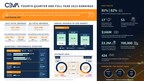
– Q4 – Total revenue of $24.2 million, in line with expectations, with GAAP loss per share of 34c and non-GAAP diluted EPS of 10c, exceeding expectations
– Q4 – Royalty revenue of $12.3 million, up 13% year-over-year, and the third consecutive quarter of royalty revenue growth
– Q4 – Strategic license agreements signed with a U.S. based MCU leader for Wi-Fi 6 and with a global automotive semiconductor leader for AI-enabling software
– Full year – 1.6 billion Ceva-powered smart edge devices shipped, equivalent to 50 devices sold every second, worldwide
– Full year – record cellular IoT royalty revenues and shipments, up 47% and 64% year-over-year, respectively, surpassing 100 million units annually
– Full year – Strong demand for diverse portfolio of IP for connect, sense and infer use cases, with 53 license agreements signed, including 16 first time customers, 10 OEMs and continued expansion of Wi-Fi 6 customer base for industrial and consumer markets
ROCKVILLE, Md., Feb. 14, 2024 /PRNewswire/ — Ceva, Inc. (NASDAQ: CEVA), the leading licensor of silicon and software IP that enables Smart Edge devices to connect, sense and infer data more reliably and efficiently, today announced its financial results for the fourth quarter ended December 31, 2023. Financial results for the fourth quarter and all periods presented reflect Ceva’s continuing operations only, with the Intrinsix business reflected as a discontinued operation, unless otherwise noted.
Ceva Q4 royalty revenue of $12.3 million, up 13% year-over-year and third consecutive quarter of royalty revenue growth
Amir Panush, Chief Executive Officer of Ceva, commented: “Our fourth quarter revenues were in line with our expectations, despite the challenges in the markets we served. I am proud of how we managed to significantly improve our profitability and earnings power through our focus on operating efficiency. Our royalty business grew for the third consecutive quarter and returned to year-over-year growth, driven by a recovery in mobile and strength across consumer IoT and industrial IoT end markets. Although our licensing revenue fell short of our expectations in the quarter, we continue to see myriad licensing opportunities for our diversified technology portfolio and expect to enhance our range of products as we push forward in developing new AI-related offerings.”
Mr. Panush continued: “Looking back on my first year as CEO of Ceva, we have made significant progress in returning the Company to a pure IP licensing and royalty business model, where we see the greatest potential for success. We have established Ceva as the trusted partner for semiconductor companies and OEMs who need our IP to enable three fundamental use cases required by smart edge devices – the ability to connect, sense and infer data, more reliably and efficiently. Our wireless communications market leadership continues to go from strength to strength as illustrated by the 1.2 billion smart edge IoT devices and more than 280 million smartphones wirelessly connected by our IP in 2023 alone. In sense and inference, we have bolstered our product offerings during the year with the introduction of our NPU family for edge AI and through the acquisition of spatial audio software from VisiSonics. Overall, our leading-edge IP portfolio, combined with our focus on execution and delivering profitable growth, will position Ceva well to help our customers succeed and drive shareholder value.”
Fourth Quarter 2023 Review
Total revenue for the fourth quarter of 2023 was $24.2 million, a 20% decrease compared to $30.3 million reported for the fourth quarter of 2022. Licensing and related revenue for the fourth quarter of 2023 was $11.8 million, compared to $19.4 million reported for the same quarter a year ago. Royalty revenue for the fourth quarter of 2023 was $12.3 million, an increase of 13% when compared to $10.9 million reported for the fourth quarter of 2022.
During the quarter, seventeen IP licensing agreements were concluded, targeting a wide range of end markets and applications, including Wi-Fi 6 for industrial IoT, consumer devices and access points, Bluetooth for IoT and medical-grade hearables, 5G RedCap and cellular IoT modems, audio for hearables and wearables, and AI for automotive ADAS. Two of the deals signed were with OEMs and three were first-time customers.
GAAP gross margin for the fourth quarter of 2023 was 91%, as compared to 89% in the fourth quarter of 2022. GAAP operating loss for the fourth quarter of 2023 was $2.8 million, as compared to a GAAP operating income of $1.0 million for the same period in 2022. GAAP net loss for the fourth quarter of 2023 was $8.1 million, as compared to a GAAP net income of $4.5 million reported for the same period in 2022. GAAP diluted loss per share for the fourth quarter of 2023 was $0.34, as compared to GAAP diluted income per share of $0.19 for the same period in 2022.
GAAP net profit including the discontinued operation for the fourth quarter of 2023 was $3.8 million, as compared to GAAP net income with the discontinued operation of $1.9 million for the same quarter last year. GAAP diluted income per share including the discontinued operation for the fourth quarter of 2023 was $0.16, as compared to GAAP diluted income per share with the discontinued operation of $0.08 for the same period in 2022.
Non-GAAP gross margin for the fourth quarter of 2023 was 92%, as compared to 90% for the same period in 2022. Non-GAAP operating income for the fourth quarter of 2023 was $1.9 million, as compared to Non-GAAP operating income of $6.8 million reported for the fourth quarter of 2022. Non-GAAP net income and diluted income per share for the fourth quarter of 2023 were $2.3 million and $0.10, respectively, compared with Non-GAAP net income and diluted income per share of $7.0 million and $0.29, respectively, reported for the fourth quarter of 2022.
Non-GAAP net income including the discontinued operation for the fourth quarter of 2023 was $2.4 million, as compared to non-GAAP net income including the discontinued operation of $5.6 million for the same quarter last year. Non-GAAP diluted income per share including the discontinued operation for the fourth quarter of 2023 was $0.10, as compared to Non-GAAP diluted income per share including the discontinued operation of $0.23 for the same period in 2022.
Full Year 2023 Review
Total revenue for 2023 was $97.4 million, a decrease of 19%, when compared to $120.6 million reported for 2022. Licensing and related revenue for 2023 was $57.6 million, a decrease of 23%, when compared to $75.2 million reported for 2022. Royalty revenue for 2023 was $39.9 million, representing a decrease of 12%, as compared to $45.4 million reported for 2022.
Yaniv Arieli, Chief Financial Officer of Ceva, added: “We are pleased to finish 2023 with our highest royalty revenue quarter of the year and non-GAAP earnings per share that exceeded our expectations. 2023 overall was a transformational year for Ceva, as we realigned our resources to focus on the key growth markets of automotive, consumer, industrial, and infrastructure. As we enter 2024, we are laser-focused on profitable growth and remaining agile to deal with any challenges. In addition, following the divestment of the non-core Intrinsix design services business, our balance sheet has been significantly bolstered, which ensures we are well positioned to pursue non-organic investments that can accelerate the company’s growth in the coming years.”
In 2023, 53 licensing deals were concluded, including 10 with OEMs and 13 for Wi-Fi 6 and Wi-Fi 7 IP. More than 1.6 billion Ceva-powered smart edge devices were shipped, including record cellular IoT device shipments of 130 million units, more than 950 million Bluetooth devices, of which more than 100 million were Wi-Fi + Bluetooth combo devices.
GAAP operating loss for 2023 was $13.5 million, as compared to a GAAP operating income of $3.9 million reported for 2022. GAAP net loss and diluted loss per share for 2023 were $18.4 million and $0.79, respectively, compared to GAAP net loss and diluted loss per share of $13.9 million and $0.60, respectively, reported for 2022.
GAAP net loss including the discontinued operation for 2023 was $11.9 million as compared to GAAP net loss including the discontinued operation of $23.2 million reported for 2022. GAAP diluted loss per share including the discontinued operation for 2023 was $0.51, compared to GAAP diluted loss per share including the discontinued operation of $1.00 reported for 2022.
Non-GAAP operating income for 2023 was $3.6 million, compared with $27.0 million reported for 2022. Non-GAAP net income and diluted earnings per share for 2023 were $4.4 million and $0.18, respectively, compared to $23.6 million and $0.98 reported for 2022.
Ceva Conference Call
On February 14, 2024, Ceva management will conduct a conference call at 8:30 a.m. Eastern Time to discuss the operating performance for the quarter and review the full year.
The conference call will be available via the following dial in numbers:
U.S. Participants: Dial 1-844-435-0316 (Access Code: CEVA)International Participants: Dial +1-412-317-6365 (Access Code: CEVA)
The conference call will also be available live via webcast at the following link: https://app.webinar.net/6MBXkYD5bVD. Please go to the web site at least fifteen minutes prior to the call to register.
For those who cannot access the live broadcast, a replay will be available by dialing +1-877-344-7529 or +1-412-317-0088 (access code: 1753733) from one hour after the end of the call until 9:00 a.m. (Eastern Time) on February 21, 2024. The replay will also be available at Ceva’s web site www.ceva-ip.com.
Forward Looking Statements
This press release contains forward-looking statements that involve risks and uncertainties, as well as assumptions that if they materialize or prove incorrect, could cause the results of Ceva to differ materially from those expressed or implied by such forward-looking statements and assumptions. Forward-looking statements include statements regarding interest in and licensing opportunities for Ceva’s diversified technology portfolio, expectations regarding enhancing Ceva’s range of products and AI-related offerings, Ceva’s positioning for driving shareholder value, Ceva’s focus on profitable growth and agility to deal with challenges, and positioning to pursue non-organic investments that can accelerate the company’s growth in the coming years. The risks, uncertainties and assumptions that could cause differing Ceva results include: the effect of intense industry competition; the ability of Ceva’s technologies and products incorporating Ceva’s technologies to achieve market acceptance; Ceva’s ability to meet changing needs of end-users and evolving market demands; the cyclical nature of and general economic conditions in the semiconductor industry; Ceva’s ability to diversify its royalty streams and license revenues; Ceva’s ability to continue to generate significant revenues from the handset baseband market and to penetrate new markets; instability and disruptions related to the ongoing Israel–Gaza conflict; and general market conditions and other risks relating to Ceva’s business, including, but not limited to, those that are described from time to time in our SEC filings. Ceva assumes no obligation to update any forward-looking statements or information, which speak as of their respective dates.
Non-GAAP Financial Measures
Non-GAAP gross margin for the fourth quarter of 2023 excluded: (a) equity-based compensation expenses of $0.2 million and (b) amortization of acquired intangibles of $0.1 million. Non-GAAP gross margin for the fourth quarter of 2022 excluded: (a) equity-based compensation expenses of $0.2 million and (b) amortization of acquired intangibles of $0.07 million.
Non-GAAP operating income for the fourth quarter of 2023 excluded: (a) equity-based compensation expenses of $4.1 million, (b) the impact of the amortization of acquired intangibles of $0.3 million and (c) $0.4 million of costs associated with business acquisitions. Non-GAAP operating income for the fourth quarter of 2022 excluded: (a) equity-based compensation expenses of $3.8 million, (b) the impact of the amortization of acquired intangibles of $0.4 million, (c) impairment cost of $0.3 million associated with the closing of an office and (d) $1.3 million associated with retirement expenses of executives.
Non-GAAP net income and diluted income per share for the fourth quarter of 2023 excluded: (a) equity-based compensation expenses of $4.1 million, (b) the impact of the amortization of acquired intangibles of $0.3 million, (c) $0.4 million of costs associated with business acquisitions, (d) $0.1 million income associated with the remeasurement of marketable equity securities, (e) $1.3 million tax charges, an impact as a result of the completion of a tax audit for prior years and (f) $4.5 million tax charges, including one-time write off of a deferred tax asset related to Section 174 (US tax regulations). Non-GAAP net income and diluted earnings per share for the fourth quarter of 2022 excluded: (a) equity-based compensation expenses of $3.8 million, (b) the impact of the amortization of acquired intangibles of $0.4 million, (c) $0.2 million loss associated with the remeasurement of marketable equity securities, (d) $0.3 million relating to impairment of closed office, (e) impairment expenses of $1.3 million relating to retirement of executives and (e) $3.5 million income associated with Section 174 (US tax regulations).
Non-GAAP gross margin 2023 excluded: (a) equity-based compensation expenses of $0.8 million and (b) amortization of acquired intangibles of $0.4 million. Non-GAAP gross margin for 2022 excluded: (a) equity-based compensation expenses of $0.7 million and (b) amortization and impairment of acquired intangibles of $2.6 million.
Non-GAAP operating income for 2023 excluded (a) equity-based compensation expenses of $15.5 million, (b) the impact of the amortization of acquired intangibles of $1.0 million, and (c) $0.6 million of costs associated with business acquisition. Non-GAAP operating income for 2022 excluded: (a) equity-based compensation expenses of $13.3 million, (b) amortization and impairment of acquired intangibles of $8.2 million, (c) impairment cost of $0.3 million associated with the closing of an office, and (d) $1.3 million associated with retirement expenses of executives.
Non-GAAP net income and diluted earnings per share for 2023 excluded (a) equity-based compensation expenses of $15.5 million, (b) the impact of the amortization of acquired intangibles of $1.0 million, (c) $0.6 million associated with business acquisition, (d) $1.3 tax charges, an impact as a result of the completion of a tax audit for prior years, and (e) $4.5 million tax charges, including one-time write off of a deferred tax asset related to Section 174 (US tax regulations).
Non-GAAP net income and diluted earnings per share for 2022 excluded (a) equity-based compensation expenses of $13.3 million, (b) amortization and impairment of acquired intangibles of $8.2 million, (c) $2.0 million, net of taxes, associated with the remeasurement of marketable equity securities, (d) $15.8 million write-off of a deferred tax asset, including withholding tax assets that we will not be able to utilize as a tax credit, (e) $0.3 million associated with the closing of an office, (f) $1.3 million associated with retirement expenses of executives, and (g) $3.5 million income related to Section 174 (US tax regulations).
Non-GAAP net income with the discontinued operation for 2023 was $2.4 million, as compared to non-GAAP net income of $18.8 million reported for 2022.
Non-GAAP diluted income per share with the disconnected operation for 2023 was $0.10, as compared to non-GAAP diluted income per share of $0.78 reported for 2022.
About Ceva, Inc.
At Ceva, we are passionate about bringing new levels of innovation to the smart edge. Our wireless communications, sensing and Edge AI technologies are at the heart of some of today’s most advanced smart edge products. From Bluetooth connectivity, Wi-Fi, UWB and 5G platform IP for ubiquitous, robust communications, to scalable Edge AI NPU IPs, sensor fusion processors and embedded application software that make devices smarter, we have the broadest portfolio of IP to connect, sense and infer data more reliably and efficiently. We deliver differentiated solutions that combine outstanding performance at ultra-low power within a very small silicon footprint. Our goal is simple – to deliver the silicon and software IP to enable a smarter, safer, and more interconnected world. This philosophy is in practice today, with Ceva powering more than 17 billion of the world’s most innovative smart edge products from AI-infused smartwatches, IoT devices and wearables to autonomous vehicles and 5G mobile networks.
Our headquarters are in Rockville, Maryland with a global customer base supported by operations worldwide. Our employees are among the leading experts in their areas of specialty, consistently solving the most complex design challenges, enabling our customers to bring innovative smart edge products to market.
Ceva: Powering the Smart Edge™
Visit us at www.ceva-ip.com and follow us on LinkedIn, X, YouTube, Facebook, and Instagram.
Ceva, Inc. AND ITS SUBSIDIARIES
CONSOLIDATED STATEMENTS OF INCOME (LOSS) – U.S. GAAP
U.S. dollars in thousands, except per share data
Three months ended
Twelve months ended
December 31,
December 31,
2023
2022
2023
2022
Unaudited
Unaudited
Unaudited
Unaudited
Revenues:
Licensing and related revenues
$ 11,816
$ 19,423
$ 57,555
$ 75,194
Royalties
12,346
10,927
39,864
45,389
Total revenues
24,162
30,350
97,419
120,583
Cost of revenues
2,259
3,294
11,648
15,131
Gross profit
21,903
27,056
85,771
105,452
Operating expenses:
Research and development, net
18,145
18,047
72,689
70,317
Sales and marketing
2,829
3,461
11,042
11,475
General and administrative
3,567
4,240
14,913
14,183
Amortization of intangible assets
149
299
594
2,025
Impairment of assets
–
–
–
3,556
Total operating expenses
24,690
26,047
99,238
101,556
Operating income (loss)
(2,787)
1,009
(13,467)
3,896
Financial income, net
1,767
2,009
5,264
2,812
Remeasurement of marketable equity securities
74
(240)
(2)
(2,511)
Income (loss) before taxes on income
(946)
2,778
(8,205)
4,197
Taxes on Income
7,152
(1,741)
10,232
18,075
Net income (loss) from continuing operations
(8,098)
4,519
(18,437)
(13,878)
Net income (loss) from discontinued operation
11,867
(2,579)
6,559
(9,305)
Net Income (loss)
$ 3,769
$ 1,940
$ (11,878)
$ (23,183)
Basic and diluted net income (loss) per share:
Continuing operations
(0.34)
0.19
(0.79)
(0.60)
Discontinued operation
0.50
(0.11)
0.28
(0.40)
Basic and diluted net income (loss) per share
$ 0.16
$ 0.08
$ (0.51)
$ (1.00)
Weighted-average shares used to compute net income
(loss) per share (in thousands):
Basic
23,518
23,197
23,484
23,172
Diluted
23,946
23,406
23,484
23,172
Unaudited Reconciliation of GAAP to Non-GAAP Financial Measures
U.S. Dollars in thousands, except per share amounts
Three months ended
Twelve months ended
December 31,
December 31,
2023
2022
2023
2022
Unaudited
Unaudited
Unaudited
Unaudited
GAAP net income (loss)
$ 3,769
$ 1,940
$ (11,878)
$ (23,183)
Equity-based compensation expense included in cost of revenues
190
176
826
687
Equity-based compensation expense included in research and
development expenses
2,430
2,271
9,133
8,259
Equity-based compensation expense included in sales and
marketing expenses
471
473
1,776
1,503
Equity-based compensation expense included in general and
administrative expenses
1,008
884
3,795
2,888
Amortization, Impairment and Write-off of intangible assets
278
370
1,031
8,163
Costs associated with business acquisitions
356
–
551
–
(Income) loss associated with the remeasurement of marketable
equity securities
(74)
240
2
2,511
Impairment cost associated with close of an office
–
318
–
318
Retirement expenses of executives
–
1,271
–
1,271
Income tax expense as a result of a write off of a deferred tax asset
and withholding tax that can’t be utilized
–
–
–
15,323
Income tax expenses, an impact as a result of the completion of a
tax audit for prior years
1,302
–
1,302
–
Adjustment related to US tax reform rule 174
4,460
(3,484)
4,460
(3,484)
Non-GAAP from discontinued operation
(11,812)
1,143
(8,579)
4,579
Non-GAAP net income
$2,378
$ 5,602
$ 2,419
$ 18,835
GAAP weighted-average number of Common Stock used in
computation of diluted net income (loss) and income (loss) per
share (in thousands)
23,518
23,406
23,484
23,172
Weighted-average number of shares related to outstanding stock-
based awards (in thousands)
1,271
684
1,197
839
Weighted-average number of Common Stock used in computation
of diluted net income (loss) per share, excluding the above (in
thousands)
24,789
24,090
24,681
24,011
GAAP diluted income (loss) per share
$ 0.16
$ 0.08
$ (0.51)
$ (1.00)
Equity-based compensation expense
$ 0.17
$ 0.16
$ 0.66
$ 0.57
Amortization, Impairment and Write-off of intangible assets
$ 0.01
$ 0.02
$ 0.04
$ 0.35
Impairment cost associated with close of an office
–
$ 0.01
–
$ 0.01
Costs associated with business acquisitions
$ 0.02
–
$ 0.02
–
Income associated with the remeasurement of marketable equity
securities
–
$ 0.01
–
$ 0.09
Retirement of executives
–
$ 0.05
–
$ 0.05
Adjustment related to income tax expenses
$ 0.24
($ 0.15)
$ 0.25
$ 0.51
Non-GAAP from discontinued operation
($ 0.50)
$ 0.05
($ 0.36)
$ 0.20
Non-GAAP diluted earnings per share
$ 0.10
$ 0.23
$ 0.10
$ 0.78
Three months ended
Twelve months ended
December 31,
December 31,
2023
2022
2023
2022
Unaudited
Unaudited
Unaudited
Unaudited
GAAP Operating Income (loss)
$ (2,787)
$ 1,009
$ (13,467)
$ 3,896
Equity-based compensation expense included in cost of
revenues
190
176
826
687
Equity-based compensation expense included in
research and development expenses
2,430
2,271
9,133
8,259
Equity-based compensation expense included in sales
and marketing expenses
471
473
1,776
1,503
Equity-based compensation expense included in
general and administrative expenses
1,008
884
3,795
2,888
Amortization, Impairment and Write-off of intangible
assets
278
370
1,031
8,163
Costs associated with the Business acquisition
356
–
551
–
Retirement of executives
–
1,271
–
1,271
Impairment cost associated with close of an office
–
318
–
318
Total non-GAAP Operating Income
$ 1,946
$ 6,772
$ 3,645
$ 26,985
Three months ended
Twelve months ended
December 31,
December 31,
2023
2022
2023
2022
Unaudited
Unaudited
Unaudited
Unaudited
GAAP Gross Profit
$ 21,903
$ 27,056
$ 85,771
$ 105,452
GAAP Gross Margin
91 %
89 %
88 %
87 %
Equity-based compensation expense included in cost of
revenues
190
176
826
687
Amortization, Impairment and Write-off of intangible
assets
129
71
437
2,582
Total Non-GAAP Gross profit
22,222
27,303
87,034
108,721
Non-GAAP Gross Margin
92 %
90 %
89 %
90 %
Ceva, Inc. AND ITS SUBSIDIARIES
CONDENSED CONSOLIDATED BALANCE SHEETS
(U.S. Dollars in thousands)
December 31,
December 31,
2023
2022 (*)
Unaudited
Unaudited
ASSETS
Current assets:
Cash and cash equivalents
$ 23,287
$ 20,116
Marketable securities and short-term bank deposits
143,251
118,194
Trade receivables, net
8,433
11,136
Unbilled receivables
21,874
18,694
Prepaid expenses and other current assets
8,461
6,789
Current assets of discontinued operation
–
2,696
Total current assets
205,306
177,625
Long-term assets:
Bank deposits
–
8,205
Severance pay fund
7,070
8,475
Deferred tax assets, net
5,674
8,484
Property and equipment, net
6,732
6,624
Operating lease right-of-use assets
6,978
8,485
Investment in marketable equity securities
406
408
Goodwill
58,308
56,794
Intangible assets, net
2,967
2,392
Other long-term assets
10,644
6,291
Long-term assets of discontinued operation
–
24,659
Total assets
$ 304,085
$ 308,442
LIABILITIES AND STOCKHOLDERS’ EQUITY
Current liabilities:
Trade payables
$ 1,154
$ 1,859
Deferred revenues
3,018
3,098
Accrued expenses and other payables
20,937
24,049
Operating lease liabilities
2,513
2,680
Current liabilities of discontinued operation
–
1,592
Total current liabilities
27,622
33,278
Long-term liabilities:
Accrued severance pay
7,524
9,064
Operating lease liabilities
3,943
5,207
Other accrued liabilities
655
526
Long-term liabilities of discontinued operation
–
1,496
Total liabilities
39,744
49,571
Stockholders’ equity:
Common stock
23
23
Additional paid in-capital
252,100
242,841
Treasury stock
(5,620)
(9,904)
Accumulated other comprehensive loss
(2,329)
(6,249)
Retained earnings
20,167
32,160
Total stockholders’ equity
264,341
258,871
Total liabilities and stockholders’ equity
$ 304,085
$ 308,442
(*) Derived from audited financial statements.
View original content to download multimedia:https://www.prnewswire.com/news-releases/ceva-inc-announces-fourth-quarter-and-full-year-2023-financial-results-302061328.html
SOURCE Ceva, Inc.








 Technology4 days ago


 Coin Market5 days ago

 Near Videos4 days ago


 Technology5 days ago

 Technology3 days ago