Connect with us

Technology

Online Video Platform Market size is set to grow by USD 2.19 billion from 2024-2028, Increase in streaming services to boost the market growth, Technavio

Published

on

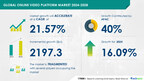
NEW YORK, June 20, 2024 /PRNewswire/ — The global online video platform market size is estimated to grow by USD 2.19 billion from 2024-2028, according to Technavio. The market is estimated to grow at a CAGR of 21.57%  during the forecast period. Increase in streaming services is driving market growth, with a trend towards live streaming of videos. However, free open-source video platform poses a challenge. Key market players include Adobe Inc., Akamai Technologies Inc., Alphabet Inc., Bharti Airtel Ltd., Brightcove Inc., Comcast Corp., Dacast Inc., International Business Machines Corp., Kaltura Inc., MediaMelon Inc., MediaPlatform Inc., Panopto Inc., Piksel srl, Samba Mobile Multimidia SA, Telstra Corp. Ltd., Viacom18 Media Pvt. Ltd., Vimeo.com Inc., Viostream, Wistia Inc., and Youku Tudou Inc..

Get a detailed analysis on regions, market segments, customer landscape, and companies – Click for the snapshot of this report

Forecast period

2024-2028

Base Year

2023

Historic Data

2018 – 2022

Segment Covered

End-user (Individuals, Brand and enterprises, and
Content creators), Type (UGC, DIY, and SaaS),
and Geography (APAC, North America, Europe,
South America, and Middle East and Africa)

Region Covered

APAC, North America, Europe, South America,
and Middle East and Africa

Key companies profiled

Adobe Inc., Akamai Technologies Inc., Alphabet
Inc., Bharti Airtel Ltd., Brightcove Inc., Comcast
Corp., Dacast Inc., International Business
Machines Corp., Kaltura Inc., MediaMelon Inc.,
MediaPlatform Inc., Panopto Inc., Piksel srl,
Samba Mobile Multimidia SA, Telstra Corp. Ltd.,
Viacom18 Media Pvt. Ltd., Vimeo.com Inc.,
Viostream, Wistia Inc., and Youku Tudou Inc.

Key Market Trends Fueling Growth

Online videos have become essential for businesses looking to engage consumers and influence buying decisions. Live streaming, a real-time Internet broadcast, is a popular trend among brand owners. Social media platforms like Facebook, YouTube, Snapchat, and Twitter have invested in enhancing live streaming capabilities. Brands use live streaming for tutorials, product launches, news, humor, and regular series. Monetization methods include micropayments, mid-roll ads, and social platform payments. These factors contribute to the growth of the Online Video Platform market.

The online video platform market is experiencing significant growth with an increasing number of users and businesses adopting video content. Large scales of live streaming and on-demand videos are driving this trend. Monetization strategies such as ads, subscriptions, and sponsorships are becoming more common. Uses include education, entertainment, marketing, and communication. Platforms offer various features like video analytics, customization, and integration with social media. User-generated content and interactive tools are also popular. The market is competitive with players like YouTube, Vimeo, and Facebook Live. Usage is expected to continue growing due to the convenience and engagement provided by online videos. 

Research report provides comprehensive data on impact of trend. For more details- Download a Sample Report

Market Challenges

The Online Video Platform (OVP) market is experiencing significant growth due to the increasing popularity of video content on the Internet. Brands are leveraging free video hosting platforms like YouTube, Metacafe, and Blip.tv to enhance their online presence. These platforms offer millions of videos on various topics and provide access to commercial content. Paid OVPs face intense competition as customers can access free live TV shows, sports events, movies, and news online with high-definition streaming. Consequently, the global OVP market is expected to grow substantially during the forecast period, as free Internet services restrict the use of paid services.The online video platform market is experiencing significant growth, with an increasing number of businesses utilizing video content for marketing and communication purposes. However, this market also presents several challenges. One major challenge is creating high-quality video content that engages and retains viewer attention. Another challenge is optimizing videos for search engines and social media platforms to increase reach and visibility. Additionally, ensuring video accessibility on various devices and ensuring secure video hosting are ongoing concerns. Furthermore, monetizing video content through ads or subscriptions can be complex, requiring a deep understanding of audience demographics and viewer behavior. Lastly, keeping up with the latest video technology trends and maintaining a consistent brand image across all video content can be time-consuming and resource-intensive.

For more insights on driver and challenges – Download a Sample Report

Segment Overview 

This online video platform market report extensively covers market segmentation by

End-user 1.1 Individuals1.2 Brand and enterprises1.3 Content creatorsType 2.1 UGC2.2 DIY2.3 SaaSGeography 3.1 APAC3.2 North America3.3 Europe3.4 South America3.5 Middle East and Africa

1.1 Individuals- Online Video Platforms (OVPs) have become essential tools for individuals to share content without the need for organizational affiliation. User-generated videos (UGVs) account for 80-85% of global trust, surpassing that of traditional sources. UGVs serve various purposes, including entertainment, education, and opinions on goods and services. Trusted UGVs can boost product usage and OVP revenue. The individual Internet video market contributes significantly to OVP growth during the forecast period.

For more information on market segmentation with geographical analysis including forecast (2024-2028) and historic data (2018 – 2022) – Download a Sample Report

Research Analysis

In the rapidly evolving digital landscape, the Online Video Platform (OVP) market continues to gain momentum. With the proliferation of smartphones and handheld devices, live streaming has become a preferred mode of video content consumption. Monetization of channels through streaming services is a significant trend, enabling content creators to reach a global audience. Telecom networks, including 4G and the emerging 5G network, facilitate seamless internet access for live streams. Transcoding and managing video content is crucial for publishers to ensure smooth delivery to viewers. Television is no longer confined to traditional broadcasting, as online video advertising becomes an integral part of video-based marketing content. Tracking viewer engagement and analytics is essential for optimizing revenue streams in this dynamic market.

Market Research Overview

The Online Video Platform market is a dynamic and growing industry, characterized by its ability to deliver high-quality video content to consumers on-demand. This market encompasses various technologies and services, including streaming, video hosting, and video analytics. The market caters to various sectors such as education, entertainment, advertising, and corporate training. The platforms offer features like adaptive bitrate streaming, personalized recommendations, and social media integration. The market is driven by factors such as increasing internet penetration, rising consumer demand for on-demand content, and advancements in video compression technology. The future of the Online Video Platform market looks promising, with continued innovation and expansion into new areas like virtual and augmented reality.

Table of Contents:

1 Executive Summary
2 Market Landscape
3 Market Sizing
4 Historic Market Size
5 Five Forces Analysis
6 Market Segmentation

End-userIndividualsBrand And EnterprisesContent CreatorsTypeUGCDIYSaaSGeographyAPACNorth AmericaEuropeSouth AmericaMiddle East And Africa

7 Customer Landscape
8 Geographic Landscape
9 Drivers, Challenges, and Trends
10 Company Landscape
11 Company Analysis
12 Appendix

About Technavio

Technavio is a leading global technology research and advisory company. Their research and analysis focuses on emerging market trends and provides actionable insights to help businesses identify market opportunities and develop effective strategies to optimize their market positions.

With over 500 specialized analysts, Technavio’s report library consists of more than 17,000 reports and counting, covering 800 technologies, spanning across 50 countries. Their client base consists of enterprises of all sizes, including more than 100 Fortune 500 companies. This growing client base relies on Technavio’s comprehensive coverage, extensive research, and actionable market insights to identify opportunities in existing and potential markets and assess their competitive positions within changing market scenarios.

Contacts

Technavio Research
Jesse Maida
Media & Marketing Executive
US: +1 844 364 1100
UK: +44 203 893 3200
Email: media@technavio.com
Website: www.technavio.com/

View original content to download multimedia:https://www.prnewswire.com/news-releases/online-video-platform-market-size-is-set-to-grow-by-usd-2-19-billion-from-2024-2028–increase-in-streaming-services-to-boost-the-market-growth-technavio-302177238.html

SOURCE Technavio

Continue Reading
Click to comment

Leave a Reply

Your email address will not be published. Required fields are marked *

Technology

DMALL Gains Momentum in Southeast Asia with AI-Driven Retail Platform

Published

on

By

SINGAPORE, May 4, 2026 /PRNewswire/ — As retailers across Southeast Asia face rising operational complexity, shifting consumer expectations and margin pressure, demand is growing for integrated, real-time retail operating systems.

Dmall Inc. (02586.HK) is supporting this shift with a unified retail operating platform that connects core retail functions, improves execution efficiency and enhances visibility across stores, supply chains and customer touchpoints.

As one of China’s largest retail digital solutions providers by revenue and gross merchandise volume, Dmall serves nearly 600 retail clients across 11 countries and regions. Its platform has been shaped by large-scale deployments in complex retail environments, including long-standing work with Wumart Group, Metro, Lawson, 7-Eleven South China and SM Group in Southeast Asia.

Dmall’s recent collaboration with Cold Storage Singapore marks a milestone in supporting retail digital transformation across Southeast Asia. Completed within seven months, the project covered 87 stores across supermarket, hypermarket and express formats, consolidating multiple systems into a single platform across supply chain, merchandising and store operations.

“The transition was completed with minimal disruption to our operations,” said Mr. Lim Boon Chiong, Managing Director of Cold Storage Singapore. “We are seeing early improvements in product availability and replenishment, supported by better visibility across our supply chain and store network.”

The platform has also contributed to more consistent store execution and a more reliable customer experience. The first phase provides a foundation for the next stage of development, including AI-driven capabilities to further support product availability, freshness management and operational efficiency.

Dmall and Cold Storage Singapore plan to extend their cooperation to the fuel and convenience store format in June 2026, reflecting a deepening partnership and a shared commitment to creating greater operational value across retail formats.

“Southeast Asia is one of the world’s most dynamic retail markets, but also one of the most operationally complex,” said Mr. Zhongwei Ren, Partner and Chief Strategy Officer of Dmall. “By combining operational integration with AI-driven capabilities, Dmall aims to help retailers build more adaptive, scalable and efficient operations.”

About Dmall 

Founded in 2015, Dmall (02586.HK) is committed to advancing retail through technology. As one of Asia’s leading providers of digital retail solutions, Dmall delivers integrated, AI-driven innovations that help retailers improve efficiency, optimize decisions and create greater value.

View original content to download multimedia:https://www.prnewswire.com/apac/news-releases/dmall-gains-momentum-in-southeast-asia-with-ai-driven-retail-platform-302761046.html

SOURCE Dmall Inc.

Continue Reading

Technology

Germany’s PDF/UA Mandate Raises the Bar for HTML to PDF C# Workflows

Published

on

By

Enterprise .NET teams generating PDFs at scale face new compliance pressure. Most aren’t ready.

CHICAGO, May 4, 2026 /PRNewswire/ — The German government’s Deutschland Stack has standardized on PDF/UA as the required format for final-form digital documents. For .NET teams building HTML to PDF C# workflows, the mandate forces a question many have deferred: does the library you depend on actually produce compliant output, or just output that looks right?

Iron Software’s IronPDF, a commercial .NET library used in regulated industries across logistics, healthcare, and finance, generates PDF/UA-1 compliant documents directly from HTML in C#. That’s the same conformance level the Deutschland Stack now requires.

“Accessibility compliance has shifted from important to mandatory,” said Cameron Rimington, CEO of Iron Software. “Government rules like this set a floor that enterprise teams are expected to meet, not aspire to. The question is whether their tooling can clear that bar without bolt-on remediation.”

From recommendation to requirement

PDF/UA (ISO 14289) defines what makes a PDF universally accessible: correct tag structure, logical reading order, and metadata that lets assistive technologies parse the document reliably. The standard has existed since 2012, but adoption has been patchy.

Germany’s decision to embed PDF/UA into its national digital stack moves it from best practice to enforceable baseline. Combined with the European Accessibility Act, which extends similar requirements to digital products serving EU markets, the compliance window for document-heavy .NET applications is closing fast.

Most HTML to PDF C# workflows aren’t compliant yet

Despite the regulatory pressure, PDF/UA compliance is still the exception across enterprise .NET. Many teams generating PDFs at volume, particularly those running HTML to PDF C# pipelines, are using libraries that produce visually correct files but miss the structural and metadata requirements accessibility standards actually demand.

As mandates harden, that gap is harder to defer.

“Germany just standardized on PDF/UA. In our experience, most development teams aren’t compliant yet, and they know it,” said Rimington. “That gap is why they’re coming to us.”

What this means for .NET developers

Teams generating PDFs in .NET, for government portals, financial statements, healthcare records, or legal filings, are increasingly being asked to prove their output meets accessibility standards, not just that it renders.

IronPDF gives developers a direct path from HTML to PDF in C# with two methods that cover the common cases:

RenderHtmlAsPdfUa generates PDF/UA-1 compliant documents directly from HTMLSaveAsPdfUa converts existing PDFs to PDF/UA-1

When source HTML is semantic and well-structured, compliant output can be produced in a single call with no remediation step required. For less structured input, additional tagging may be needed to reach full compliance.

The library also supports PDF/A (conformance levels 1 through 3, both b and a) and PDF versions 1.2 through 1.7, covering archival and compliance requirements common in public sector and enterprise deployments.

In production: serving Germany’s regulated industries

The compliance pressure IronPDF is built for is already shaping decisions on the ground. ThreeB IT, a software engineering firm based in Ibbenbüren, has standardized on IronPDF for document generation across logistics and healthcare platforms, including systems serving Kuehne + Nagel and nationwide COVID-19 testing infrastructure.

Operating under strict GDPR and healthcare data rules made the library choice a compliance decision as much as a technical one.

“Because Iron Software doesn’t store any data, GDPR compliance is simple. That’s critical for every project we build,” said Thimo Buchheister, CEO of ThreeB IT.

Deployment speed mattered just as much.

“IronPDF made it possible to build a nationwide COVID testing system in two weeks. The key part was ready within hours,” said Buchheister.

The firm now treats Iron Software libraries as a default in its stack.

“We’ll integrate at least one Iron Software product in every future project. It’s become part of our standard stack,” Buchheister added.

View original content:https://www.prnewswire.com/news-releases/germanys-pdfua-mandate-raises-the-bar-for-html-to-pdf-c-workflows-302761055.html

SOURCE Iron Software

Continue Reading

Technology

Cregis Showcases at Money20/20 Asia 2026, Exploring a New Paradigm for Financial Infrastructure Powered by Stablecoins and On-Chain Payments

Published

on

By

HONG KONG, DUBAI, UAE and SINGAPORE, May 4, 2026 /PRNewswire/ — From April 21 to 23, 2026, at Money20/20 Asia 2026—one of the most influential fintech events in the Asia-Pacific region—Cregis participated as an exhibitor at Booth 6001. The conference brought together industry leaders to discuss key themes such as payment innovation, cross-border settlement, digital assets, and regulatory developments. During the event, Cregis presented its comprehensive digital asset infrastructure solutions tailored for enterprises and financial institutions, while engaging in in-depth conversations with participants from banks, payment providers, fintech companies, and Web3 organizations.

Advancing Payment Infrastructure

Throughout the event, the Cregis team highlighted its end-to-end capabilities in on-chain payments and digital asset management, with a focus on enterprise payment and treasury needs. As stablecoins and blockchain technologies increasingly move into real-world applications, enterprise priorities are shifting from simply supporting crypto assets to enabling efficient, secure, and controllable fund flows.

Cregis offers a unified infrastructure that supports multi-chain and multi-asset management, adaptable to a wide range of use cases including cross-border trade settlement, merchant payments, and corporate treasury operations. By ensuring both security and compliance, the platform enables more efficient global fund movement and greater transparency in settlement processes.

Richard, Co-Founder of Cregis, commented during the event: “Today, the key challenge for enterprises is no longer whether to enter the digital asset space, but how to build a fund management system that balances efficiency, security, and compliance. Through our infrastructure, we aim to help businesses operate more effectively in an increasingly complex global payments landscape.”

A New Cross-Border Payment Paradigm Driven by Stablecoins

Stablecoins and on-chain payments emerged as central topics at this year’s conference. As more financial institutions and payment providers explore the use of digital assets in cross-border settlement, stablecoins are becoming a critical bridge between traditional finance and the crypto economy.

During the event, Cregis engaged with various industry partners to discuss practical applications of stablecoins in cross-border trade, enterprise settlement, and treasury management. Compared to traditional cross-border payment rails, stablecoin-based settlement offers clear advantages in efficiency, cost, and transparency. At the same time, it raises higher requirements for underlying infrastructure, particularly in areas such as secure custody, fund monitoring, and regulatory compliance.

Engaging Industry Leaders: Exploring the Future Evolution of Finance in Asia

Beyond its presence on the exhibition floor, Cregis co-hosted a side event titled The Reserved Table: Redefining Asia’s Future of Settlements alongside WIDTH, StraitsX, and PlatON. The event brought together key players across payments, stablecoins, and cross-border settlement to explore the future trajectory of financial infrastructure in Asia.

At the event, Tannie, Head of Southeast Asia at Cregis, joined a panel discussion themed “A New Standard of Value: Stablecoins, Settlement & the New Money Stack”, where he shared insights from frontline enterprise use cases.

Tannie noted that the market still tends to view stablecoins primarily as a “product”, such as a yield-generating tool or trading instrument. However, in real-world business scenarios, stablecoins are increasingly evolving into foundational infrastructure. For exchanges, payment providers, and cross-border enterprises, the focus is no longer on yield, but on critical operational questions: how to enable real-time global settlement, how to manage liquidity across regions, and how to reduce reliance on traditional banking systems.

Looking ahead, Tannie emphasized that the deeper significance of stablecoins lies in their ability to fundamentally reshape how enterprises manage capital. Within an infrastructure-driven stablecoin framework, businesses can achieve:

Policy-based approval and signing mechanisms for fund movementsReal-time on-chain reconciliation and automated settlementA unified liquidity view across multiple chains and wallets24/7 uninterrupted treasury operations

This shift signals that stablecoins are not merely replacing traditional payment rails—they are driving enterprises to transition from conventional financial workflows toward a more programmable, automated “next-generation operating system for capital.”

From Payment Capabilities to Global Financial Connectivity

As stablecoins, on-chain payments, and enterprise-grade asset management systems continue to mature, a more efficient, transparent, and globally connected financial network is taking shape.

Richard noted: “In the coming years, as the convergence between traditional finance and Web3 accelerates, demand for robust digital asset infrastructure will continue to grow. Cregis aims to be a key enabler in this transition, providing enterprises with secure, scalable, and reliable foundational capabilities.”

Looking ahead, Cregis will continue to enhance its product offerings across custody, payments, and asset management. By focusing on real-world business needs, the company is committed to building a more comprehensive digital asset infrastructure, empowering global enterprises to improve efficiency, manage risks, and achieve sustainable growth in the next generation of financial systems.

View original content to download multimedia:https://www.prnewswire.com/apac/news-releases/cregis-showcases-at-money2020-asia-2026-exploring-a-new-paradigm-for-financial-infrastructure-powered-by-stablecoins-and-on-chain-payments-302761060.html

SOURCE Cregis

Continue Reading

Trending