Connect with us

Technology

Mobile Robot Charging Station Market size is set to grow by USD 817.9 million from 2024-2028, Reduced cost price of electronic components boost the market, Technavio

Published

on

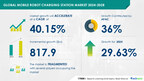
NEW YORK, July 4, 2024 /PRNewswire/ — The global mobile robot charging station market size is estimated to grow by USD 817.9 million from 2024-2028, according to Technavio. The market is estimated to grow at a CAGR of over 40.15%  during the forecast period. Reduced cost price of electronic components is driving market growth, with a trend towards contactless charging. However, replacement cost of charging station  poses a challenge. Key market players include Clearpath Robotics Inc., DF Automation and Robotics Sdn Bhd, Festo SE and Co. KG, KUKA AG, Locus Robotics Corp., Mobile Industrial Robots AS, Neobotix GmbH, Nidec Corp., OMRON Corp., PAL Robotics, Paul Vahle GmbH and Co. KG, Robotnik Automation SLL, Shenzhen Tianyou Intelligence Co. Ltd., Singapore Technologies Engineering Ltd., SMP Robotics Systems Corp., Trossen Robotics, Volkswagen AG, WiBotic, Wiferion GmbH, and Zebra Technologies Corp..

Get a detailed analysis on regions, market segments, customer landscape, and companies- View the snapshot of this report

Mobile Robot Charging Station Market Scope

Report Coverage

Details

Base year

2023

Historic period

2018 – 2022

Forecast period

2024-2028

Growth momentum & CAGR

Accelerate at a CAGR of 40.15%

Market growth 2024-2028

USD 817.9 million

Market structure

Fragmented

YoY growth 2022-2023 (%)

29.63

Regional analysis

North America, Europe, APAC, Middle East and Africa, and South America

Performing market contribution

APAC at 36%

Key countries

US, China, UK, Germany, and Japan

Key companies profiled

Clearpath Robotics Inc., DF Automation and Robotics Sdn Bhd, Festo SE and Co. KG, KUKA AG, Locus Robotics Corp., Mobile Industrial Robots AS, Neobotix GmbH, Nidec Corp., OMRON Corp., PAL Robotics, Paul Vahle GmbH and Co. KG, Robotnik Automation SLL, Shenzhen Tianyou Intelligence Co. Ltd., Singapore Technologies Engineering Ltd., SMP Robotics Systems Corp., Trossen Robotics, Volkswagen AG, WiBotic, Wiferion GmbH, and Zebra Technologies Corp.

Market Driver

Mobile robot charging stations are crucial for seamless operations in industrial and commercial settings. Traditional charging methods through stations cause delays due to extended downtime. To address this issue, contactless charging technology using capacitive power transfer (CPT) is gaining popularity. CPT reduces electromagnetic interference and ensures uninterrupted power supply to AMRs. This contactless charging facility eliminates the need for wired connections or contact with docking stations, enabling continuous power supply and uninterrupted robot performance. The global market for mobile robot charging stations is expected to experience significant growth due to these advancements. 

The Mobile Robot Charging Station market is experiencing significant growth, with various solutions and technologies in use. Charging stations for charing robots are essential for their efficient operation. Autonomous mobile robots require regular charging to function optimally. Carbon fiber reinforced plastic and aluminum materials are commonly used in the construction of these charging stations. The market includes stations for stationsary and transport robots. Docinking stations are also popular for quick charging. The market consists of companies providing mobility and automation solutions, robot manufacturers, and component suppliers. The trend is towards smaller, more efficient charging stations that can be easily integrated into various industrial settings. The use of undeground charging systems is also gaining popularity for its convenience and space-saving benefits. The market for charging stations is expected to continue growing as the adoption of robots increases across industries. 

Research report provides comprehensive data on impact of trend. For more details- Download a Sample Report

Market Challenges

•         Mobile robot charging stations are essential components of automated mobile robot (AMR) systems. These stations come in various configurations and power capacities to accommodate different AMR models. However, technical issues in charging stations can lead to replacement, increasing costs and hindering robot mobility. Multi-robot charging stations face larger-scale disruptions, impacting floor operations and requiring significant replacement expenses.

•         The Mobile Robot Charging Station market faces several challenges. Connectors and contacts in charging stations need to be reliable and durable for consistent performance. The size and weight of charging stations must be considered to ensure they can be easily transported and integrated into various environments. The cost of charging stations is also a concern, as businesses seek affordable solutions without compromising on quality. Additionally, the need for fast charging times and compatibility with various robot models adds complexity to the market. The use of advanced materials and technologies can help address these challenges, making charging stations more efficient, durable, and cost-effective.

For more insights on driver and challenges – Request a sample report!

Segment Overview 

This mobile robot charging station market report extensively covers market segmentation by  

Application 1.1 Industrial1.2 CommercialType 2.1 Stand-alone chargers2.2 Multi-robot chargersGeography 3.1 North America3.2 Europe3.3 APAC3.4 Middle East and Africa3.5 South America

1.1 Industrial-  The manufacturing, oil and gas, aerospace and defense, healthcare, and mining industries are increasingly utilizing Autonomous Mobile Robots (AMRs) for tasks that cannot be performed manually. Unmanned Ground Vehicles (UGVs) in manufacturing are self-navigating and require continuous charging. Docking stations transmit signals to guide AMRs to charging facilities, ensuring uninterrupted operations and contributing to the market growth for mobile robot charging stations.

For more information on market segmentation with geographical analysis including forecast (2024-2028) and historic data (2017-2021) – Download a Sample Report

Research Analysis

The Mobile Robot Charging Station market is experiencing significant growth due to the increasing adoption of mobile robots in various industries, including electric vehicles and autonomous vehicles. Charging stations and docking stations are essential components of mobile robot systems, enabling efficient and automated charging experiences. Multi-robot chargers and stand-alone chargers are two primary types of charging solutions, catering to different user requirements. Contactless charging technology is gaining popularity in this market due to its convenience and safety benefits. The growth of automation in industries and the expanding NEV market are key drivers for the Mobile Robot Charging Station market. Charging infrastructure development is a critical factor in the market’s growth, ensuring seamless integration and operation of mobile robots.

Market Research Overview

The Mobile Robot Charging Station market is a significant segment in the robotics industry, catering to the growing demand for automated solutions in various sectors. These stations enable uninterrupted operation of mobile robots by providing efficient charging mechanisms. Charging stations come in different designs, such as docking stations and wireless charging pads. They are essential for industries like manufacturing, logistics, healthcare, and agriculture, where mobile robots are extensively used. The market for these charging stations is driven by factors like the increasing adoption of automation, the need for round-the-clock robot operation, and advancements in charging technology. The market is expected to grow steadily in the coming years, offering opportunities for technology innovations and improvements in efficiency.

Table of Contents:

1 Executive Summary
2 Market Landscape
3 Market Sizing
4 Historic Market Size
5 Five Forces Analysis
6 Market Segmentation

ApplicationIndustrialCommercialTypeStand-alone ChargersMulti-robot ChargersGeographyNorth AmericaEuropeAPACMiddle East And AfricaSouth America

7 Customer Landscape
8 Geographic Landscape
9 Drivers, Challenges, and Trends
10 Company Landscape
11 Company Analysis
12 Appendix

About Technavio

Technavio is a leading global technology research and advisory company. Their research and analysis focuses on emerging market trends and provides actionable insights to help businesses identify market opportunities and develop effective strategies to optimize their market positions.

With over 500 specialized analysts, Technavio’s report library consists of more than 17,000 reports and counting, covering 800 technologies, spanning across 50 countries. Their client base consists of enterprises of all sizes, including more than 100 Fortune 500 companies. This growing client base relies on Technavio’s comprehensive coverage, extensive research, and actionable market insights to identify opportunities in existing and potential markets and assess their competitive positions within changing market scenarios.

Contacts

Technavio Research
Jesse Maida
Media & Marketing Executive
US: +1 844 364 1100
UK: +44 203 893 3200
Email: media@technavio.com
Website: www.technavio.com/

View original content to download multimedia:https://www.prnewswire.com/news-releases/mobile-robot-charging-station-market-size-is-set-to-grow-by-usd-817-9-million-from-2024-2028–reduced-cost-price-of-electronic-components-boost-the-market-technavio-302188842.html

SOURCE Technavio

Continue Reading
Click to comment

Leave a Reply

Your email address will not be published. Required fields are marked *

Technology

LiftLab Launches PlatformSense: Delivers Real-Time Intelligence That Makes MMMs React Today, Not Next Quarter

Published

on

By

Marketing mix models now respond to what’s happening today, not three months ago.

OAKLAND, Calif., June 18, 2026 /PRNewswire/ — LiftLab, the Full-Funnel MMM and Incrementality Testing platform, announced PlatformSense: a real-time intelligence layer connecting LiftLab’s Agile MMM to live ad platform data for daily updates to channel effectiveness.

With LiftLab’s PlatformSense, Marketing Mix Models now respond to what’s happening today, not three months ago.

Most MMMs rely on historical data to identify effective channels and investment levels. While this is grounded in statistical rigor, it cannot capture real-time changes: a creative losing effectiveness mid-campaign, a competitor eroding auction position, or a seasonal demand shift moving faster than expected.

Marketing teams rely on two separate sources: platform dashboards, which provide speed but lack verifiability, and MMMs, which are credible but slow. As a result, decisions are often instinct-driven. This gap can lead to significant financial loss. Effective spend scales slowly, while inefficient spend persists. According to industry research, 60% of marketing budgets are lost to planning and execution inefficiencies, making every misallocated dollar more consequential.

“MMMs implicitly assume that all impressions are created equal. Most marketers instinctively know this is wrong, so they often override MMM recommendations. PlatformSense changes this by incorporating real-time signals allowing marketers to discern impression quality as it actually varies. This is not just an improvement — it solves a fundamental problem plaguing econometric measurement for decades,” said John Wallace, CEO, LiftLab.

PlatformSense addresses this gap by connecting LiftLab’s MMM to live platform data — click-through rates, conversion rates, and verified spend signals — delivering daily channel effectiveness updates. The long-term model remains grounded in historical data for reliability, and the daily intelligence layer surfaces current insights. The two work together: stable response curves and live performance signals.

The result is sharper, faster decision-making. When a new creative outperforms, PlatformSense detects it within 24 hours, not after the next quarter model refresh. If a channel becomes inefficient, budget recommendations adjust before overspend accumulates. During seasonal peaks and campaign optimization windows, the model reflects current performance, not historical averages. 

PlatformSense is out of beta and available to enterprise omnichannel brands, D2C/eCommerce brands, and next-generation CPGs. To learn more or schedule a demo, visit https://liftlab.com.

About LiftLab

LiftLab is the Full-Funnel MMM and Incrementality Testing platform trusted by category leaders like SKIMS, Pandora, Birkenstock, and Cinemark. LiftLab enables brands to maximize the value of every media dollar by lowering CAC, improving ROAS, and building long-term brand equity on the P&L.

View original content:https://www.prnewswire.com/news-releases/liftlab-launches-platformsense-delivers-real-time-intelligence-that-makes-mmms-react-today-not-next-quarter-302804548.html

SOURCE LiftLab

Continue Reading

Technology

S3 Recycling Solutions expands to 34,000-square-foot facility

Published

on

By

The new California space triples the size of existing location.

FULLERTON, Calif., Jun 18, 2026 /PRNewswire/ — S3 Recycling Solutions, a nationally recognized IT asset disposition (ITAD) company serving clients across North America, announced the expansion of its California operations with the relocation to a new 34,000-square-foot facility at 2350 Artesia Ave in Fullerton. The move triples the company’s existing California footprint and supports increasing demand across the Western United States.

The company expects to complete the transition to the new facility within 60 days.

“This expansion represents a strategic investment in infrastructure, people, and systems to support long-term growth and increasing client demand across the West Coast,” said Rod McDaniel, CEO of S3 Recycling Solutions.

S3 encourages organizations looking for a secure, transparent, and scalable ITAD partner to schedule a pickup today.

The California expansion coincides with several major milestones for S3, including:

the 10-year anniversary of Rod McDaniel’s leadership.the two-year anniversary of S3’s acquisition of iGlobal Asset Management.the 2025 acquisition of assets of ERS in Gallatin, Tenn.S3’s implementation of an enterprise resource planning platform, Makor ERP 2.0. The system unifies operations into a single platform, enabling real-time visibility, improved processing speed, serialized chain-of-custody tracking, and enhanced reporting capabilities for clients while increasing operational efficiency.

The new Fullerton facility will operate as a full-service processing location aligned with S3’s Tennessee operations and is expected to significantly increase processing capacity, improve turnaround times, and support continued client growth throughout healthcare, enterprise, and technology sectors.

S3 plans to pursue R2v3 certification at the new Fullerton facility, with a target completion date in Q2 2027. S3’s Tennessee facility currently maintains R2v3 certification, as well as ISO 9001, ISO 14001, and ISO 45001 certifications, which support quality management systems, environmental responsibility, and employee health and safety standards across the organization.

In 2025, S3 processed more than 500,000 devices across its operations in Tennessee and California. In 2026, S3 is projected to achieve more than 3,000 percent revenue growth since 2016, a benchmark that has been accomplished through acquisitions, operational standardization, technology investments, and enterprise client expansion across North America.

About S3 – S3 is a full-service ITAD firm that helps businesses responsibly and securely manage their electronic and biomed assets. S3 customers reduce the cost of ownership of their assets while receiving the industry’s highest safety and security standards. For more information, visit www.s3rs.com

View original content to download multimedia:https://www.prnewswire.com/news-releases/s3-recycling-solutions-expands-to-34-000-square-foot-facility-302804549.html

SOURCE S3 Recycling Solutions

Continue Reading

Technology

Capital, Policy, Corporates, Connectivity: New Guide Maps the Four Strengths Powering Singapore’s Climate-Tech Ecosystem

Published

on

By

New Venture Climate Alliance guide details how Singapore anchors climate technology commercialization across Southeast Asia — a practical resource for companies, investors, and ecosystem stakeholders, produced through the philanthropic HSBC-supported Innovation Scaling Initiative

SAN FRANCISCO, June 18, 2026 /PRNewswire/ — Today the Venture Climate Alliance (VCA) has launched the Singapore Climate Technology Ecosystem Guide, a practical resource designed to help climate technology companies, investors, and ecosystem stakeholders navigate one of the world’s most important growth markets for climate innovation and regional expansion.

Developed through VCA’s Innovation Scaling Initiative and supported by HSBC, the guide provides insights into Singapore’s climate technology ecosystem, including the capital stack, policy and regulatory frameworks, corporate landscape, and pathways for expansion across Southeast Asia.

As climate technologies move beyond innovation toward commercial deployment, founders and investors increasingly face questions about where to establish regional operations, access customers, attract capital, and scale solutions. The guide aims to address these questions by providing practical intelligence on Singapore’s role as a platform for climate technology commercialization and regional growth.

The research draws on more than 200 publicly available sources, interviews, and insights from ecosystem leaders across government, investment, corporate, and startup communities.

“HSBC is proud to support the Venture Climate Alliance’s practical guide for climate tech start-ups and investors entering the Singapore market and beyond. Too often progress is slowed by market complexity—policy nuance, fragmented demand, partnership dependencies, access to capital and perceived and actual risk —rather than technology. This report turns ecosystem insight into actionable guidance to reduce friction and help innovators scale from pilots to deployment.”

Kiran Sura, Global Head of Sustainability Partnerships, HSBC

“Climate technology is at an inflection point; the solutions exist but scaling them into new markets remains one of the sector’s greatest challenges. Southeast Asia is a standout global growth opportunity combining urgent need, rising demand, and an increasingly sophisticated capital ecosystem. Singapore sits at the heart of this, offering the stability, connectivity, and financial infrastructure innovators need to move from validation to large-scale deployment. Guides like this help turn ecosystem complexity into actionable insight, helping founders and investors to make faster, better-informed decisions about where and how to grow.”

Thomas Miles, Senior Manager, Sustainable Finance & Transition, Climate Tech, HSBC

“Across the ecosystem, we heard a common challenge: companies don’t just need capital. They need the partners, policy support, corporate demand, and regional connections that must come together for a solution to scale. Singapore’s strength lies in how it brings these elements together within a highly connected ecosystem. This guide was developed to help founders, investors, and ecosystem stakeholders better understand that landscape and identify practical pathways for commercialization and regional expansion across Southeast Asia.”

Kate Costaris, Venture Climate Alliance

The guide identifies four key strengths that position Singapore at the center of climate technology commercialization across Southeast Asia:

Access to capital through a deep ecosystem of venture capital, growth investors, institutional capital, blended finance vehicles, and government-supported funding programs. Singapore accounts for over half of ASEAN’s green, social, sustainability, and sustainability-linked bond and loan issuance.A coordinated policy environment that provides regulatory clarity and long-term support for climate innovation and deploymentDense corporate networks that create opportunities for pilot projects, commercial partnerships, and customer acquisitionStrategic regional connectivity that enables companies to coordinate growth and deployment across Southeast Asia

The release marks the first in a planned series of Innovation Scaling Initiative market guides exploring key growth climate technology markets globally.

The full guide is available here: https://ventureclimatealliance.org/resources/singapore-guide

About Venture Climate Alliance

The Venture Climate Alliance (VCA) is a global non-profit network of leading venture capital firms that provides general partners and portfolio companies with practical tools, market intelligence, support, and connections to help identify opportunities arising from the transition to a low-carbon economy and navigate climate-related risks. Founded by VCs for VCs, the VCA membership represents more than US$60 billion in assets under management. The VCA helps its members shape best practices, address ecosystem-wide challenges, and embed commercially relevant, climate-aligned strategies within portfolios from day one.

About the Innovation Scaling Initiative

The Innovation Scaling Initiative (ISI) is a two-year program designed to accelerate the commercialization and deployment of climate technologies. Philanthropically sponsored by HSBC and delivered by Venture Climate Alliance in close collaboration with its members, ecosystem partners, and Node, the initiative works to address critical scaling barriers facing climate technology companies through research, ecosystem engagement, market intelligence, and strategic convening.

About HSBC

HSBC Holdings plc, the parent company of HSBC, is headquartered in London. HSBC serves customers worldwide from offices in 56 countries and territories. With assets of US$3,306bn at 31 March 2026, HSBC is one of the world’s largest banking and financial services organisations.

View original content to download multimedia:https://www.prnewswire.com/news-releases/capital-policy-corporates-connectivity-new-guide-maps-the-four-strengths-powering-singapores-climate-tech-ecosystem-302804550.html

SOURCE Venture Climate Alliance (VCA)

Continue Reading

Trending