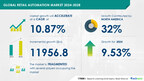
NEW YORK, July 8, 2024 /PRNewswire/ — The global retail automation market size is estimated to grow by USD 11.95 billion from 2024-2028, according to Technavio. The market is estimated to grow at a CAGR of 10.87% during the forecast period. High adoption of contactless payment solutions is driving market growth, with a trend towards emergence of big data management. However, privacy and security concerns poses a challenge. Key market players include Datalogic SpA, Diebold Nixdorf Inc., ek robotics GmbH, FAMETECH INC., Fiserv Inc., Fujitsu Ltd., Grey Orange Pte. Ltd., Honeywell International Inc., iFuture Robotics, Infoplus Commerce, MIDEA Group Co. Ltd., Napse, NCR Voyix Corp., Posiflex Technology Inc., Pricer AB, Sea Point China Ltd., Simbe Robotics Inc., Toshiba Corp., Vinculum Solutions Pvt. Ltd., and Zebra Technologies Corp..
Get a detailed analysis on regions, market segments, customer landscape, and companies – Click for the snapshot of this report
Forecast period
2024-2028
Base Year
2023
Historic Data
2018 – 2022
Segment Covered
Type (Point-of-sale, Barcode and RFID, Camera, and Others), End-user (Supermarkets, Hypermarkets, Single item stores, Fuel stations, and Retail pharmacies), and Geography (APAC, North America, Europe, Middle East and Africa, and South America)
Region Covered
APAC, North America, Europe, Middle East and Africa, and South America
Key companies profiled
Datalogic SpA, Diebold Nixdorf Inc., ek robotics GmbH, FAMETECH INC., Fiserv Inc., Fujitsu Ltd., Grey Orange Pte. Ltd., Honeywell International Inc., iFuture Robotics, Infoplus Commerce, MIDEA Group Co. Ltd., Napse, NCR Voyix Corp., Posiflex Technology Inc., Pricer AB, Sea Point China Ltd., Simbe Robotics Inc., Toshiba Corp., Vinculum Solutions Pvt. Ltd., and Zebra Technologies Corp.
Key Market Trends Fueling Growth
Retail automation is set to experience significant growth due to the increasing adoption of cloud-based solutions. This shift allows merchants to integrate more back-end software in the cloud, enabling seamless access to customer and product data across multiple platforms. Compatible retail automation solutions are essential for managing large volumes of data, capturing demographics, payment preferences, and buying behavior. Incorporating Point of Sale (POS) systems in retail offers several advantages. Merchants can gain insights into consumer behavior with in-store products, empower associates with customer profile data, engage customers throughout their visit, and offer creative loyalty reward programs. These benefits will drive the expansion of the global retail automation market during the forecast period.
Retail automation is a growing trend in the industry, with Artificial Intelligence (AI) leading the way. AI in retail is revolutionizing demand forecasting through predictive data, enhancing customer experiences with personalized campaigns, and improving supply chain management. Interactive chat programs and logistics management systems streamline operations, while barcode & RFID technology and automated conveyor systems optimize retailers’ inventory, staffing, distribution, and delivery schedules. Automation technology, including robotics in warehouses and fulfillment centers, boosts organizational efficiency. Retailers must also prioritize cybersecurity threats in their automation strategies. Point-of-sale (POS) systems, department shops, and single item stores, from fuel stations to retail pharmacies and e-commerce warehouses, all benefit from retail automation software and machine learning (ML). Robotics process automation and cloud-based POS software further enhance operational workflows.
Discover 360° analysis of this market. For complete information, schedule your consultation- Book Here!
Market Challenges
The retail automation market faces significant challenges related to consumer data privacy and security. With the rise of e-commerce and m-commerce, there are concerns about the safety of financial data during online transactions. Identity theft and breaches in personal bank accounts pose substantial risks. Additionally, the collection and use of customer data for marketing purposes can infringe on privacy. Mobile service providers gather data through cookies for customized advertising, but this practice raises concerns about customer consent and control over their personal information. Location-based services also require geo-based information, adding to privacy concerns. Mastercard Inc.’s USD250 million commitment to help small businesses with identity theft protection and cybersecurity assessments is a positive step towards addressing these challenges. However, the risks of unauthorized access to financial data continue to discourage users from using retail automation for transactions. These privacy and security concerns may hinder the growth of the global retail automation market during the forecast period.Retail automation is transforming the way retailers manage their operations, from e-commerce warehouses to in-store segments. Automation technology, including robotics and artificial intelligence (AI), is streamlining supply chain management and improving organizational efficiency. Retailers are adopting automation software for tasks like inventory scanning and self-checkout systems. E-commerce sector challenges, such as cybersecurity threats, are driving the need for advanced technology solutions. E-commerce warehouses utilize autonomous systems for warehouse storage and inventory management. Robotics process automation and machine learning (ML) are key tools in this area. In the retail environment, point-of-sale (POS) systems, like Markt POS and cloud-based POS software, are being upgraded with AI capabilities. Retail giants are investing in automation systems to enhance customer experience and adapt to changing consumer preferences. Challenges in the in-store segment, such as omnichannel retailing and self-checkout systems, are being addressed through the use of autonomous guided vehicles and autonomous mobile robotics. The camera segment and supermarket segment are also seeing significant advancements in automation technology. The economic growth and individual spending capacities are fueling the adoption of retail automation. However, challenges persist, including the need for application programming interfaces and the integration of hardware and software solutions. Cybersecurity threats remain a concern, with retailers requiring robust security measures to protect their data. In conclusion, retail automation is a critical component of the retail landscape, addressing challenges in e-commerce warehouses, supply chain management, and in-store operations. With the continued advancement of technology, retailers will continue to find innovative ways to improve their operational workflows and provide a seamless shopping experience for consumers.
For more insights on driver and challenges – Download a Sample Report
Segment Overview
This retail automation market report extensively covers market segmentation by
Type 1.1 Point-of-sale1.2 Barcode and RFID1.3 Camera1.4 OthersEnd-user 2.1 Supermarkets2.2 Hypermarkets2.3 Single item stores2.4 Fuel stations2.5 Retail pharmaciesGeography 3.1 APAC3.2 North America3.3 Europe3.4 Middle East and Africa3.5 South America
1.1 Point-of-sale- Point-of-Sale (POS) systems are essential components in retail transactions, combining hardware and software to manage sales, payments, and customer information. Compared to traditional cash registers, POS automation offers numerous advantages, such as improved inventory management, efficient reporting, and enhanced customer experience. With the ability to store and share sales data, POS systems save time and increase accuracy. Fixed POS terminals have become a common feature in large retail stores, fueling the growth of the retail automation market. The convenience and high return on investment of POS systems, along with their wide range of applications including bill printing and payment processing, further boost market expansion.
For more information on market segmentation with geographical analysis including forecast (2024-2028) and historic data (2018 – 2022) – Download a Sample Report
Research Analysis
The Retail Automation Market is experiencing significant growth due to the increasing adoption of automation technology in the retail sector. E-commerce warehouses are leveraging automation to streamline their operations, from inventory scanning systems to autonomous mobile robots and autonomous guided vehicles. In the retail environment, automation is transforming Point-of-Sale (POS) systems, with cloud-based POS software and self-checkout systems becoming increasingly popular. Machine Learning (ML) and Artificial Intelligence (AI) are also playing a crucial role in retail automation, optimizing supply chain management and improving organizational efficiency. The in-store segment is also benefiting from automation, with robotics process automation and autonomous systems enhancing retail operational workflows. The E-commerce sector and Omnichannel retailing are major drivers of the retail automation market, with the Internet of Things and Application Programming Interface (API) enabling seamless integration between different systems. However, as retailers adopt more automation, cybersecurity threats become a growing concern, requiring robust security measures to protect sensitive customer and financial data.
Market Research Overview
Retail automation is transforming the retail industry by streamlining operations and enhancing customer experiences. E-commerce warehouses are leveraging automation technology, such as robotics process automation, artificial intelligence (AI), and machine learning (ML), for efficient supply chain management. Retailers in various segments, including department shops, supermarkets, hypermarkets, and single item stores, are adopting automation systems for inventory management, demand forecasting, and predictive data analysis. Automation is also making strides in the in-store segment, with self-checkout systems, interactive chat programs, and autonomous guided vehicles becoming commonplace. Retail operational workflows are being optimized through the use of cloud-based POS software, IoT devices, and APIs. Cybersecurity threats are a concern as retailers adopt more technology, but retail automation software providers are addressing these challenges with robust security measures. Retail giants and individual retailers alike are investing in automation tools and technology solutions to improve organizational efficiency, meet changing consumer preferences, and adapt to economic growth. Warehouse and inventory management are key areas of focus, with the implementation of inventory-scanning systems, autonomous mobile robotics, and automated conveyor systems. Logistics management systems are also being automated to optimize staffing, distribution, and delivery schedules. Barcode & RFID technology, warehouse robotics, and on-premises automation are also playing a significant role in retail automation. Fuel stations and retail pharmacies are also adopting automation technology to enhance their operations. Overall, retail automation is revolutionizing the retail industry, from the warehouse to the point-of-sale.
Table of Contents:
1 Executive Summary
2 Market Landscape
3 Market Sizing
4 Historic Market Size
5 Five Forces Analysis
6 Market Segmentation
TypePoint-of-saleBarcode And RFIDCameraOthersEnd-userSupermarketsHypermarketsSingle Item StoresFuel StationsRetail PharmaciesGeographyAPACNorth AmericaEuropeMiddle East And AfricaSouth America
7 Customer Landscape
8 Geographic Landscape
9 Drivers, Challenges, and Trends
10 Company Landscape
11 Company Analysis
12 Appendix
About Technavio
Technavio is a leading global technology research and advisory company. Their research and analysis focuses on emerging market trends and provides actionable insights to help businesses identify market opportunities and develop effective strategies to optimize their market positions.
With over 500 specialized analysts, Technavio’s report library consists of more than 17,000 reports and counting, covering 800 technologies, spanning across 50 countries. Their client base consists of enterprises of all sizes, including more than 100 Fortune 500 companies. This growing client base relies on Technavio’s comprehensive coverage, extensive research, and actionable market insights to identify opportunities in existing and potential markets and assess their competitive positions within changing market scenarios.
Contacts
Technavio Research
Jesse Maida
Media & Marketing Executive
US: +1 844 364 1100
UK: +44 203 893 3200
Email: media@technavio.com
Website: www.technavio.com/
View original content to download multimedia:https://www.prnewswire.com/news-releases/retail-automation-market-size-is-set-to-grow-by-usd-11-95-billion-from-2024-2028–high-adoption-of-contactless-payment-solutions-to-boost-the-market-growth-technavio-302189610.html
SOURCE Technavio










 Technology2 days ago
 Technology5 days ago
 Technology4 days ago
 Technology5 days ago
 Technology4 days ago

 Coin Market4 days ago
 Technology4 days ago