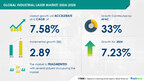
NEW YORK, July 16, 2024 /PRNewswire/ — The global industrial laser market size is estimated to grow by USD 2.89 billion from 2024-2028, according to Technavio. The market is estimated to grow at a CAGR of 7.58% during the forecast period. Growing demand for industrial lasers from several industries is driving market growth, with a trend towards government support and initiatives associated with industrial lasers. However, limited material compatibility of industrial lasers poses a challenge. Key market players include Active Fiber Systems GmbH, AdValue Photonics Inc, AISIN CORP., Amonics Ltd., Calmar Laser Inc., Coherent Inc., FANUC Corp., Hamamatsu Photonics KK, Hans Laser Technology Industry Group Co. Ltd., IPG Photonics Corp., Jenoptik AG, Laserglow Technologies, Laserline GmbH, Lumentum Holdings Inc., MKS Instruments Inc., nLIGHT Inc., Nuphoton Technologies Inc., Photonics Industries International Inc., Precitec GmbH and Co. KG, TroGroup GmbH, TRUMPF SE Co. KG, and VYDENCE Medical.
Get a detailed analysis on regions, market segments, customer landscape, and companies- View the snapshot of this report
Industrial Laser Market Scope
Report Coverage
Details
Base year
2023
Historic period
2018 – 2022
Forecast period
2024-2028
Growth momentum & CAGR
Accelerate at a CAGR of 7.58%
Market growth 2024-2028
USD 2.89 billion
Market structure
Fragmented
YoY growth 2022-2023 (%)
7.23
Regional analysis
APAC, North America, Europe, Middle East and Africa, and South America
Performing market contribution
APAC at 33%
Key countries
US, China, Japan, Germany, and UK
Key companies profiled
Active Fiber Systems GmbH, AdValue Photonics Inc, AISIN CORP., Amonics Ltd., Calmar Laser Inc., Coherent Inc., FANUC Corp., Hamamatsu Photonics KK, Hans Laser Technology Industry Group Co. Ltd., IPG Photonics Corp., Jenoptik AG, Laserglow Technologies, Laserline GmbH, Lumentum Holdings Inc., MKS Instruments Inc., nLIGHT Inc., Nuphoton Technologies Inc., Photonics Industries International Inc., Precitec GmbH and Co. KG, TroGroup GmbH, TRUMPF SE Co. KG, and VYDENCE Medical
Market Driver
Government initiatives are significantly boosting the global industrial laser market. Various governments worldwide are funding research and development in industrial lasers through programs like the EU’s Horizon Europe and the US’s Small Business Innovation Research (SBIR). These initiatives provide financial support to businesses and organizations, encouraging the adoption of industrial lasers in industries such as aerospace and defense. Additionally, governments establish regulations and standards, like OSHA and IEC, ensuring safe and efficient use. These favorable policies and incentives are expected to fuel the market’s growth during the forecast period.
The industrial laser market is thriving with advancements in CO2, solid state, diode/excimer, and fiber lasers. CO2 lasers lead in macro material processing, while fiber lasers excel in high efficiency and accuracy for varied applications. Solid state lasers offer energy efficiency and compact marking solutions. Diode modules power micro processing and deep marking solutions. Excimer lasers deliver blind hole machining and micro cutting. Long life expectancy and optimum flexibility make these lasers ideal for industries like medical and electronics. Political uncertainties impact the market, but automation and high precision processing remain key trends. Laser processing machines cater to complex product processing, macro material processing, and laser engraving applications. High accuracy and personalization are driving demands for laser machines in different materials. Laser processing offers solutions for 3D micro milling, blind hole machining, micro cutting, and macro processing.
Discover 360° analysis of this market. For complete information, schedule your consultation – Book Here!
Market Challenges
Industrial lasers offer significant benefits for material processing, yet achieving consistent results across various materials poses challenges. Material reflectivity and absorption properties impact laser efficiency and interaction. Metals with high reflectivity can be difficult to process uniformly. Thickness and thermal conductivity variations affect laser response. Non-uniform surfaces and irregular shapes can impact processing uniformity. Thermal effects from laser processing can lead to material distortion and residual stresses, which can be problematic in applications requiring material integrity. In industries like healthcare and automotive, dealing with materials of unknown or variable properties adds to the complexity. Lack of comprehensive knowledge about laser processing requirements for specific materials can hinder the industrial laser market’s growth. Limited material compatibility is a significant challenge.The industrial laser market is experiencing significant growth due to increasing automation and high efficiency demands in various industries. Laser processing offers high precision and accuracy for varied applications on different materials. The market caters to complex product processing in sectors like automotive, industrial machinery, aerospace, construction, and more. Laser machines provide optimum flexibility and personalization through laser engraving applications. Laser processing machines enhance productivity and improve time-efficiency in material processing. Industrial laser sources, with multiple secondary sources, cater to welding applications in e-mobility and commercial vehicles. Foreign investment restrictions and special purpose applications in new energy and construction sectors present challenges. However, laser systems offer enhanced flexibility and improved productivity, reducing errors and waste, and enabling faster Time-To-Market. Laser manufacturers focus on customization, 3D manufacturing, and additive manufacturing for commercial applications. The market includes laser metal deposition, selective laser melting, and optimization technologies. 3D printing and machine tools component manufacturing are also key areas of growth. Overall, the industrial laser market offers significant benefits, including reduced costs and improved accuracy, making it a valuable investment for businesses.
For more insights on driver and challenges – Request a sample report!
Segment Overview
This industrial laser market report extensively covers market segmentation by
Type 1.1 Macro processing1.2 Micro processingPower Output2.1 More than 1.1 kW2.2 Less than 1 kWGeography 3.1 APAC3.2 North America3.3 Europe3.4 Middle East and Africa3.5 South America
1.1 Macro processing- The macro processing segment of the industrial laser market refers to lasers used for large-scale material processing in industries. These lasers, which include CO2, fiber, and solid-state types, are essential for heavy-duty manufacturing applications such as automotive, aerospace, shipbuilding, and heavy machinery production. Macro processing lasers are designed for cutting, welding, and drilling thick materials like metals, plastics, and composites. With power outputs of 1 kilowatt (KW) or more, they offer high precision and speed. Macro processing lasers can handle complex operations like bevel cutting and multi-axis welding, increasing efficiency and productivity. Their versatility in handling various industrial applications and materials makes them indispensable tools for manufacturers. As a result, the macro processing segment is expected to significantly contribute to the growth of the global industrial laser market during the forecast period.
For more information on market segmentation with geographical analysis including forecast (2024-2028) and historic data (2017-2021) – Download a Sample Report
Learn and explore more about Technavio’s in-depth research reports
The global ENT Laser Devices market is witnessing significant growth due to advancements in medical technology, increased prevalence of ENT disorders, and rising demand for minimally invasive procedures. Key players are focusing on innovative product development to enhance precision and patient outcomes.
The global Laser Cutting Machine market is expanding rapidly, driven by growing industrial automation, demand for high-precision cutting, and advancements in laser technology. Key industries, including automotive, aerospace, and electronics, are increasingly adopting laser cutting machines to enhance efficiency and production quality.
Research Analysis
The industrial laser market is experiencing significant growth due to the increasing demand for automation, high efficiency, and accuracy in various industries. Laser processing offers high precision processing for a varied range of applications and materials, including automotive, industrial machinery, aerospace, construction, and more. Industrial laser machines provide optimum flexibility and personalization through laser engraving applications. These machines are essential for complex product processing, offering enhanced flexibility, improved productivity, and time-efficiency. Industrial laser sources, such as fiber lasers and CO2 lasers, are the backbone of these systems, with multiple secondary sources ensuring consistent performance. With the ability to weld and cut different materials, industrial lasers are revolutionizing material processing, offering high accuracy and time-efficiency for businesses seeking to stay competitive in today’s market.
Market Research Overview
The industrial laser market is experiencing significant growth due to the increasing demand for automation, high efficiency, and accuracy in various industries. Laser processing offers high precision processing for varied applications and different materials, providing optimum flexibility and personalization. Industrial laser machines are used for complex product processing in automotive, industrial machinery, aerospace, construction, and other sectors. These laser systems offer enhanced flexibility and improved productivity, reducing errors and waste, and providing faster Time-To-Market. Industrial laser sources include CO2 lasers, solid state lasers, diode/excimer lasers, fiber lasers, and others. Applications include laser engraving, additive manufacturing, laser metal deposition, selective laser melting, optimization, and more. Laser processing machines are also used for 3D micro milling, blind hole machining, micro cutting, and macro processing. Energy efficiency and long life expectancy are key benefits, with compact marking solutions and deep marking solutions available for specific applications. Political uncertainties and foreign investment restrictions may impact the market, but the trend towards customization, new energy, e-mobility, commercial vehicles, passenger cars, and 3D printing is driving growth.
Table of Contents:
1 Executive Summary
2 Market Landscape
3 Market Sizing
4 Historic Market Size
5 Five Forces Analysis
6 Market Segmentation
TypeMacro ProcessingMicro ProcessingPower OutputMore Than 1.1 KWLess Than 1 KWGeographyAPACNorth AmericaEuropeMiddle East And AfricaSouth America
7 Customer Landscape
8 Geographic Landscape
9 Drivers, Challenges, and Trends
10 Company Landscape
11 Company Analysis
12 Appendix
About Technavio
Technavio is a leading global technology research and advisory company. Their research and analysis focuses on emerging market trends and provides actionable insights to help businesses identify market opportunities and develop effective strategies to optimize their market positions.
With over 500 specialized analysts, Technavio’s report library consists of more than 17,000 reports and counting, covering 800 technologies, spanning across 50 countries. Their client base consists of enterprises of all sizes, including more than 100 Fortune 500 companies. This growing client base relies on Technavio’s comprehensive coverage, extensive research, and actionable market insights to identify opportunities in existing and potential markets and assess their competitive positions within changing market scenarios.
Contacts
Technavio Research
Jesse Maida
Media & Marketing Executive
US: +1 844 364 1100
UK: +44 203 893 3200
Email: media@technavio.com
Website: www.technavio.com/
View original content to download multimedia:https://www.prnewswire.com/news-releases/industrial-laser-market-size-is-set-to-grow-by-usd-2-89-billion-from-2024-2028–growing-demand-for-industrial-lasers-from-several-industries-boost-the-market-technavio-302196860.html
SOURCE Technavio










 Technology5 days ago

 Near Videos4 days ago
 Technology5 days ago
 Technology5 days ago
 Technology4 days ago
 Near Videos5 days ago
 Coin Market4 days ago