Connect with us

Technology

Data Center Market Size In China is set to grow by USD 181.33 billion from 2024-2028, Rising demand for hyper-converged data centers boost the market, Technavio

Published

on

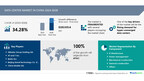
NEW YORK, July 24, 2024 /PRNewswire/ — The data center market size in China is estimated to grow by USD 181.33 billion from 2024-2028, according to Technavio. The market is estimated to grow at a CAGR of 34.28% during the forecast period. Rising demand for hyper-converged data centers is driving market growth, with a trend towards use of server disaggregation to improve utilization rates. However, growing focus on consolidating data centers poses a challenge. Key market players include Alibaba Group Holding Ltd., AT and T Inc., Baidu Inc., Beijing Sinnet technology Co. Ltd., China Mobile Ltd., China Telecom Corp. Ltd., China Unicom Hong Kong Ltd., CICC Data Group Co. Ltd., Digital Realty Trust Inc., Eaton Corp. Plc, Equinix Inc., Fujitsu Ltd., GDS Holdings Ltd., Global Switch Ltd., Shanghai Dataport Co. Ltd., Telstra Corp. Ltd., Tencent Holdings Ltd., VNET Group Inc., Wangsu Science and Technology Co. Ltd., and Zenlayer Inc..

Get a detailed analysis on regions, market segments, customer landscape, and companies- View the snapshot of this report

Data Center Market In China Scope

Report Coverage

Details

Base year

2023

Historic period

2018 – 2022

Forecast period

2024-2028

Growth momentum & CAGR

Accelerate at a CAGR of 34.28%

Market growth 2024-2028

USD 181335.6 million

Market structure

Fragmented

YoY growth 2022-2023 (%)

25.64

Regional analysis

China

Performing market contribution

APAC at 100%

Key countries

China

Key companies profiled

Alibaba Group Holding Ltd., AT and T Inc., Baidu Inc., Beijing Sinnet technology Co. Ltd., China Mobile Ltd., China Telecom Corp. Ltd., China Unicom Hong Kong Ltd., CICC Data Group Co. Ltd., Digital Realty Trust Inc., Eaton Corp. Plc, Equinix Inc., Fujitsu Ltd., GDS Holdings Ltd., Global Switch Ltd., Shanghai Dataport Co. Ltd., Telstra Corp. Ltd., Tencent Holdings Ltd., VNET Group Inc., Wangsu Science and Technology Co. Ltd., and Zenlayer Inc.

Market Driver

Data centers in China are facing the challenge of increasing power consumption due to the growing adoption of cloud computing, AI, machine learning, and IoT workloads. To address this issue, server disaggregation is gaining popularity as a solution. This approach logically separates server components into memory and compute subsystems, increasing server efficiency and reducing power consumption. With server disaggregation, workloads can utilize exactly the resources they need, preventing the need for replacing entire servers for just one component. Vendors are introducing composable server infrastructure solutions to help data centers in China allocate resources dynamically and efficiently, driving market growth during the forecast period.

The Data Center market in China is witnessing significant growth due to increasing digital services and data storage needs. Regulatory requirements and expanding user bases drive businesses to prioritize scalability and efficiency in their infrastructure. This includes increasing storage capacity, computing power, and adopting green data centers with renewable energy sources like solar, wind, and hydroelectric electricity. Energy-efficient solutions and the rollout of 5G networks are also key trends. Businesses, including large enterprises and cloud service providers, are investing in data centers for hyper scalability and modern processes. The market consists of hardware and software segments, with enterprise network equipment, virtualization, and professional services playing crucial roles. Traditional data centers are being replaced by modularized, compact, and portable options, which offer cost savings and flexibility. Despite the high initial cost, data center operators are turning to hyperscale and hyper-dense server racks for advanced technologies like Artificial Intelligence and Machine Learning.

Discover 360° analysis of this market. For complete information, schedule your consultation – Book Here!

Market Challenges

Infrastructure-as-a-Service (IaaS) is a cloud computing concept that enables organizations to utilize virtualized computing resources over the Internet. The adoption of IaaS has resulted in data center consolidation, which involves reducing data center sizes or merging facilities. This consolidation leads to cost savings as organizations shift to common cloud platforms. However, the transition to virtualized storage requires careful planning for efficiency and capacity. Virtualization increases I/O streams through resource pooling, but efficiency can be compromised due to the high IOPS. Data center consolidation is a complex process requiring expertise and time, and carries risks. Despite these challenges, the focus on consolidation is expected to negatively impact the growth of the data center market in China during the forecast period.The Data Center market in China is experiencing significant growth due to the increasing demand for digital data from organizations, driven by remote working and the internet. Hyperscale data centers and cloud service providers lead this trend, requiring high server rack density and advanced technologies like Artificial Intelligence and Machine Learning. Traditional data centers face challenges in hyper scalability, sustainability, and automation. Modular data centers offer a solution, but small enterprises may find the upfront costs prohibitive. Technology providers are focusing on energy efficiency and green data centers to address concerns over electricity consumption and sustainability. The Department of Energy is pushing for modern business processes and asset performance management to optimize data center capacity and functionality. Information security is a top concern, with software testing and enterprise engineering solutions essential for maintaining operating conditions. Global traffic and internet usage continue to surge, driving the need for cloud computing and edge computing. Energy consumption remains a challenge, with electricity costs a significant expense. Organizations must balance functionality and cost-effectiveness while ensuring data security. Overall, the Data Center market in China presents both opportunities and challenges for businesses and technology providers alike.

For more insights on driver and challenges – Request a sample report!

Segment Overview

This data center market in China report extensively covers market segmentation by

Component1.1 IT infrastructure1.2 Power management1.3 Mechanical construction1.4 General construction1.5 OthersEnd-user2.1 BFSI2.2 Telecom and IT2.3 Government2.4 Energy and utilities2.5 OthersGeography3.1 APAC

1.1 IT infrastructure- The Data Center market in China continues to grow, with significant investments from domestic and international companies. In 2020, the market size was valued at over USD30 billion and is projected to reach USD60 billion by 2025. Key drivers include increasing digitalization, cloud adoption, and data protection regulations. Companies like Alibaba, Tencent, and Huawei are major players, expanding their data center capacities to meet growing demand. China’s favorable business environment and large population make it an attractive market for data center investments.

For more information on market segmentation with geographical analysis including forecast (2024-2028) and historic data (2017-2021) – Download a Sample Report

Learn and explore more about Technavio’s in-depth research reports

The global Data Center Colocation and Managed Hosting Services Market is experiencing significant growth, driven by increasing demand for scalable, cost-effective IT solutions. Parallelly, the global Containerized and Modular Data Center Market is expanding due to rising adoption of flexible and efficient data center solutions. Additionally, the global Data Center Infrastructure Management (DCIM) Solutions Market is thriving as organizations seek enhanced visibility and control over data center operations. These markets are pivotal in supporting the evolving needs of businesses in a rapidly digitizing world.

Research Analysis

The Data Center Market in China is experiencing significant growth due to the increasing demand for digital services and expanding user base. Businesses require more storage capacity and efficient infrastructure to support modern processes and advanced technologies like Artificial Intelligence and Machine Learning. Regulatory requirements are also driving the need for data centers that prioritize sustainability and energy efficiency. Renewable energy sources, such as solar, wind, and hydroelectric electricity, are being integrated into data centers to reduce carbon emissions. Hyper scalability and automation are essential for business scalability, while energy-efficient solutions and 5G network enable faster data transmission speeds and edge computing services. Micro data centers and cloud services are also gaining popularity among large enterprises for their cost-effectiveness and flexibility. Overall, the Data Center Market in China is a dynamic and innovative space, driven by the demands of the digital economy and the pursuit of sustainability.

Market Research Overview

The Data Center Market in China is experiencing significant growth due to the expanding user base and increasing digital services adoption. Businesses require more data storage needs to support modern business processes, leading to a surge in demand for efficient infrastructure with high computing power. Regulatory requirements for data security and sustainability are driving the adoption of green data centers, which utilize renewable energy sources like solar, wind, and hydroelectric electricity. Energy-efficient solutions are essential for data center operators to reduce their carbon footprint and lower operating costs. The market comprises various segments, including hardware, software, and professional services. The hardware segment includes server racks, enterprise network equipment, and virtualization solutions. The software segment offers cloud services, data transmission services, and edge computing services. Modularized data centers, micro data centers, and portable data centers are gaining popularity for their scalability and flexibility. Despite the high initial cost, large enterprises are investing in hyperscale data centers for hyper scalability and advanced technologies like Artificial Intelligence and Machine Learning. Small enterprises and cloud service providers are also adopting data centers to support remote working and increasing internet usage. The market is expected to continue growing, driven by the global traffic and digital data generated by organizations. The Department of Energy is also promoting energy efficiency and sustainability in data centers to address concerns over electricity consumption and functionality.

Table of Contents:

1 Executive Summary
2 Market Landscape
3 Market Sizing
4 Historic Market Size
5 Five Forces Analysis
6 Market Segmentation

ComponentIT InfrastructurePower ManagementMechanical ConstructionGeneral ConstructionOthersEnd-userBFSITelecom And ITGovernmentEnergy And UtilitiesOthersGeographyAPAC

7 Customer Landscape
8 Geographic Landscape
9 Drivers, Challenges, and Trends
10 Company Landscape
11 Company Analysis
12 Appendix

About Technavio

Technavio is a leading global technology research and advisory company. Their research and analysis focuses on emerging market trends and provides actionable insights to help businesses identify market opportunities and develop effective strategies to optimize their market positions.

With over 500 specialized analysts, Technavio’s report library consists of more than 17,000 reports and counting, covering 800 technologies, spanning across 50 countries. Their client base consists of enterprises of all sizes, including more than 100 Fortune 500 companies. This growing client base relies on Technavio’s comprehensive coverage, extensive research, and actionable market insights to identify opportunities in existing and potential markets and assess their competitive positions within changing market scenarios.

Contacts

Technavio Research
Jesse Maida
Media & Marketing Executive
US: +1 844 364 1100
UK: +44 203 893 3200
Email: media@technavio.com
Website: www.technavio.com/

View original content to download multimedia:https://www.prnewswire.com/news-releases/data-center-market-size-in-china-is-set-to-grow-by-usd-181-33-billion-from-2024-2028–rising-demand-for-hyper-converged-data-centers-boost-the-market-technavio-302204048.html

SOURCE Technavio

Continue Reading

Technology

Massachusetts Technology Executive Named Toastmasters International President

Published

on

By

Stefano S. McGhee becomes leader of global educational organization

ENGLEWOOD, Colo., Sept. 8, 2026 /PRNewswire/ — Stefano S. McGhee, DTM, of Weymouth, Massachusetts, has been elected to the Board of Directors of Toastmasters International, the world’s leading organization devoted to communication and leadership skills development. McGhee assumed the one-year term at the organization’s 2026 International Convention, held in Vancouver, Canada, Aug. 19-22.

McGhee, most recently worked as the Senior Director of Technology Operations for Harvard Business Publishing. He led a team of cloud engineers, architects, integration engineers, and help desk technicians in ensuring the availability and stability of the organization’s most critical applications, including Harvard Business Review.

McGhee earned a master’s degree in military operational arts and sciences from the United States Air Force’s higher education organization. During his time in school, McGhee earned the International Security Studies Research Award for his work that was of interest to national security. He is a member of the Aircraft Owners and Pilots Association, where he shares the wonder of flying with children and young adults. He is also a motorcycle enthusiast and leader at a local yacht club.

A Toastmaster since 2005, McGhee’s home club is Network Voice Toastmasters in Weymouth. He has held several high-profile leadership positions within Toastmasters and has attained the Distinguished Toastmaster designation—the highest level of educational achievement in the organization. 

“To those willing to put the time in, Toastmasters gives the critical skills to be a better version of yourself,” he says. “From there, you can confidently take on more challenges at work and life and become the sought-after leader needed in today’s world.”

As an officer of the Toastmasters International Board of Directors, McGhee is a “working ambassador” for the organization. He works with the Board to develop, support, and modify the policies and procedures that guide Toastmasters International in fulfilling its mission.

About Toastmasters International
Toastmasters International is a nonprofit educational organization that builds confidence and teaches public speaking skills through a worldwide network of clubs that meet online and in person. In a supportive community or corporate environment, members prepare and deliver speeches, respond to impromptu questions, and give and receive constructive feedback. It is through this regular practice that members are empowered to meet personal and professional communication goals. Founded in 1924, the organization is headquartered in Englewood, Colorado with over 245,000 members in more than 14,000 clubs in nearly 150 countries. For information about local Toastmasters clubs, please visit toastmasters.org.

View original content to download multimedia:https://www.prnewswire.com/news-releases/massachusetts-technology-executive-named-toastmasters-international-president-302872579.html

SOURCE Toastmasters International

Continue Reading

Technology

EntangleX Announces Collaboration with TraderMade Systems Ltd to Test AI and Quantum-Powered Financial Prediction Models

Published

on

By

LOCUST VALLEY, N.Y., Sept. 8, 2026 /PRNewswire/ — TraderMade Systems Ltd, a leading provider of foreign exchange market data and financial technology solutions, today announced a collaboration with EntangleX, part of the QuantumX Group, to support the testing and evaluation of advanced financial market prediction models.

As part of the collaboration, EntangleX will use TraderMade’s high-quality real-time and historical foreign exchange data to test and validate predictive models developed using artificial intelligence, machine learning and emerging quantum computing techniques.

The project brings together TraderMade’s expertise in financial market data with EntangleX’s work in advanced computational modelling. The initial focus will be on foreign exchange markets, where the depth and volume of market data provide a strong environment for evaluating the performance and reliability of predictive technologies.

EntangleX is exploring how AI and quantum computing approaches can be applied to complex financial datasets to identify patterns, relationships and market behaviours that may be difficult to detect using more traditional analytical methods.

Chris Randall, CEO of TraderMade Systems Ltd, said:

“We are pleased to be working with EntangleX and the wider QuantumX Group on this project. AI and quantum computing are creating exciting new opportunities in quantitative finance, but the quality of any predictive model depends heavily on the quality of the data behind it.

TraderMade will provide the accurate and reliable FX data needed to test these technologies against real-world market behaviour. We are very interested to see how these advanced modelling techniques can be applied to financial market analysis.”

The collaboration will allow EntangleX to benchmark its models against established market data and assess performance across different market conditions.

Ujjwal Roy, spokesperson EntangleX / QuantumX said: “Access to reliable market data is essential when developing and testing advanced prediction models. TraderMade provides the depth and quality of FX data required to evaluate our technology in real-world conditions. By combining high-quality financial data with artificial intelligence and quantum computing techniques, we aim to explore new approaches to market modelling and forecasting.”

The initial programme will focus on testing, benchmarking and evaluating EntangleX models using TraderMade FX datasets, with both companies exploring further opportunities for collaboration as the project develops.

About TraderMade Systems Ltd

TraderMade Systems Ltd provides real-time and historical foreign exchange and financial market data, APIs and technology solutions to financial institutions, fintech companies, developers and quantitative research teams. Its market data is used across trading, analytics, research, financial applications and data-driven modelling.

About EntangleX

EntangleX, part of the QuantumX Group of Two Hands Corporation, develops advanced financial modelling technologies incorporating artificial intelligence, machine learning and quantum computing techniques. Its work focuses on applying next-generation computational approaches to complex financial datasets for market analysis and predictive modelling. Two Hands Corporation (OTCID: TWOH) is a publicly traded company focused on identifying and developing opportunities in quantum technology, artificial intelligence applications and related emerging technology sectors. The Company is advancing its strategic transition toward technology-focused opportunities while continuing to evaluate complementary technologies and potential commercial applications.

Forward-Looking Statements

This press release contains forward-looking statements within the meaning of applicable securities laws. Forward-looking statements include, but are not limited to, statements concerning the testing, evaluation, functionality and performance of EntangleX’s artificial intelligence, machine learning and quantum computing technologies; the ability of such technologies to identify patterns, relationships or market behaviours within financial market data; the potential applications of EntangleX’s technologies in financial modelling and forecasting; the anticipated scope and results of the collaboration with TraderMade Systems Ltd; potential future opportunities arising from the collaboration; the possible commercialization of EntangleX technologies; and the Company’s business strategy and transition toward quantum technology, artificial intelligence and related emerging technology opportunities.

Forward-looking statements are based on the Company’s current expectations, estimates, assumptions and projections and are subject to known and unknown risks and uncertainties that could cause actual results to differ materially from those expressed or implied.

These risks and uncertainties include technical feasibility and performance, the results of testing and validation, the availability and quality of third-party data, development delays, reliance on third-party software and infrastructure, access to qualified personnel and financial resources, cybersecurity and data-protection risks, intellectual-property risks, competition, market acceptance, regulatory developments, market conditions and the Company’s ability to execute its business strategy.

There can be no assurance that testing or evaluation will produce anticipated results, that the technologies discussed will achieve anticipated performance or commercial applications, that the collaboration will result in any further agreement or commercial relationship, or that any contemplated commercial objective will be achieved. Readers are cautioned not to place undue reliance on forward-looking statements. Additional information regarding risk factors is available in the Company’s filings with the U.S. Securities and Exchange Commission. The Company undertakes no obligation to update or revise any forward-looking statement except as required by applicable law.

View original content:https://www.prnewswire.com/news-releases/entanglex-announces-collaboration-with-tradermade-systems-ltd-to-test-ai-and-quantum-powered-financial-prediction-models-302872578.html

SOURCE Two Hands Corporation

Continue Reading

Technology

AI puts $4.7 trillion of profits at stake, creating a competitive battleground across industries

Published

on

By

AI’s impact on corporate profit pools will more than triple the Internet’s—in half the timeProductivity gains get headlines today, but 75% of the opportunity and disruption lies beyond these, in innovation and competitive shiftsAI will structurally transform 71% of sectors, versus 41% for the Internet—reaching industries the Internet never touched, with far-reaching consequences

NEW YORK and SAN FRANCISCO, Sept. 8, 2026 /PRNewswire/ — AI puts $4.7 trillion of the profits of global business at stake between now and 2035 as its far-reaching impact drastically reshapes the global economy. In-depth Bain & Company analysis maps for the first time how AI is reorganizing whole industries and will create a wave of winners and losers across sectors as companies battle to seize the technology’s potential.

Bain’s calculation of the $4.7 trillion of profits put at stake by AI captures the scale of the business battleground confronting CEOs over the decade. It dwarfs even the $1.4 trillion of profit shifts over 20 years from the advent of the Internet, the last great technology disruption. In only half that time, AI will have more than triple the economic impact, reaching 1.7 times more widely, with 71% of sectors confronting structural transformation, versus 41% for the Internet, Bain reports.

Across 92 individual sectors, Bain’s study charts the seismic shifts already taking place in industries’ profit pools as AI use rapidly expands. It lays out the driving forces and breaks down which sectors will be most disrupted as the technology, and how CEOs respond, shapes a global business landscape of leaders, laggards, and losers.

“The $4.7 trillion profit pool shift is real, revolutionary, and already well underway. This is why, whatever sector companies are in, their CEO needs a clear prediction of where the industry is headed and a board-level commitment to act on it,” said Dunigan O’Keeffe, partner in Bain & Company’s Strategy & Transformation practice and lead author of the report. “Speed matters more than most CEOs realize. Move early and each deployment leaves you smarter than the last, with more data, workflows rewired around AI, and results that keep improving . None of that is for sale, so the company two years behind cannot buy its way back. The work is to figure out of what will matter in your industry a decade from now. Get that right and moving fast stops being a risk.”

AI transformation is reaching the parts the internet didn’t reach

Understanding the transformation underway, and who the winners and losers will be, requires a clear view of how technology disruptions work and what makes the AI revolution different, the report notes.

AI’s fast-advancing restructuring of knowledge work, combined with its imminent impact on physical production through AI embodied in robots, means it will soon affect most of what the global economy does, Bain concludes. Its reach will extend into the high-value core of industries like industrial manufacturing, healthcare delivery, and pharmaceutical R&D that the Internet left untouched.

The Internet was chiefly a distribution technology that collapsed companies’ costs to reach customers, but AI is a production technology that collapses the cost of producing goods and services themselves, not just how they are delivered, Bain says. It will have far greater impact as a result.

The forces behind the profit shifts: productivity gains, innovation, and market share shifts

Three driving forces underlie the $4.7 trillion shift in companies’ profit pools over the next decade, Bain finds.

Productivity gains: Much of the focus on AI today is about productivity gains, and with good reason: Beyond the benefits reaped by consumers from better or cheaper products, companies will keep about $1.1 trillion in new profits as AI makes existing work cheaper, faster, and more scalable. Yet those gains represent just 24% of the total profit pool shift. Roughly 75% lies beyond productivity, in gains from innovation and market share shifts.

New innovation: Innovation among incumbents and new AI-enabled categories will generate $2.2 trillion in new profits (at 47%, the largest share of the total shift). New players will emerge, as they did in the Internet era, but AI offers incumbents opportunities to innovate in their core business across a much broader swath of the economy than the Internet did. AI will pull much of the rest of the economy into the digital world.

Market share shifts: $1.3 trillion of the shift will result from an extensive redistribution of existing profits between competing businesses as AI upends who can compete best, what cost structures work, and what capabilities matter. For many CEOs, the biggest risk and opportunity will be figuring out how to use AI better than their existing competitors.

Mapping the AI battlegrounds

Productivity gains, innovation, and market share shifts will play out unevenly across industries, Bain finds, but CEOs can build conviction about the implications of AI for their industry by understanding where their industry falls in one of four clusters.

Technology Foundation – demand is unavoidable, growth is explosive: in this cluster, with $1.5 trillion of profits in play, demand explodes because every other sector’s AI adoption is unavoidable and non-negotiable. As every industry adopts AI, explosive demand follows for cloud infrastructure, data centers, semiconductors, mobile devices, PCs and servers, and AI foundation models, as well as the energy and physical infrastructure that powers and supports it all.

Rewired – an open race, the swift will win: in this cluster, with $1.5 trillion of profits at stake, Bain identifies a battleground in which AI will rapidly rewire competitive advantage in the affected industries, with a leadership gap between fast and slow AI adopters opening up within a few years, rather than decades and profit pools being fundamentally rebuilt.

In this “Rewired” cluster, leading incumbent companies that move fast to adopt AI will entrench their position as their data, regulatory, and scale advantages allow them to control profit pool shifts and capture disproportionate value. Incumbents who hesitate will cede value. Leaders will reinforce their position in sectors such as pharma and biotech, life sciences, healthcare delivery, healthcare equipment, aerospace and defense, and payments in financial services.

Yet other sectors in this ‘Rewired’ cluster will confront a wide-open race between established players and new entrants as AI erodes traditional boundaries and removes ‘moats’ for incumbents. Leadership in a sector then becomes a position to defend. And cost structures, workforce composition, and channel relationships may create drag for incumbents as AI-native competitors build competing models. These disruptions will mean there are no predetermined winners in sectors such as enterprise software, automotive manufacturing, advertising, consulting, corporate law, cybersecurity, ground transportation, freight, and logistics, and machinery.

Enterprise workflow software also sits squarely here. A market leader with deep customer integrations, high switching costs and defensible data moats has a structural advantage – but only if it treats AI as a board level priority and creates features customers will pay for.

Augmentation – the sector survives, leaders may not: in this cluster, with $1.3 trillion of profits at stake, Bain finds AI brings less dramatic changes to underlying business models while the critical question is who will win the race for AI-powered productivity gains. Companies that move more slowly to capture those gains will find that more aggressive competitors squeeze margins. Fast adopters in hospitality, for instance, could use AI to sharpen consumer insights, extend demand forecasting, dynamically adjust pricing, and sustain customer engagement beyond their next visit.

Revolution – delivery changes, the need doesn’t: with $0.3 trillion of profits at stake, this cluster echoes the disruptions from the Internet as the sectors affected, such as customer support, IT services, and online tutoring and test prep, see their core product or service shift to AI or the margin for intermediaries disappears. Companies in these sectors face replacement of their entire delivery model. The profit pool does not disappear but migrates to whoever owns the AI layer.

Media contacts:
Dan Pinkney (Boston) – Email: dan.pinkney@bain.com
Gary Duncan (London) – Email: gary.duncan@bain.com
Ann Lee (Singapore) – Email: ann.lee@bain.com

About Bain & Company

Bain & Company works with leaders worldwide to solve their toughest challenges and deliver enduring results. Since 1973, we’ve partnered with clients, including private equity and portfolio companies, to build the capabilities they need to stay ahead of change and help them redefine their industries. We measure our success by our clients’ success, and we proudly hold the highest levels of client advocacy in our field.

Bain is consistently recognized globally as one of the best places to work. We operate as one global team, uniting strategists, industry and functional experts, technologists, and advisors with a vibrant ecosystem of technology partners.

Notes to Editors  

Bain & Company was founded in 1973 and today has 19,000 employees across 67 cities in 40 countries. We have worked with more than two-thirds of the Global 500 and more than 9,000 companies worldwide. Bain has pledged to deliver $2 billion in pro bono consulting to nonprofit, public-sector and charitable organizations by 2035. The firm is consistently recognized as a Leader in major analyst rankings across multiple areas, including digital business, innovation, strategy, experience design, customer experience, and carbon-zero transformation.

View original content to download multimedia:https://www.prnewswire.com/news-releases/ai-puts-4-7-trillion-of-profits-at-stake-creating-a-competitive-battleground-across-industries-302872589.html

SOURCE Bain & Company

Continue Reading

Trending