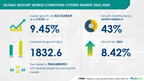
NEW YORK, July 25, 2024 /PRNewswire/ — The global military mobile computing systems market size is estimated to grow by USD 1.83 billion from 2024-2028, according to Technavio. The market is estimated to grow at a CAGR of 9.45% during the forecast period. Greater focus on isr operations is driving market growth, with a trend towards ongoing digitization of battlefield operations. However, cyber security threats associated with military communication systems poses a challenge. Key market players include ASELSAN AS, BAE Systems Plc, Collins Aerospace, Curtiss Wright Corp., Elbit Systems Ltd., Getac Holdings Corp., Inmarsat Global Ltd., Israel Aerospace Industries Ltd., L3Harris Technologies Inc., Leonardo Spa, Lockheed Martin Corp., Miltope, Northrop Grumman Corp., Panasonic Holdings Corp., Rolta India Ltd., Saab AB, Samsung Electronics Co. Ltd., Thales Group, Viasat Inc., and Zebra Technologies Corp..
Get a detailed analysis on regions, market segments, customer landscape, and companies- View the snapshot of this report
Military Mobile Computing Systems Market Scope
Report Coverage
Details
Base year
2023
Historic period
2018 – 2022
Forecast period
2024-2028
Growth momentum & CAGR
Accelerate at a CAGR of 9.45%
Market growth 2024-2028
USD 1832.6 million
Market structure
Fragmented
YoY growth 2022-2023 (%)
8.42
Regional analysis
North America, Europe, APAC, South America, and Middle East and Africa
Performing market contribution
North America at 43%
Key countries
US, China, Russia, India, and UK
Key companies profiled
ASELSAN AS, BAE Systems Plc, Collins Aerospace, Curtiss Wright Corp., Elbit Systems Ltd., Getac Holdings Corp., Inmarsat Global Ltd., Israel Aerospace Industries Ltd., L3Harris Technologies Inc., Leonardo Spa, Lockheed Martin Corp., Miltope, Northrop Grumman Corp., Panasonic Holdings Corp., Rolta India Ltd., Saab AB, Samsung Electronics Co. Ltd., Thales Group, Viasat Inc., and Zebra Technologies Corp.
Market Driver
The military mobile computing systems market is experiencing significant growth due to the increasing digitization of battlefields worldwide. This digitization involves integrating and updating components, including communication and surveillance systems, to their maximum capacity. One primary application of these networked technologies is the detection of incoming projectiles and counterterrorism efforts. They provide military units with automated remote area target monitoring and map-based situation awareness displays, enhancing surveillance capabilities in all weather conditions. Elbit Systems Sweden AB, a subsidiary of Elbit Systems Ltd, recently received a USD48 million contract from the Swedish Defense Materiel Administration to supply Technical High Mobility Shelters for mobile communication platforms. This contract is part of the Swedish Army’s new command and control infrastructure, highlighting the growing focus on digitalization among armed forces globally. As more nations adopt electronic warfare as a defense strategy, the demand for advanced mobile computing systems will continue to increase, driving market growth during the forecast period.
The Military Mobile Computing Systems (MMCS) market is experiencing significant growth due to the increasing need for advanced technology in military operations. However, this trend comes with new challenges, particularly in the realm of security. Data breaches, unauthorized access, and cyber threats pose major concerns for data sovereignty and confidentiality. Security measures such as access controls, encryption mechanisms, intrusion detection, and prevention systems are essential. Data centers and cloud service providers offer solutions, but insider threats and cyberattacks remain a risk. Real-time data analysis, advanced analytics, and intelligence capabilities are crucial for situational awareness and predictive modeling. The MCC ecosystem includes sensors, surveillance systems, social media, and networking capabilities. Mission planning, threat detection, and network connectivity are key requirements. Tech giants and the Air Force segment are major players in this market, utilizing virtual private networks, dedicated communication channels, and virtualized computing resources for secure network infrastructure and internet connectivity. Bandwidth capacity and cloud resources are essential for real-time communication and data transmission.
Discover 360° analysis of this market. For complete information, schedule your consultation – Book Here!
Market Challenges
Military mobile computing systems play a crucial role in ensuring effective communication between armored vehicles and unmanned aerial vehicles (UAVs) by transmitting essential flight parameters. However, the reliance on wireless communication equipment for data transmission increases the vulnerability of these systems to cyberattacks. Unencrypted networks, such as Wi-Fi, pose a significant risk as intruders can interfere with the data transmitted between the UAV and its controller, potentially leading to catastrophic consequences. Both the sender and receiver must use the same specific channel for proper communication to prevent brute force attacks and de-authentication packets that can disrupt the connection and manipulate sensor data. The threat of cyberattacks is a significant challenge to the growth of the global military mobile computing systems market.The Military Mobile Computing Systems market faces unique challenges in the international market, particularly in meeting the demands of modern armed forces for technologically advanced computers in war zones. Rugged computers, embedded systems, laptops, handhelds, wearables, and rugged tablets are essential for military equipment on airborne platforms, naval platforms, military aircraft, ground segments, commercial ships, and national navy. These computers support mission-critical applications like data management, intelligence, surveillance, reconnaissance, and ML, Big data analytics. Military organizations require safety purposes, cost-effective solutions, and interoperability for joint operations and coalition efforts in the defense landscape. Pre-integrated forms of military computer software, such as avionics computers, are necessary for mission success. Cybersecurity advancements are crucial to protect sensitive information. Rapid prototyping and experimentation are essential to address emerging threats and improve equipment performance. Computational power is vital for operational strategies and real-time decision-making.
For more insights on driver and challenges – Request a sample report!
Segment Overview
This military mobile computing systems market report extensively covers market segmentation by
Component 1.1 Products1.2 ServicesDevice 2.1 Radio2.2 Smartphones2.3 Tablets2.4 PCs and laptopsGeography 3.1 North America3.2 Europe3.3 APAC3.4 South America3.5 Middle East and Africa
1.1 Products- The military and defense sector require robust and reliable mobile computing devices due to the harsh environmental conditions they operate in. Market growth is driven by the increasing use of secure mobile communication technologies in defense, as secure networks are essential for mission-critical operations. With most military missions conducted in remote areas, uninterrupted transmission and reception of mission-critical information are necessary. The US Department of Defense (DoD) is pushing the defense industry to ruggedize commercial technologies for military use, boosting the demand for rugged mobile computing. Increased military spending on advanced electronic equipment is also driving demand. For instance, Northrop Grumman Corp’s AN/APR-39E(V)2 radar warning receiver, which provides instantaneous bandwidth and frequency coverage to protect against modern radar threats, was awarded a multi-year contract by the US Army. This will increase demand for military mobile computing products, such as mobile computers and handheld computers, for communication in the military sector, thereby driving the growth of the global military mobile computing systems market during the forecast period.
For more information on market segmentation with geographical analysis including forecast (2024-2028) and historic data (2017-2021) – Download a Sample Report
Learn and explore more about Technavio’s in-depth research reports
The global Urban Air Mobility Market is set to revolutionize transportation driven by advances in eVTOL technology and smart city initiatives. Meanwhile, the global Rugged Handheld Devices Market is fueled by demand in industrial and military applications. The global Military Cybersecurity Market is also on the rise as nations invest heavily in securing critical infrastructure and combating cyber threats.
Research Analysis
The Military Mobile Computing Systems market is a critical segment in the defense sector, providing advanced technology solutions for various military applications. These systems are integral to armor, tanks, and guided missile systems, enhancing their capabilities and effectiveness. The integration of biosensors and AI technology is revolutionizing military operations, enabling real-time data analysis and improved decision-making. 3D printable weaponry and advanced digital infrastructure are shaping the future of military technology, offering cost-effective and flexible solutions for the defense landscape. Startups and private companies are making significant strides in this field, with innovations in ML, big data analytics, and cybersecurity advancements. Military mobile computing systems play a crucial role in mission-critical applications, including intelligence, surveillance, reconnaissance, and joint operations. Cloud computing and coalition efforts are enabling interoperability and information sharing, enhancing the overall effectiveness of military operations. Border road development and weapons purchases continue to drive demand for military mobile computing systems, as these systems are essential for data management and mission success. The integration of AI and ML in military technology is transforming the defense sector, offering new opportunities for innovation and growth.
Market Research Overview
The Military Mobile Computing Systems market encompasses advanced technologies that cater to the unique requirements of the defense sector. These systems include rugged computers, laptops, handhelds, wearables, and tablets designed for use in war zones and other challenging environments. Military mobile computing systems are integrated into various military equipment, such as armor, guided missile systems, tanks, and biosensors, to enhance their capabilities. The market also includes 3D printable weaponry, AI technology, and digital infrastructure solutions. Modern armed forces rely on these systems for mission-critical applications, including data management, intelligence, surveillance, and reconnaissance. Cloud computing offers a cost-effective and flexible solution for military organizations, enabling real-time data analysis and interoperability for joint operations and coalition efforts. However, the defense landscape is constantly evolving, with emerging threats, cybersecurity advancements, and rapid prototyping and experimentation shaping the market. Military mobile computing systems must prioritize security measures, including confidentiality, integrity, access controls, encryption mechanisms, intrusion detection, prevention systems, security policies, and security audits. Cyber threats, data breaches, unauthorized access, insider threats, and data sovereignty concerns are significant challenges for the market. The market also includes ML and big data analytics, cybersecurity advancements, and safety purposes for military bases and avionics computers in pre-integrated forms.
Table of Contents:
1 Executive Summary
2 Market Landscape
3 Market Sizing
4 Historic Market Size
5 Five Forces Analysis
6 Market Segmentation
ComponentProductsServicesDeviceRadioSmartphonesTabletsPCs And LaptopsGeographyNorth AmericaEuropeAPACSouth AmericaMiddle East And Africa
7 Customer Landscape
8 Geographic Landscape
9 Drivers, Challenges, and Trends
10 Company Landscape
11 Company Analysis
12 Appendix
About Technavio
Technavio is a leading global technology research and advisory company. Their research and analysis focuses on emerging market trends and provides actionable insights to help businesses identify market opportunities and develop effective strategies to optimize their market positions.
With over 500 specialized analysts, Technavio’s report library consists of more than 17,000 reports and counting, covering 800 technologies, spanning across 50 countries. Their client base consists of enterprises of all sizes, including more than 100 Fortune 500 companies. This growing client base relies on Technavio’s comprehensive coverage, extensive research, and actionable market insights to identify opportunities in existing and potential markets and assess their competitive positions within changing market scenarios.
Contacts
Technavio Research
Jesse Maida
Media & Marketing Executive
US: +1 844 364 1100
UK: +44 203 893 3200
Email: media@technavio.com
Website: www.technavio.com/
View original content to download multimedia:https://www.prnewswire.com/news-releases/military-mobile-computing-systems-market-size-is-set-to-grow-by-usd-1-83-billion-from-2024-2028–greater-focus-on-isr-operations-boost-the-market-technavio-302205102.html
SOURCE Technavio










 Technology3 days ago
 Technology5 days ago
 Technology5 days ago
 Coin Market4 days ago
 Technology4 days ago
 Technology5 days ago
 Coin Market3 days ago
 Coin Market3 days ago