Technology
Conversational Computing Platform Market size is set to grow by USD 35.64 billion from 2024-2028, Reduction in time and cost required to develop conversational computing platforms to boost the market growth, Technavio
Published
2 years agoon
By
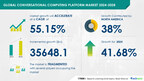
NEW YORK, July 29, 2024 /PRNewswire/ — The global conversational computing platform market size is estimated to grow by USD 35.64 billion from 2024-2028, according to Technavio. The market is estimated to grow at a CAGR of 55.15% during the forecast period. Reduction in time and cost required to develop conversational computing platforms is driving market growth, with a trend towards use of ai in conversational computing platforms. However, issues associated with data privacy poses a challenge. Key market players include Alphabet Inc., Amazon.com Inc., Amelia US LLC, Artificial Solutions International AB, Creative Virtual Ltd., Eudata, Inbenta Holdings Inc., International Business Machines Corp., Jio Haptik Technologies Ltd., Kore.ai Inc., Liveperson Inc., Meta Platforms Inc., Microsoft Corp., onereach.ai, Oracle Corp., Pypestream Inc., Rasa Technologies Inc., Rulai, Salesforce Inc., and SmarTek21 LLC.
Get a detailed analysis on regions, market segments, customer landscape, and companies – Click for the snapshot of this report
Forecast period
2024-2028
Base Year
2023
Historic Data
2018 – 2022
Segment Covered
Type (Virtual digital assistants and Chatbots) and Geography (North America, APAC, Europe, South America, and Middle East and Africa)
Region Covered
North America, APAC, Europe, South America, and Middle East and Africa
Key companies profiled
Alphabet Inc., Amazon.com Inc., Amelia US LLC, Artificial Solutions International AB, Creative Virtual Ltd., Eudata, Inbenta Holdings Inc., International Business Machines Corp., Jio Haptik Technologies Ltd., Kore.ai Inc., Liveperson Inc., Meta Platforms Inc., Microsoft Corp., onereach.ai, Oracle Corp., Pypestream Inc., Rasa Technologies Inc., Rulai, Salesforce Inc., and SmarTek21 LLC
Key Market Trends Fueling Growth
Conversational computing platforms have evolved from handling basic customer queries to executing complex tasks, thanks to advancements in AI and machine learning. AI algorithms analyze customer conversations to determine their needs and take appropriate actions. Sentiment analysis helps understand customer moods, while real-time analytics enables quick human intervention when necessary. Chatbots use natural language processing (NLP) to summarize key information, assisting with product queries and technical support. An example is Woebot, a chatbot using AI technologies for mental health support, implementing cognitive behavioral therapy and dialectical behavior therapy techniques. Woebot, created by Stanford University experts, sends over a million messages weekly to help users cope with depression, anxiety, or loneliness.
The Conversational Computing Platform market is experiencing significant growth as businesses adopt chatbots, text assistants, and voice assistants for advertising, customer service, and internal enterprise systems. Natural language processing (NLP), machine learning (ML), and deep learning are key technologies driving this trend. Cloud-based solutions are popular due to their flexibility and scalability. Telecom, entertainment and media, travel and hospitality, IT and telecom, and startups are major industries investing in conversational AI and generative AI. NLP and ML enable voice recognition technologies for AI chatbots on messaging services and platforms. Customer bases are expanding as these technologies improve digital transformation, remote work, and IT department efficiency. Big Data, IoTs, Blockchain, and bi data analytics are also integrating with conversational computing platforms for enhanced capabilities.
Discover 360° analysis of this market. For complete information, schedule your consultation- Book Here!
Market Challenges
Conversational computing platforms, which include chatbots and virtual digital assistants, offer valuable insights for businesses by identifying search and buying patterns, consumer behavior, and more. However, data privacy is a significant concern for users. These platforms learn and improve through feedback and behavioral data, but the collection and use of personal information raises privacy and security concerns. Regulations like the GDPR limit data collection and usage, and some conversational computing platforms provide data ownership to customers. However, not all vendors offer this flexibility, and users may not fully understand the data being shared and third-party policies. Compliance with regulations, such as GDPR, is crucial, but some platforms offer workarounds to generate insights while adhering to regulations. Overall, addressing privacy concerns is essential for the growth of the conversational computing market.The Conversational Computing Platform market is witnessing significant growth due to the increasing demand for AI-driven solutions that enhance customer engagement and automate business processes. IT and telecom industries are leading the way, integrating Conversational AI, Generative AI, Computer vision, and Voice recognition technology into their offerings. Messaging services and platforms are also adopting conversational computing solutions to provide more personalized customer service. However, challenges persist. Integrating conversational computing with internal enterprise systems and remote work environments requires IT departments to adapt. Natural Language Interfaces, NLP, ML, and Voice recognition technologies pose challenges in understanding complex queries and providing accurate responses. Big Data, IoTs, Blockchain, Bi data analytics, and AI-based technology require robust conversational techniques for effective information dissemination. Digital Marketing managers seek AI-driven conversational techniques for automated customer queries, insurance quotes, and claims inquiries. Healthcare and other industries also benefit from conversational computing, improving customer satisfaction and streamlining business processes.
For more insights on driver and challenges – Download a Sample Report
Segment Overview
This conversational computing platform market report extensively covers market segmentation by
Type 1.1 Virtual digital assistants1.2 ChatbotsGeography 2.1 North America2.2 APAC2.3 Europe2.4 South America2.5 Middle East and Africa
1.1 Virtual digital assistants- The Conversational Computing Platform market is experiencing significant growth as businesses seek to enhance customer engagement and streamline operations. These platforms enable natural language processing, allowing for human-like interactions between users and machines. Companies can build chatbots and voice assistants to handle customer queries, automate workflows, and gather valuable data. This technology is transforming industries, from retail and finance to healthcare and education. By integrating conversational computing into their strategies, businesses can improve customer satisfaction, reduce response times, and gain a competitive edge.
For more information on market segmentation with geographical analysis including forecast (2024-2028) and historic data (2018 – 2022) – Download a Sample Report
Learn and explore more about Technavio’s in-depth research reports
The global Cloud AI market is projected to reach $122 billion by 2028, driven by increasing adoption of AI-powered services across industries. Cloud AI solutions offer scalable, cost-effective data processing and advanced analytics. Meanwhile, the Edge Computing market is expected to hit $80 billion by 2027, fueled by the demand for real-time data processing and reduced latency. Edge computing complements Cloud AI by enabling faster decision-making at the data source, enhancing overall system efficiency and performance. Both markets are experiencing rapid growth due to technological advancements and rising enterprise needs.
Research Analysis
Conversational computing solutions have revolutionized the way businesses interact with their customers and automate business processes. These technologies, which include speech synthesis and recognition, natural language understanding, and neural networks, enable AI-based systems to understand and respond to customer queries, provide insurance quotes and claims inquiries, and even offer healthcare consultations. Automated conversational techniques, such as chatbots and conversational AI, have become essential tools for digital marketing managers to enhance customer satisfaction and engagement. Generative AI and computer vision are also being integrated into conversational computing platforms to provide more personalized and visual experiences. Voice recognition technology and AI chatbots are transforming messaging services and platforms, making customer service more efficient and effective. Overall, conversational computing is a rapidly growing market that offers significant benefits for businesses and consumers alike.
Market Research Overview
Conversational computing solutions are revolutionizing the way businesses interact with their customers and internal systems. Speech synthesis and speech recognition, powered by neural networks and natural language understanding, enable automated conversational techniques for handling customer queries, providing insurance quotes, and managing claims inquiries. These technologies are not limited to customer service but also extend to healthcare, digital marketing, advertising, and more. AI-based technology, including natural language processing, machine learning, and deep learning, plays a crucial role in understanding and responding to customer needs. Conversational AI, generative AI, computer vision, and voice recognition technologies are transforming industries such as telecom, entertainment and media, travel and hospitality, and startups. Consulting and training, support and maintenance, cloud services, and IT departments are essential for implementing and optimizing conversational computing solutions. Remote work and internal enterprise systems are also benefiting from these advanced technologies. Big Data, IoTs, Blockchain, and Bi data analytics are integral to enhancing the capabilities of conversational computing platforms.
Table of Contents:
1 Executive Summary
2 Market Landscape
3 Market Sizing
4 Historic Market Size
5 Five Forces Analysis
6 Market Segmentation
TypeVirtual Digital AssistantsChatbotsGeographyNorth AmericaAPACEuropeSouth AmericaMiddle East And Africa
7 Customer Landscape
8 Geographic Landscape
9 Drivers, Challenges, and Trends
10 Company Landscape
11 Company Analysis
12 Appendix
About Technavio
Technavio is a leading global technology research and advisory company. Their research and analysis focuses on emerging market trends and provides actionable insights to help businesses identify market opportunities and develop effective strategies to optimize their market positions.
With over 500 specialized analysts, Technavio’s report library consists of more than 17,000 reports and counting, covering 800 technologies, spanning across 50 countries. Their client base consists of enterprises of all sizes, including more than 100 Fortune 500 companies. This growing client base relies on Technavio’s comprehensive coverage, extensive research, and actionable market insights to identify opportunities in existing and potential markets and assess their competitive positions within changing market scenarios.
Contacts
Technavio Research
Jesse Maida
Media & Marketing Executive
US: +1 844 364 1100
UK: +44 203 893 3200
Email: media@technavio.com
Website: www.technavio.com/
View original content to download multimedia:https://www.prnewswire.com/news-releases/conversational-computing-platform-market-size-is-set-to-grow-by-usd-35-64-billion-from-2024-2028–reduction-in-time-and-cost-required-to-develop-conversational-computing-platforms-to-boost-the-market-growth-technavio-302207619.html
SOURCE Technavio
You may like
Technology
Singtel Receives Four Frost & Sullivan 2026 Recognitions for Leadership in Enterprise Connectivity, Cybersecurity, and Digital Transformation
Published
47 minutes agoon
July 19, 2026By
The recognitions highlight Singtel’s leadership in secure connectivity, network transformation, IoT innovation, and cybersecurity, delivering customer value through intelligent digital infrastructure and AI-enabled enterprise services.
SAN ANTONIO, July 19, 2026 /CNW/ — Frost & Sullivan is pleased to honor Singtel with the 2026 Southeast Asia IoT Connectivity Service Provider Company of the Year, 2026 Singapore Network Transformation Customer Value Leadership, 2026 Singapore Cybersecurity Services Company of the Year, and 2026 Singapore SD-WAN and SASE Service Provider Company of the Year recognitions. These acknowledgements reflect Singtel’s outstanding achievements in delivering secure, intelligent, and scalable digital infrastructure that enables enterprises to modernize operations, simplify complexity, and accelerate digital transformation across Singapore and Southeast Asia. They underscore the company’s consistent leadership in strategy execution, customer value creation, and innovation across enterprise connectivity, cybersecurity, software-defined networking, and IoT connectivity services.
Frost & Sullivan evaluates companies through a rigorous benchmarking process across two core dimensions: strategy effectiveness and strategy execution. Singtel excelled in both, demonstrating its ability to anticipate evolving enterprise requirements while consistently translating long-term vision into measurable customer outcomes. Through platforms such as Singtel CUBΣ (CUBE) and its multidomestic IoT connectivity architecture, the company continues to unify networking, cybersecurity, automation, and AI-driven intelligence into integrated solutions that address the growing complexity of hybrid, multicloud, and connected environments. “Singtel has established itself as a benchmark for enterprise digital infrastructure by converging connectivity, cybersecurity, network intelligence, and IoT orchestration into a unified, customer-centric ecosystem. Its disciplined execution, platform-led innovation, and commitment to simplifying complex enterprise environments continue to strengthen operational resilience and deliver sustained value for organizations across the region,” said Kenny Yeo, Director at Frost & Sullivan.
Guided by a long-term strategy focused on digital innovation, intelligent infrastructure, and customer-centric transformation, Singtel has moved well-beyond traditional telecommunications to a trusted technology partner for enterprises navigating increasingly connected and data-driven environments. Its strategic investments in AI-enabled operations, cloud-native platforms, secure connectivity, and ecosystem partnerships enable organizations to modernize critical infrastructure while maintaining the flexibility to support future business growth.
The company’s strategic agility and sustained investment in integrated digital platforms have enabled it to scale innovative services across local, regional, and global enterprise environments. Innovation remains central to Singtel’s approach through solutions including the CUBΣ connected intelligence platform, multidomestic IoT connectivity powered by eSIM orchestration, managed cybersecurity services, AI-driven network automation, and network-as-a-service capabilities. These solutions simplify network and security management, strengthen cyber resilience, improve operational visibility, and provide enterprises with scalable, secure, and high-performing connectivity across cloud, edge, IoT, and hybrid infrastructures.
By streamlining service delivery through intelligent automation, centralized orchestration, proactive monitoring, and flexible managed and co-managed service models, Singtel continues to help organizations reduce operational complexity while improving service reliability and business agility. Its ability to integrate best-of-breed technologies in a unified operational framework, combined with strong regional network ownership and localized expertise, enables customers to confidently scale digital initiatives while maintaining security, governance, and operational excellence.
Frost & Sullivan commends Singtel for setting a high standard in competitive strategy, execution, and customer value across multiple technology domains. By combining intelligent networking, secure digital infrastructure, AI-enabled operations, and cross-border IoT capabilities in an integrated platform strategy, the company is shaping the future of enterprise connectivity while helping organizations build resilient, future-ready digital ecosystems.
Each year, Frost & Sullivan presents its Company of the Year and Customer Value Leadership recognitions to organizations that demonstrate outstanding strategy development and implementation, resulting in measurable improvements in customer satisfaction, competitive positioning, and business performance. These recognitions honor forward-thinking companies that continuously raise industry standards through innovation, operational excellence, and long-term value creation.
Frost & Sullivan Best Practices Recognition
Frost & Sullivan’s Best Practices Recognitions honor companies across regional and global markets that exhibit exceptional achievement and consistent excellence in areas such as leadership, technological innovation, customer experience, and strategic product development. Each recognition is the result of a rigorous analytical process in which Frost & Sullivan industry experts benchmark performance through comprehensive interviews, deep-dive analysis, and extensive secondary research. The goal is to identify true best-in-class organizations that are driving transformative growth and setting new industry standards.
Contact us: Start the discussion.
Contact:
Tarini Singh
E: Tarini.Singh@frost.com
View original content:https://www.prnewswire.com/news-releases/singtel-receives-four-frost–sullivan-2026-recognitions-for-leadership-in-enterprise-connectivity-cybersecurity-and-digital-transformation-302829114.html
SOURCE Frost & Sullivan
Technology
Emdoor Launches “Ailyn” AI Hub at WAIC 2026: Unifying Intelligence Across Every Device
Published
5 hours agoon
July 19, 2026By
SHANGHAI, July 18, 2026 /PRNewswire/ — Emdoor, a leading provider of intelligent computing devices, unveiled its latest innovation — Ailyn, an integrated software-hardware AI hub — at the World Artificial Intelligence Conference (WAIC) 2026. Under the theme “Intelligence in All Things, Boundless Edge Intelligence”, Emdoor’s Booth X1B-804 showcases four immersive scenarios spanning personal, home, enterprise, and industrial use cases, demonstrating how AI can flow seamlessly across devices.
With decades of experience across cloud, edge, device, and wearable form factors, Emdoor has established one of the industry’s most comprehensive intelligent hardware portfolios. Yet the company recognized a critical gap: while individual devices grow smarter, they often operate in isolation.
Ailyn is Emdoor’s answer to this challenge. Introduced on the WAIC Magic Box stage, Ailyn serves as a unified intelligence layer that orchestrates storage, computing power, AI models, and data across PCs, NAS systems, computing boxes, and IoT devices. The result is a scalable, centrally managed intelligence platform that delivers seamless cross-device collaboration, data privacy, and AI capabilities that improve with use.
At its core, Ailyn follows a device-first, multi-device connected philosophy. By prioritizing on-device model deployment, it reduces costs while preserving privacy, minimizing latency, and enabling offline functionality. Key capabilities include unified data access, uninterrupted task handoff between devices, intelligent multi-model routing, and dynamic compute scaling — plus built-in features for knowledge accumulation, skill expansion, persona customization, and automated task execution.
Four Scenarios, One Intelligent Ecosystem
The enterprise lineup features high-performance AI workstations, AI servers, AI NAS, Mini PCs, and motherboards. Workstations support up to 96-core processors and four double-width GPUs with integrated BMC remote management. AI servers run dual Intel Xeon scalable processors with up to eight mainstream AI accelerators. The single-GPU workstation series offers dual-platform compatibility with both Intel and AMD, featuring a PCIe 5.0 ×16 slot and up to 128GB DDR5 memory. Available in two form factors — a 23.9L tower chassis and a 15.3L compact chassis with tempered glass side panel — it delivers balanced performance for both creative workloads and local AI inference. The AI NAS unifies storage and AI computing power in one device, with192GB of octa-channel LPDDR5X memory to support local large model deployment. Ailyn unifies these resources into a private computing backbone, intelligently offloading heavy workloads so users get instant on-device responsiveness with datacenter-grade power on demand.
For individual users, the showcase includes Mini PCs, AI PCs, AI tablets, and multimodal wearables. The AP16, powered by Intel’s 3rd Generation Core™ Ultra processor, delivers 180 TOPS of AI performance with sustained 54W output — capable of running large models locally. Multimodal wearable solutions built on Qualcomm and BES chips offer faster time-to-market for brand partners. Within the Ailyn ecosystem, PCs handle heavy computing while wearables provide continuous environmental awareness, each device strengthening the whole.
Industrial visitors will find AI BOX units, rugged AI notebooks, handheld terminals, and industrial PCs. AI BOX devices come preloaded with industry-specific models for production line visual inspection. Rugged notebooks deliver reliable performance for mobile field operations. Industrial PCs feature industrial-grade architecture for 24/7 uptime. Through Ailyn, these connected devices break down traditional data silos, enabling intelligent resource orchestration and a closed-loop perception-decision-execution system that accelerates industrial digital transformation.
At the center of the home scenario are AI tablets and home NAS, connected to a full-house AIoT network. The NAS acts as the family’s private data and computing hub, while the tablet serves as the primary interface for senior health reminders and children’s learning support. Ailyn weaves these devices into a cohesive system covering family memories, health care, companionship, and home security — bringing intelligence into daily life without intruding on it.
The launch of Ailyn marks a significant evolution for Emdoor — shifting from a hardware manufacturer to a builder of intelligent infrastructure. It represents the convergence of the company’s deep hardware heritage and its AI innovation roadmap. Moving forward, Emdoor will continue investing in edge AI technology and expanding the Ailyn ecosystem alongside partners, bringing distributed intelligence from the showroom into everyday life.
Company: Emdoor Digital Technology Co.,Ltd.
Contact Person: Yao Zhou
Email: marketing.digi@emdoor.com
Website: http://www.emdoordigi.com/
City: Shenzhen, China
View original content to download multimedia:https://www.prnewswire.com/news-releases/emdoor-launches-ailyn-ai-hub-at-waic-2026-unifying-intelligence-across-every-device-302829098.html
SOURCE Emdoor Digital
Technology
AI-Powered Connectivity: APAC Charts a Path to a Smarter Digital Future
Published
14 hours agoon
July 18, 2026By
Asia-Pacific’s first Broadband Development Summit brings regulators and operators to Bangkok to set the agenda
BANGKOK, July 19, 2026 /PRNewswire/ — Government officials, standards bodies and telecom operators gathered in Bangkok on 14 July for the inaugural Broadband Development Summit APAC 2026, convened by the World Broadband Association (WBBA) to build consensus on AI-era networks.
Participants included the ITU, Thailand’s National Board of the Digital Economy and Society, WBBA, IAB, FNCAP, WAA, NIDA and the IPv6 Council, alongside operators Telkomsel, XLSmart, Surge, Globe, AIS, CMI and HKT and Huawei.
Denny Deng, President of Huawei Asia Pacific Carrier Business, envisions a “faster, smarter, greener” Asia-Pacific.
VOICES FROM THE SUMMIT
“To seize the opportunities of the AI era, we call on the industry to accelerate broadband evolution, advance computing-network synergy, and strengthen the cross-border connectivity. Together, let us build faster, smarter, and greener digital infrastructure for Asia-Pacific.”
— Denny Deng, President of Asia Pacific Carrier Business, Huawei
“High-speed broadband is no longer just about ‘getting online’ — it is the vital infrastructure upon which the entire AI revolution is being built. We view AI not merely as a tool, but as a primary engine for national competitiveness and a catalyst for improving the quality of life for all.”
— Wetang Phuangsup, Ph.D., Secretary-General, the National Board of the Digital Economy and Society, Thailand
“Three initiatives define the road to 2030. We must close the quality divide so the value of broadband reaches everyone. We must build AI-ready networks — 10G access, 800GE cores, intelligence end to end. And we must do it together, through shared standards.”
— Martin Creaner, Director General of WBBA
“Moving towards next-generation networks, network architectures must continue to evolve to deliver broader connectivity, superior quality, enhanced security, and greater intelligence. This evolution is essential for Net5.5G, positioning the network not simply as infrastructure, but as the foundation that enables AI, strengthens resilience and efficiency, and supports digital transformation across industries.”
— Dhruv Dhody, Industry Standardization Expert at Huawei, Chair of the IAB, IETF
“Across Asia-Pacific, fibre is extending beyond homes and offices into rooms, devices, and machines. By working together, we can accelerate fibre innovation and adoption to build truly AI-ready infrastructure.”
— Ilham Nandana, Chair of the Market Intelligence Committee, Fiber Network Council APAC (FNCAP)
“We fixed it before you feel it! AIS is redefining premium home broadband by combining ultra-fast connectivity with AI-driven network intelligence and smart home ecosystem — delivering proactive, invisible service excellence that transforms connectivity into differentiated customer value and sustainable ARPU growth.”
— Thanit Chaiyaboonthanit, Head of Technology Department, Broadband Business, AIS
“Connecting the Unconnected: Affordable Broadband at Scale. Create equal access to global information and empower Indonesia’s digital society.”
— Shannedy Ong, CTO of Surge Indonesia
“Beyond Connectivity: Telkomsel is transforming into a true value creator. By leveraging our FBB market-leading footprint, we power growth through service excellence, customer loyalty, and a next-generation home ecosystem.”
— Stanislaus Susatyo, Director of Sales, Telkomsel Indonesia
“We stopped treating AI as an add-on feature. Instead, our approach at Globe starts with architecture, embedding intelligence into the very core of how we build, how we sell, and how we operate.
AI continuously monitors network health, customer behavior and service quality. Rather than waiting for failures, the system predicts degradation and initiates corrective actions. By maintaining minute-level awareness of network health, our systems automatically resolve 30% of all Wi-Fi issues without any human intervention.”
— Danny Theseira, Head of Broadband Business Group at Globe Telecom
“Huawei is driving the Optics-AI Synergy to foster their collaborative growth. Through AI-ON, operators could build an AI-centric all-optical target network and establish 1-5-20ms latency circles across the Asia Pacific region. AI-ON also supports efficient computing access and usage while delivering an ultimate network experience through gigabit/ultra-gigabit home broadband, accelerating the widespread adoption of AI services.”
— Kim Jin, Vice President & Chief Marketing Officer Optical Business Product Line, Huawei
“Connectivity is not just about technology. It is a lifeline, a platform for opportunity, and a driver of sustainable development. I believe the intersection of connectivity and artificial intelligence will shape the future of smarter, more resilient networks.”
— Dr. Cosmas Zavazava, Director of the Telecommunication Development Bureau, ITU
“Performance and user experience are the essential path to the next-generation WLAN. Based on standards and AI-driven innovation, let’s jointly explore the path to the future autonomous WLAN with all the stakeholders.”
— Dr. Crane H. Yang, Secretary-General, World WLAN Application Alliance (WAA)
“At the summit, NIDA and WBBA signed an MOU to accelerate next-generation network evolution and establish pioneering smart city benchmarks through the co-development of industry standards, the harmonization of global regulations, and the sharing of vertical industry insights.
NIDA focuses on advancing network architecture standards, while WBBA drives global consensus on broadband evolution. This natural strategic complementarity creates vast opportunities for future collaboration.”
— Joey Deng, Secretary-General of NIDA
“ION-2030 develops the global standard for next generation optical networks in the AI era. It provides exceptional AI application and service experience. The WBBA and ITU will jointly accelerate its development, and this is a unique opportunity for Asia-Pacific stakeholders to actively influence the future of optical broadband networks.”
— Dr. Marcus Brunner, Chief Expert Standardization, WBBA WG1 Chair and Vice-Chair of ETSI ISG F5G
“The transition into the AI era demands a high-quality, deterministic digital foundation. By releasing Net5.5G policy guidelines, Malaysia is accelerating the evolution of next-generation network standards based on IPv6, establishing an innovative infrastructure to unleash AI’s value and drive a prosperous digital economy for 2030.”
— Prof. Sureswaran Ramadass, Chair of APAC at IPv6 Council, Industry Partner of WBBA
“The digital economy is thriving across the Asia-Pacific region, with AI emerging as a core catalyst for intelligent transformation. China Mobile International (CMI) is driving regional growth by integrating China’s advanced AI capabilities with comprehensive communications, computing, and AI services. Moving forward, CMI will collaborate closely with industry partners to foster a shared, AI-driven future for the region.”
— Paul Lin, Managing Director of Commercial and Technology, Asia Pacific, China Mobile International
“Next-generation network infrastructure is the oxygen of the intelligent economy. By integrating cutting-edge 800G connectivity with quantum-safe security, HKT is laying the essential foundations to keep Hong Kong’s enterprises highly competitive, secure, and ready for the computing paradigm shifts of tomorrow.”
— Wilson Cheung, Vice President, Broadband Design & Cyber Security, HKT
“The evolution toward Net5.5G AI WAN is an important step in strengthening XLSMART’s transport network for the future. By progressively adopting AI-assisted operations, SRv6, SDN, service differentiation, and higher-capacity transport infrastructure, we are enhancing network intelligence, operational efficiency, and service resilience while supporting long-term sustainability. This transformation is a continuous journey that aligns with the industry’s vision of AI-native broadband networks. Through collaboration with our technology partners and the broader ecosystem, we will continue to develop capabilities that deliver better network performance and support Indonesia’s growing digital connectivity needs.”
— Regie Ginanjar, Head of Transport Autonomy & Orchestration, Transport Network Transformation, XLSMART
“For the AI era, Huawei upgrades the IP bearer network via security resilience, multi-dimensional awareness, and network autonomy. This empowers carriers to guarantee service experience, accelerate monetization, and enhance efficiency, ushering in a new chapter of intelligent connectivity.”
— Arthur Wang, Vice President of Data Communication Product Line, Huawei
A CONVERGING VIEW
Speakers agreed AI is shifting networks from connectivity to intelligent connectivity, as broadband, IP, computing and cross-border infrastructure converge to support innovation and coordination.
WBBA launched the AI-Net Certification, a global benchmark for national policy, industrial ecosystems and network intelligence. XLSmart was named first AI-Net Champion, and Indonesia was among the first with a certified operator, backed by its Net5.5G roadmap.
In another high-profile segment, WBBA Director General Martin Creaner presented the Gigacity Certification to KOMDIGI, SURGE, Telkomsel, AIS, TRUE, HKT and Globe, recognizing regional broadband pioneers.
View original content to download multimedia:https://www.prnewswire.com/apac/news-releases/ai-powered-connectivity-apac-charts-a-path-to-a-smarter-digital-future-302829032.html
SOURCE HUAWEI
Singtel Receives Four Frost & Sullivan 2026 Recognitions for Leadership in Enterprise Connectivity, Cybersecurity, and Digital Transformation
Emdoor Launches “Ailyn” AI Hub at WAIC 2026: Unifying Intelligence Across Every Device
AI-Powered Connectivity: APAC Charts a Path to a Smarter Digital Future
Send Rakhi to UK swiftly with UK Gifts Portal
Whiteboard Series with NEAR | Ep: 45 Joel Thorstensson from ceramic.network
New Gooseneck Omni Antennas Offer Enhanced Signals in a Durable Package
Why You Should Build on #NEAR – Co-founder Illia Polosukhin at CV Labs
Whiteboard Series with NEAR | Ep: 45 Joel Thorstensson from ceramic.network
NEAR End of Year Town Hall 2021: The Open Web World, MetaBUILD 2 Hackathon and 2021 recap
Trending
-
Coin Market4 days agoOstium pauses trading as security firms report multimillion-dollar oracle exploit
-
Technology3 days agoGPU.ai Named Official Title Sponsor of AGI Summit SF 2026
-
Coin Market3 days agoRevolut receives in-principle approval from UAE authorities for crypto services
-
Technology4 days agoInventHelp Inventor Develops Improved Food Delivery Bag (LBT-9719)
-
Near Videos5 days agoConfidential Intents is now generally available
-
Coin Market4 days agoAave launches V4 on Avalanche, laying groundwork for tokenized credit markets
-
Near Videos3 days agoThe best AI agents need your most sensitive data
-
Coin Market4 days agoCrypto firms face AML risks during post-MiCA migration, says AMLA chair