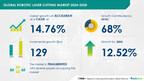
NEW YORK, Aug. 26, 2024 /PRNewswire/ — The global robotic laser cutting market size is estimated to grow by USD 129 million from 2024-2028, according to Technavio. The market is estimated to grow at a CAGR of 14.76% during the forecast period. Increased productivity with improved laser technology is driving market growth, with a trend towards IoT and industry 4.0.However, lower least count of accuracy of robotic laser cutting poses a challenge. Key market players include ABB Ltd., AMADA Co. Ltd., Amdoit Technologies Pvt. Ltd, BLM S.P.A., Chutian Laser, Daihen Corp., DIVINE TECHNO ENGINEERS, FANUC Corp., HGLaser Engineering Co. Ltd., Jenoptik AG, KUKA AG, Laser Photonics, MIDEA Group Co. Ltd., Precitec GmbH and Co. KG, Productive Robotics Inc., Shape Process Automation, SHFULAI, Spark Robotic, Staubli International AG, Suresh Indu Lasers Pvt Ltd., VP Synergic Weld Solutions Pvt Ltd., and Yaskawa Electric Corp..
Get a detailed analysis on regions, market segments, customer landscape, and companies- View the snapshot of this report
Robotic Laser Cutting Market Scope
Report Coverage
Details
Base year
2023
Historic period
2018 – 2022
Forecast period
2024-2028
Growth momentum & CAGR
Accelerate at a CAGR of 14.76%
Market growth 2024-2028
USD 129 million
Market structure
Fragmented
YoY growth 2022-2023 (%)
12.52
Regional analysis
APAC, Europe, North America, South America, and Middle East and Africa
Performing market contribution
APAC at 68%
Key countries
China, Japan, US, South Korea, and Germany
Key companies profiled
ABB Ltd., AMADA Co. Ltd., Amdoit Technologies Pvt. Ltd, BLM S.P.A., Chutian Laser, Daihen Corp., DIVINE TECHNO ENGINEERS, FANUC Corp., HGLaser Engineering Co. Ltd., Jenoptik AG, KUKA AG, Laser Photonics, MIDEA Group Co. Ltd., Precitec GmbH and Co. KG, Productive Robotics Inc., Shape Process Automation, SHFULAI, Spark Robotic, Staubli International AG, Suresh Indu Lasers Pvt Ltd., VP Synergic Weld Solutions Pvt Ltd., and Yaskawa Electric Corp.
Market Driver
The integration of IoT and Industry 4.0 technologies is a significant trend in the global robotic laser cutting market. These innovations enable seamless connectivity, data exchange, and intelligent decision-making, improving system efficiency, flexibility, and performance. Smart sensors and monitoring devices in robotic laser cutting equipment collect real-time data on temperature, vibration, and energy consumption. Predictive maintenance algorithms use this data to anticipate and address potential issues, reducing downtime and increasing system uptime. IoT-enabled systems can link to larger manufacturing networks, facilitating dynamic production scheduling, adaptive process optimization, and real-time decision-making. Data analytics and artificial intelligence derive actionable insights from performance data and production metrics, optimizing cutting parameters and improving process efficiency and product quality. The convergence of IoT, Industry 4.0, and robotic laser cutting technology is driving the growth of the global market, promising a new era of smart, connected manufacturing.
The robotic laser cutting market is experiencing significant growth in various industries, including fabrication and energy. Robotic laser systems are revolutionizing metal fabrication by providing precision cutting applications for aluminum, composites, and other lightweight materials. This technology is also making strides in the energy industry for fuel efficiency and emissions reduction. Improved laser technology, such as YAG cutting machines, is enabling the processing of both metal and non-metal materials. Key trends include drilling holes for semiconductors, endoscopy, and automotive components like body panels, door modules, hoods, and fuel tanks. Aerospace and defense are also adopting this cutting-edge technology for manufacturing complex parts. Innovation hubs and research institutions continue to drive technical achievements through the use of infrared laser beams, mirrors, nozzles, and advanced optics. The future of robotic laser cutting lies in automation and precision, making it an essential tool for businesses seeking to stay competitive.
Explore a 360° Analysis of the Market: Unveil the Impact of AI. For complete insights- Request Sample!
Market Challenges
The robotic laser cutting market offers significant flexibility for various industries, but faces a challenge from five-axis laser cutting machines in terms of accuracy. Five-axis machines have linear axes for the first four and rotational axes for the last two. This design reduces positional errors in the Z-direction, enhancing precision. In contrast, robotic arms with six axes have an articulated design, where deviations from the first axis accumulate, affecting end effector (EOAT) precision. A historical error of +-5 mm at the EOAT has been reduced to the least count of +-0.05 mm due to advancements in control modules and software. However, this accuracy lags behind the +-0.01 mm least count in five-axis laser cutting machines. Although improvements in control technology are expected to address this issue during the forecast period, it remains a significant hurdle for the global robotic laser cutting market.The Robotic Laser Cutting Market is experiencing significant growth due to the increasing demand for automation in various industries. Precision cutting applications, particularly in automotive and aerospace sectors, are driving this trend. Improved laser technology, such as YAG Cutting Machines and high-power lasers, enables the processing of metal and non-metal materials with micron-level accuracy. YAG Cutting Machines and CO2 lasers are popular choices for metal processing operations, allowing for the production of automotive components, body panels, door modules, hoods, and fuel tanks. In the non-metal sector, laser cutting is used for drilling holes in various materials, including carbon, for endoscopy equipment and consumer electronics. Robotics, artificial intelligence (AI), and machine learning are essential components of modern laser cutting systems. Industrial robots, robot controllers, robotic arms, and material positioners ensure robust structure and precise operational accuracy. The aviation industry and metal processing sector are major consumers of high-power lasers, while rare earth elements are crucial for the production of YAG Cutting Machines. The automotive segment is a significant market for laser cutting due to its versatility and ability to process various materials efficiently. Kitchenware and electronic components are also common applications, with laser cutting offering advantages in terms of operational efficiency and cost savings.
For more insights on driver and challenges – Request a sample report!
Segment Overview
This robotic laser cutting market report extensively covers market segmentation by
End-user 1.1 Automotive Industry1.2 Metal Industry1.3 Aerospace Industry1.4 OthersType 2.1 CO2 Laser Cutting Machine2.2 Fiber Laser Cutting Machine2.3 YAG Cutting MachineGeography 3.1 APAC3.2 Europe3.3 North America3.4 South America3.5 Middle East and Africa
1.1 Automotive Industry- The automotive industry is experiencing significant shifts in production processes, with labor-intensive tasks becoming increasingly burdensome for human workers. As automotive companies’ profit margins rise, there is a growing focus on optimizing facilities and enhancing production through automation. With increasing labor costs in major automotive markets like Japan, Europe, and the US, automakers are turning to automation. Robotic laser cutting is a key technology in this regard, enabling the mass-production of complex vehicle body components with high precision and efficiency. This technology is particularly valuable for cutting ultra-high tensile steel sheets, which have become increasingly popular due to their high strength and ability to reduce vehicle weight and improve fuel mileage. Additionally, robotic laser cutting offers flexibility in handling hydroformed parts, making it an attractive solution for automotive manufacturers. The technology is used for cutting various components, including edges, door panels, interior panels, and airbags, and its high-speed capabilities contribute to cost and time savings. These factors are expected to fuel the growth of the robotic laser cutting market in the automotive industry during the forecast period.
For more information on market segmentation with geographical analysis including forecast (2024-2028) and historic data (2017-2021) – Download a Sample Report
Research Analysis
The Robotic Laser Cutting market is experiencing significant growth due to the increasing demand for automation in various industries. Improved laser technology has enabled the use of YAG cutting machines for micron-level precision and accuracy in cutting a wide range of materials. Industrial robots, robot controllers, robotic arms, and material positioners are essential components of robotic laser cutting systems, ensuring versatility and sturdy construction for continuous operation. These systems offer numerous advantages, including increased productivity, reduced labor costs, and improved product quality. With the ability to cut various materials, including metals, plastics, and composites, robotic laser cutting is an indispensable technology for modern manufacturing processes.
Market Research Overview
The robotic laser cutting market is experiencing significant growth due to the increasing demand for automation in various industries. Precision cutting applications in metal and non-metal materials have become essential in sectors like automotive, aerospace and defense, and fabrication. Improved laser technology, such as YAG Cutting Machines and high-power lasers, enables processing of metals and rare earth elements with micron-level accuracy. Robotic systems, including industrial robots, robot controllers, robotic arms, and material positioners, are integral to these operations. YAG Cutting Machines and CO2 lasers are popular choices for metal processing operations, while carbon and composites are processed using robotic laser systems. Drilling holes, endoscopy, and fabrication of automotive components, body panels, hoods, fuel tanks, and aerospace parts are common applications. The aviation industry and energy sector also benefit from the sturdy construction and precise operational accuracy of these systems. Robotic laser cutting offers versatility and fuel efficiency, reducing emissions and increasing operational efficiency. Innovation hubs and research institutions continue to push the boundaries of this cutting-edge technology, incorporating artificial intelligence (AI) and machine learning into robotic laser systems. Applications extend to industries like milling, water jet cutting, plasma cutting, and processing lightweight materials such as aluminum and composites. Semiconductors and consumer electronics also utilize laser cutting for their intricate components.
Table of Contents:
1 Executive Summary
2 Market Landscape
3 Market Sizing
4 Historic Market Size
5 Five Forces Analysis
6 Market Segmentation
End-userAutomotive IndustryMetal IndustryAerospace IndustryOthersTypeCO2 Laser Cutting MachineFiber Laser Cutting MachineYAG Cutting MachineGeographyAPACEuropeNorth AmericaSouth AmericaMiddle East And Africa
7 Customer Landscape
8 Geographic Landscape
9 Drivers, Challenges, and Trends
10 Company Landscape
11 Company Analysis
12 Appendix
About Technavio
Technavio is a leading global technology research and advisory company. Their research and analysis focuses on emerging market trends and provides actionable insights to help businesses identify market opportunities and develop effective strategies to optimize their market positions.
With over 500 specialized analysts, Technavio’s report library consists of more than 17,000 reports and counting, covering 800 technologies, spanning across 50 countries. Their client base consists of enterprises of all sizes, including more than 100 Fortune 500 companies. This growing client base relies on Technavio’s comprehensive coverage, extensive research, and actionable market insights to identify opportunities in existing and potential markets and assess their competitive positions within changing market scenarios.
Contacts
Technavio Research
Jesse Maida
Media & Marketing Executive
US: +1 844 364 1100
UK: +44 203 893 3200
Email: media@technavio.com
Website: www.technavio.com/
View original content to download multimedia:https://www.prnewswire.com/news-releases/robotic-laser-cutting-market-to-grow-by-usd-129-million-2024-2028-driven-by-enhanced-laser-tech-and-increased-productivity-ai-powered-market-evolution-report-by-technavio-302230448.html
SOURCE Technavio








 Technology5 days ago
 Technology4 days ago
 Technology5 days ago
 Coin Market4 days ago

 Technology5 days ago
 Technology5 days ago
 Technology4 days ago