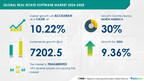
NEW YORK, Aug. 27, 2024 /PRNewswire/ — Report on How AI is Driving Market Transformation- The global real estate software market size is estimated to grow by USD 7.20 billion from 2024-2028, according to Technavio. The market is estimated to grow at a CAGR of 10.22% during the forecast period. Growing middle-class population is driving market growth, with a trend towards use of blockchain technology in real estate management software. However, threat of open-source real estate management software poses a challenge. Key market players include Altus Group Ltd., AppFolio Inc., Autodesk Inc., Bentley Systems Inc., CDK Global Inc., CoStar Group Inc., CREATIO EMEA Ltd., Dassault Systemes SE, Fiserv Inc., Fortive Corp., IFCA MSC Berhad, International Business Machines Corp., LanTrax Inc., MRI Software LLC, Oracle Corp., Planon Shared Services BV, RealPage Inc., SAP SE, Trimble Inc., and Yardi Systems Inc..
Get a detailed analysis on regions, market segments, customer landscape, and companies – Click for the snapshot of this report
Forecast period
2024-2028
Base Year
2023
Historic Data
2018 – 2022
Segment Covered
Deployment (Cloud-based and On-premises), Application (Residential and Commercial), and Geography (North America, Europe, APAC, South America, and Middle East and Africa)
Region Covered
North America, Europe, APAC, South America, and Middle East and Africa
Key companies profiled
Altus Group Ltd., AppFolio Inc., Autodesk Inc., Bentley Systems Inc., CDK Global Inc., CoStar Group Inc., CREATIO EMEA Ltd., Dassault Systemes SE, Fiserv Inc., Fortive Corp., IFCA MSC Berhad, International Business Machines Corp., LanTrax Inc., MRI Software LLC, Oracle Corp., Planon Shared Services BV, RealPage Inc., SAP SE, Trimble Inc., and Yardi Systems Inc.
Key Market Trends Fueling Growth
The global real estate software market is witnessing significant advancements, with blockchain technology emerging as a potential game-changer. This technology offers transparency, security, and efficiency by encrypting every record and making ledgers impenetrable to hackers. Transactions are irreversible, reducing fraud and transaction duplication. Blockchain also enables prompt and secure payments, even outside business hours, and eliminates the need for intermediaries. However, regulatory compliance and data transfer from authorities to general ledgers pose challenges. Lantmateriet, Sweden’s mapping, cadastral, and land registration authority, is leading the way with a pilot project for land registration using blockchain. The advantages of blockchain in real estate transactions are expected to drive a shift from traditional methods, contributing to market growth.
The Real Estate Software Market is thriving with trends that streamline transactions for sellers and buyers. Transactions are managed efficiently with appointment scheduling, reminders, and property management components. Building sites and housing initiatives benefit from on-premise and cloud-based access on mobile devices. Real estate executives oversee the real estate lifecycle with software technologies like artificial intelligence and machine learning. Property management, real estate accounting, lease administrators, and transaction managers are essential components. Cloud-based solutions offer easy access to customer data, smart solutions, and data management strategies. Sensitive data protection is crucial, with virtualization, virtual reality, and user engagement enhancing the customer experience. Social media and online advertising boost marketing efforts, while websites provide a central hub for information. Construction activities are optimized with software tools, and virtual reality offers immersive property tours. Overall, the Real Estate Software Market is transforming the industry with innovative solutions.
Discover a Comprehensive 360° Market Analysis: Understand the Impact of AI. For detailed information- Request Sample!
Market Challenges
The global real estate software market is experiencing significant competition from open-source real estate management software and pirated software. Open-source software, which is freely available on the Internet, offers cost benefits and scalability to end-users. Popular options include EspoCRM, Vtiger CRM, and Bitrix CRM. Users appreciate the transparency of open-source software, as they have access to the source code, enabling them to modify and eliminate defects before implementation. However, the market also faces a threat from pirated software, particularly in developing and underdeveloped economies where purchasing power is lower. Vendors in these regions often opt for pirated versions of software due to the lack of stringent regulatory laws. This results in a loss of sales for real estate software developers, posing a challenge to the market’s growth during the forecast period.The Real Estate Software Market is experiencing significant growth as the industry embraces digital applications to streamline operations and enhance workplace experience. Challenges such as workflow automation, sales and marketing, finance, project management, and data privacy regulations require advanced solutions. Blockchain technology and smart contracts offer secure, transparent, and efficient ways to handle sales deals, inspections, and financial data. Online platforms facilitate communication between real estate agents, brokers, investors, agencies, property managers, architects, and engineers. Construction, renting, and managing buildings, structures, utility systems, roads, and lands also benefit from these digital tools. However, cyber security threats and cybercrimes pose risks to data privacy and financial information, necessitating robust cybersecurity measures. Real estate companies must adapt to these trends to remain competitive in the commercial and residential markets.
For more insights on driver and challenges – Download a Sample Report
Segment Overview
This real estate software market report extensively covers market segmentation by
Deployment 1.1 Cloud-based1.2 On-premisesApplication 2.1 Residential2.2 CommercialGeography 3.1 North America3.2 Europe3.3 APAC3.4 South America3.5 Middle East and Africa
1.1 Cloud-based- Cloud-based real estate software deployment offers several advantages to businesses, particularly small and medium-sized enterprises (SMEs) and startups. These benefits include low initial investments, quick implementation, easy accessibility, scalability, and cost-effectiveness. Cloud-based deployment eliminates the need for purchasing servers and allows buyers to subscribe to the software on a monthly or annual basis. The infrastructure is already in place, and electronic devices are sufficient for access. Post-implementation, buyers can easily switch to different providers, reducing the need for extensive trials. IBM’s TRIRIGA and Bentley Systems are dominant vendors in cloud-based real estate software management. Remotely located servers in a cloud-based deployment help increase scalability, allowing buyers to opt for more bandwidth and storage space as needed. Construction companies can change subscriptions according to ongoing projects. However, concerns over security, limited customization, and the requirement of the internet hinder adoption. Real estate companies manage confidential financial data, increasing apprehension over data security. Despite these challenges, the advantages of cloud-based real estate software, such as dynamic space planning using AI-driven insights, will drive demand during the forecast period.
For more information on market segmentation with geographical analysis including forecast (2024-2028) and historic data (2018 – 2022) – Download a Sample Report
Research Analysis
The Real Estate Software Market is witnessing significant growth due to the increasing adoption of advanced technologies in construction activities. Smart solutions are transforming the way real estate professionals manage customer data, utility systems, and building structures. Software technologies, including cloud, artificial intelligence, social media, online advertising, and digital applications, are revolutionizing the real estate industry. Construction projects, renting properties, and housing initiatives are all benefiting from these innovations. Real estate agents can manage transactions, appointments, and reminders more efficiently, while clients and sellers have access to valuable information and tools to make informed decisions. Building sites and utility systems can be monitored in real-time, ensuring optimal performance and reducing maintenance costs. Data management is a critical component of real estate software, enabling real estate professionals to analyze trends and gain insights into market conditions. With the integration of artificial intelligence and machine learning, software can provide personalized recommendations and automate routine tasks, freeing up time for more strategic activities. Overall, the real estate software market is poised for continued growth as technology continues to transform the industry.
Market Research Overview
The Real Estate Software Market is witnessing significant growth due to the increasing adoption of digital applications in the real estate industry. Construction activities are being streamlined with smart solutions that leverage software technologies such as cloud, artificial intelligence, and machine learning. Customer data is being effectively managed and protected with advanced data management strategies and sensitive data protection measures. Virtualization, virtual reality, and automation are transforming the workplace experience for real estate professionals. Real estate sector players are embracing online platforms for sales and marketing, transactions, and project management. Finance and accounting functions are being automated with contract software, dashboard solutions, and financial data management tools. Building management, property management, and real estate companies are leveraging blockchain technology, smart contracts, and automation to enhance efficiency and security. Social media and online advertising are essential tools for real estate agents, brokers, investors, agencies, property managers, and commercial centers to reach clients and sell properties. Data privacy regulations are driving the need for robust cybersecurity measures to protect sensitive information from cybercrimes and cybersecurity threats. The real estate industry is undergoing a digital transformation, with digital applications being used for residential and commercial buildings, utility systems, roads, and land management. Real estate executives, lease administrators, transaction managers, and real estate lifecycle managers are using mobile devices and cloud-based access to manage appointments, reminders, and building sites. Housing initiatives and government agencies are also adopting digital solutions to streamline their operations. Overall, the Real Estate Software Market offers a wide range of components, including project management software, real estate accounting, and lease administration tools, to cater to the diverse needs of the real estate sector.
Table of Contents:
1 Executive Summary
2 Market Landscape
3 Market Sizing
4 Historic Market Size
5 Five Forces Analysis
6 Market Segmentation
DeploymentCloud-basedOn-premisesApplicationResidentialCommercialGeographyNorth AmericaEuropeAPACSouth AmericaMiddle East And Africa
7 Customer Landscape
8 Geographic Landscape
9 Drivers, Challenges, and Trends
10 Company Landscape
11 Company Analysis
12 Appendix
About Technavio
Technavio is a leading global technology research and advisory company. Their research and analysis focuses on emerging market trends and provides actionable insights to help businesses identify market opportunities and develop effective strategies to optimize their market positions.
With over 500 specialized analysts, Technavio’s report library consists of more than 17,000 reports and counting, covering 800 technologies, spanning across 50 countries. Their client base consists of enterprises of all sizes, including more than 100 Fortune 500 companies. This growing client base relies on Technavio’s comprehensive coverage, extensive research, and actionable market insights to identify opportunities in existing and potential markets and assess their competitive positions within changing market scenarios.
Contacts
Technavio Research
Jesse Maida
Media & Marketing Executive
US: +1 844 364 1100
UK: +44 203 893 3200
Email: media@technavio.com
Website: www.technavio.com/
View original content to download multimedia:https://www.prnewswire.com/news-releases/real-estate-software-market-to-expand-by-usd-7-2-billion-from-2024-2028–driven-by-growing-middle-class-population-ai-powered-market-evolution–report-by-technavio-302231535.html
SOURCE Technavio








 Technology5 days ago
 Technology5 days ago
 Coin Market5 days ago
 Technology5 days ago

 Technology5 days ago
 Technology5 days ago
 Technology5 days ago