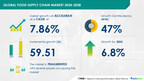
NEW YORK, Sept. 11, 2024 /PRNewswire/ — Report on how AI is redefining market landscape- The global food supply chain market size is estimated to grow by USD 59.51 billion from 2024-2028, according to Technavio. The market is estimated to grow at a CAGR of 7.86% during the forecast period. Integration of blockchain in food supply chain is driving market growth, with a trend towards increasing mergers and acquisitions among market vendors. However, data security and cyber threats associated with food supply chain management poses a challenge. Key market players include Archer Daniels Midland Co., AWL India Pvt. Ltd., Best Food Logistics, Burris Logistics Co., C H Robinson Worldwide Inc., Cargill Inc., DACHSER SE, DB Schenker, Eight Point Distributors, Gordon Food Service Inc., International Business Machines Corp., Lineage Inc, Nishimoto Co. Ltd., Olam Group Ltd., Oracle Corp., Radhakrishna Foodland Pvt Ltd., SAP SE, Schneider National Inc., SITRA, Sysco Corp., VersaCold Logistics Services, WayCool, and YUSEN LOGISTICS CO. LTD..
Key insights into market evolution with AI-powered analysis. Explore trends, segmentation, and growth drivers- View the snapshot of this report
Food Supply Chain Market Scope
Report Coverage
Details
Base year
2023
Historic period
2018 – 2022
Forecast period
2024-2028
Growth momentum & CAGR
Accelerate at a CAGR of 7.86%
Market growth 2024-2028
USD 59.51 billion
Market structure
Fragmented
YoY growth 2022-2023 (%)
6.8
Regional analysis
APAC, North America, Europe, South America, and Middle East and Africa
Performing market contribution
APAC at 47%
Key countries
US, Germany, Canada, China, France, India, Japan, UK, Italy, and South Korea
Key companies profiled
Archer Daniels Midland Co., AWL India Pvt. Ltd., Best Food Logistics, Burris Logistics Co., C H Robinson Worldwide Inc., Cargill Inc., DACHSER SE, DB Schenker, Eight Point Distributors, Gordon Food Service Inc., International Business Machines Corp., Lineage Inc, Nishimoto Co. Ltd., Olam Group Ltd., Oracle Corp., Radhakrishna Foodland Pvt Ltd., SAP SE, Schneider National Inc., SITRA, Sysco Corp., VersaCold Logistics Services, WayCool, and YUSEN LOGISTICS CO. LTD.
Market Driver
Mergers and acquisitions among food supply chain market vendors are significantly driving market growth. Companies benefit from these alliances by combining complementary strengths, sharing resources, and creating more efficient and resilient supply networks. These collaborations lead to improved logistics, enhanced traceability, and the adoption of advanced technologies like blockchain and IoT sensors. For instance, Dachser SE’s acquisition of Frigoscandia AB in February 2024 expands DACHSER’s food logistics network to the Nordic countries. Such partnerships help reduce costs, minimize waste, ensure food safety and quality, and enable better demand forecasting and inventory management. As the food industry navigates challenges such as climate change and evolving consumer preferences, strategic partnerships are crucial for adapting to market demands and ensuring long-term sustainability. Therefore, mergers and acquisitions will continue to fuel the growth of the global food supply chain market during the forecast period.
The food supply chain market is experiencing significant trends in fresh and perishable foods. Temperature-controlled logistics, such as refrigerated transport technologies and cold chain management, are crucial for ensuring the quality and safety of these items. E-commerce platforms are driving growth in food trade, with safety regulations and consumer preferences prioritizing temperature-controlled logistics. Artificial intelligence and the Internet of Things are improving inventory management and traceability. Blockchain technologies offer transparency and security in food supply chains. Meats, dairy, fruits, and vegetables are major sectors, with sustainability and customized logistics solutions key considerations. Economic growth and trade liberalization are increasing demand for multi-modal transportation. Food safety, nutrition, and health are top priorities, with transportation, warehousing, and agriculture all playing important roles. Food retailers must adapt to these trends, implementing cold chain capabilities, logistics infrastructure, and supply chain integration to meet consumer needs and regulations. Environmental concerns and food waste reduction are also important considerations, with processing stage optimization and online platforms facilitating payment transactions and reducing food loss.
Request Sample of our comprehensive report now to stay ahead in the AI-driven market evolution!
Market Challenges
The food supply chain market is experiencing significant digitization and interconnection, leading to increased vulnerability to cybersecurity risks. Data such as customer information, logistics details, and financial transactions are prime targets for cybercriminals. A successful breach disrupts supply chains, compromises food safety, causes financial losses, and damages brand reputation. Interconnected networks mean a weakness in one area can compromise the entire system. IoT devices and sensors, while beneficial, add potential entry points. Compliance with regulations like GDPR adds complexity and cost. Smaller food businesses face challenges in investing in cybersecurity and staying vigilant. These concerns may hinder the adoption of advanced supply chain solutions, posing significant challenges to the food supply chain market’s growth.
The Food Supply Chain market faces various challenges in providing Fruits, Vegetables, and Processed foods to consumers sustainably. Customized logistics solutions and cold chain capabilities are crucial for maintaining product quality and freshness. Logistics infrastructure and supply chain integration are essential for economic growth, but environmental concerns require sustainable practices. Nutrition and food safety regulations demand refrigerated transport technologies, inventory management, and traceability. Trade liberalization and multi-modal transportation enable global access, but health and safety regulations must be met. Precision farming and agri-tech startups improve agriculture, while data management ensures product traceability and consumer trust. Food waste and loss occur at the processing stage, affecting sustainability and profitability. Food retailers require standards, funding, and online platforms for payment transactions. Contamination sources and health risks necessitate strict adherence to health and safety regulations. Positioning systems, radio frequency identification, and warehouse management systems streamline operations. Sustainability, nutrition, and food safety are key concerns, requiring continuous innovation in the Food Supply Chain market.
Discover how AI is revolutionizing market trends- Get your access now!
Segment Overview
This food supply chain market report extensively covers market segmentation by
Product Type1.1 Packaged food1.2 Fresh foodEnd-user 2.1 Households2.2 Commercial2.3 IndustrialGeography 3.1 APAC3.2 North America3.3 Europe3.4 South America3.5 Middle East and Africa
1.1 Packaged food- The packaged food market, encompassing processed foods, snacks, beverages, and ready-to-eat meals, is witnessing a notable increase in demand. This trend is driven by shifting consumer lifestyles, urbanization, and the preference for convenient, long-lasting food solutions. The intricate packaged food supply chain involves sourcing raw materials, manufacturing, packaging, distribution, and retail placement. Food safety and quality control are essential, necessitating advanced tracking and tracing systems. Vendors invest in automation and smart packaging to enhance shelf life and product integrity. Sustainability is a priority, with efforts to minimize packaging waste and optimize transportation routes. The COVID-19 pandemic has intensified demand, necessitating supply chain adaptations for resilience. As consumer preferences evolve towards healthier and more diverse options, the packaged food supply chain continues to innovate while maintaining efficiency and cost-effectiveness, fueling the market’s growth during the forecast period.
Download a Sample of our comprehensive report today to discover how AI-driven innovations are reshaping competitive dynamics
Research Analysis
The food supply chain market encompasses the production, transportation, warehousing, and trade of fresh and perishable foods, including meats, dairy, fruits, vegetables, and processed foods. Temperature-controlled logistics plays a crucial role in ensuring the quality and safety of these products. E-commerce platforms are transforming food trade by enabling consumers to purchase fresh produce and other perishable items online. Safety regulations are a top priority in the food supply chain, with stringent guidelines for handling, storage, and transportation of food items. Technology is revolutionizing the industry with the use of artificial intelligence, Internet of Things, and blockchain technologies for traceability and efficiency. Transportation and cold chain management are essential components of the food supply chain, ensuring that perishable items are kept at the correct temperature during transportation and storage. Positioning systems, Radio Frequency Identification (RFID), and Warehouse Management Systems (WMS) are used to optimize logistics and improve inventory management. Agriculture plays a significant role in the food supply chain, with farmers using technology to optimize crop yields and reduce waste. Consumer preferences for healthier, locally sourced foods are driving innovation in the industry, with a focus on sustainable farming practices and minimizing the carbon footprint of food production and transportation.
Market Research Overview
The Food Supply Chain market encompasses the production, transportation, warehousing, and retail of fresh and perishable foods. Temperature-controlled logistics plays a crucial role in ensuring the quality and safety of these products. E-commerce platforms are transforming food trade by offering consumers convenient access to a wide range of fresh and processed foods. Safety regulations are a top priority in the food supply chain, with a focus on food safety, traceability, and product authenticity. Consumer preferences for healthier, sustainable, and customized food options are driving innovation in the sector. Advancements in technology, such as artificial intelligence, the Internet of Things, and blockchain technologies, are revolutionizing food supply chain operations. These technologies enable real-time inventory management, cold chain capabilities, and supply chain integration. Meats, dairy, fruits, vegetables, and processed foods are all integral parts of the food supply chain. Sustainability and economic growth are key considerations, with a focus on reducing food waste and loss. Agriculture is a critical component of the food supply chain, with precision farming and data management playing increasingly important roles. Logistics infrastructure, multi-modal transportation, and trade liberalization are also essential for ensuring a reliable and efficient food supply chain. Food retailers and standards organizations play a vital role in maintaining consumer trust by ensuring food safety and product traceability. Funding and agri-tech startups are driving innovation in areas such as refrigerated transport technologies, warehouse management systems, and online platforms for payment transactions. Health and safety regulations, positioning systems, radio frequency identification, and warehouse management systems are all critical components of the food supply chain. Contamination sources, such as pests and pathogens, must be carefully managed to maintain food safety. Provenance and nutrition are becoming increasingly important to consumers, with a growing demand for transparency and information about the origin and composition of their food. The food supply chain must adapt to meet these changing consumer preferences while also addressing economic, environmental, and sustainability concerns.
Table of Contents:
1 Executive Summary
2 Market Landscape
3 Market Sizing
4 Historic Market Size
5 Five Forces Analysis
6 Market Segmentation
Product TypePackaged FoodFresh FoodEnd-userHouseholdsCommercialIndustrialGeographyAPACNorth AmericaEuropeSouth AmericaMiddle East And Africa
7 Customer Landscape
8 Geographic Landscape
9 Drivers, Challenges, and Trends
10 Company Landscape
11 Company Analysis
12 Appendix
About Technavio
Technavio is a leading global technology research and advisory company. Their research and analysis focuses on emerging market trends and provides actionable insights to help businesses identify market opportunities and develop effective strategies to optimize their market positions.
With over 500 specialized analysts, Technavio’s report library consists of more than 17,000 reports and counting, covering 800 technologies, spanning across 50 countries. Their client base consists of enterprises of all sizes, including more than 100 Fortune 500 companies. This growing client base relies on Technavio’s comprehensive coverage, extensive research, and actionable market insights to identify opportunities in existing and potential markets and assess their competitive positions within changing market scenarios.
Contacts
Technavio Research
Jesse Maida
Media & Marketing Executive
US: +1 844 364 1100
UK: +44 203 893 3200
Email: media@technavio.com
Website: www.technavio.com/
View original content to download multimedia:https://www.prnewswire.com/news-releases/food-supply-chain-market-to-grow-by-usd-59-51-billion-from-2024-2028–driven-by-blockchain-integration-and-ais-impact-on-market-trends–technavio-report-302244014.html
SOURCE Technavio










 Technology4 days ago

 Coin Market4 days ago

 Coin Market4 days ago

 Coin Market4 days ago

 Coin Market4 days ago

 Technology4 days ago

 Coin Market5 days ago

 Technology5 days ago