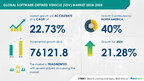
NEW YORK, Sept. 12, 2024 /PRNewswire/ — Report with market evolution powered by AI- The global software-defined vehicle (SDV) market size is estimated to grow by USD 76.12 billion from 2024-2028, according to Technavio. The market is estimated to grow at a CAGR of 22.73% during the forecast period. Increasing demand for autonomous vehicles is driving market growth, with a trend towards integration of advanced safety technologies in luxury cars . However, decline in automotive production due to global shortage of semiconductor chips poses a challenge. Key market players include Arm Ltd., Arorian Technologies GmbH, BlackBerry Ltd., Bluekei Solutions Pvt.Ltd., Continental AG, ETAS GmbH, Expleo Group SAS, Keysight Technologies Inc., Larsen and Toubro Ltd., Li Auto Inc., MulticoreWare Inc., NCC Group Plc, NIO Ltd., NTT DATA Corp., NXP Semiconductors NV, Real-Time Innovations Inc., Rivian Automotive LLC, Robert Bosch GmbH, Samsung Electronics Co. Ltd., Siemens AG, TE Connectivity Ltd., Tesla Inc., u blox AG, Vector Informatik GmbH, XPeng Inc., and Zhejiang Geely Holding Group Co. Ltd..
Key insights into market evolution with AI-powered analysis. Explore trends, segmentation, and growth drivers- View the snapshot of this report
Software-Defined Vehicle (Sdv) Market Scope
Report Coverage
Details
Base year
2023
Historic period
2018 – 2022
Forecast period
2024-2028
Growth momentum & CAGR
Accelerate at a CAGR of 22.73%
Market growth 2024-2028
USD 76121.8 million
Market structure
Fragmented
YoY growth 2022-2023 (%)
21.28
Regional analysis
North America, Europe, APAC, South America, and Middle East and Africa
Performing market contribution
North America at 40%
Key countries
US, China, Germany, Canada, and UK
Key companies profiled
Arm Ltd., Arorian Technologies GmbH, BlackBerry Ltd., Bluekei Solutions Pvt.Ltd., Continental AG, ETAS GmbH, Expleo Group SAS, Keysight Technologies Inc., Larsen and Toubro Ltd., Li Auto Inc., MulticoreWare Inc., NCC Group Plc, NIO Ltd., NTT DATA Corp., NXP Semiconductors NV, Real-Time Innovations Inc., Rivian Automotive LLC, Robert Bosch GmbH, Samsung Electronics Co. Ltd., Siemens AG, TE Connectivity Ltd., Tesla Inc., u blox AG, Vector Informatik GmbH, XPeng Inc., and Zhejiang Geely Holding Group Co. Ltd.
Market Driver
The automotive industry is experiencing a shift towards safer and more reliable vehicles, particularly in the luxury segment. With growing concerns over road safety and increasing customer demand for advanced safety features, automotive Original Equipment Manufacturers (OEMs) are incorporating technologies such as emergency brake assist, lane departure warning systems, collision mitigation warning, blind-spot detection, and automatic emergency braking systems. These safety technologies have higher penetration rates in sedans than in SUVs, but are now being introduced on a larger scale in crossovers. Customers’ preferences for safety systems, coupled with safety awareness and ratings by automotive bodies like the New Car Assessment Program (NCAP), have driven the focus on safety features. For instance, the Australasian New Car Assessment Program (ANCAP) conducts safety tests, including frontal crashworthiness and side-impact tests, to determine a vehicle’s safety quotient. These ratings significantly influence customers’ purchasing decisions. In response, automakers are integrating Software-Defined Vehicles (SDV) to enhance safety and meet customer demands. SDVs enable the integration of advanced safety systems and connectivity features, providing real-time data processing and improved vehicle performance. This shift towards SDVs is expected to positively impact the luxury vehicle market during the forecast period.
The Software-Defined Vehicle (SDV) market is experiencing significant growth, particularly in the area of Hybrid Electric Vehicles (HEVs). Key trends include the use of Hybrid powertrains, Battery Management Systems, Electric Motor Control, Energy Regeneration, Human-Machine Interfaces (HMIs), and Cybersecurity. These innovations aim to improve vehicle performance, efficiency, and safety. SDVs also face challenges such as Safety and Environmental Regulations, Hardware configurations, Faults, and Recall campaigns. Logistical challenges arise from the need for Over-the-Air updates and Online fixes, which require Cybersecurity measures to prevent cyberattacks. The market is also seeing advancements in areas like Infotainment, Connectivity and Security, Autonomous Driving, Navigation, and V2X Communication. However, the complexity of these Software systems can lead to operational costs and potential risks from Remote Hacking. The future of the SDV market lies in balancing innovation with security and regulatory compliance.
Request Sample of our comprehensive report now to stay ahead in the AI-driven market evolution!
Market Challenges
The global semiconductor chip shortage is negatively impacting the automotive industry and, consequently, the growth of the software-defined vehicle (SDV) market. As vehicles become more reliant on advanced electronic systems and software-driven functionalities, the disrupted automobile manufacturing process due to the chip shortage has led to production delays and reduced output. Automakers are prioritizing critical vehicle components, causing delays in software development and integration investments. This bottleneck hinders the adoption of innovative software-driven technologies and stifles revenue opportunities for SDV vendors. The chip shortage has forced carmakers to idle production lines, resulting in reduced automotive production in various parts of the world. For instance, Ford Motor Co. And Renault have announced production reductions due to chip shortages. This production slowdown will hinder the growth of the global SDV market during the forecast period.The Software-Defined Vehicle (SDV) market is experiencing rapid growth as technologically advanced vehicles become the norm. OEMs and Tier 1 hardware providers collaborate to create safer, more connected vehicles. However, challenges persist. Safety protocols and encryption procedures are crucial for secure SDV platforms. Monetization through software-centric business models and continuous customer engagement are essential. Remote diagnostics, fleet management, and software updates are key features. Security patching and vehicle safety are top priorities, as interconnected systems increase vulnerabilities to cyber threats. Standardizing hardware and autonomous driving technology are critical to overcoming legacy OEMs’ resistance to software upgrades. SemiSDVs offer a middle ground, while cloud-native technologies and opensource platforms enable innovation. Driving assistance, connectivity, digitalization, and electrification are driving the market forward. NIO, Tesla, and other automotive manufacturers are leading the charge towards autonomous driving and electrification, using advanced technologies like sensor fusion and vehicle-to-everything (V2X) communication. The future of the SDV market is bright, but addressing cybersecurity concerns and ensuring standardization will be crucial for success.
Discover how AI is revolutionizing market trends- Get your access now!
Segment Overview
This software-defined vehicle (sdv) market report extensively covers market segmentation by
Type 1.1 Semi-SDV1.2 SDVVehicle Type2.1 Passenger cars2.2 Commercial vehiclesGeography 3.1 North America3.2 Europe3.3 APAC3.4 South America3.5 Middle East and Africa
1.1 Semi-SDV- The Software-Defined Vehicle (SDV) market is experiencing significant growth due to the increasing demand for customizable automobiles and the rapid advancement of technology. Semi-SDVs, a subset of SDVs, are gaining popularity as they allow users to manage and control underlying vehicle hardware and capabilities through software. Infotainment systems, sensors, diagnostics, navigation, and battery charging are just a few functions being simplified by SDV software. This software offers an economical solution for modifying vehicles to meet changing user needs, eliminating the need for costly hardware upgrades. The automotive industry’s focus on comfort and convenience has also driven the development of SDVs. With the competition increasing and sales growing in the global automotive market, the development timeline for innovative SDV technologies and their adoption among Original Equipment Manufacturers (OEMs) are decreasing. Additionally, the increasing dependency on automation technologies in vehicles necessitates improvements in safety and security. Semi-SDVs, which can be controlled both automatically and manually, are designed to meet these requirements while ensuring the driver remains ready to take control. This shift towards semi-SDVs is expected to positively impact the growth of the SDV market.
Download a Sample of our comprehensive report today to discover how AI-driven innovations are reshaping competitive dynamics
Research Analysis
Software-Defined Vehicles (SDVs) represent the future of the automotive industry, offering advanced features and capabilities through complex software systems. Unlike conventional vehicles with fixed hardware configurations, SDVs allow for over-the-air updates, online fixes, and continuous customer engagement. However, these vehicles also present unique challenges. Faults in software can lead to recall campaigns, and logistical challenges arise from the need for constant connectivity and remote diagnostics. Cyberattacks and cyber threats, including remote hacking, are significant concerns due to the interconnected nature of SDVs. Navigation, autonomous driving, and V2X communication are just a few of the advanced technologies enabled by SDVs. However, software development shortcomings, safety protocols, and encryption procedures must be addressed to ensure vehicle safety. Monetization of SDV platforms and a software-centric business model offer new opportunities for OEMs, Tier 1 hardware providers, and chip providers. Standardizing hardware and addressing cyber vulnerabilities are essential to the automotive life prolongation and the adoption of autonomous driving technology. Cloud-native technologies are also crucial for managing fleet operations, software updates, and security patching.
Market Research Overview
Software-Defined Vehicles (SDVs) represent the future of the automotive industry, offering advanced technologies and capabilities that go beyond conventional vehicles. Unlike traditional vehicles with fixed hardware configurations, SDVs allow for over-the-air updates and online fixes, reducing operational costs and improving vehicle safety. However, these complex software systems also present new challenges, such as cyberattacks and vulnerabilities. SDVs enable features like autonomous driving, navigation, and V2X communication through continuous software updates and security patching. The software-centric business model offers opportunities for monetization and customer engagement, while fleet management and remote diagnostics become more efficient. However, SDVs also face logistical challenges, including standardizing hardware and ensuring cybersecurity and safety protocols. OEMs, technologically advanced vehicle manufacturers, and Tier 1 hardware providers collaborate to address these challenges and create a seamless connected ecosystem. SDVs also include semi-SDVs, which offer a hybrid approach between hardware-centric and software-centric designs. The automotive industry’s digitalization and electrification trends further drive the adoption of SDVs, with electric mobility and hybrid powertrains becoming increasingly popular. Despite the benefits, SDVs also present new challenges, such as cyber threats and vulnerabilities, which require ongoing attention and innovation from the industry. The future of the SDV market lies in advanced technologies, autonomous driving, and the integration of cloud-native technologies and opensource platforms.
Table of Contents:
1 Executive Summary
2 Market Landscape
3 Market Sizing
4 Historic Market Size
5 Five Forces Analysis
6 Market Segmentation
TypeSemi-SDVSDVVehicle TypePassenger CarsCommercial VehiclesGeographyNorth AmericaEuropeAPACSouth AmericaMiddle East And Africa
7 Customer Landscape
8 Geographic Landscape
9 Drivers, Challenges, and Trends
10 Company Landscape
11 Company Analysis
12 Appendix
About Technavio
Technavio is a leading global technology research and advisory company. Their research and analysis focuses on emerging market trends and provides actionable insights to help businesses identify market opportunities and develop effective strategies to optimize their market positions.
With over 500 specialized analysts, Technavio’s report library consists of more than 17,000 reports and counting, covering 800 technologies, spanning across 50 countries. Their client base consists of enterprises of all sizes, including more than 100 Fortune 500 companies. This growing client base relies on Technavio’s comprehensive coverage, extensive research, and actionable market insights to identify opportunities in existing and potential markets and assess their competitive positions within changing market scenarios.
Contacts
Technavio Research
Jesse Maida
Media & Marketing Executive
US: +1 844 364 1100
UK: +44 203 893 3200
Email: media@technavio.com
Website: www.technavio.com/
View original content to download multimedia:https://www.prnewswire.com/news-releases/ai-revolutionizes-the-software-defined-vehicle-market-growth-of-usd-76-1-billion-driven-by-autonomous-vehicles-2024-2028–technavio-report-302246475.html
SOURCE Technavio









 Coin Market5 days ago
 Technology5 days ago
 Technology5 days ago
 Technology5 days ago
 Technology4 days ago

 Technology5 days ago