Connect with us

Technology

Road Safety Market to Grow by USD 1.80 Billion (2024-2028), Rise in Road Accidents Driving Growth, Report Highlights How AI is Redefining the Market – Technavio

Published

on

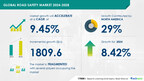
NEW YORK, Sept. 26, 2024 /PRNewswire/ — Report with market evolution powered by AI- The global road safety market size is estimated to grow by USD 1.80 billion from 2024-2028, according to Technavio. The market is estimated to grow at a CAGR of  9.45%  during the forecast period. Increase in number of road fatalities or accidents is driving market growth, with a trend towards adoption of connected vehicles and connected road infrastructure. However, lack of standardized and uniform technologies  poses a challenge. Key market players include Altumint, Belcons International doo, Clearview Intelligence Ltd., Conduent Inc., Cubic Corp., Dahua Technology Co. Ltd., IDEMIA France SAS, IEG America, Jenoptik AG, Kapsch TrafficCom AG, Laser Technology Inc., Motorola Solutions Inc., Sensys Gatso Group AB, Siemens AG, Stein Bildverarbeitungssysteme GmbH, SWARCO AG, Syntell Pty. Ltd, Teledyne Technologies Inc., and Verra Mobility Corp..

Key insights into market evolution with AI-powered analysis. Explore trends, segmentation, and growth drivers- View the snapshot of this report

Road Safety Market Scope

Report Coverage

Details

Base year

2023

Historic period

2018 – 2022

Forecast period

2024-2028

Growth momentum & CAGR

Accelerate at a CAGR of 9.45%

Market growth 2024-2028

USD 1809.6 million

Market structure

Fragmented

YoY growth 2022-2023 (%)

8.42

Regional analysis

North America, Europe, APAC, Middle East and Africa, and South America

Performing market contribution

North America at 29%

Key countries

US, China, UK, Germany, and Japan

Key companies profiled

Altumint, Belcons International doo, Clearview Intelligence Ltd., Conduent Inc., Cubic Corp., Dahua Technology Co. Ltd., IDEMIA France SAS, IEG America, Jenoptik AG, Kapsch TrafficCom AG, Laser Technology Inc., Motorola Solutions Inc., Sensys Gatso Group AB, Siemens AG, Stein Bildverarbeitungssysteme GmbH, SWARCO AG, Syntell Pty. Ltd, Teledyne Technologies Inc., and Verra Mobility Corp.

Market Driver

Connected vehicles and smart traffic lights are revolutionizing road safety through the Internet of Things (IoT). Vehicles can connect with mobile devices and be monitored and managed wirelessly. Smart traffic lights use cameras and radar sensors to detect real-time traffic flow and adjust signals accordingly, improving safety for vehicles and pedestrians. These systems are automated and linked to a main control room, where operators analyze camera footage to manage traffic patterns. The integration of connected vehicles and smart traffic lights will significantly drive the growth of the global road safety market. 

The Road Safety Market is experiencing significant growth due to increasing road traffic injuries and fatalities worldwide. Government agencies are prioritizing section enforcement and upgrading infrastructure to improve highway safety. Road safety products, such as incident detection systems and surveillance, play a crucial role in identifying and responding to traffic accidents. Smart cities and megacities are investing in security spending to enhance public safety and traffic mobility. Consulting and planning services are in high demand for implementing safety programs and initiatives. The threat landscape includes motorization and urbanization, making intelligent corridor and tag-based solutions essential for effective traffic management. Safety authorities collaborate with the National Safety Council and Land Transport Authority to address road accidents and improve health conditions. Upgrading road infrastructure and implementing advanced technologies are key trends in this market. 

Request Sample of our comprehensive report now to stay ahead in the AI-driven market evolution!

Market Challenges

The global road safety market faces challenges due to varying traffic regulations across countries. For instance, the US follows a left-driving rule, while European countries adhere to right-driving rules. These inconsistencies necessitate customized road safety solutions, hindering the development of standardized offerings. Additionally, many countries lack the financial resources to implement advanced road safety technologies fully. This resource constraint creates gaps in the adoption of road safety solutions, posing challenges to market growth during the forecast period.The road safety market is experiencing significant growth due to the increasing demand for advanced technologies to ensure transportation safety and mobility. Key challenges include capturing granular data on pedestrian, cyclist, and vehicle movement at intersections and capturing real-time images for ALPR/ANPR. Road safety solutions require integration of hardware components like cameras, radars, sensors, and software like Image-Processing, GIS, GPS, and Big Data. Communication and workflow protocols are essential for mass adoption, with a common protocol ensuring seamless data sharing between systems. Threats include social media misinformation and environmental impact. Road safety market offerings include smartphone applications, drones, virtual-reality simulators, and back-office systems for railroad crossing safety, red light enforcement, and speed enforcement. Data security is paramount, with solutions incorporating data encryption and access control. The market is expected to continue growing, driven by the need for road safety solutions that address road user behavior, road characteristics, operational environment, and road safety factors.

Discover how AI is revolutionizing market trends- Get your access now!

Segment Overview

This road safety market report extensively covers market segmentation by

Component 1.1 Solution1.2 ServicesGeography 2.1 North America2.2 Europe2.3 APAC2.4 Middle East and Africa2.5 South America

1.1 Solution-  The Road Safety Market is a significant business sector focusing on providing products and services to ensure safe travel on roads. This includes vehicle safety systems, infrastructure solutions, educational programs, and emergency response services. Companies in this market aim to reduce accidents and save lives through innovation and collaboration with governments and organizations. They offer advanced technologies like collision avoidance systems, road sensors, and traffic management software to enhance road safety. The market is expected to grow due to increasing vehicle sales, government regulations, and rising awareness about road safety.

Download a Sample of our comprehensive report today to discover how AI-driven innovations are reshaping competitive dynamics

Research Analysis

The Road Safety Market encompasses various solutions and services aimed at ensuring the safe transportation of goods and people on roads. In the current context, with the freight system playing a crucial role in the supply chain of essential goods, road safety has taken on renewed importance. Digital services, such as real-time traffic mobility information and advanced driver assistance systems, are transforming the transport sector, enhancing safety and efficiency. Road safety products, from highway safety barriers to vehicle safety systems, are essential for reducing road fatalities and ensuring the safety of transport operators and other road users. Safety authorities and traffic management systems work together to enforce regulations, manage congestion, and maintain optimal traffic flow, all contributing to the overall goal of enhancing road safety. The National Safety Council and other organizations play a vital role in advocating for road safety initiatives and raising awareness about best practices.

Market Research Overview

The road safety market encompasses various solutions and technologies aimed at enhancing transport safety in the freight system and ensuring the well-being of essential workers. Digital services play a crucial role, including traffic management solutions, transport demand management, and digitalization of business operations. Latest technologies such as computer vision, IoT sensors, artificial intelligence, and traffic management tools are employed to analyze granular data on pedestrian, cyclist, and vehicle movement. Road safety factors include road user behavior, road characteristics, and operational environment. Hardware components like cameras, radars, and sensors are integrated with communication protocols and back-office systems for mass adoption. Transportation safety solutions encompass mobility, environmental impact, and threat landscape considerations. Road safety data is collected and analyzed using technologies like ALPR/ANPR, incident detection systems, and surveillance. Government agencies and transportation operators collaborate on programs and initiatives to reduce road traffic injuries and fatalities. Road infrastructure upgrading and smart city development are key areas of investment, with spending on security and surveillance increasing in the face of evolving threats. Transport modes like railroad crossing safety, bus lanes, and speed enforcement are addressed through specialized solutions. Virtual-reality simulators, social media, and drones are also utilized in road safety efforts. Big Data analysis is integral to understanding road safety trends and optimizing road safety solutions.

Table of Contents:

1 Executive Summary
2 Market Landscape
3 Market Sizing
4 Historic Market Size
5 Five Forces Analysis
6 Market Segmentation

ComponentSolutionServicesGeographyNorth AmericaEuropeAPACMiddle East And AfricaSouth America

7 Customer Landscape
8 Geographic Landscape
9 Drivers, Challenges, and Trends
10 Company Landscape
11 Company Analysis
12 Appendix

About Technavio

Technavio is a leading global technology research and advisory company. Their research and analysis focuses on emerging market trends and provides actionable insights to help businesses identify market opportunities and develop effective strategies to optimize their market positions.

With over 500 specialized analysts, Technavio’s report library consists of more than 17,000 reports and counting, covering 800 technologies, spanning across 50 countries. Their client base consists of enterprises of all sizes, including more than 100 Fortune 500 companies. This growing client base relies on Technavio’s comprehensive coverage, extensive research, and actionable market insights to identify opportunities in existing and potential markets and assess their competitive positions within changing market scenarios.

Contacts

Technavio Research
Jesse Maida
Media & Marketing Executive
US: +1 844 364 1100
UK: +44 203 893 3200
Email: media@technavio.com
Website: www.technavio.com/

View original content to download multimedia:https://www.prnewswire.com/news-releases/road-safety-market-to-grow-by-usd-1-80-billion-2024-2028-rise-in-road-accidents-driving-growth-report-highlights-how-ai-is-redefining-the-market–technavio-302258568.html

SOURCE Technavio

Continue Reading
Click to comment

Leave a Reply

Your email address will not be published. Required fields are marked *

Technology

Manufacturing Category at 139th Canton Fair Presents Smarter, Lighter and More Connected Solutions

Published

on

By

GUANGZHOU, China, April 24, 2026 /PRNewswire/ — At the 139th Canton Fair, Manufacturing category presented a clear view of how industrial equipment is evolving to address efficiency, labor shortages, and sustainability goals. Across power equipment, machinery, automation systems, and industrial robots, exhibitors pointed to a common direction: smarter operation, stronger engineering performance, and deeper integration with digital manufacturing systems.

Industrial equipment is advancing towards intelligence with products emphasizing built-in sensing and automatic adjustment to enhance reliability and efficiency. Silent inverter generators, for example, can detect operating conditions and ambient temperature to regulate cooling for better fuel use and stability. Pumps and cleaning equipment with variable-frequency drives and integrated protection systems follow the same approach, prioritizing smooth operation, longer service life, and consistent output.

Lightweight, high-performance design has also become a priority across categories. Advances in materials and structural engineering are enabling major weight reductions without compromising power or durability. Aluminum-extrusion housings in three-phase asynchronous motors cut weight by up to 40% while improving heat dissipation and installation efficiency. Lightweight permanent-magnet submersible pumps delivered stronger flow stability despite smaller size and reduced weight.

AI-based visual inspection and quality control are also becoming essential. AI-powered optical inspection stations demonstrated full-process, high-speed inspection without relying on manual sampling. By turning experience-based judgment into standardized, repeatable rules, these systems help manufacturers improve scalability and consistency.

Industrial robots are taking on more active roles as well. Security patrol robot dogs and inspection robots are moving beyond monitoring to direct intervention, such as carrying fire-suppression modules for emergency response. This shift marks a broader move from passive observation to active execution in high-risk or labor-intensive environments.

Finally, more industrial devices are being designed as system nodes rather than standalone machines. Intelligent industrial gateways that combine data collection, protocol conversion, edge computing, and secure transmission show how equipment value increasingly depends on its ability to connect with enterprise-level digital systems.

The 139th Canton Fair vividly showcased the accelerated shift of industrial equipment toward intelligent and system-level development.

For pre-registration, please click: https://buyer.cantonfair.org.cn/register/buyer/email?source_type=16


View original content to download multimedia:https://www.prnewswire.com/news-releases/manufacturing-category-at-139th-canton-fair-presents-smarter-lighter-and-more-connected-solutions-302752629.html

SOURCE Canton Fair

Continue Reading

Technology

Zhejiang unicorn ranks grow to 58 as Hangzhou tightens lead, top ranking shows

Published

on

By

Province adds three unicorns, expands high-growth pipeline
Hangzhou accounts for 83% as new entrants and startups scale up

HANGZHOU, China, April 24, 2026 /PRNewswire/ — Zhejiang’s roster of unicorn companies has expanded to 58 as of April 2026, highlighting the province’s growing role as a hub for emerging technologies and industrial upgrading.

The latest rankings, released at the 10th All Blossom Conference in Hangzhou on April 23, show companies spread across seven cities, including Hangzhou, Ningbo, Jiaxing, Jinhua, Shaoxing, Taizhou and Wenzhou.

While Hangzhou, Ningbo and Jiaxing remain the top three hubs, the broader distribution points to a more geographically balanced innovation landscape. The province’s unicorn count rose by three from a year earlier.

Hangzhou continues to dominate the landscape, home to 48 of Zhejiang’s unicorns, up from 44 last year—when it already accounted for roughly four out of every five such startups.

The annual rankings also include tiered lists of “future unicorns,” valued between $100 million and $1 billion, and early-stage “seed unicorns” worth $10 million to $100 million.

Together, they map a full pipeline of high-growth companies across sectors such as artificial intelligence, embodied intelligence, life sciences, new energy, semiconductors, advanced manufacturing and aerospace, and have become a key barometer of Zhejiang’s startup ecosystem.

Among the top 100 future unicorns, integrated circuits lead with 22 companies, followed by artificial intelligence and life sciences with 19 each. Advanced manufacturing accounts for 16 firms, new energy and materials 15, and next-generation information technology nine.

In the seed unicorn category, new energy and life sciences each count 22 companies, ahead of advanced manufacturing with 19, while AI, next-generation IT and semiconductors each have 11 firms, and aerospace-related companies total four.

Against that provincial backdrop, Hangzhou remains the clear center of gravity—continuing to generate both the largest share of unicorns and the deepest pipeline of emerging startups.

The city added eight companies to its unicorn ranks on April 23, bringing the total to 48, according to the same conference ranking.

The new entrants—Hailiang Technology Services, Geener Microelectronics, Spirit AI, Geespace, Sunrise, Seepin, DEEP Robotics and Simplexity Robotics—span sectors from semiconductors and robotics to commercial aerospace.

As of April, Hangzhou accounted for 83% of Zhejiang’s unicorns, up from 80% a year earlier, underscoring its outsized role in the province’s innovation economy.

The conference also released a list of 413 quasi-unicorns—companies typically valued between $100 million and $1 billion—including 50 new additions.

Several firms, such as Diagens Biotechnology, Manycore Tech, Mirxes, Promisemed, Saint Bella, Tide Pharmaceutical, Tongshifu and ISV, exited the list after scaling into unicorn status or completing initial public offerings.

Quasi-unicorns are concentrated in sectors aligned with Hangzhou’s broader “296X” industrial strategy. Life sciences lead with 118 firms, followed by next-generation information technology with 78 and AI and embodied intelligence with 50—together accounting for about 60% of the total.

The “296X” is an industrial cluster blueprint the city introduced in October 2025 in an effort to speed up the integration of technological and industrial innovation.

More than half of both unicorns and quasi-unicorns—255 companies—are classified as nationally recognized “specialized and refined” enterprises, including 20 unicorns and 235 quasi-unicorns, reflecting a structured pipeline of high-growth firms.

Since 2018, Hangzhou’s unicorn count has risen from 26 to 48, while quasi-unicorns have expanded from 105 to 413, underscoring sustained growth in its innovation-driven economy.

View original content to download multimedia:https://www.prnewswire.com/apac/news-releases/zhejiang-unicorn-ranks-grow-to-58-as-hangzhou-tightens-lead-top-ranking-shows-302752640.html

SOURCE All Blossom Conference

Continue Reading

Technology

KUN Unveils AI Intelligent Strategy at Money20/20 Asia: Reconstructing Global Commercial Efficiency with “1-1-4-6” Layout

Published

on

By

BANGKOK, April 24, 2026 /PRNewswire/ — At the prestigious Money20/20 Asia held at QSNCC, KUN showcased its upgraded brand identity and launched the “1-1-4-6” Intelligent Strategic Blueprint. This milestone marks KUN’s comprehensive transition toward a globalized, full-stack, and intelligent ecosystem.

Dr. Louis Liu, Founder & Group CEO of KUN, stated at the launch: “While the convergence of Web2 and Web3 defines the current era, we believe the embedded ecosystem synergy of AI and Web3 is the inevitable future of commerce. Our evolution is an intelligent reconstruction of commercial efficiency. By leveraging decades of vertical payment expertise, we provide enterprise clients with full-stack, end-to-end payment and financial solutions. Through digital orchestration and operations, we deliver secure, compliant, and high-velocity transaction safeguards to empower global business growth.”

Money20/20 Roundtable: Compliance as the “Scaling Layer” for Institutional Adoption

At the “Bridging TradFi and DeFi” roundtable, Dr. Liu shared three key insights on the future of cross-border finance:

Asia as the Hub for Real-World Stablecoin Settlement: Asia has emerged as a critical hub for cross-border trade flows and stablecoin settlement, connecting high-growth emerging markets. Currently, 60% of the world’s on-chain stablecoin trade volume is centered in Asia, making it a primary corridor for capital flows between Asia, LATAM, Africa, and the Middle East.

Compliance as the “Scaling Layer”: The bottleneck for scaling digital payments is not technology or licensing, but the ability to embed jurisdictional compliance frameworks into business logic. Integrating AML and risk controls directly into the payment flow is the prerequisite for the explosion of global institutional applications.

Accelerating AI and Web3 Ecosystem Convergence: As AI agents increasingly enter commercial decision-making, payments are shifting from human-controlled to autonomous. Blockchain and stablecoins will serve as the default infrastructure for Agent-to-Agent (A2A) transactions.

Exhibition Interaction: From Platform Governance to Vertical Efficiency

At the main exhibition area, KUN demonstrated its dual-brand synergy through a new visual identity:

KUN: Positioned as the Trusted Vertical Digital Payments Platform for Real Economy, providing one-stop digital payments and scenario-based on-chain financial solutions.

YeeZ: A KUN Group brand specializing in 2B2C Global Corporate Card Issuance for global enterprises.

The “1-1-4-6” Strategic Blueprint: Driving Global Growth

KUN decoded its “1-1-4-6” strategy—an AI-powered blueprint designed for seamless asset mobility. The ecosystem integrates KUN Space™ (the digital payments & financial services platform) with KUN Nexus™ (the AI-orchestrated liquidity network). Driven by four core engines—KUN | Pay, KUN | Cards, KUN | Money, and KUN | Agent—the strategy empowers liquidity for six vertical sectors: Bulk Commodity, General Trade, B2B Cross-border E-Commerce, Service Trade, Web3 Ecosystems, and AI Applications.

Future Vision: The Era of “Driverless” Intelligent Payments

The launch highlighted KUN | Agent as the pioneer of the “driverless” era of intelligent global payments.

KUNClaw.AI: Orchestrates autonomous financial workflows to drive intelligent cost reduction and efficiency.

AI Agent Wallet: Features programmable KYC and authorization fences to ensure secure, compliant execution where “decision is payment”.

Seamless Network, Borderless Payments.

KUN remains dedicated to serving as the engine for the real economy, providing secure, compliant, and efficient one-stop cross-border payment solutions in an uncertain global environment.

About KUN

KUN is an innovative financial infrastructure company centered on digital payments and embedded finance. Built on a globally distributed licensing framework and a robust compliance and risk-management system, KUN connects Asia with high-growth emerging markets across Africa, Latin America, and the Middle East.

Positioned as a trusted vertical digital payments platform for real economies, the company operates across four core pillars—Cross-Border Digital Payments, On-Chain Finance, Card Issuing, and AI Agentic Payments. By integrating artificial intelligence and blockchain technologies, KUN delivers secure, compliant, and efficient one-stop payment and transaction services for enterprise clients across industries including commodity trade, B2B cross-border e-commerce, service trade, Web3 ecosystems, and AI applications.

Through this integrated infrastructure, KUN serves as a growth engine enabling enterprises to expand globally with speed, trust, and financial connectivity.

Learn more about KUN → www.kun.global

Contact: KUN: brandmkt@kun.global  

View original content:https://www.prnewswire.com/apac/news-releases/kun-unveils-ai-intelligent-strategy-at-money2020-asia-reconstructing-global-commercial-efficiency-with-1-1-4-6-layout-302752641.html

SOURCE KUN

Continue Reading

Trending