Connect with us

Technology

Transmission Electron Microscope Market to Grow by USD 528.8 Million (2024-2028), Driven by Nanotechnology Focus, AI-Powered Market Evolution Report – Technavio

Published

on

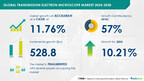
NEW YORK, Oct. 1, 2024 /PRNewswire/ — Report on how AI is driving market transformation- The global transmission electron microscope market size is estimated to grow by USD 528.8 million from 2024-2028, according to Technavio. The market is estimated to grow at a CAGR of over 11.76%  during the forecast period. Increasing focus on nanotechnology is driving market growth, with a trend towards development of new forms of transmission electron microscopes. However, high cost and heavy excise duty of transmission electron microscopes  poses a challenge. Key market players include Advantest Corp., Agilent Technologies Inc., AMETEK Inc., Angstrom Advanced Inc., Bruker Corp., Carl Zeiss Stiftung, Danaher Corp., DELONG INSTRUMENTS AS, Hirox Co. Ltd., Hitachi Ltd., IXRF Inc., JEOL Ltd, NanoScience Instruments Inc., Nikon Corp., Nion, Olympus Corp., Oxford Instruments plc, Roper Technologies Inc., Thermo Fisher Scientific Inc., and VIDEOTON HOLDING ZRt.

Key insights into market evolution with AI-powered analysis. Explore trends, segmentation, and growth drivers- View the snapshot of this report

Transmission Electron Microscope Market Scope

Report Coverage

Details

Base year

2023

Historic period

2017 – 2021

Forecast period

2024-2028

Growth momentum & CAGR

Accelerate at a CAGR of 11.76%

Market growth 2024-2028

USD 528.8 million

Market structure

Fragmented

YoY growth 2022-2023 (%)

10.21

Regional analysis

APAC, North America, Europe, South America, and Middle East and Africa

Performing market contribution

APAC at 57%

Key countries

China, US, Japan, South Korea, and Canada

Key companies profiled

Advantest Corp., Agilent Technologies Inc., AMETEK Inc., Angstrom Advanced Inc., Bruker Corp., Carl Zeiss Stiftung, Danaher Corp., DELONG INSTRUMENTS AS, Hirox Co. Ltd., Hitachi Ltd., IXRF Inc., JEOL Ltd, NanoScience Instruments Inc., Nikon Corp., Nion, Olympus Corp., Oxford Instruments plc, Roper Technologies Inc., Thermo Fisher Scientific Inc., and VIDEOTON HOLDING ZRt

Market Driver

The transmission electron microscope market is experiencing significant growth due to the development of new types of transmission electron microscopes. These advanced models include reflection electron microscopes (REMs), scanning-transmission electron microscopes (STEMs), low-voltage electron microscopes (LVEMs), and cryo-EM. Reflection electron microscopes (REMs) differ from traditional transmission electron microscopes by collecting electrons that are elastically scattered from the object, rather than those that pass through it. REMs are particularly useful when surface information of the specimen is required. Scanning-transmission electron microscopes (STEMs) are increasingly adopted in research laboratories due to their ability to produce images or results directly, without the need for interpretation. STEMs come in two types: conventional transmission electron microscopes, which require additional detectors, scanning coils, and circuitry, and dedicated STEMs, which have all the circuitry embedded. Low-voltage electron microscopes (LVEMs) combine the features of transmission electron microscopes, scanning electron microscopes, and STEMs. Operating at a low voltage, LVEMs provide high contrast images, which is essential for studying biological specimens. LVEMs are available in benchtop mode and are one of the smallest multimode desktop electron microscopes. Cryo-EM uses frozen samples, gentle electron beams, and sophisticated image processing to study biomolecules without the need for crystals. Cryo-EM allows scientists to observe biomolecules as they perform their functions, making it an invaluable tool in the field of biology. Liquid-phase TEM (LP-TEM) ensures in-situ observations of materials in liquids at the highest spatial and temporal resolution in controlled environments. LP-TEM is crucial for studying fluid properties and temperature, but caution must be taken for changes induced by electron beams in pH, nucleation rate, and radiolysis. Overall, the advancements in transmission electron microscopes are driving the growth of the global transmission electron microscope market. These new forms of microscopes offer unique benefits, making them indispensable tools in various industries, including materials science, biology, and electronics. 

The Transmission Electron Microscope (TEM) market is experiencing significant growth due to its application in various industries. In life sciences, TEMs are crucial for cancer research and virology, providing 2D images of specimens at the nanoscale. In materials sciences, TEMs help analyze semiconductors and wafers, enabling the study of their 3D structure and properties. TEMs are also essential in pollution research, nanotechnology, paleontology, and palynology. Industries like automotive, aerospace, electronics, oil & gas, environmental, water treatment, hospitals, diagnostic centers, blood banks, and forensic labs rely on TEMs for their research and development. TEMs offer high throughput methods, super resolution, digitization, live-cell imaging, and expansion and multi-view microscopes. Sample preparation techniques have also advanced, making TEMs more accessible. Neutron spectroscopy, X-ray diffraction, and electron microscopy imaging are complementary techniques that enhance TEM’s capabilities. TEMs operate at the de Broglie wavelength, enabling the study of nanometers-scale objects. Overall, the TEM market is expanding, driven by its applications in various industries and advancements in technology. 

Request Sample of our comprehensive report now to stay ahead in the AI-driven market evolution!

 Market Challenges

The Transmission Electron Microscope (TEM) market faces significant challenges due to the high initial investment cost and the dependence on government and corporate funding for research institutes. This funding can be unpredictable, leading to market volatility. Additionally, high import duties and taxes, such as customs duties, imposed by various governments can increase the final product cost. Some countries, like the US, China, Canada, India, and Brazil, levy indirect taxes at both the national and state levels, with tax rates ranging from 11% to 17%. These taxes and excise duties contribute to the overall increase in product costs, potentially hindering the growth of the global TEM market during the forecast period.The Transmission Electron Microscope (TEM) market faces several challenges in various industries. In research centers, the use of licensed closed-source software limits the flexibility and collaboration among researchers. In electronics and medicine, the need for advanced microscopes for nanotechnology, surface physics, and surface analyses is growing, requiring significant investment. For solid specimens, TEMs offer unparalleled magnification, making them essential for gemology, medical sciences, forensic sciences, and more. However, the complex electron gun, condenser system, objective lens, movable specimen stage, image-recording system, and vacuum system make TEM instruments expensive and challenging to operate. The market for TEMs is expanding in nanomaterials, energy-related materials, polymers, glassy substances, biomolecular mechanisms, viruses, macromolecular complexes, and cellular structures. Industries, including catalysis research, environmental particles, and the nanoworld, rely on TEMs for scientific research and technological innovation. The electron source and electron optics system in a vacuum environment enable the study of ultrafast processes, making TEMs indispensable tools. Environmental TEMs and beam chopper technology, such as UTEM, offer solutions for specific applications. Overall, the TEM market’s growth is driven by the need for deeper understanding and discovery in various fields.

Discover how AI is revolutionizing market trends- Get your access now!

Segment Overview 

This transmission electron microscope market report extensively covers market segmentation by  

Application 1.1 Life science1.2 Material science1.3 Nanotechnology1.4 Semiconductor1.5 OthersEnd-user 2.1 Industries2.2 Academic institutes2.3 OthersGeography 3.1 APAC3.2 North America3.3 Europe3.4 South America3.5 Middle East and Africa

1.1 Life science-  Transmission Electron Microscopes (TEMs) play a crucial role in the field of life sciences, particularly in microbiology, by enabling researchers to examine microorganisms and their structures at the atomic level. These advanced instruments allow scholars to study intricate details of cellular environments, contributing significantly to the understanding of cell behavior, structure, and growth. With the potential to develop new drugs and medicines, academic institutions and pharmaceutical firms invest heavily in TEM technology. For instance, the Pennsylvania State University’s acquisition of FEI Company’s Titan/Krios TEM, which operates at extremely low temperatures, enhances their research capabilities and opens new avenues for exploration. TEMs enable the creation of 3D images of biological molecules such as DNA, proteins, and viruses, including the SARS-CoV-2 virus causing COVID-19. This technology’s ability to produce high-resolution images of these structures aids in the development of new vaccines and treatments. The ongoing research on single-dose COVID-19 vaccines is expected to fuel the demand for TEMs in the global market during the forecast period.

Download a Sample of our comprehensive report today to discover how AI-driven innovations are reshaping competitive dynamics

Research Analysis

The Transmission Electron Microscope (TEM) market encompasses a wide range of industries and applications, driven by the need for high-resolution imaging and analysis of nanoscale objects. TEM utilizes the principle of de Broglie wavelength, allowing electrons to pass through thin samples and create detailed images. Applications span various fields such as cancer research, virology, materials sciences, nanotechnology, paleontology, and palynology. Industries like life sciences, automotive, aerospace, electronics, oil & gas, environmental, water treatment, and research institutes, hospitals, diagnostic centers, blood banks, and forensic labs all benefit from TEM technology. Semiconductors and X-ray diffraction are also significant applications. TEMs, including Scanning Transmission Electron Microscopes (STEMs), are essential tools for studying nanometers-scale structures, providing valuable insights into their properties and behavior.

Market Research Overview

Transmission Electron Microscopes (TEMs) use the principle of de Broglie wavelength to generate high-resolution 2D images of specimens at the nanoscale. TEMs differ from light microscopes as they employ an electron gun and condenser system instead of light to illuminate the specimen. TEMs have significant applications in various fields such as cancer research, virology, materials sciences, pollution analysis, nanotechnology, paleontology, and palynology. They provide detailed information on the 3D structure of nanoscale objects, semiconductors, wafers, and other materials. TEMs are used extensively in the life sciences, semiconductor industry, automotive, aerospace, electronics, oil & gas, environmental, water treatment, hospitals, diagnostic centers, blood banks, forensic labs, and other industries. TEMs offer advanced features like live-cell imaging, super resolution, high throughput methods, expansion microscopes, multi-view microscopes, and integrated microscopy workflows. Sample preparation is crucial for obtaining high-quality images, and TEMs require specialized equipment and expertise. TEMs use closed-source and proprietary software, which can be expensive, while open-source software like ImageJ/Fiji, Neuronstudio, and L-measure offer cost-effective alternatives for small-scale end users. TEMs require skilled operators, including physicists, laboratory technicians, and other experts. The electron gun and objective lens focus the electron beam on the specimen, while the condenser system controls the illumination. The electron beam interacts with the specimen, producing various signals that are used to form the image. Neutron spectroscopy, X-ray diffraction, and electron microscopy imaging are complementary techniques used in conjunction with TEMs for comprehensive material analysis.

Table of Contents:

1 Executive Summary
2 Market Landscape
3 Market Sizing
4 Historic Market Size
5 Five Forces Analysis
6 Market Segmentation

ApplicationLife ScienceMaterial ScienceNanotechnologySemiconductorOthersEnd-userIndustriesAcademic InstitutesOthersGeographyAPACNorth AmericaEuropeSouth AmericaMiddle East And Africa

7 Customer Landscape
8 Geographic Landscape
9 Drivers, Challenges, and Trends
10 Company Landscape
11 Company Analysis
12 Appendix

About Technavio

Technavio is a leading global technology research and advisory company. Their research and analysis focuses on emerging market trends and provides actionable insights to help businesses identify market opportunities and develop effective strategies to optimize their market positions.

With over 500 specialized analysts, Technavio’s report library consists of more than 17,000 reports and counting, covering 800 technologies, spanning across 50 countries. Their client base consists of enterprises of all sizes, including more than 100 Fortune 500 companies. This growing client base relies on Technavio’s comprehensive coverage, extensive research, and actionable market insights to identify opportunities in existing and potential markets and assess their competitive positions within changing market scenarios.

Contacts

Technavio Research
Jesse Maida
Media & Marketing Executive
US: +1 844 364 1100
UK: +44 203 893 3200
Email: media@technavio.com
Website: www.technavio.com/

View original content to download multimedia:https://www.prnewswire.com/news-releases/transmission-electron-microscope-market-to-grow-by-usd-528-8-million-2024-2028-driven-by-nanotechnology-focus-ai-powered-market-evolution-report–technavio-302264391.html

SOURCE Technavio

Continue Reading

Technology

Trimble for Government Achieves ‘Initial Implementation’ Status for FedRAMP Class C (Moderate) Certification

Published

on

By

Milestone accelerates secure cloud adoption for federal, state and local entities managing infrastructure, spatial data and capital assets 

WESTMINSTER, Colo., Oct. 20, 2026 /PRNewswire/ — Trimble today announced that Trimble for Government is listed as ‘Initial Implementation’ status for Federal Risk and Authorization Management Program (FedRAMP®) Class C (Moderate) certification and is now listed on the FedRAMP Marketplace. In conjunction with seeking FedRAMP certification, Trimble is also pursuing GovRAMP authorization to support state, local and education (SLED) customers with reciprocal cybersecurity compliance standards.

This dual milestone marks a critical step forward in delivering a software as a service (SaaS) cloud environment built within a secure Government Community Cloud. Designed specifically for U.S. Federal Government departments, state and local agencies, and defense and civilian contractors, Trimble for Government provides a unified ecosystem for managing infrastructure, spatial data, capital projects, permitting and facility assets across their entire lifecycle.

Achieving FedRAMP Class C (Moderate) and GovRAMP alignment will enable public sector entities and Department of Defense (DoD) contractors to comply with stringent security mandates — including Cybersecurity Maturity Model Certification (CMMC) alignment — while modernizing digital engineering and asset management.

“Federal, state and local agencies face the dual challenge of modernizing critical infrastructure while maintaining uncompromising cybersecurity standards,” said Mark Schwartz, group president, AECO at Trimble. “Achieving ‘Initial Assessment’ status reflects our commitment to delivering mission-critical spatial, capital project and asset management capabilities inside a secure, audit-ready cloud boundary across all levels of government.”

Integrated cloud solutions built for government operations

The in-scope environment brings together Trimble’s proven field execution, asset, project and permitting software into four modular packages designed to support specific public sector outcomes:

Trimble® Field Collaboration: Delivers field data services using foundational spatial database infrastructure and GIS integration to support high-security field operations, map assets, and enable seamless field-to-cloud workflows across Trimble’s core Field Systems portfolio.Trimble Project Management powered by Trimble ProjectSight® software: Connects design-to-build workflows in the field, providing precision data layout, project tracking, collaboration and quality assurance across construction projects.Trimble Asset Management powered by Trimble Unity™ Maintain software: Serves as a centralized facilities data core for federal, state, and local government agencies, military installations, and public infrastructure — such as public buildings, utilities, and transportation networks — to optimize maintenance and long-term capital planning.Trimble Permit Management powered by Trimble Unity Permit software: Streamlines end-to-end management of permitting, licensing, land use and infrastructure rights-of-way in a fully compliant cloud environment.

The unifying in-scope element across all four packages is the Trimble Connect® platform, providing collaboration and a common data environment (CDE) across the Trimble for Government platform.

With assessment processes underway, Trimble continues to advance toward full FedRAMP and GovRAMP authorizations to ensure public sector customers can innovate with confidence.

About Trimble
Trimble is a global technology company that connects the physical and digital worlds, transforming the ways work gets done. With relentless innovation in precise positioning, modeling and data analytics, Trimble enables essential industries including construction, geospatial and transportation. Whether it’s helping customers build and maintain infrastructure, design and construct buildings, optimize global supply chains or map the world, Trimble is at the forefront, driving productivity and progress. For more information about Trimble, visit: www.trimble.com.

GTRMB

View original content to download multimedia:https://www.prnewswire.com/news-releases/trimble-for-government-achieves-initial-implementation-status-for-fedramp-class-c-moderate-certification-302913499.html

SOURCE Trimble

Continue Reading

Technology

Delta Development Team and The Good Drone Company Awarded U.S. Army Contract for Aerial Blood Delivery

Published

on

By

TUCSON, Ariz., Oct. 20, 2026 /PRNewswire/ — Delta Development Team (DDT), a leader in prehospital blood storage and cold chain technology, and The Good Drone Company (GDC) have been awarded a U.S. Army contract to develop a drone-based blood delivery capability for the Army Blood Link (ABL) program.

The program is part of the broader Armed Services Blood Program (ASBP), which supplies blood products to U.S. military forces worldwide. Army Blood Link is designed to support battlefield medical logistics through rapid, temperature-controlled delivery of lifesaving blood products to the field, providing an additional resupply option when traditional ground transportation is unavailable, delayed, or unsafe. Under the contract, The Good Drone Company will provide two U.S.-built prototypes of its hybrid vertical takeoff and landing (VTOL) cargo drone, each designed to transport up to six units of blood, while DDT will provide the temperature-controlled storage capability through its Delta ICE 2L Smart Blood Cooler.

The companies are combining commercial off-the-shelf (COTS) technologies to create a U.S.-sourced aerial blood delivery system capable of transporting blood directly to the point of need.

To meet ABL program requirements, DDT will supply six Delta ICE 2L Smart Blood Coolers, each designed to maintain two units of blood within the required temperature range for three hours of aerial delivery in high-humidity environments with ambient temperatures ranging from 15°F to 120°F. Built-in temperature monitoring and data recording, along with Bluetooth and cellular connectivity, support cold-chain oversight and blood accountability. The program extends DDT’s blood storage and monitoring capabilities into aerial delivery.

“Getting blood to the point of need is only part of the challenge. It must also remain within the required temperature range throughout the journey,” said Montgomery Leija, CEO of Delta Development Team. “This program brings DDT’s experience in blood storage and cold chain management into a new operational environment, taking the blood supply chain from the ground to the air.”

The prototype system is designed to deliver blood within 10 meters of a designated target during both day and night operations. It will feature a communications range of up to 30 miles and semi-autonomous waypoint navigation. It is intended for single-person operation with minimal training and is built on GDC’s existing commercial cargo drone technology to accelerate development and fielding while meeting U.S.-sourcing requirements.

“We have seen strong interest in middle-mile drones in emerging markets for some time, from both public and private sector customers spanning healthcare to third-party logistics,” said Jake Vander Ploeg, CEO of The Good Drone Company. “This program is a great example of how the military is adopting commercial technology like our cargo drones to quickly test new ideas in the field without starting a full aircraft development program.”

The collaboration combines GDC’s expertise in commercial drone platforms and aerial delivery with DDT’s temperature-controlled blood storage and transport capabilities to support:

Rapid resupply: Delivering blood when conventional ground transportation is unavailable or unsafe.Cold chain protection: Maintaining required blood temperatures during aerial transport.U.S.-sourced capability: Supporting domestic defense supply chain objectives.Accelerated development: Combining GDC’s existing commercial cargo drone technology with DDT’s established blood storage solutions.

The ABL effort addresses the challenge of delivering critical medical supplies in contested and austere environments. When terrain, damaged infrastructure, or tactical conditions prevent conventional resupply, aerial delivery combined with temperature-controlled storage can expand options for getting lifesaving blood products to service members when and where they are needed.

About Delta Development Team

Delta Development Team (DDT) is a U.S.-based medical technology company headquartered in Tucson, Arizona, specializing in blood storage, transport, monitoring, and logistics solutions for military and prehospital environments. DDT develops technology designed to keep blood available, traceable, and mission-ready from the blood bank to the point of injury. Its portfolio includes the APRU 6L, Delta ICE 2L, TBS 40L, and BloodCOMM® blood management platform.

Media Contact: info@deltadevteam.com | www.deltadevteam.com

About The Good Drone Company

The Good Drone Company (GDC) is an aerospace company headquartered in Tempe, Arizona, that designs and builds autonomous hybrid VTOL cargo drones for middle-mile logistics. GDC’s aircraft take off and land vertically without a runway, carry up to 55 lb (25 kg) of payload, and fly more than 300 miles (500 km) at speeds up to 93 mph (150 km/h). GDC is deploying in Kenya to close the middle-mile transportation gap for public and private sector customers, working closely with its local partner ThatcherX and the Kenyan government to change how goods move around the country.

Media Contact: info@thegooddronecompany.com | www.thegooddronecompany.com

View original content to download multimedia:https://www.prnewswire.com/news-releases/delta-development-team-and-the-good-drone-company-awarded-us-army-contract-for-aerial-blood-delivery-302913294.html

SOURCE Delta Development Team

Continue Reading

Trending