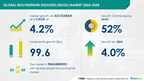
NEW YORK, Nov. 6, 2024 /PRNewswire/ — Report with the AI impact on market trends – The global molybdenum disulfide (MOS2) market size is estimated to grow by USD 99.6 million from 2024-2028, according to Technavio. The market is estimated to grow at a CAGR of 4.2% during the forecast period. Increasing demand due to growing end-user industries is driving market growth, with a trend towards increased construction activities to provide enhanced opportunities. However, presence of alternative materials poses a challenge.Key market players include American Elements, ARK Co. Ltd., Centerra Gold, EPRUI Biotech Co. Ltd., Freeport McMoRan Inc., FUCHS PETROLUB SE, JinMo Group, Luoyang Shenyu Molybdenum Co. Ltd, McGee Industries Inc., Moly Metal LLP, Omkar Speciality Chemicals, Rose Mill Co., Sigma Aldrich Chemicals Pvt Ltd, Shanghai Xinglu Chemical Technology Co. Ltd., Treibacher Industrie AG, and US Research Nanomaterials Inc..
Key insights into market evolution with AI-powered analysis. Explore trends, segmentation, and growth drivers- View Free Sample PDF
Molybdenum Disulfide (MoS2) Market Scope
Report Coverage
Details
Base year
2023
Historic period
2018 – 2022
Forecast period
2024-2028
Growth momentum & CAGR
Accelerate at a CAGR of 4.2%
Market growth 2024-2028
USD 99.6 million
Market structure
Fragmented
YoY growth 2022-2023 (%)
4.0
Regional analysis
APAC, North America, Europe, South America, and Middle East and Africa
Performing market contribution
APAC at 52%
Key countries
Germany, China, US, India, and Japan
Key companies profiled
American Elements, ARK Co. Ltd., Centerra Gold, EPRUI Biotech Co. Ltd., Freeport McMoRan Inc., FUCHS PETROLUB SE, JinMo Group, Luoyang Shenyu Molybdenum Co. Ltd, McGee Industries Inc., Moly Metal LLP, Omkar Speciality Chemicals, Rose Mill Co., Sigma Aldrich Chemicals Pvt Ltd, Shanghai Xinglu Chemical Technology Co. Ltd., Treibacher Industrie AG, and US Research Nanomaterials Inc.
Market Driver
The global molybdenum disulfide (MOS2) market is set to experience notable growth due to its increasing usage in construction activities. MoS2 is a preferred choice for construction machinery and equipment due to its excellent lubrication properties, which enhances their efficiency and lifespan. Its ability to endure high pressures and temperatures makes it suitable for heavy-duty applications. Moreover, MoS2 is employed in protective coatings to safeguard structures from corrosion and wear, increasing its demand in the construction sector. With urbanization and infrastructure development on the rise, particularly in emerging economies, the requirement for efficient construction materials like MoS2 is anticipated to expand. This trend is likely to generate lucrative opportunities for MoS2 manufacturers and suppliers, contributing to the expansion of the market. The material’s versatility and effectiveness in diverse applications make it an essential component in contemporary construction projects, fostering innovation and efficiency throughout the industry. Therefore, these factors are projected to fuel the growth of the MoS2 market during the forecast period.
The Molybdenum Disulfide (Mos2) market is experiencing significant growth due to its unique properties in various industries. In the aerospace sector, Mos2 is used for lubrication in bearings and chassis, providing excellent friction reduction and corrosion resistance. In the transportation sector, Mos2 is utilized as a solid lubricant in heavy vehicles and railway grease, enhancing oxidation resistance and chemical stability. Mos2 is also a popular choice in the electronics industry for its electrical conductivity and use in semiconductors. General engineering and manufacturing processes benefit from Mos2’s high conductivity and quality control capabilities. Urbanization and infrastructure investments have led to increased demand for Mos2 in water treatment and petrochemicals, where it is used as an alternative to Tungsten disulfide in engine oils and transmission fluids. Mos2’s inorganic compound structure offers superior corrosion resistance and chemical stability. Moreover, Mos2’s use extends to advanced semiconductor technology, light emitting diodes, lasers, and super capacitors. Its trending use as an OEM lubricant and in microelectronics highlights its importance in high-tech industries. With growing environmental awareness, Mos2’s use as a solid lubricant in various industries offers a sustainable solution for friction reduction.
Request Sample of our comprehensive report now to stay ahead in the AI-driven market evolution!
Market Challenges
The Molybdenum Disulfide (MoS2) market may face challenges due to the availability of alternative materials, specifically Tungsten Disulfide (WS2). WS2 shares a similar lamellar structure and features with MoS2, including a low coefficient of friction, good chemical stability, and thermal stability. With the advancement of mechanical exfoliation techniques, single layers of WS2 can be isolated, revealing its unique properties. WS2’s bandgap changes from indirect to direct when transitioning to a 2D material, making it a promising material for various applications. Like MoS2, WS2 boasts a high on/off ratio in field-effect transistors, controllable spin and valley polarization, and tunable photoluminescence. Consequently, the presence of WS2 as a viable alternative may hinder the growth of the MoS2 market during the forecast period.The Molybdenum Disulfide (Mos2) market is experiencing significant growth due to its unique properties in various industries. In microelectronics, Mos2 is used as an alternative to Tungsten disulfide in high-tech industries for its superior conductivity and electrical stability in semiconductors and advanced semiconductor technology. In infrastructure investments, Mos2 is utilized in water treatment for its chemical stability and corrosion resistance. The petrochemical industry uses Mos2 in engine oils and transmission fluids for friction reduction and lubrication. In the manufacturing processes of super capacitors, Mos2’s high conductivity and electrical stability are essential. For infrastructure development, Mos2’s use in construction as a reinforcing agent is increasing. The aerospace and defense industry, electric vehicles, and automotive production also benefit from Mos2’s lightweight, high-strength, and excellent thermal stability. The transition metal dichalcogenide is also used in lubricants for commercial airplanes, consumer electronics, and greases. The environmental awareness trend is driving the demand for Mos2 in the production of lubricants for electric vehicles. The challenges for the Mos2 market include ensuring quality control, cost-effective manufacturing processes, and the development of alternatives to crystalline MoS2 for specific applications. The military sector is also exploring the potential uses of Mos2 in various applications due to its excellent conductivity, conductive stability, and friction coefficient.
Discover how AI is revolutionizing market trends- Get your access now!
Segment Overview
This molybdenum disulfide (mos2) market report extensively covers market segmentation by
Product 1.1 Powder1.2 CrystalGeography 2.1 APAC2.2 North America2.3 Europe2.4 South America2.5 Middle East and Africa
1.1 Powder- The molybdenum disulfide (MoS2) powder segment holds a significant position in the global MoS2 market due to its extensive applications. Its exceptional lubrication properties make it a preferred choice in industries such as automotive, aerospace, and industrial machinery. MoS2 powder reduces friction and wear, improving mechanical component performance and longevity. In 2022, the powder segment accounted for the largest revenue share, driven by its use in lubrication, friction reduction, and as a solid lubricant. The automotive industry benefits from MoS2 powder, enhancing engine efficiency and reducing wear on moving parts. Historically used as a lubricant in greases, MoS2 powder is a dry, insoluble in water and dilute acids, powdered lubricant ingredient. It is also employed as a co-catalyst in petrochemistry for desulfurization processes like hydrodesulfurization. These factors are expected to fuel the growth of the MoS2 powder segment in the forecast period.
Download a Sample of our comprehensive report today to discover how AI-driven innovations are reshaping competitive dynamics
Research Analysis
Molybdenum Disulfide, also known as MoS2, is a versatile inorganic compound known for its exceptional properties, including high lubricity, oxidation resistance, and corrosion protection. It is widely used in various industries due to its ability to enhance the performance of lubricants in extreme conditions. In the transportation sector, MoS2 is extensively used in automotive production and heavy vehicles for chassis lubrication and in railway grease. The electric vehicle industry also utilizes MoS2 in lubricants for improved efficiency and longevity. In the aerospace and defense sector, MoS2 is used in lubricants for bearings and other critical components due to its high performance under extreme temperatures and pressures. The electrical and electronics industry uses MoS2 in the form of powders and crystals for applications such as lubricants in LEDs, lasers, and water treatment. The petrochemical industry uses MoS2 in engine oils and transmission fluids to enhance their performance and longevity. Overall, Molybdenum Disulfide is a valuable resource for various industries, offering superior lubrication, oxidation resistance, and corrosion protection.
Market Research Overview
Molybdenum Disulfide (Mos2), a transition metal dichalcogenide, is a versatile inorganic compound with unique properties that make it an essential component in various industries. Its high thermal and conductive stability, low friction coefficient, and excellent lubrication properties make it an ideal choice for use in lubricants, particularly in the transportation sector. In automotive production, Mos2 is used in greases for chassis lubrication and in heavy vehicles for bearing applications. In the aerospace and defense industry, it is used for corrosion protection and oxidation resistance in commercial airplanes and military applications. In the electrical and electronics sector, Mos2 is used in solid lubricants for microelectronics, semiconductors, and advanced semiconductor technology. Its use extends to the construction industry for infrastructure investments, and in the petrochemical industry for engine oils and transmission fluids. Mos2 is also used in the manufacturing processes of light emitting diodes, lasers, and water treatment systems. Its high electrical conductivity and chemical stability make it an essential component in super capacitors and batteries. The growing trend towards electric vehicles and environmental awareness is driving the demand for Mos2 as an alternative to traditional lubricants like tungsten disulfide.
Table of Contents:
1 Executive Summary
2 Market Landscape
3 Market Sizing
4 Historic Market Size
5 Five Forces Analysis
6 Market Segmentation
ProductPowderCrystalGeographyAPACNorth AmericaEuropeSouth AmericaMiddle East And Africa
7 Customer Landscape
8 Geographic Landscape
9 Drivers, Challenges, and Trends
10 Company Landscape
11 Company Analysis
12 Appendix
About Technavio
Technavio is a leading global technology research and advisory company. Their research and analysis focuses on emerging market trends and provides actionable insights to help businesses identify market opportunities and develop effective strategies to optimize their market positions.
With over 500 specialized analysts, Technavio’s report library consists of more than 17,000 reports and counting, covering 800 technologies, spanning across 50 countries. Their client base consists of enterprises of all sizes, including more than 100 Fortune 500 companies. This growing client base relies on Technavio’s comprehensive coverage, extensive research, and actionable market insights to identify opportunities in existing and potential markets and assess their competitive positions within changing market scenarios.
Contacts
Technavio Research
Jesse Maida
Media & Marketing Executive
US: +1 844 364 1100
UK: +44 203 893 3200
Email: media@technavio.com
Website: www.technavio.com/
View original content to download multimedia:https://www.prnewswire.com/news-releases/molybdenum-disulfide-mos2-market-to-grow-by-usd-99-6-million-from-2024-2028–driven-by-rising-demand-from-end-user-industries-and-ai-driven-market-transformation—technavio-302296559.html
SOURCE Technavio










 Technology3 days ago

 Technology5 days ago

 Technology5 days ago

 Coin Market4 days ago

 Technology4 days ago

 Technology5 days ago

 Coin Market3 days ago

 Coin Market3 days ago