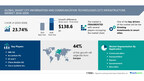
NEW YORK, Nov. 6, 2024 /PRNewswire/ — Report with the AI impact on market trends – The global smart city information and communication technologies (ict) infrastructure market size is estimated to grow by USD 138.6 billion from 2024-2028, according to Technavio. The market is estimated to grow at a CAGR of 23.74% during the forecast period. Growing investments in smart cities is driving market growth, with a trend towards proliferation of smart city projects in emerging economies. However, growing adaption of machine-to-machine in various industries poses a challenge.Key market players include ABB Ltd., Accenture Plc, AT and T, China Mobile Ltd., Cisco Systems Inc., Deutsche Telekom AG, Hitachi Ltd., Honeywell International Inc., Huawei Technologies Co. Ltd., International Business Machines Corp., Microsoft Corp., Nokia Corp., NTT Communications Corp., Oracle Corp., Schneider Electric SE, Siemens AG, Telefonaktiebolaget LM Ericsson, Telefonica SA, Verizon, and Vodafone Group Plc.
AI-Powered Market Evolution Insights. Our comprehensive market report ready with the latest trends, growth opportunities, and strategic analysis- View Free Sample Report PDF
Forecast period
2024-2028
Base Year
2023
Historic Data
2018 – 2022
Segment Covered
Application (Communication, Transportation, Express, Governement, and Education), Component (Smart utilities, Smart transport, Smart home and building, and Others), and Geography (Europe, North America, APAC, Middle East and Africa, and South America)
Region Covered
Europe, North America, APAC, Middle East and Africa, and South America
Key companies profiled
ABB Ltd., Accenture Plc, AT and T, China Mobile Ltd., Cisco Systems Inc., Deutsche Telekom AG, Hitachi Ltd., Honeywell International Inc., Huawei Technologies Co. Ltd., International Business Machines Corp., Microsoft Corp., Nokia Corp., NTT Communications Corp., Oracle Corp., Schneider Electric SE, Siemens AG, Telefonaktiebolaget LM Ericsson, Telefonica SA, Verizon, and Vodafone Group Plc
Key Market Trends Fueling Growth
In developed economies of North America and Europe, smart city projects have been underway for over a decade, with numerous implementations. The Asia-Pacific region is the fastest-growing market for smart city technologies, driven by urban population growth and infrastructure development in emerging countries like India and China. For instance, India plans to implement pilot smart city projects in 100 cities, while China aims to build 500. The Association of Southeast Asian Nations (ASEAN) also supports smart urban development in 26 cities by 2025. Rapid urbanization, particularly in India, necessitates the deployment of smart city infrastructure to help governments, healthcare, and transportation providers respond effectively to urban challenges. With the increasing number of smart devices in these cities, a substantial amount of data will be generated, necessitating analysis for business improvement and innovation. Urban population growth, fueled by mass migration, will continue to expand the smart city market in emerging economies.
At Spherical Insights & Consulting, we’re excited about the trends shaping the Smart City ICT Infrastructure market. With the Smart Cities Mission, urban areas are transforming into Intellectual Metropolises, integrating Digital Infrastructure for Smart Grid, Water Network, Healthcare, Education, Security, Transport, Express Industry, and more. Telecommunications are advancing with 5G Networks and Fiber-Optic Internet, while Wireless Technologies ensure Operational Efficiency and Citizens’ Welfare. Urban Practitioners leverage Innovative Technology for Smart Energy, Buildings, and Governance. Sustainable Development is at the core, focusing on Clean Environment, Water Supply, Sanitation, and Solid Waste Management. Urban Mobility and Public Transportation are essential for Urbanization and Affordable Housing. Smart Home, Digital Transformation, Cybersecurity, and Data Privacy are key areas of Economic Development. Let’s work together to create Sustainable, Connected, and Efficient Cities.
Insights on how AI is driving innovation, efficiency, and market growth- Request Sample!
Market Challenges
• The Smart City Information and Communication Technologies (ICT) market, specifically Machine-to-Machine (M2M) solutions, holds significant potential in various industries such as automotive, manufacturing, energy, healthcare, and military. Operators are challenged to provide unique M2M platforms catering to distinct use cases due to market fragmentation. M2M devices and applications necessitate different connectivity requirements than conventional mobile data devices, leading to potential network overload during emergencies or disasters with millions of connected devices. High signaling traffic from numerous small devices operating on and off the network further complicates matters. However, by optimally utilizing existing spectrum and network assets, profits can be maximized, resulting in reduced customer acquisition and support costs and increased revenue through the integration of new wireless devices and business processes. Integrating M2M devices with cellular M2M techniques is intricate for vendors, requiring redesigning of devices and integration with back-end infrastructure using middleware and enterprise application software. Factors like network overload, poor protocol implementation, and emergencies or disasters can impact the growth of the M2M market during the forecast period.
• The Smart City ICT infrastructure market is a dynamic and growing industry focused on enhancing operational efficiency and improving citizens’ welfare in urban areas. This involves the deployment of innovative technology in sectors such as energy, buildings, transportation, governance, and residential living. Key challenges include ensuring a clean environment with sustainable solutions for water supply, sanitation, and solid waste management. Urban mobility and public transportation are also crucial, as is the provision of affordable housing, health, and education. Digital transformation is at the heart of this revolution, with cybersecurity and data privacy essential for protecting citizens’ information. Economic development, urbanization, and industrial transformation are also major drivers, with energy solutions, value-added resellers, investors, consulting firms, and venture capitalists playing key roles in driving innovation. Silicon Valleys and Intellectual Metropolises are hubs for this technological urban evolution, shaping the future of our cities.
Insights into how AI is reshaping industries and driving growth- Download a Sample Report
Segment Overview
This smart city information and communication technologies (ict) infrastructure market report extensively covers market segmentation by
Application 1.1 Communication1.2 Transportation1.3 Express1.4 Governement1.5 EducationComponent 2.1 Smart utilities2.2 Smart transport2.3 Smart home and building2.4 OthersGeography 3.1 Europe3.2 North America3.3 APAC3.4 Middle East and Africa3.5 South America
1.1 Communication- The communication segment of the global smart city ICT infrastructure market encompasses wireless networks, broadband infrastructure, IoT, smart grid, digital signage and displays, and public safety and emergency management technologies. Wireless networks serve as the foundation for modern smart city communications, enabling citizens and businesses to access information and services citywide. High-speed broadband connectivity is essential for numerous smart city applications, such as smart transportation, buildings, and energy. The IoT connects various devices and sensors, allowing city officials to monitor and manage city functions. The smart grid optimizes energy consumption, while digital signage and displays offer interactive communication channels. Public safety and emergency management technologies enhance response capabilities during crises. Overall, these communication solutions facilitate effective city-stakeholder interaction and enable city officials to manage various city aspects, fueling the demand for communication systems in the smart city market.
Download complimentary Sample Report to gain insights into AI’s impact on market dynamics, emerging trends, and future opportunities- including forecast (2024-2028) and historic data (2018 – 2022)
Research Analysis
The Smart City Information and Communication Technologies (ICT) infrastructure market refers to the advanced digital systems and networks that enable the development of smart cities. These cities leverage ICT to optimize urban services and improve the quality of life for residents. Key areas of focus include Smart Grid for energy management, Smart Water Network for water conservation, Smart Healthcare for efficient healthcare delivery, Smart Education for digital learning, Smart Security for public safety, Smart Transport for efficient mobility, and the Express Industry for logistics optimization. Digital Infrastructure, Population Expansion, and the Smart Cities Mission are driving the demand for these technologies. Urban practitioners, Silicon Valleys, Intellectual Metropolis, and Innovative Technology are at the forefront of this transformation. Smart Energy, Smart Buildings, Smart Transportation, Smart Governance, Smart Residents, Sustainable Development, and Urban Landscapes are other essential components of a smart city. The ultimate goal is to create a city that is operationally efficient, citizen-centric, and sustainable.
Market Research Overview
The Smart City Information and Communication Technologies (ICT) infrastructure market refers to the deployment of advanced technologies and digital solutions to enhance urban living and promote sustainable development. Spherical Insights & Consulting reports that the market is witnessing significant growth due to the integration of various sectors such as Smart Grid, Smart Water Network, Smart Healthcare, Smart Education, Smart Security, and Smart Transport. The express industry, digital infrastructure, and telecommunications are also playing a crucial role in this transformation. Population expansion and government initiatives like the Smart Cities Mission are driving the demand for ICT infrastructure. Innovative technologies like 5G networks, fiber-optic internet, and wireless technologies are being adopted to ensure operational efficiency and improve citizens’ welfare. Urban practitioners and Silicon Valleys are collaborating to create Intellectual Metropolises, where smart energy, smart buildings, and smart transportation are becoming the norm. Smart Governance, smart residents, sustainable development, and urban landscapes are other areas where ICT infrastructure is making a significant impact. Infrastructure development, clean environment, water supply, sanitation, solid waste management, urban mobility, public transportation, affordable housing, health and education, smart home, and digital transformation are all benefiting from this technological revolution. Value-added resellers, investors, consulting firms, and venture capitalists are also showing interest in the market, recognizing the potential for economic development and industrial transformation. However, challenges such as cybersecurity, data privacy, and affordability remain, requiring ongoing attention and innovation.
Table of Contents:
1 Executive Summary
2 Market Landscape
3 Market Sizing
4 Historic Market Size
5 Five Forces Analysis
6 Market Segmentation
ApplicationCommunicationTransportationExpressGovernementEducationComponentSmart UtilitiesSmart TransportSmart Home And BuildingOthersGeographyEuropeNorth AmericaAPACMiddle East And AfricaSouth America
7 Customer Landscape
8 Geographic Landscape
9 Drivers, Challenges, and Trends
10 Company Landscape
11 Company Analysis
12 Appendix
About Technavio
Technavio is a leading global technology research and advisory company. Their research and analysis focuses on emerging market trends and provides actionable insights to help businesses identify market opportunities and develop effective strategies to optimize their market positions.
With over 500 specialized analysts, Technavio’s report library consists of more than 17,000 reports and counting, covering 800 technologies, spanning across 50 countries. Their client base consists of enterprises of all sizes, including more than 100 Fortune 500 companies. This growing client base relies on Technavio’s comprehensive coverage, extensive research, and actionable market insights to identify opportunities in existing and potential markets and assess their competitive positions within changing market scenarios.
Contacts
Technavio Research
Jesse Maida
Media & Marketing Executive
US: +1 844 364 1100
UK: +44 203 893 3200
Email: media@technavio.com
Website: www.technavio.com/
View original content to download multimedia:https://www.prnewswire.com/news-releases/smart-city-ict-infrastructure-market-to-grow-by-usd-138-6-billion-from-2024-2028–driven-by-rising-smart-city-investments-and-ai-driven-market-transformation—technavio-302296460.html
SOURCE Technavio







 Technology3 days ago
 Technology5 days ago

 Technology5 days ago

 Coin Market4 days ago

 Technology4 days ago

 Technology5 days ago

 Coin Market3 days ago

 Coin Market3 days ago