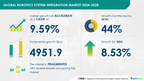
NEW YORK, Nov. 21, 2024 /PRNewswire/ — Report with the AI impact on market trends – The global robotics system integration market size is estimated to grow by USD 4.95 billion from 2024-2028, according to Technavio. The market is estimated to grow at a CAGR of over 9.59% during the forecast period. Increase in demand for cobots is driving market growth, with a trend towards increase in demand for application-specific industrial robots. However, high cost of services for robotic system integration poses a challenge.Key market players include Amtec Solutions Group Inc., Burke Porter Group, CNC Robotics Ltd., Concept Systems Inc., FH Automation, Geku Automation, Hitachi Ltd., IPG Photonics Corp., JH Robotics Inc, MESH Automation Inc., Midwest Engineered Systems Inc., Mitsui and Co. Ltd., Motion Controls Robotics Inc., Peak Analysis and Automation Ltd., Phoenix Control Systems Ltd., Rhein Nadel Automation GmbH, Scott Technology Ltd., TASI Group, TW Automation, and United Robotics Inc..
AI-Powered Market Evolution Insights. Our comprehensive market report ready with the latest trends, growth opportunities, and strategic analysis- View Free Sample Report PDF
Forecast period
2024-2028
Base Year
2023
Historic Data
2018 – 2022
Segment Covered
Application (Material handling, Welding and soldering, Assembly line, and Others), End-user (Electronics, Automotive, Healthcare, Aerospace and defence, and Logistics and others), and Geography (APAC, Europe, North America, South America, and Middle East and Africa)
Region Covered
APAC, Europe, North America, South America, and Middle East and Africa
Key companies profiled
Amtec Solutions Group Inc., Burke Porter Group, CNC Robotics Ltd., Concept Systems Inc., FH Automation, Geku Automation, Hitachi Ltd., IPG Photonics Corp., JH Robotics Inc, MESH Automation Inc., Midwest Engineered Systems Inc., Mitsui and Co. Ltd., Motion Controls Robotics Inc., Peak Analysis and Automation Ltd., Phoenix Control Systems Ltd., Rhein Nadel Automation GmbH, Scott Technology Ltd., TASI Group, TW Automation, and United Robotics Inc.
Key Market Trends Fueling Growth
The Robotics System Integration market is experiencing significant growth as industries seek to automate processes and increase efficiency. Industrial robots, including collaborative robots or cobots, are being integrated into manufacturing units in sectors like automotive, electronics, aerospace and defense, and more. Robotics system integrators provide consulting services to help businesses optimize their infrastructure and application integration. Next-generation robots are being developed with advanced hardware and software for tasks in material handling, logistics, healthcare, defense, IT and telecom, and more. The robotic industry is also seeing accelerated adoption due to advancements in AI, machine learning algorithms, IoT sensors, and data analytics. This leads to real-time monitoring, improved productivity, and reduced operational costs. Robotic system integrators play a crucial role in configuring and optimizing cohesive robotic systems. With the increasing use of cobots, labor costs are becoming more competitive. Skilled robotics engineers and technicians are in high demand to ensure the successful implementation of these advanced technologies. However, cybersecurity concerns remain a challenge as robots become more integrated into critical infrastructure. Dynamic Automation Solutions offer solutions to address these concerns while ensuring political stability and dynamic automation.
The industrial robotics market is experiencing significant growth due to the increasing adoption of robots in industries previously relying on manual labor. This trend is particularly noticeable in sectors facing workforce deficits, such as construction. For instance, in regions like the Nordic countries, where construction is on the rise, there is an emerging need for specialist integrators to facilitate the implementation of robots for improved efficiency. Small and medium-sized enterprises (SMEs) represent a substantial opportunity for the expansion of the global robotics system integration market.
Insights on how AI is driving innovation, efficiency, and market growth- Request Sample!
Market Challenges
The Robotics System Integration market is experiencing significant growth as more industries automate their processes with industrial robots. However, integration of these robots presents challenges such as programming and configuration. Robotics system integrators play a crucial role in ensuring a cohesive system by handling infrastructure and application integration. Industries like automotive, electronics, aerospace and defense, and manufacturing units are leading the way in robotic automation. Next-generation robots, including collaborative robots (cobots), are increasingly being adopted for material handling applications. Robotic system integrators help optimize productivity, reduce operational costs, and improve product quality. Challenges include the need for skilled engineers and technicians, cybersecurity concerns, and the integration of IoT sensors, data analytics, and real-time monitoring. Advancements in robotics and AI are accelerating adoption in various sectors, from logistics and healthcare to defense and finance. Robots are being used for tasks ranging from bomb disposal and reconnaissance to surgeries and patient care. Dynamic Automation Solutions provides comprehensive consulting services to help businesses navigate these challenges and maximize the benefits of robotics and automation.System integrators play a crucial role in the deployment of industrial robots for businesses. The process involves various formalities, including contract signing, competitive bidding, and legalities. Vendors must focus on streamlining these pre-purchase procedures to save end-users time and money. Robotic integration market players offer software packages for seamless robot programming and integration. Innovations in the process, such as efficient contract negotiations and quick evaluations, are essential to maintain competitiveness. By optimizing these steps, integrators can help businesses effectively incorporate robots into their operations.
Insights into how AI is reshaping industries and driving growth- Download a Sample Report
Segment Overview
This robotics system integration market report extensively covers market segmentation by
Application 1.1 Material handling1.2 Welding and soldering1.3 Assembly line1.4 OthersEnd-user 2.1 Electronics2.2 Automotive2.3 Healthcare2.4 Aerospace and defence2.5 Logistics and othersGeography 3.1 APAC3.2 Europe3.3 North America3.4 South America3.5 Middle East and Africa
1.1 Material handling- The robotics system integration market for material handling is experiencing significant growth, particularly in industries such as automotive, chemicals, electrical and electronics, industrial machinery, and food and beverage. Robots are increasingly being used for material handling due to their ability to work on multiple processes simultaneously and improve process efficiency. In the automotive industry, the need to move bulk payloads efficiently has resulted in high demand for robotics system integration. The chemical industry also represents a major consumer due to the handling of hazardous materials and the desire to reduce liability and refurbishment costs. In the electrical and electronics industry, the trend towards miniaturization necessitates high throughput and quality, making robots an attractive solution. The industrial machinery industry seeks to reduce worker fatigue, accidents, and costs by automating production processes, including material handling. In the food and beverage industry, robots help improve efficiency in material handling and packaging a variety of SKUs within a short timeframe. Companies like Coop in the food industry have automated their warehousing, distribution, and order fulfillment functions to address labor shortages, increasing wages, and consumer expectations. As the demand for material handling automation continues to grow, manufacturers, system integrators, and consultancies stand to benefit from this trend in industries worldwide.
Download complimentary Sample Report to gain insights into AI’s impact on market dynamics, emerging trends, and future opportunities- including forecast (2024-2028) and historic data (2018 – 2022)
Research Analysis
Robotics system integration refers to the process of bringing together industrial robots, programming software, and infrastructure to create a cohesive automation solution. This market encompasses the integration of units from various robotics manufacturers to meet specific manufacturing tasks in industries such as automotive, electronics, aerospace and defense, and material handling applications. The next generation of robots, including collaborative robots, are driving growth in this sector. Robotic system integrators provide configuration, optimization, hardware, and software solutions to automate processes in manufacturing units. The goal is to improve efficiency, reduce costs, and enhance productivity in the robotic industry. Mesh Engineering, for instance, offers integration services for Robots, Automation, and Infrastructure, enabling seamless communication between hardware and software components.
Market Research Overview
Robotics system integration refers to the process of bringing together industrial robots, collaborative robots (cobots), and related hardware, software, and infrastructure to create a cohesive automation solution. This involves programming, configuration, optimization, and application integration to automate tasks in manufacturing, material handling, automotive, electronics, aerospace and defense, and various industries. The next generation of robots is characterized by advancements in AI, machine learning algorithms, IoT sensors, data analytics, and real-time monitoring. Robotic system integrators play a crucial role in the robotic industry, providing consulting services, infrastructure integration, and productivity improvements, while reducing operational costs and enhancing product quality. The adoption of robotics is accelerating due to advancements in robotics and AI, as well as the need for labor cost savings and dynamic automation solutions. Skilled robotics engineers and technicians are in high demand to meet the increasing demand for robotic systems in manufacturing, logistics, healthcare, defense, IT and telecom, data centers, network management, bomb disposal, reconnaissance, surveillance, banking, financial services, insurance, inspection maintenance, exploration, surgeries, medications, patient care, political stability, and more. Robotic system integration also involves dealing with cyberattacks and ensuring the security of robotic systems.
Table of Contents:
1 Executive Summary
2 Market Landscape
3 Market Sizing
4 Historic Market Size
5 Five Forces Analysis
6 Market Segmentation
ApplicationMaterial HandlingWelding And SolderingAssembly LineOthersEnd-userElectronicsAutomotiveHealthcareAerospace And DefenceLogistics And OthersGeographyAPACEuropeNorth AmericaSouth AmericaMiddle East And Africa
7 Customer Landscape
8 Geographic Landscape
9 Drivers, Challenges, and Trends
10 Company Landscape
11 Company Analysis
12 Appendix
About Technavio
Technavio is a leading global technology research and advisory company. Their research and analysis focuses on emerging market trends and provides actionable insights to help businesses identify market opportunities and develop effective strategies to optimize their market positions.
With over 500 specialized analysts, Technavio’s report library consists of more than 17,000 reports and counting, covering 800 technologies, spanning across 50 countries. Their client base consists of enterprises of all sizes, including more than 100 Fortune 500 companies. This growing client base relies on Technavio’s comprehensive coverage, extensive research, and actionable market insights to identify opportunities in existing and potential markets and assess their competitive positions within changing market scenarios.
Contacts
Technavio Research
Jesse Maida
Media & Marketing Executive
US: +1 844 364 1100
UK: +44 203 893 3200
Email: media@technavio.com
Website: www.technavio.com/
View original content to download multimedia:https://www.prnewswire.com/news-releases/robotics-system-integration-market-to-grow-by-usd-4-95-billion-2024-2028-rising-demand-for-cobots-driving-revenue-ai-transforming-the-market—technavio-302311483.html
SOURCE Technavio










 Technology3 days ago
 Technology5 days ago
 Technology4 days ago
 Coin Market4 days ago
 Technology4 days ago
 Technology5 days ago
 Coin Market3 days ago
 Coin Market3 days ago