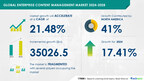
NEW YORK, Nov. 28, 2024 /PRNewswire/ — Report with the AI impact on market trends – The global enterprise content management market size is estimated to grow by USD 35.03 billion from 2024-2028, according to Technavio. The market is estimated to grow at a CAGR of 21.48% during the forecast period. Growing need to enhance content security and optimize business processes with automated workflows is driving market growth, with a trend towards rise in adoption of ai-based enterprise content management. However, difficulties with integration and implementation of enterprise content management with current applications poses a challenge. Key market players include Acquia Inc., Adobe Inc., Alfresco Software Ltd., Capgemini Service SAS, Compulink Management Center Inc., Datamatics Global Services Limited, DNN Corp., Epicor Software Corp., HP Inc., Hyland Software Inc., International Business Machines Corp., M Files, Microsoft Corp., Newgen Software Technologies Ltd., OpenText Corp., Optimizely Inc., Oracle Corp., Ricoh Co. Ltd., Salesforce Inc., and Xerox Holdings Corp..
Key insights into market evolution with AI-powered analysis. Explore trends, segmentation, and growth drivers- View Free Sample PDF
Enterprise Content Management Market Scope
Report Coverage
Details
Base year
2023
Historic period
2018 – 2022
Forecast period
2024-2028
Growth momentum & CAGR
Accelerate at a CAGR of 21.48%
Market growth 2024-2028
USD 35026.5 million
Market structure
Fragmented
YoY growth 2022-2023 (%)
17.41
Regional analysis
North America, Europe, APAC, South America, and Middle East and Africa
Performing market contribution
North America at 41%
Key countries
US, Germany, UK, Canada, and France
Key companies profiled
Acquia Inc., Adobe Inc., Alfresco Software Ltd., Capgemini Service SAS, Compulink Management Center Inc., Datamatics Global Services Limited, DNN Corp., Epicor Software Corp., HP Inc., Hyland Software Inc., International Business Machines Corp., M Files, Microsoft Corp., Newgen Software Technologies Ltd., OpenText Corp., Optimizely Inc., Oracle Corp., Ricoh Co. Ltd., Salesforce Inc., and Xerox Holdings Corp.
Market Driver
The Enterprise Content Management (ECM) market is witnessing a significant trend towards centralized platforms that help business organizations manage information throughout the project lifecycle. Bigger organizations require efficient and secure ways to manage sensitive data and regulatory content on wireless devices. Operational efficiency and compliance requirements are key concerns, as risks such as data breaches and unauthorized access pose significant threats. ECM solutions offer features like indexing, retrieval, and informed decision-making for improved patient care and administrative efficiency in healthcare. Centralized repositories ensure the integrity of content assets, including electronic health records, consent forms, insurance claims, and invoices. In industries like telecom and IT, manufacturing, media and entertainment, and financial services, ECM platforms enable automation of workflows, record management, and audit trails. ECM systems are increasingly integrating artificial intelligence, machine learning, and predictive learning to enhance document management, risk reduction, and content collaboration. Enterprise size, industry regulations, and digital transformation initiatives influence the choice between on-premise and cloud-based ECM systems. Consulting, system integration, and operation & maintenance services ensure effective implementation and ongoing support. ECM solutions provide end-to-end platform capabilities, mobile platforms, and cloud platforms to cater to diverse business needs.
Enterprise content management systems have experienced increased adoption of AI technology. Companies in various industries integrate AI into their content management systems to streamline operations and gain a competitive edge. An illustration of this trend is the implementation of AI-driven chatbots in customer service. These chatbots, fueled by AI, efficiently access and retrieve pertinent information from the content management system, enabling them to provide prompt and accurate responses to customer inquiries. This enhances customer satisfaction and enables customer service teams to focus on more intricate issues.
Request Sample of our comprehensive report now to stay ahead in the AI-driven market evolution!
Market Challenges
Business organizations face numerous challenges in managing their content, particularly during the project lifecycle. Bigger organizations deal with vast amounts of sensitive information, including electronic health records, patient medical history, diagnostic reports, and treatment plans, which require strict compliance with regulatory requirements and high levels of security. Centralized ECM platforms offer a solution, providing a centralized repository for content assets, enabling efficient indexing, retrieval, and informed decision-making. However, challenges persist, such as risks of data breaches and unauthorized access. ECM solutions offer security features, including consent forms, audit trails, and access controls. Wireless devices and cloud platforms expand accessibility, but raise concerns for data security and confidentiality. ECM market offers various solutions, including document management, workflow automation, and record management, catering to industries like healthcare, financial services, telecom and IT, manufacturing, media and entertainment, and more. Enterprises face operational efficiency and compliance requirements, necessitating the need for ECM platforms that offer automation, business continuity, and digital transformation initiatives. Effective operations and high-quality patient care rely on efficient content management processes, reducing risks, and ensuring data integrity. ECM solutions offer end-to-end platforms, mobile platforms, and AI-integrated systems, requiring a skilled workforce for system integration, operation & maintenance, and consulting services.Enterprise content management is a crucial business tool for managing, organizing, and storing digital content. However, integrating and implementing this solution with existing applications can present challenges. Technical limitations of current technology infrastructure are a significant hurdle. For instance, outdated database systems may not be compatible with the database management component of enterprise content management systems. This incompatibility can hinder the successful implementation of enterprise content management solutions. To overcome these challenges, businesses may need to invest in upgrading their technology infrastructure or seek the assistance of technology experts. By addressing these technical limitations, businesses can effectively leverage enterprise content management to streamline their content management processes and improve overall efficiency.
Discover how AI is revolutionizing market trends- Get your access now!
Segment Overview
This enterprise content management market report extensively covers market segmentation by
Deployment 1.1 On-premises1.2 CloudEnd-user 2.1 BFSI2.2 Manufacturing2.3 Healthcare2.4 Retail2.5 OthersGeography 3.1 North America3.2 Europe3.3 APAC3.4 South America3.5 Middle East and Africa
1.1 On-premises- On-premise Enterprise Content Management (ECM) solutions refer to the deployment of software or applications within a company’s network infrastructure or physical hardware. This approach offers several advantages to businesses. Firstly, it provides enhanced security as companies can maintain critical data within their own network, reducing the risk of data breaches or unauthorized access. Secondly, businesses can ensure compliance with industry regulations and internal policies by controlling access privileges, data encryption, and security configurations. Thirdly, on-premise deployment offers customization benefits, allowing companies to configure their workflows, integrations, and user roles to suit their specific needs. Lastly, it provides performance benefits by eliminating lag time associated with cloud-based systems or web applications. Several industries, including healthcare, finance, and government agencies, have adopted on-premise solutions due to their sensitive nature and regulatory requirements. For instance, healthcare providers must adhere to regulations like HIPAA, which necessitates secure systems for managing patient data. Therefore, the on-premise segment’s growth in the global market is expected to be driven by these factors during the forecast period.
Download a Sample of our comprehensive report today to discover how AI-driven innovations are reshaping competitive dynamics
Research Analysis
Enterprise Content Management (ECM) refers to the centralized platform used by business organizations to manage and store various types of information throughout the project lifecycle. Bigger organizations rely on ECM systems to efficiently manage structured and unstructured content, including regulatory content, wirelessly from wireless devices. ECM solutions enable effective information sharing, audit management, and compliance requirements. They offer document management, case management, workflow management, record management, digital asset management, and content management tools. Cloud-based storage, artificial intelligence, machine learning, predictive learning, audit trails, data security, and social media content management are some advanced features of ECM systems. Sensitive data, corporate information, and paperwork are effectively managed and secured using these systems, ensuring operational efficiency and reducing the need for physical storage.
Market Research Overview
The Enterprise Content Management (ECM) market is a dynamic and growing industry that provides businesses of all sizes with centralized platforms for managing and securing their information throughout the project lifecycle. Bigger organizations rely on ECM solutions to streamline operational efficiency, ensure compliance with regulatory requirements, and mitigate risks related to data breaches and unauthorized access. ECM platforms offer a centralized repository for managing content assets, including sensitive data, and provide security features such as encryption, access controls, and audit trails. They enable digital processes for industries like healthcare, where electronic health records, patient medical histories, diagnostic reports, and treatment plans are crucial for informed decision-making and improved patient care. ECM solutions offer document capture, imaging process, and digitizing paper documents into electronic formats, reducing manual data entry and paperwork. They also provide workflow automation, remote access capabilities, and indexing and retrieval features for efficient document management and informed decision-making. The ECM market caters to various industries, including telecom and IT, manufacturing, media and entertainment, financial services, and healthcare, among others. It offers cloud-based and on-premise solutions, as well as consulting, system integration, and operation & maintenance services. ECM platforms also offer AI-integrated systems, predictive learning, and record management capabilities, making them essential tools for businesses undergoing massive digital transformation initiatives.
Table of Contents:
1 Executive Summary
2 Market Landscape
3 Market Sizing
4 Historic Market Size
5 Five Forces Analysis
6 Market Segmentation
DeploymentOn-premisesCloudEnd-userBFSIManufacturingHealthcareRetailOthersGeographyNorth AmericaEuropeAPACSouth AmericaMiddle East And Africa
7 Customer Landscape
8 Geographic Landscape
9 Drivers, Challenges, and Trends
10 Company Landscape
11 Company Analysis
12 Appendix
About Technavio
Technavio is a leading global technology research and advisory company. Their research and analysis focuses on emerging market trends and provides actionable insights to help businesses identify market opportunities and develop effective strategies to optimize their market positions.
With over 500 specialized analysts, Technavio’s report library consists of more than 17,000 reports and counting, covering 800 technologies, spanning across 50 countries. Their client base consists of enterprises of all sizes, including more than 100 Fortune 500 companies. This growing client base relies on Technavio’s comprehensive coverage, extensive research, and actionable market insights to identify opportunities in existing and potential markets and assess their competitive positions within changing market scenarios.
Contacts
Technavio Research
Jesse Maida
Media & Marketing Executive
US: +1 844 364 1100
UK: +44 203 893 3200
Email: media@technavio.com
Website: www.technavio.com/
View original content to download multimedia:https://www.prnewswire.com/news-releases/enterprise-content-management-market-to-grow-by-usd-35-03-billion-2024-2028-demand-for-secure-content–automated-workflows-rises-with-ai-driving-transformation—technavio-302318413.html
SOURCE Technavio










 Coin Market3 days ago
 Technology3 days ago
 Near Videos4 days ago
 Technology3 days ago
 Coin Market3 days ago
 Coin Market3 days ago
 Near Videos3 days ago