Connect with us

Technology

Fleet Space Closes USD$100M Series D with USD$525M Valuation

Published

on

Funding from Teachers’ Venture Growth and Other Investors to Scale Exploration Solutions Powered by Space & AI for Faster Energy Transition Mineral Discovery

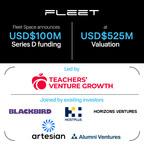
ADELAIDE, Australia, Dec. 11, 2024 /CNW/ — Fleet Space Technologies (Fleet Space), Australia’s leading space exploration company, today announced the closing of a USD$100M Series D funding round, led by Teachers’ Venture Growth (TVG), the late-stage venture and growth investment arm of Ontario Teachers’ Pension Plan, and joined by existing investors Blackbird Ventures, Hostplus, Horizons Ventures, Artesian Venture Partners, and Alumni Ventures. The new investment will be used to expand the capabilities of Fleet Space’s global end-to-end exploration platform, ExoSphere, to accelerate the discovery of critical minerals needed for Earth’s clean energy future.

“The ability to meet the rapidly increasing demand for critical minerals presents a significant challenge to achieving global net-zero targets,” said Rick Prostko, Senior Managing Director, Teachers’ Venture Growth. “Current mineral exploration methods are inadequate for efficient discovery and production. Fleet Space addresses this with advanced 3D subsurface imaging and AI analysis tools, which have the potential to sustainably transform the industry. We are proud to support the multidisciplinary team at Fleet Space in their efforts to accelerate the global energy transition.”

“We’re proud to continue our investment in Fleet Space, building on many years of history,” added Niki Scevak, Partner at Blackbird. “Quite simply, the discovery of critical minerals must exponentially increase if we are to electrify our society by 2050 and breakthroughs, like ExoSphere, are needed to make it happen.”

Real-Time Exploration Powered by Space & AI
Founded by former propulsion engineer at the European Space Agency, Flavia Tata Nardini, and aerospace entrepreneur, Matt Pearson, Fleet Space was created to harness the capabilities of space exploration technologies for a new wave of solutions that can accelerate decarbonisation and the global energy transition. By integrating Fleet Space’s satellites in LEO, smart seismic sensors, and AI into an end-to-end solution, Fleet Space’s ExoSphere technology streamlines the acquisition, processing, and integration of exploration datasets, providing the global mining industry with high-quality targeting insights faster than ever before while minimising environmental impact.

“There are two versions of the future. One where we bend the latest advances in space, AI, and big data towards building a clean energy future and another where we risk net-zero targets falling out of reach as the rate of new discoveries of energy transition minerals continues to decline,” added Flavia Tata Nardini, CEO & Co-Founder of Fleet Space. “With ExoSphere, we have combined these technologies into an end-to-end platform that seamlessly integrates with and compliments modern mining operations – making the frontier of exploration technology accessible to the global mining industry within a single workflow. This is a fundamental step to unlock humanity’s potential for making extraordinary discoveries with less environmental impact.”

Exponential Growth
Today’s announcement caps a period of exponential growth for Fleet Space. In the past year, Fleet Space has:

Expanded the company’s global footprint to the US, Canada, Chile, and Luxembourg with 130+ employees worldwide to support the deployment of ExoSphere for over 40+ industry leading exploration companies across five continents.Deployed ExoSphere to accelerate exploration in some of the most prospective areas on Earth with industry leaders like Rio Tinto and Barrick Gold– while also delivering the world’s largest real-time 3D imaging survey in Australia’s Macquarie Arc and the world’s highest real-time 3D imaging survey in Chile’s Atacama region.Launched ExoSphere Discovery, Fleet Space’s breakthrough AI-powered exploration technology which uses proprietary multimodal AI models to predict opportunity zones and targets with potential mineralisation – a pioneering advance for the use of AI in mineral exploration met with widespread demand in the industry.

“This funding is not just a testament to Fleet Space’s growth, strong investor confidence, and sustained innovation in core technologies needed to address dual challenges of climate change and mineral exploration. It’s a signal that in a period of turbulent macroeconomic conditions, the shared commitment to build technologies needed for Earth’s clean energy future combined with solid business execution can attract the right partners,” said Federico Tata Nardini, Chief Financial Officer and Chief Investment Officer of Fleet Space. “We are proud to be among the few companies globally to close a Series D round in the context of reduced activity in the venture ecosystem and look forward to furthering our vision, strategic initiatives, and roadmap to scale the business to the next level.”

Technology Roadmap for Explorers of New Worlds
While advancing the capabilities of data-driven exploration on Earth with ExoSphere, Fleet Space has also laid the technology foundation to rapidly accelerate the exploration of new worlds.  The smart seismic sensors used as part of Fleet Space’s terrestrial ExoSphere system represent the technological precursor for its lunar variant – SPIDER – which will be deployed on the Moon in 2026 to enhance humanity’s understanding of the lunar subsurface. Collaborating with MIT Media Lab’s Space Exploration Initiative, Fleet Space is also helping to advance off-world research needed for the planning of future missions to the Moon, Mars, and beyond. Additionally, Fleet Space unveiled a cost-effective, resilient full duplex SATCOM system using microsatellites and reprogrammed Centauri-4 to become the world’s smallest voice-enabled satellite.

“The convergence of innovation in space, AI, and 3D subsurface imaging represents a foundational pillar of the core technology set that will enable humanity to build permanent research stations on the Moon, Mars, and beyond,” said Matt Pearson, Chief Exploration Officer at Fleet Space. “The flywheel we’ve created by continuously enhancing the subsurface understanding of Earth through the global deployment of ExoSphere simultaneously drives advances in the technology needed to build highly scalable, data-driven exploration systems for new worlds. A bold new chapter in the history of space exploration is about to begin and we are positioned to play a significant role as humanity boldly ventures deeper into our solar system.”

About Fleet Space Technologies
Fleet Space Technologies, Australia’s leading space exploration company, is revolutionizing critical mineral discovery with its end-to-end mineral exploration solution, ExoSphere, which combines satellite connectivity, 3D multiphysics, and AI to image mineral systems in real-time. Over 40 leading exploration companies like Rio Tinto, Barrick Gold, and Core Lithium have used ExoSphere’s real-time 3D subsurface imaging on projects across five continents. Due to global demand for ExoSphere, Fleet Space’s international footprint has expanded to the US, Canada, Chile, and Luxembourg with over 130+ employees, representing 37 nationalities, worldwide. In 2024, Fleet Space was recognised as the winner of the Innovation category at the Mining Technology Excellence Awards and received the Climate Impact Technology Award by the Banksia Foundation. To learn more about ExoSphere, please reach out to the Fleet Space team here.

About Teachers’ Venture Growth
Teachers’ Venture Growth (TVG) focuses on late-stage venture and growth equity investments in cutting-edge technology companies worldwide. We partner with founders with bold missions, looking to expand their product offering, scale geographically, and become the leaders in their markets. We bring long-term thinking and active investing to help build better businesses and a better world. We think globally and act locally through our direct presence across Asia, North America and Europe.

TVG is part of the Ontario Teachers’ Pension Plan Board (Ontario Teachers’), a global investor with net assets of CAD 255.8 billion as at June 30, 2024. We invest in more than 50 countries in a broad array of assets including public and private equities, fixed income, credit, commodities, natural resources, infrastructure, real estate and venture growth to deliver retirement income for 340,000 working members and pensioners.

Our more than 450 investment professionals operate in key financial centres around the world and bring deep expertise in a broad range of sectors and industries. We are a fully funded defined benefit pension plan and have earned an annual total-fund net return of 9.3% since the plan’s founding in 1990. At Ontario Teachers’, we don’t just invest to make a return, we invest to shape a better future for the teachers we serve, the businesses we back, and the world we live in. For more information, visit otpp.com/teachersventuregrowth and follow us on LinkedIn.

View original content to download multimedia:https://www.prnewswire.com/news-releases/fleet-space-closes-usd100m-series-d-with-usd525m-valuation-302329494.html

SOURCE Fleet Space

Continue Reading
Click to comment

Leave a Reply

Your email address will not be published. Required fields are marked *

Technology

Chef Robotics Physical AI Models Can Now Automate Baked Goods Packing

Published

on

By

SAN FRANCISCO, April 29, 2026 /PRNewswire/ — Chef Robotics, a leader in physical AI for the food industry, today announced that Chef robots can now automate tray assembly for baked goods packing. The application places baked products, such as burger buns, chocolate chip cookies, biscotti, butter cookies, biscuits, fortune cookies, granola bars, rusks, and shortbreads into trays and packaging containers before sealing.

Watch Chef robots in action.

Baked goods packing has historically been difficult to automate for high-mix production. Each item behaves differently on the production line—a granola bar compresses under the wrong grip, while a biscotti or rusk can crack if placed at the wrong angle. Surface textures range from glazed and smooth to crumbly and irregular, and strict presentation requirements leave little room for error. This variability has made it challenging for automation systems to reliably handle baked goods at production speeds, leaving food manufacturers dependent on manual labor and traditional bakery equipment.

To address this, Chef built its baked goods packing application on its existing piece-picking capability, which uses Chef’s AI-powered computer vision and physical AI models trained across diverse real-world production environments. This allows Chef robots to assess each item’s position, shape, and orientation in real time and determine how to pick the items from the pan and place them quickly and precisely without damaging them.

The baked goods packing application supports four distinct placement capabilities.

First, Chef’s vision system detects the angle at which each item sits in the pan and reorients it after picking, placing it on the tray at the exact angle required, regardless of its original position, enabling retail-ready presentation for SKUs that require precise angular placement.

Second, Chef robots can place multiple baked goods into the same packaging container in a single automated pass, completing full tray assembly without manual intervention.

Third, for packaging containers with multiple small compartments, Chef robots can precisely place items into each designated section, including multiple items in the same compartment, using Chef’s AI vision model to detect compartment positions and orientations in real time.

Fourth, Chef’s vision system identifies the exact center of each tray and places every item at a predefined offset from that center, ensuring a uniform, consistent arrangement across every pack regardless of how trays arrive on the conveyor.

For food manufacturers evaluating bakery systems and baked goods packaging automation, the application offers higher throughput, reduced labor dependency, and consistent presentation across shifts. The capability runs on Chef’s existing robotic hardware and software, allowing manufacturers to deploy it without requiring any changes to their production lines.

Chef’s baked goods packing application is available in the U.S., Canada, Germany, and the UK and is included as part of Chef’s robotics-as-a-service (RaaS) pricing model.

About Chef Robotics
Chef is the first company to have commercialized a scalable AI-driven food robotics solution. With over 104 million servings made in production, Chef leverages ChefOS, an AI platform for food manipulation, to offer a Robotics-as-a-Service solution that helps industry-leading food companies increase production volume and meet demand. Headquartered in San Francisco, CA, Chef aims to empower humans to do what humans do best by accelerating the advent of intelligent machines. Visit https://chefrobotics.ai to learn more.

View original content:https://www.prnewswire.com/news-releases/chef-robotics-physical-ai-models-can-now-automate-baked-goods-packing-302756923.html

SOURCE Chef Robotics

Continue Reading

Technology

Chef Robotics Physical AI Models Can Now Automate Baked Goods Packing

Published

on

By

SAN FRANCISCO, April 29, 2026 /PRNewswire/ — Chef Robotics, a leader in physical AI for the food industry, today announced that Chef robots can now automate tray assembly for baked goods packing. The application places baked products, such as burger buns, chocolate chip cookies, biscotti, butter cookies, biscuits, fortune cookies, granola bars, rusks, and shortbreads into trays and packaging containers before sealing.

Watch Chef robots in action.

Baked goods packing has historically been difficult to automate for high-mix production. Each item behaves differently on the production line—a granola bar compresses under the wrong grip, while a biscotti or rusk can crack if placed at the wrong angle. Surface textures range from glazed and smooth to crumbly and irregular, and strict presentation requirements leave little room for error. This variability has made it challenging for automation systems to reliably handle baked goods at production speeds, leaving food manufacturers dependent on manual labor and traditional bakery equipment.

To address this, Chef built its baked goods packing application on its existing piece-picking capability, which uses Chef’s AI-powered computer vision and physical AI models trained across diverse real-world production environments. This allows Chef robots to assess each item’s position, shape, and orientation in real time and determine how to pick the items from the pan and place them quickly and precisely without damaging them.

The baked goods packing application supports four distinct placement capabilities.

First, Chef’s vision system detects the angle at which each item sits in the pan and reorients it after picking, placing it on the tray at the exact angle required, regardless of its original position, enabling retail-ready presentation for SKUs that require precise angular placement.

Second, Chef robots can place multiple baked goods into the same packaging container in a single automated pass, completing full tray assembly without manual intervention.

Third, for packaging containers with multiple small compartments, Chef robots can precisely place items into each designated section, including multiple items in the same compartment, using Chef’s AI vision model to detect compartment positions and orientations in real time.

Fourth, Chef’s vision system identifies the exact center of each tray and places every item at a predefined offset from that center, ensuring a uniform, consistent arrangement across every pack regardless of how trays arrive on the conveyor.

For food manufacturers evaluating bakery systems and baked goods packaging automation, the application offers higher throughput, reduced labor dependency, and consistent presentation across shifts. The capability runs on Chef’s existing robotic hardware and software, allowing manufacturers to deploy it without requiring any changes to their production lines.

Chef’s baked goods packing application is available in the U.S., Canada, Germany, and the UK and is included as part of Chef’s robotics-as-a-service (RaaS) pricing model.

About Chef Robotics
Chef is the first company to have commercialized a scalable AI-driven food robotics solution. With over 104 million servings made in production, Chef leverages ChefOS, an AI platform for food manipulation, to offer a Robotics-as-a-Service solution that helps industry-leading food companies increase production volume and meet demand. Headquartered in San Francisco, CA, Chef aims to empower humans to do what humans do best by accelerating the advent of intelligent machines. Visit https://chefrobotics.ai to learn more.

View original content:https://www.prnewswire.com/news-releases/chef-robotics-physical-ai-models-can-now-automate-baked-goods-packing-302756923.html

SOURCE Chef Robotics

Continue Reading

Technology

Air Products to Expand Industrial Gas Supply for Samsung Electronics’ Next-Generation Semiconductor Fab in South Korea

Published

on

By

New investment underscores the company’s long-term commitment to Korea and its leading role in the global semiconductor industry 

LEHIGH VALLEY, Pa., April 29, 2026 /PRNewswire/ — Air Products (NYSE:APD), a world-leading industrial gases company and serving Samsung globally, today announced it has been selected by Samsung to supply industrial gases for its new advanced semiconductor fab in Pyeongtaek, Gyeonggi Province, South Korea.

Under the agreement, Air Products will build, own and operate multiple state-of-the-art production facilities and a bulk specialty gas supply system to supply nitrogen, oxygen, argon, and hydrogen for Samsung’s new semiconductor fab. The new facilities are expected to come onstream in multiple phases from 2028 through 2030.

Air Products has a long track record of executing multiple phase expansions in Pyeongtaek to support Samsung’s growing manufacturing needs. This latest project represents Air Products’ largest investment to date in the semiconductor industry and will establish Pyeongtaek as the company’s single largest operations site globally supporting the electronics industry. 

“Air Products is honored to be selected once again by Samsung and to have their continued confidence as a trusted partner supporting their strategic growth plans,” said SR Kim, President, Air Products Korea. “This significant investment reinforces Air Products’ role as a leading global supplier to the semiconductor industry and underscores our long-standing commitment to supporting our strategic customers with safety, reliability, efficiency and excellent service.”

Air Products has served the global electronics industry for more than 40 years, supplying industrial gases safely and reliably to many of the world’s leading technology companies. The company has operated in Korea for more than 50 years and has established a strong position in electronics and manufacturing sectors.

About Air Products

Air Products (NYSE: APD) is a world-leading industrial gases company in operation for over 85 years focused on serving energy, environmental, and emerging markets and generating a cleaner future. The Company supplies essential industrial gases, related equipment and applications expertise to customers in dozens of industries, including refining, chemicals, metals, electronics, manufacturing, medical and food. As the leading global supplier of hydrogen, Air Products also develops, engineers, builds, owns and operates some of the world’s largest clean hydrogen projects, supporting the transition to low- and zero-carbon energy in the industrial and heavy-duty transportation sectors. Through its sale of equipment businesses, the Company also provides turbomachinery, membrane systems and cryogenic containers globally.

Air Products had fiscal 2025 sales of $12 billion from operations in approximately 50 countries. For more information, visit airproducts.com or follow us on LinkedInXFacebook or Instagram.

This release contains “forward-looking statements” within the safe harbor provisions of the Private Securities Litigation Reform Act of 1995. These forward-looking statements are based on management’s expectations and assumptions as of the date of this release and are not guarantees of future performance. While forward-looking statements are made in good faith and based on assumptions, expectations and projections that management believes are reasonable based on currently available information, actual performance and financial results may differ materially from projections and estimates expressed in the forward-looking statements because of many factors, including the risk factors described in our Annual Report on Form 10-K for the fiscal year ended September 30, 2025 and other factors disclosed in our filings with the Securities and Exchange Commission. Except as required by law, we disclaim any obligation or undertaking to update or revise any forward-looking statements contained herein to reflect any change in the assumptions, beliefs or expectations or any change in events, conditions or circumstances upon which any such forward-looking statements are based.

View original content to download multimedia:https://www.prnewswire.com/news-releases/air-products-to-expand-industrial-gas-supply-for-samsung-electronics-next-generation-semiconductor-fab-in-south-korea-302757497.html

SOURCE Air Products

Continue Reading

Trending