Connect with us

Technology

Iridium Transforms Satellite IoT with the Launch of Revolutionary Iridium Certus 9704 Module

Published

on

The new module is supported by the Iridium Certus 9704 Development Kit, and is ideal for data, audio messages and image transfers, while positioning companies as more future ready in anticipation of Satellite AIoT

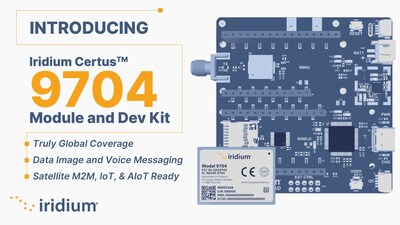
MCLEAN, Va., Dec. 12, 2024 /PRNewswire/ — Iridium Communications Inc. (NASDAQ: IRDM), a leading provider of global voice and data satellite communications, today launched the Iridium Certus™9704, its newest  IoT module, and Iridium Certus 9704 Development Kit. This transformational new module, featuring Iridium Messaging Transport® (IMT®) technology, is the smallest and most powerful created by Iridium, ideal for supporting satellite IoT applications that require real-time data analysis, analytics and automated decision-making. The Iridium Certus 9704 provides larger file transfer sizes and faster message speeds than previous Iridium® IoT modules, delivering data, picture, and audio messages for industrial (IIoT), machine-to-machine (M2M) and remote personnel use cases. Like other Iridium Connected® devices, the Iridium Certus 9704 can provide two-way IoT services anywhere in the world, making fast and reliable connections to a broad array of applications.

The Iridium Certus 9704 architecture simplifies data transfer requirements for use cases like predictive maintenance, diagnostics, telemetry monitoring, remote asset tracking, and command and control for uncrewed aircraft, vehicles and vessels. The module’s larger-sized data messages are also ideal for remote sensing applications protecting wildlife, detecting wildfires and flooding, and enable a new generation of purpose-built satellite messengers and personal safety devices.

“We’ve now packed more capability and value into the smallest module ever from Iridium,” said Matt Desch, CEO, Iridium. “When companies choose to develop with Iridium, they know they are partnering with the leader in satellite IoT applications, and we’ll support them through the development and deployment of their solutions. We’re excited to see how they implement this new technology.”

Designed for ease of integration, the Iridium Certus 9704 is 34% smaller than the Iridium 9603, 79% smaller than the Iridium 9602, and has an 83% reduction in idle power consumption compared to both. This power optimization makes the new module ideal to support battery powered applications, while taking advantage of two-way messaging, including delivery confirmation, over Iridium’s low-latency, truly global satellite network.

Ideal for supporting traditional satellite IoT applications, the new module can also help organizations become more future ready as Artificial Intelligence (AI) becomes integrated with IoT services, known as AIoT (Artificial Intelligence of Things). With this integration, satellite AIoT services should quickly follow, and companies that deploy products with Iridium Certus 9704 modules inside can then choose to offload more computing to the cloud in a single message, where an AIoT engine can quickly make decisions and send new, actionable instructions back to the remote device. This can lessen the required edge device processing power, lower hardware cost, and increase battery life and overall device lifespan. With IMT at its core, a built-in topic-sorting capability means messages can be efficiently organized for delivery to the appropriate engine for various types of real-time data, audio or image analysis.  

“The Iridium Certus 9704 module and Development Kit were designed with the developer in mind,” said Omar Azad, associate director, product management, Iridium. “We want to make it as easy as possible for anyone to experience the new module’s capabilities and quality of the IMT service. When they’re ready to take the next step and build a product to take to market, we’re there to support them with our decades of experience in the satellite IoT space.”

The Iridium Certus 9704 Development Kit is a complete test kit featuring a motherboard, power supply, antenna, module and software from the popular Arduino platform. It was designed to provide maximum autonomy and flexibility for developers, coming with 1,000 free messages and GitLab hosted reference materials. The kit is initially available to prospective Iridium customers for evaluation of the Iridium Certus 9704 module and IMT data service. Iridium has partnered with Blynk to give developers an all-in-one platform for data visualization and a rapid unboxing-to-live-testing experience.

Iridium operates the world’s only truly global, weather resilient satellite constellation designed to reliably deliver critical data to and from anywhere on the planet. As the satellite IoT market leader, Iridium’s IoT service revenue has been growing at an 11% CAGR over the last 10 years. Iridium goes to market through more than 500 companies around the world that integrate its core technology modules, like the Iridium Certus 9704, and sell airtime access to its network.

The Iridium Certus 9704 has received FCC and ISED authorizations for use, with additional regulatory approvals pending.

For more information about Iridium, visit: www.iridium.com

About Iridium Communications Inc.

Iridium® is the only mobile voice and data satellite communications network that spans the entire globe. Iridium enables connections between people, organizations, and assets to and from anywhere, in real time. Together with its ecosystem of partner companies, Iridium delivers an innovative and rich portfolio of reliable solutions for markets that require truly global communications. In 2024, Iridium acquired Satelles and announced the Iridium Satellite Time and Location service. Iridium Communications Inc. is headquartered in McLean, Va., U.S.A., and its common stock trades on the Nasdaq Global Select Market under the ticker symbol IRDM. For more information about Iridium products, services, and partner solutions, visit www.iridium.com.

Forward-Looking Statements Disclosure

Statements in this press release that are not purely historical facts may constitute forward-looking statements as defined in the Private Securities Litigation Reform Act of 1995. The Company has based these statements on its current expectations and the information currently available to us. Forward-looking statements in this press release include statements regarding the capabilities, benefits and availability of the Iridium Certus 9704 module and Development Kit. Forward-looking statements can be identified by the words “anticipates,” “may,” “can,” “believes,” “expects,” “projects,” “intends,” “likely,” “will,” “to be” and other expressions that are predictions or indicate future events, trends or prospects. These forward-looking statements involve known and unknown risks, uncertainties and other factors that may cause the actual results, performance or achievements of Iridium to differ materially from any future results, performance or achievements expressed or implied by such forward-looking statements. These risks and uncertainties include, but are not limited to, uncertainties regarding the company’s ability to maintain the health, capacity and content of its satellite constellation, as well as general industry and economic conditions, and competitive, legal, governmental and technological factors. Other factors that could cause actual results to differ materially from those indicated by the forward-looking statements include those factors listed under the caption “Risk Factors” in the Company’s Form 10-K for the year ended December 31, 2023, filed with the Securities and Exchange Commission (the “SEC”) on February 15, 2024, and the Company’s Form 10-Q for the quarter ended September 30, 2024, filed with the SEC on October 17, 2024, as well as other filings Iridium makes with the SEC from time to time. There is no assurance that Iridium’s expectations will be realized. If one or more of these risks or uncertainties materialize, or if Iridium’s underlying assumptions prove incorrect, actual results may vary materially from those expected, estimated or projected. Iridium’s forward-looking statements speak only as of the date of this press release, and Iridium undertakes no obligation to update forward-looking statements.

Press Contact:

Investor Contact:

Jordan Hassin

Kenneth Levy

Iridium Communications Inc.

Iridium Communications Inc.

Jordan.Hassin@Iridium.com

Ken.Levy@Iridium.com

+1 (703) 287-7421

+1 (703) 287-7570

X: @Iridiumcomm


SOURCE Iridium Communications Inc.

Continue Reading

Technology

ModelBest and OpenBMB Open-Source MiniCPM-OCR Series, Delivering High-Performance Document Parsing and AI-Powered Quality Control

Published

on

By

BEIJING, Oct. 31, 2026 /PRNewswire/ — ModelBest and OpenBMB jointly announced the release and open-source availability of the MiniCPM-OCR series, a family of models for efficient document parsing and parsing-quality assessment. The launch includes two models: MiniCPM-OCR 1.0 (1.3B) and MiniCPM-OCR Jev (2B).

As the first OCR-focused model in the MiniCPM family, MiniCPM-OCR 1.0 brings top-tier parsing accuracy to a compact 1.3-billion-parameter architecture optimized for edge deployment, pushing forward the balance between efficiency and performance for open-source OCR models. Built for real-world conditions, it accurately parses scanned, photographed, curved, tilted and screen-captured documents without cumbersome image pre-correction, lowering the barrier to large-scale document digitization.

The model handles dense bilingual Chinese-English content, complex mathematical formulas, and multi-level or borderless tables, consistently performing at a leading level across a broad range of mainstream industry evaluations. Beyond full-page reconstruction, it supports key information extraction (KIE), pulling specified fields from invoices, IDs and financial statements according to business instructions.

Powered by DSpark decoding acceleration, MiniCPM-OCR 1.0 significantly increases end-to-end throughput while lowering per-page latency. For enterprises processing millions of pages—such as financial contract archives, academic libraries and government records—this means processing far more documents with the same hardware and time budget, at a substantially lower computing cost.

To address the long-standing need for page-by-page manual review, ModelBest and OpenBMB also introduced MiniCPM-OCR Jev, the first OCR result decision model that acts as an “AI quality inspector.” Rather than performing OCR itself, Jev compares the source image with OCR output and rapidly assigns confidence scores to text, LaTeX formulas and tables, detecting missing characters, errors and formatting misalignments. Despite its compact 2B-parameter size, Jev delivers judgment accuracy typically associated with far larger models.

Jev supports cross-model deployment and can be integrated into existing OCR workflows without replacing the underlying OCR engine. It can automatically identify reliable results for direct processing, flag potentially inaccurate outputs for human review and select the best result from multiple OCR systems. This enables enterprises to move from full manual inspection toward risk-based, automated quality control.

The MiniCPM-OCR series is available on GitHub, Hugging Face and ModelScope, and supports vLLM, SGLang, llama.cpp and Ollama, along with SDKs, APIs, Agent Skill plugins and open-source fine-tuning code. Day-0 hardware adaptation covers AMD, Arm, Houmo AI, Intel and NVIDIA. Through the FlagOS software stack, it also has Day-0 support for AI and edge chips from CIX Technology, Huawei Ascend, Hygon, Iluvatar CoreX, Kunlunxin, MetaX, Moore Threads, Sunrise, T-Head, TsingMicro, NVIDIA and Apple Mac (Arm).

View original content:https://www.prnewswire.com/news-releases/modelbest-and-openbmb-open-source-minicpm-ocr-series-delivering-high-performance-document-parsing-and-ai-powered-quality-control-302925594.html

SOURCE ModelBest

Continue Reading

Technology

Wulcea Elevates Consumer Trust in Heated Apparel Through Multi-National Safety Certifications and Rigorous Technical Testing

Published

on

By

NEW YORK, Oct. 31, 2026 /PRNewswire/ — As smart heated clothing gains broader adoption, consumers are paying closer attention to the safety and reliability of the technology behind these products. Wulcea, a brand specializing in graphene-powered heated apparel, combines its flexible GrapheneNano™ heating technology with documented safety compliance and durability testing for its heating components and battery systems.

“Trust in smart heated apparel goes beyond warmth—it comes down to confidence in battery safety and heating element reliability,” said John C, Founder of Wulcea. “Our goal is to give users peace of mind through certified technical standards.”

Advanced Graphene Heating Elements Supported by Global Standards

At the core of Wulcea’s thermal architecture is its GrapheneNano™ heating technology. Engineered to eliminate garment stiffness, Wulcea integrates flexible graphene elements that deliver balanced warmth across key upper-body zones while preserving natural garment drape and full freedom of movement.

Wulcea supports its heating components with applicable compliance documentation for major markets. These include CE and FCC compliance documentation addressing relevant electrical and electromagnetic compatibility requirements, as well as PSE compliance for applicable products in Japan. RoHS compliance further addresses restrictions on specified hazardous substances in applicable electrical and electronic components.

Multi-Certified Battery System for Dependable Power

To power its heating elements, Wulcea pairs its heated apparel with rechargeable battery systems designed for convenient everyday use. Featuring a compact design and housed in dedicated interior pockets, the batteries provide portable power while maintaining a streamlined garment profile and comfortable fit.

Wulcea backs its battery options with comprehensive third-party accreditations. UL certification demonstrates that the battery system has been evaluated against recognized power bank safety requirements, covering key areas such as overcharge protection, short-circuit protection, and thermal safety. The battery systems are also supported by applicable CE and FCC compliance documentation, addressing relevant regulatory requirements for electrical and electromagnetic compatibility.

For daily handling and travel, RoHS compliance validates that the battery system meets stringent global standards for material safety. The battery models have also undergone applicable UN 38.3 testing, supporting compliance with international requirements for lithium battery transportation.

Real-World Durability and Practical Usability

Component compliance forms Wulcea’s foundation, but reliability is defined by real-world performance. Built for high-flex endurance, Wulcea’s flexible graphene heating elements are tested through 10,000 active flexing cycles to maintain steady thermal output through repeated bending and everyday body movement.

Everyday convenience is equally essential. Built for hassle-free care, Wulcea’s heating elements withstand 100 machine-wash cycles under standard care guidelines, maintaining internal conductivity and structural stability under repeated laundering.

Integrated NTC temperature sensors provide thermal monitoring and are designed to stop heating if temperatures exceed 131°F (55°C). Combined with runtime of up to 10 hours on the low setting and a discreet interior control button, these features support practical everyday use in cold-weather conditions.

Aligning Technical Standards with Everyday Warmth

By combining graphene-based heating technology with documented battery safety compliance and durability testing, Wulcea continues to focus on the technical foundations of dependable heated apparel. This approach reflects the brand’s emphasis on bringing together safety considerations, practical functionality, and everyday comfort for cold-weather use.

View original content to download multimedia:https://www.prnewswire.com/news-releases/wulcea-elevates-consumer-trust-in-heated-apparel-through-multi-national-safety-certifications-and-rigorous-technical-testing-302925554.html

SOURCE Wulcea

Continue Reading

Technology

NIDS Co., Ltd. Confirms CES 2027 Participation, Pursues Expansion of Global Supply Chain for Environmental Sensors

Published

on

By

Company introduced optical and gas sensors at SEDEX and is strengthening its composite sensor business for robotics, home appliances, automotive, and smart building applications

SEOUL, South Korea, Oct. 31, 2026 /PRNewswire/ — Environmental sensor manufacturer NIDS Co., Ltd. has confirmed its participation in CES 2027 and is moving to expand its global business-to-business (B2B) supply chain. Building on its experience supplying sensors to domestic and international home appliance and automotive companies, the company aims to secure overseas customers and extend its applications into smart building HVAC and robotics.

NIDS recently participated in the Korea Semiconductor Industry Association’s Sensor Pavilion at SEDEX 2026, held at COEX in Seoul, where it introduced its next-generation sensor modules. The company said the exhibition allowed it to raise awareness of its technology among domestic home appliance and electronic component industry professionals and to lay the groundwork for collaboration in the sensor field.

The company will use CES 2027 as its next stage. NIDS plans to firm up discussions on sensor module supply with global home appliance makers, HVAC specialists, and robotics companies. It aims to extend the industry contacts gained at the domestic exhibition overseas and to convert product introductions into actual supply opportunities.

Founded in 2000, NIDS develops and manufactures environmental sensors and air quality management solutions. According to the company, it has supplied more than 10 million sensors cumulatively to domestic and international companies, including Dyson, Samsung Electronics, and Hyundai Motor. Drawing on this supply track record, the company intends to showcase its precision sensing technology and mass-production capabilities to overseas customers.

Its main products include particulate matter sensors, optical gas sensors based on non-dispersive infrared (NDIR) technology, composite environmental sensors, and electronic nose sensor modules. The particulate matter sensors measure PM1.0, PM2.5, and PM10, while the gas sensor lineup targets carbon dioxide (CO₂), carbon monoxide (CO), and other gases. The electronic nose is used for detecting everyday odors, gas leaks, and fires. The company said it designs the core components required for air quality measurement in-house and has a system in place to mass-produce 5 million units annually.

The area where NIDS will expand development and supply going forward is next-generation composite sensor modules. The company has been pursuing a sensor business that responds to industry-specific demand in home appliances, automotive, and smart building HVAC, and is now concentrating its capabilities on markets such as robotics, industrial safety, and odor detection based on this technology. Building on its experience supplying individual components, NIDS plans to continue developing and supplying, on a B2B basis, modules that handle multiple types of environmental data.

The company will also highlight its sensor product lineup and its newly developed ultra-compact MEMS sensor technology at the exhibition. NIDS plans to introduce its optical and gas sensor lineup along with examples of their application in actual air quality management systems. By explaining both the measurement functions of its components and its experience operating sensors for finished-product services, the company aims to broaden the scope of partnership discussions.

NIDS explained that, because it owns its precision sensors, it can control sensor sensitivity and tune algorithms to suit the system in which they are applied. Drawing on this technical operating experience, the company plans to pursue partnerships with customers and to promote its business capabilities extending from sensor components to air quality and odor management and industrial safety management.

NIDS will also leverage its existing branch network in its overseas market development. Through its overseas bases in the United States, Japan, and China, the company plans to widen its touchpoints with buyers and seek new supply opportunities in conjunction with its CES participation. Its goal is to generate export results by combining exhibition participation with its local networks.

The company intends to keep expanding the global supply of sensor components as a core pillar of its business. Building on the supply experience accumulated in home appliances and automotive, it will broaden its partners to robotics, HVAC, and smart buildings, and respond to industry-specific air quality measurement demand through the development of next-generation modules.

“We plan to continue expanding the development and B2B supply of next-generation composite sensor modules needed across a range of industries, including home appliances, automotive, and smart building HVAC,” NIDS said.

View original content to download multimedia:https://www.prnewswire.com/news-releases/nids-co-ltd-confirms-ces-2027-participation-pursues-expansion-of-global-supply-chain-for-environmental-sensors-302925577.html

SOURCE NIDS Co., Ltd.

Continue Reading

Trending