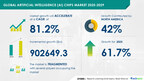
NEW YORK, Jan. 24, 2025 /PRNewswire/ — Report on how AI is redefining market landscape – The global artificial intelligence (AI) chips market size is estimated to grow by USD 902.65 billion from 2025-2029, according to Technavio. The market is estimated to grow at a CAGR of over 81.2% during the forecast period. Increased focus on developing AI chips for smartphones is driving market growth, with a trend towards convergence of AI and IoT. However, dearth of technically skilled workers for ai chips development poses a challenge. Key market players include Advanced Micro Devices Inc., Baidu Inc., Broadcom Inc., Cerebras, Fujitsu Ltd., Google LLC, Graphcore Ltd., Huawei Technologies Co. Ltd., Intel Corp., International Business Machines Corp., MediaTek Inc., Microchip Technology Inc., NVIDIA Corp., NXP Semiconductors NV, Qualcomm Inc., SambaNova Systems Inc., Samsung Electronics Co. Ltd., SenseTime Group Inc., Taiwan Semiconductor Manufacturing Co. Ltd., and Tesla Inc..
Key insights into market evolution with AI-powered analysis. Explore trends, segmentation, and growth drivers- View Free Sample PDF
Artificial Intelligence (AI) Chips Market Scope
Report Coverage
Details
Base year
2024
Historic period
2019 – 2023
Forecast period
2025-2029
Growth momentum & CAGR
Accelerate at a CAGR of 81.2%
Market growth 2025-2029
USD 902.65 billion
Market structure
Fragmented
YoY growth 2022-2023 (%)
61.7
Regional analysis
North America, Europe, APAC, South America, and Middle East and Africa
Performing market contribution
North America at 42%
Key countries
US, Canada, China, UK, Germany, France, Japan, Italy, India, and Brazil
Key companies profiled
Advanced Micro Devices Inc., Baidu Inc., Broadcom Inc., Cerebras, Fujitsu Ltd., Google LLC, Graphcore Ltd., Huawei Technologies Co. Ltd., Intel Corp., International Business Machines Corp., MediaTek Inc., Microchip Technology Inc., NVIDIA Corp., NXP Semiconductors NV, Qualcomm Inc., SambaNova Systems Inc., Samsung Electronics Co. Ltd., SenseTime Group Inc., Taiwan Semiconductor Manufacturing Co. Ltd., and Tesla Inc.
Market Driver
Artificial Intelligence (AI) is revolutionizing industries from healthcare to retail, finance, automotive, and more. Deep learning and machine learning algorithms require powerful hardware components like AI chips. Advanced Micro Devices (AMD) and Nvidia lead the market with their Trainium2 chip and A100 chip, respectively. These chips use highbandwidth memory for energy efficiency and high computing power. Quantum computing and generative AI are emerging trends in AI technologies. AI chip lines, such as Ascend 910B chipset and H200 chipset, are designed specifically for AI applications. Cloud providers like Microsoft Azure, Amazon Web Services, and Google Cloud offer AI services, while edge computing enables real-time data processing on Edge devices. Ethical concerns surrounding AI use are rising. AI applications in healthcare, elder care, and IoT devices require high security and privacy. ML and DL algorithms power computer vision, image recognition, and pose detection, while cognitive computing and machine intelligence enable personalized health and treatment devices. AI technologies require various hardware components, including CPUs, GPUs, FPGAs, ASICs, DSPs, microcontrollers, frame buffers, and display devices. Energy efficiency, latency, and parallel computing are crucial factors for AI data centers. Theoretical and algorithmic basis, automatic analysis, and extraction are essential for AI applications. Patent filings for AI technologies are increasing, with applications in various industries, including manufacturing machines, wearable devices, smart homes, and connected cars. System failure and malfunctioning are concerns, and ethical considerations are necessary for the successful implementation of AI technologies.
The Internet of Things (IoT) market is experiencing significant growth due to the numerous advantages it offers in various industries, including aerospace and defense, automotive, consumer electronics, healthcare, and more. IoT devices, which include cameras, drones, smart speakers, smartphones, smart TVs, and others, are making decisions based on data they receive without human intervention. To enhance the capabilities of these devices, manufacturers are integrating Human-Machine Interface (HMI) technologies and deploying AI chips. These chips enable power-efficient data processing and machine learning computation, allowing IoT devices to function more intelligently and autonomously. The integration of AI chips in IoT devices is a key trend driving market growth.
Request Sample of our comprehensive report now to stay ahead in the AI-driven market evolution!
Market Challenges
Artificial Intelligence (AI) is revolutionizing industries from healthcare to retail, finance, and automotive. However, the growing demand for AI technologies, including deep learning and machine learning, puts pressure on hardware components like AI chips. Companies like Advanced Micro Devices and Nvidia are investing in AI chip lines, such as the Trainium2 chip and Nvidia’s A100 chip, to meet this demand. These chips enable AI algorithms to run efficiently, powering applications like image recognition and pose detection. However, challenges remain. Energy efficiency is crucial, as AI data centers require vast amounts of power. Quantum computing and generative AI may offer solutions, but they present complexities. Ethical concerns around AI use also arise. Edge computing and Edge devices are becoming essential for real-time applications, reducing latency and processing data locally. Big data requires high-bandwidth memory and parallel computing, which can be achieved through system on chip, multichip module, or ASICs. Major cloud providers like Microsoft Azure, Amazon Web Services, and Google Cloud offer AI services, but they face competition from edge devices and AI data centers. AI applications in industries like healthcare, retail, finance, and automotive require specialized hardware, such as CPUs, GPUs, FPGAs, and DSPs. The future of AI lies in the intersection of AI technologies, hardware components, and ethical considerations.The AI chips market is experiencing significant growth due to the potential revenue increases for businesses adopting artificial intelligence. However, the lack of skilled labor in AI technology poses a significant challenge to market expansion. Companies must carefully consider the high research and development costs and potential talent shortage before implementing AI solutions. Enterprise AI implementation is currently hindered by the scarcity of experienced professionals with the necessary technical expertise in this field.
Discover how AI is revolutionizing market trends- Get your access now!
Segment Overview
This artificial intelligence (ai) chips market report extensively covers market segmentation by
Product 1.1 ASICs1.2 GPUs1.3 CPUs1.4 FPGAsEnd-user 2.1 Media and advertising2.2 BFSI2.3 IT and telecommunication2.4 OthersGeography 3.1 North America3.2 Europe3.3 APAC3.4 South America3.5 Middle East and AfricaProcessing TypeApplicationTechnology
1.1 ASICs- Artificial Intelligence (AI) chips are experiencing significant growth, with application-specific integrated circuits (ASICs) leading the way. ASICs are customized chips designed for specific functions, offering faster performance than GPUs and FPGAs. Google’s Tensor Processing Unit (TPU) is an ASIC-based AI chip, specifically engineered for deep neural networks. TPU is a hardware-software solution that learns tasks by analyzing large data sets. It’s already being used in Google Search and Google Street View. Data centers are integrating TPUs into servers to manage data efficiently. TPU’s instruction set allows TensorFlow programs to be modified, enabling new algorithms. TensorFlow is an open-source machine learning library, making ASIC-based AI chips a promising choice for data center applications. The use of ASICs is driving the growth of AI chips market, providing superior performance and speed compared to GPUs, FPGAs, and CPUs.
Download a Sample of our comprehensive report today to discover how AI-driven innovations are reshaping competitive dynamics
Research Analysis
Artificial Intelligence (AI) Chips Market: The global AI Chips Market is experiencing significant growth due to the increasing demand for advanced AI technologies in various industries. AI Chips are specialized hardware components designed to accelerate AI algorithms, including deep learning and machine learning. These chips are integral to AI applications in robotics, autonomous vehicles, healthcare, retail, finance, automotive, IoT devices, and more. Quantum computing is also expected to revolutionize AI technologies, leading to the development of more powerful AI chips. Advanced Micro and other key players are investing heavily in AI chip research and development. The market includes various types of chips such as CPU, FPGA, GPU, system on chip, multichip module, and Trainium2 chip. Ethical concerns surrounding AI are also driving the need for more efficient and specific integrated AI chips. The market is segmented into cloud and edge computing, with the edge computing segment expected to grow rapidly due to the increasing demand for real-time AI processing. Highbandwidth memory is another critical component of AI chips, enabling faster data processing and analysis. Overall, the AI Chips Market is poised for significant growth in the coming years.
Market Research Overview
Artificial Intelligence (AI) Chips Market: Overview The Artificial Intelligence (AI) Chips Market is a rapidly growing sector that focuses on designing and manufacturing specialized hardware components for AI applications. These chips are designed to accelerate AI algorithms, including deep learning and machine learning, to enable advanced functionalities such as image recognition, pose detection, behavioral patterns analysis, and natural language processing. AI Chips are essential components of various AI technologies, including robotics, quantum computing, and cognitive computing. They come in different forms, such as System on Chip (SoC), Multichip Module (MCM), CPU, GPU, FPGA, ASIC, DSP, and microcontrollers. The market for AI Chips is driven by the increasing demand for AI applications in various industries, including healthcare, retail, finance, automotive, and manufacturing. The need for real-time data processing and energy efficiency is also a significant factor driving the growth of the market. AI Chips are used in both centralized cloud servers and edge devices for data processing. Centralized cloud servers, such as Microsoft Azure, Amazon Web Services, and Google Cloud, require high computing power and high-bandwidth memory, making GPUs and CPUs popular choices for AI Chips. Edge devices, on the other hand, require low power consumption and small form factors, making FPGAs and ASICs popular choices. The market for AI Chips is also driven by the increasing use of AI in mobile applications, healthcare, and IoT devices. Ethical concerns regarding AI and the elderly population’s growing demand for personalized health solutions are also expected to fuel the market’s growth. Some of the notable AI Chips in the market include Nvidia’s A100 chip, Ascend 910B chipset, and H200 chipset. Companies are also investing heavily in patent filing and system failure prevention to ensure the reliability and efficiency of their AI Chips. The market for AI Chips is expected to continue growing as AI applications become more prevalent in various industries. The increasing use of AI in real-time applications, such as autonomous vehicles and smart homes, is also expected to drive the market’s growth. However, the market’s growth may be hindered by the high cost of developing and manufacturing AI Chips and the ethical concerns surrounding AI. In conclusion, the AI Chips Market is a dynamic and growing sector that plays a crucial role in enabling advanced AI applications across various industries. The market’s growth is driven by the increasing demand for AI applications, the need for energy efficiency, and the development of new AI technologies, such as generative AI and cognitive computing. However, the market’s growth may be hindered by ethical concerns and the high cost of developing and manufacturing AI Chips.
Table of Contents:
1 Executive Summary
2 Market Landscape
3 Market Sizing
4 Historic Market Size
5 Five Forces Analysis
6 Market Segmentation
ProductASICsGPUsCPUsFPGAsEnd-userMedia And AdvertisingBFSIIT And TelecommunicationOthersGeographyNorth AmericaEuropeAPACSouth AmericaMiddle East And AfricaProcessing TypeApplicationTechnology
7 Customer Landscape
8 Geographic Landscape
9 Drivers, Challenges, and Trends
10 Company Landscape
11 Company Analysis
12 Appendix
About Technavio
Technavio is a leading global technology research and advisory company. Their research and analysis focuses on emerging market trends and provides actionable insights to help businesses identify market opportunities and develop effective strategies to optimize their market positions.
With over 500 specialized analysts, Technavio’s report library consists of more than 17,000 reports and counting, covering 800 technologies, spanning across 50 countries. Their client base consists of enterprises of all sizes, including more than 100 Fortune 500 companies. This growing client base relies on Technavio’s comprehensive coverage, extensive research, and actionable market insights to identify opportunities in existing and potential markets and assess their competitive positions within changing market scenarios.
Contacts
Technavio Research
Jesse Maida
Media & Marketing Executive
US: +1 844 364 1100
UK: +44 203 893 3200
Email: media@technavio.com
Website: www.technavio.com/
View original content to download multimedia:https://www.prnewswire.com/news-releases/artificial-intelligence-ai-chips-market-to-grow-by-usd-902-65-billion-2025-2029-focus-on-ai-chips-for-smartphones-drives-growth-report-with-ai-trends—technavio-302358946.html
SOURCE Technavio








 Technology5 days ago
 Technology4 days ago
 Technology5 days ago
 Coin Market4 days ago

 Technology5 days ago
 Technology5 days ago
 Technology4 days ago