Connect with us

Technology

Private Tutoring Market in the US to Grow by USD 28.85 Billion (2025-2029), Driven by Emphasis on STEM Education, Report Highlights AI-Driven Transformation – Technavio

Published

on

NEW YORK, Jan. 24, 2025 /PRNewswire/ — Report with the AI impact on market trends – The private tutoring market in US  size is estimated to grow by USD 28.85 billion from 2025-2029, according to Technavio. The market is estimated to grow at a CAGR of  11.1%  during the forecast period. Growing emphasis on stem education is driving market growth, with a trend towards increasing emphasis on microlearning. However, availability of open-source material  poses a challenge. Key market players include American Tutor Inc., ArborBridge, Boston Tutoring Services, Chegg Inc., Club Z Inc., Coursera Inc., Graham Holdings Co., Growing Stars Inc., Huntington Mark LLC, IXL Learning Inc., John Wiley and Sons Inc., Mathnasium LLC, Pearson Plc, Superprof SAS, Sylvan Learning LLC, Think and Learn Pvt. Ltd., Tutor Doctor, TutorMe LLC, Tutors International Ltd., and Varsity Tutors LLC.

AI-Powered Market Evolution Insights. Our comprehensive market report ready with the latest trends, growth opportunities, and strategic analysis- View Free Sample Report PDF

Forecast period

2025-2029

Base Year

2024

Historic Data

2019 – 2022

Segment Covered

Type (Curriculum-based learning and Test preparation), Learning Method (Online, Blended, and Classroom-based), and Geography (North America)

Region Covered

US

Key companies profiled

American Tutor Inc., ArborBridge, Boston Tutoring Services, Chegg Inc., Club Z Inc., Coursera Inc., Graham Holdings Co., Growing Stars Inc., Huntington Mark LLC, IXL Learning Inc., John Wiley and Sons Inc., Mathnasium LLC, Pearson Plc, Superprof SAS, Sylvan Learning LLC, Think and Learn Pvt. Ltd., Tutor Doctor, TutorMe LLC, Tutors International Ltd., and Varsity Tutors LLC

Key Market Trends Fueling Growth

The private tutoring market in the US is witnessing a significant trend towards microlearning. This approach to education involves breaking down learning content into small, manageable modules. Vendors in the market are incorporating microlearning into their course offerings to enhance learner engagement and improve understanding. Microlearning modules consist of various formats such as video, audio, text, and infographics, with each session typically lasting 5-10 minutes. Quizzes, games, and just-in-time content delivery are also essential components. Microlearning offers several advantages, including bridging knowledge gaps, enabling better understanding and retention, addressing time and resource constraints, and offering flexibility and compatibility across devices. As a result, the emphasis on microlearning is expected to drive growth in the US private tutoring market during the forecast period. 

The private tutoring market is on the rise, with students seeking individualized attention for academic success. Technology-based learning is a major trend, offering online subscriptions, subject-related content, presentations, 3D colored diagrams, animations, and more. Education technology is transforming literacy and subjects like Mathematics and Sciences. Wealthy parents and private schools invest in private tuition for career development, while public school-based students also opt for shadow education. Annual service contracts are common, with Cambridge Assessment and other test preparation services leading the way. Private tutors use teaching methods tailored to each student, available in both offline and online modes. UpGrad, Caltech University, Fullstack Academy, and Deeksha Classes offer short-term and long-term courses, microlearning, and mentorships. Bramble survey reveals that post-K-12 students compete in academic ranks, focusing on competitive examinations and academic and non-academic subjects. 

Insights on how AI is driving innovation, efficiency, and market growth- Request Sample!

Market Challenges

The private tutoring market in the US is experiencing significant competition from open-source tutoring services that provide free learning materials. Established tutoring service providers like Club Z Inc. And Kaplan offer tutoring sessions for various subjects against a fee. However, open-source platforms such as Coursera, edX, Udacity, and FutureLearn offer Massive Open Online Courses (MOOCs) with flexible accessibility and course duration. While some MOOCs charge a minimal fee for certifications, most open-source content is accessible free of cost. The popularity of MOOCs is increasing due to their adaptable curriculum and affordability. Students can access free courses on mobile devices and learn at their own pace. MOOCs are becoming a viable alternative to traditional education, posing a threat to the growth of the private tutoring market in the US.The private tutoring market is a significant sector in the education industry, serving students from Post-K-12 to those preparing for competitive examinations in academic and non-academic subjects. According to the Bramble survey, the market size is substantial, with billionaires spending thousands of dollars on tutoring monthly, while the median household spends an average of a few hundred dollars. Short-term courses in microlearning and test preparation services are popular, with long-term coaching courses and mentorships also in demand. UpGrad, Caltech University, Fullstack Academy, Deeksha Classes, and various other institutions offer various types of tutoring services. However, challenges include managing monthly bills, accidental overdrafts, and expenses on debit cards, making online tutoring an attractive alternative. Online banks and savings accounts with competitive interest rates are essential tools for managing education-related expenses.

Insights into how AI is reshaping industries and driving growth- Download a Sample Report

Segment Overview 

This private tutoring market in US report extensively covers market segmentation by

Type 1.1 Curriculum-based learning1.2 Test preparationLearning Method2.1 Online2.2 Blended2.3 Classroom-basedGeography 3.1 North America

1.1 Curriculum-based learning-  The private tutoring market continues to grow as more students seek individualized instruction for academic success. Tutors offer personalized learning plans, flexible schedules, and one-on-one attention. Parents value this customized approach, leading to increased demand for private tutoring services. Tutors use various teaching methods and tools to cater to diverse learning styles, ensuring effective learning outcomes. This market trend is expected to persist, providing opportunities for dedicated educators to make a positive impact on students’ academic journeys.

Download complimentary Sample Report to gain insights into AI’s impact on market dynamics, emerging trends, and future opportunities- including forecast (2025-2029) and historic data (2019 – 2022) 

Research Analysis

The tutoring market has experienced significant growth in recent years, driven by the increasing demand for personalized learning solutions. With the advent of technology-based learning, students now have access to a wealth of subject-related content through online subscriptions. This includes presentations, 3D colored diagrams, animations, and flashcards, making education more engaging and interactive. Education technology has revolutionized the way we learn, offering annual service for academic subjects like Literacy, Mathematics, Sciences, and non-academic subjects. Short-term and long-term courses in competitive examinations and post-K-12 education are also popular offerings. UpGrad, Caltech University, and Fullstack Academy are some institutions leading the way in technology-driven education. Microlearning, mentorships, coaching courses, and test preparation services are other areas of growth in the tutoring market.

Market Research Overview

The tutoring market continues to grow as students seek personalized learning solutions, both online and offline. Technology-based learning is at the forefront, with subject-related content, presentations, 3D colored diagrams, animations, and flashcards enhancing education. Annual service subscriptions offer access to a wealth of resources for literacy, mathematics, sciences, career development, and more. Education technology companies provide test preparation services and subject tutoring, while private tutors use innovative teaching methods. Private tuition, also known as shadow education, is popular among parents seeking academic improvement for their children, especially in competitive examinations and academic subjects. The market caters to both wealthy parents and those on a median household income, with monthly bills varying from accidental overdrafts to debit card transactions at the supermarket or clothing store. UpGrad, Caltech University, Fullstack Academy, and other allied industries offer microlearning and coaching courses. The Bramble survey reports that post-K-12 students benefit from private tutoring in all subjects, including non-academic areas. Annual service subscriptions offer flexible plans, with short-term and long-term courses catering to various learning styles and budgets. Education technology platforms like Cambridge Assessment, Deeksha Classes, and mentorship programs provide comprehensive solutions for students aiming for academic ranks in public and private schools. The tutoring market is a significant industry, with billionaire investors recognizing its potential and investing in education technology companies. In summary, the tutoring market is a dynamic and growing industry, catering to students’ diverse learning needs through technology-based solutions, private tutoring, and education technology companies. With various pricing models and subscription plans, it offers flexible solutions for students and parents alike, making education accessible and affordable.

Table of Contents:

1 Executive Summary
2 Market Landscape
3 Market Sizing
4 Historic Market Size
5 Five Forces Analysis
6 Market Segmentation

TypeCurriculum-based LearningTest PreparationLearning MethodOnlineBlendedClassroom-basedGeographyNorth America

7 Customer Landscape
8 Geographic Landscape
9 Drivers, Challenges, and Trends
10 Company Landscape
11 Company Analysis
12 Appendix

About Technavio

Technavio is a leading global technology research and advisory company. Their research and analysis focuses on emerging market trends and provides actionable insights to help businesses identify market opportunities and develop effective strategies to optimize their market positions.

With over 500 specialized analysts, Technavio’s report library consists of more than 17,000 reports and counting, covering 800 technologies, spanning across 50 countries. Their client base consists of enterprises of all sizes, including more than 100 Fortune 500 companies. This growing client base relies on Technavio’s comprehensive coverage, extensive research, and actionable market insights to identify opportunities in existing and potential markets and assess their competitive positions within changing market scenarios.

Contacts

Technavio Research
Jesse Maida
Media & Marketing Executive
US: +1 844 364 1100
UK: +44 203 893 3200
Email: media@technavio.com
Website: www.technavio.com/

View original content to download multimedia:https://www.prnewswire.com/news-releases/private-tutoring-market-in-the-us-to-grow-by-usd-28-85-billion-2025-2029-driven-by-emphasis-on-stem-education-report-highlights-ai-driven-transformation—technavio-302358318.html

SOURCE Technavio

Continue Reading

Technology

CollectivIQ Introduces GigaBrain, Giving Enterprises a Shared Brain That Gets Smarter as Employees Work

Published

on

By

New Enterprise Intelligence Layer Turns the Collective Learnings of AI Agents Into Secure, Usable Organizational Knowledge

BOSTON, Oct. 21, 2026 /PRNewswire/ — CollectivIQ, the collective intelligence platform built to give employees more honest AI insights and digital teammates that put its intelligence to work, today announced the availability of GigaBrain, a new shared intelligence layer that enables organizations to capture, connect, and use the knowledge accumulated by employees and their Digital Direct Reports (DDRs), which are specialized AI teammates that work for people much like human direct reports do. Every company has valuable knowledge that lives outside its formal systems, across various tools, residing in employees’ heads, embedded in conversations, and lodged in disparate company applications. GigaBrain is designed to make that collective intelligence available to the organization and its employees.

As employees work with their Digital Direct Reports, those AI teammates develop context about their work, including projects, processes, responsibilities, relationships, and preferences. With GigaBrain, those individual learnings can contribute to a shared enterprise memory, allowing knowledge developed in one part of an organization to make AI more useful across the business. The result is an enterprise AI environment that gets smarter through use. Rather than requiring employees to repeatedly find, upload or explain the same information, GigaBrain gives employees and their Digital Direct Reports access to relevant organizational context when they need it.

When a sales representative’s DDR learns the intricacies of a customer’s procurement process, including approval requirements, key decision-makers, and purchasing timelines, that knowledge can automatically become available to other team members, subject to appropriate access permissions. When the customer reaches out for help, the team will already have the context needed to navigate the relationship effectively, without asking the customer to repeat information or relying on a manual handoff.

“Companies are collectively spending billions to bring intelligence to their employees, but very little of that investment makes the company itself smarter,” said John Davie, CEO of CollectivIQ. “The breakthrough isn’t just giving every employee an AI teammate, it’s making sure what those employees and AI teammates learn becomes an advantage for the entire organization. GigaBrain turns everyday work into intelligence that compounds across the enterprise.”

While enterprise AI platforms such as Microsoft Copilot and Glean help employees access organizational information, GigaBrain is designed to capture knowledge that emerges through employees’ day-to-day interactions with their DDRs, including insights that may never be formally documented. GigaBrain creates an organizational knowledge layer that can connect what employees and their Digital Direct Reports learn through everyday work, giving AI access to relevant internal context alongside the broader knowledge available from large language models.

GigaBrain was built to provide a source of enterprise knowledge that Digital Direct Reports can draw upon as they work, including the ability to trace information back to its source, giving employees greater visibility into where organizational knowledge came from, and helping AI work from relevant company context. Employees do not need to manually document every useful insight for the system to become more valuable. As they collaborate with their Digital Direct Reports, relevant knowledge can become part of the enterprise intelligence available to other authorized AI teammates.

GigaBrain is also designed for the realities of enterprise information governance, as employees can use an incognito mode when working with information that should not contribute to shared organizational memory, giving users a way to keep sensitive or confidential interactions out of GigaBrain.

GigaBrain expands CollectivIQ’s vision for Digital Direct Reports beyond individual AI productivity, allowing the knowledge developed through that work to become part of a broader organizational intelligence layer. Together, they give companies a foundation for AI that does more than answer questions. CollectivIQ’s ecosystem can learn how an organization works, retain what it learns and make that knowledge useful across the enterprise.

GigaBrain is available through the CollectivIQ platform. For more information, visit www.collectiviq.ai.

About CollectivIQ

CollectivIQ is the collective intelligence platform built to give employees more accurate AI insights and teammates that put its intelligence to work. Founded by the leadership team behind Buyers Edge Platform, CollectivIQ was built to bring accountability, action, and economic alignment to enterprise AI adoption. Learn more at www.collectiviq.ai.

View original content to download multimedia:https://www.prnewswire.com/news-releases/collectiviq-introduces-gigabrain-giving-enterprises-a-shared-brain-that-gets-smarter-as-employees-work-302915537.html

SOURCE CollectivIQ

Continue Reading

Technology

Pactum Launches Intake Agent, Cutting Purchase Request Cycle Time by 90%

Published

on

By

New AI agent replaces complicated purchase forms and repeated follow-ups by completing and checking every request before it is submitted, inside Microsoft Teams, Coupa, and SAP Ariba.

MOUNTAIN VIEW, Calif., Oct. 21, 2026 /PRNewswire/ — Pactum, the most advanced agentic AI platform for enterprise autonomous procurement execution, today announced the launch of its Intake Agent, which lets employees describe what they need to buy in plain language. The agent turns each request into a complete, correctly coded requisition and checks it against company buying policies before it is submitted.  Available now in Microsoft Teams, Coupa, and SAP Ariba, the Intake Agent connects with Pactum’s other agents to enable end-to-end autonomous indirect procurement. A purchase can draw on an existing contract or move to autonomous sourcing and negotiation, with a human buyer handling requests that require judgment.

The launch extends Pactum’s growing portfolio of AI agents to the start of indirect procurement, covering purchases such as software, office equipment, and professional services. It brings Pactum’s co-founders’ vision of procurement run with AI agents from the first request through sourcing and negotiation into operation. Procurement teams set the buying rules once, and the agent applies them to every request, whatever its value.

“Procurement teams can now run indirect procurement with full autonomy while remaining in control and managing the exceptions,” said Kaspar Korjus, Co-Founder and CEO of Pactum. “Our Intake Agent helps resolve questions earlier so requests can move forward with less back-and-forth and teams can focus on the decisions that need their expertise.”

For employees, finding an approved supplier or selecting the right accounting code can require expertise across procurement, finance, operations, and IT teams. Missing or incorrect information can lead to rejected requisitions and repeated follow-ups, leaving buyers to focus on correcting forms instead of focusing on supplier relationships and commercial decisions. Review queues can stretch from days to weeks.

With Pactum Intake, employees describe what the business needs, whether goods or services of any complexity, and can provide supporting documents such as a supplier quote. The agent uses the request and relevant documents to identify the best procurement category and complete the accounting and supplier details. It asks only the follow-up questions needed to complete the requisition. Once the request is checked, it is handed off to another Pactum digital worker to autonomously source and negotiate for better pricing and terms where required.

“Building software that assists procurement professionals is relatively easy. Building software that runs the whole process on its own, from the first request to the final purchase, is much harder,” said Kristjan Korjus, Co-Founder and Chief Scientist at Pactum. “It is the difference between driver assistance and a car with no one behind the wheel. Most procurement AI still needs a buyer at the wheel for every request. Our AI agents take the request all the way to the purchase on their own, and it is remarkable to watch them pass the work from one agent to the next.”

The launch follows Pactum’s Requisition Alignment Agent surpassing one million requisition checks, which validates purchase requests against company buying policies, existing contracts, and approved suppliers. Intake builds on this foundation in policy enforcement by connecting employee requests with agents that carry out sourcing and negotiation.

For more information about Pactum Intake, visit https://pactum.com/procurement-agents/intake.     

About Pactum:

Since 2019, Pactum has been leading the shift to autonomous procurement. Its AI agents check every purchase request against a company’s policies, contracts and approved suppliers, source and negotiate with suppliers in more than 40 languages, and work inside Coupa and SAP Ariba. Pactum agents are relied on by more than 60 of the world’s largest enterprises. To learn more, visit www.pactum.com.

View original content to download multimedia:https://www.prnewswire.com/news-releases/pactum-launches-intake-agent-cutting-purchase-request-cycle-time-by-90-302915539.html

SOURCE Pactum

Continue Reading

Technology

Crush Security Launches Crush Dollar Exposure, Turning Cyber Risk Into Dollars and Showing Which Security Investments Reduce It Most

Published

on

By

New financial risk intelligence capability uses FAIR-informed modeling, Monte Carlo analysis and security data to help CISOs and CFOs quantify cyber exposure, prioritize remediation and communicate financial risk to executive leadership.

SCOTTSDALE, Ariz., Oct. 21, 2026 /PRNewswire/ — Crush Security today announced the launch of Crush Dollar Exposure, a new capability within its cybersecurity intelligence platform that translates cyber risk into financial exposure and helps organizations identify which security improvements can deliver the greatest reduction in potential financial loss.

For years, cybersecurity teams have measured their environments through vulnerabilities, risk scores, compliance percentages and control gaps. While valuable to security operations, those measurements often fail to answer the fundamental questions that executives and boards need answered:

How much could our cybersecurity weaknesses cost the business, and where should we invest to reduce that exposure?

Crush Dollar Exposure is designed to answer those questions by connecting an organization’s security posture, control coverage, threat intelligence and industry financial loss data to a quantitative view of cyber risk. The result is a financial perspective that enables security and business leaders to evaluate potential losses, compare remediation priorities and make more informed investment decisions.

From Technical Risk Scores to Financial Decisions

Traditional cybersecurity assessments often produce long lists of findings ranked by technical severity. But the most technically severe vulnerability is not necessarily the one that represents the greatest potential financial loss to the organization.

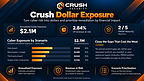
Crush Dollar Exposure changes the decision-making process by evaluating security gaps through their estimated contribution to financial risk. The capability provides four principal measurements:

Annualized Financial Exposure: An estimate of potential annual cyber losses, expressed in dollars.Financial Exposure Relative to Revenue: A view of modeled cyber exposure in relation to the organization’s annual revenue, providing business context.Value-at-Risk Analysis: Potential loss thresholds at selected probability levels, supported by loss-exceedance curves that illustrate the range of possible financial outcomes.Financially Prioritized Remediation: Security control gaps ranked by their modeled contribution to financial exposure, helping teams identify where remediation may reduce the most risk.

Rather than simply reporting that a security control is missing or a vulnerability is critical, Crush Dollar Exposure helps organizations understand the potential financial consequences and prioritize corrective action accordingly.

Connecting Every Security Gap to Business Impact

One of the capability’s key differentiators is its ability to connect security control weaknesses to modeled loss scenarios and financial consequences.

For example, a security team evaluating investments in identity protection, endpoint security and vulnerability remediation can use the model to determine which weaknesses contribute most significantly to estimated financial exposure. This allows security leaders to move beyond asking which problem is technically most severe and begin asking which investment is likely to provide the greatest financial risk reduction.

The analysis also connects control gaps to underlying loss scenarios, helping organizations understand how multiple weaknesses may contribute to the same business risk. For CFOs and executive teams, this provides a more financially grounded way to evaluate cybersecurity spending. For CISOs, it creates a defensible framework for explaining security priorities and communicating their potential business impact.

Transparent, Reproducible Risk Modeling — Not a Black-Box AI Score

Crush Dollar Exposure uses a quantitative methodology informed by the Factor Analysis of Information Risk (FAIR) framework and Monte Carlo simulation to model possible financial losses.

The methodology incorporates security control coverage, industry-relevant threat activity, recognized adversary techniques, organizational characteristics and established financial loss reference data.

Unlike opaque risk-scoring approaches, the capability is designed to make the assumptions, data inputs and modeled loss scenarios underlying its financial estimates visible and reviewable. Although Crush Security’s broader platform includes Cassandra, its AI-powered security advisor, the financial risk calculations themselves rely on defined quantitative modeling rather than generative AI.

The capability distinguishes between uncertainty in modeled financial outcomes and confidence in the quality of supporting data, helping executives understand both the estimated exposure and the limitations of the underlying analysis. This transparency is intended to support repeatable analysis, auditability and more defensible conversations with boards, regulators and financial stakeholders.

Giving CISOs and CFOs a Common Language

“Cybersecurity leaders are constantly asked to justify their budgets, but we’re still presenting information to boards that doesn’t directly answer the questions they’re asking,” said Josh Jones, CEO and Co-Founder of Crush Security. “Boards don’t just want to know how many vulnerabilities you have or how many security tools you’ve deployed. They want to understand what the risk could cost the business, where their money is going, and whether those investments are making a measurable difference.”

“With Crush Dollar Exposure, we’re connecting cybersecurity decisions to financial outcomes. Our goal is to give every CISO the ability to walk into a board meeting and explain their organization’s estimated financial exposure, identify the gaps driving it, and show which actions have the greatest potential to reduce that risk.” -Joshua Jones, CEO-

Built on the Crush Security Intelligence Platform

Crush Dollar Exposure extends Crush Security’s intelligence platform, which brings together vendor, control, compliance and threat data to support security investment decisions.

Powered by Cassandra, the platform helps organizations identify coverage gaps, compare technology and vendors, and optimize cybersecurity spending.

Risk calculations are performed within each customer’s data environment, with customer-specific information remaining within its designated security boundary. Anonymized and aggregated industry reference information supports comparative risk modeling.

Availability

Crush Dollar Exposure is available now within the Crush Security platform. Organizations interested in quantifying their financial cyber exposure, evaluating remediation priorities or scheduling a demonstration can visit www.CrushSecurity.com. Access information is available directly from Crush Security.

About Crush Security

Crush Security is a veteran-owned cybersecurity technology and advisory company headquartered in Scottsdale, Arizona.

Its proprietary intelligence platform, advisory services and cybersecurity procurement data help customers make data-driven technology purchasing decisions leveraging Crush Security’s resell capabilities.

Cassandra, its AI-powered advisor, unifies security, vendor and compliance intelligence to identify gaps, optimize investments, quantify risk and evaluate solutions to shorten the decision time and accuracy for each project.

Crush Security’s core intelligence platform is currently included at no separate subscription cost with eligible customer engagements.

Website: www.CrushSecurity.com

View original content to download multimedia:https://www.prnewswire.com/news-releases/crush-security-launches-crush-dollar-exposure-turning-cyber-risk-into-dollars-and-showing-which-security-investments-reduce-it-most-302914088.html

SOURCE Crush Security Group Inc

Continue Reading

Trending