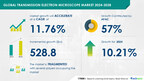
NEW YORK, Jan. 28, 2025 /PRNewswire/ — Report with the AI impact on market trends – The global transmission electron microscope market size is estimated to grow by USD 528.8 million from 2024-2028, according to Technavio. The market is estimated to grow at a CAGR of over 11.76% during the forecast period. Increasing focus on nanotechnology is driving market growth, with a trend towards development of new forms of transmission electron microscopes. However, high cost and heavy excise duty of transmission electron microscopes poses a challenge. Key market players include Advantest Corp., Agilent Technologies Inc., AMETEK Inc., Angstrom Advanced Inc., Bruker Corp., Carl Zeiss Stiftung, Danaher Corp., DELONG INSTRUMENTS AS, Hirox Co. Ltd., Hitachi Ltd., IXRF Inc., JEOL Ltd, NanoScience Instruments Inc., Nikon Corp., Nion, Olympus Corp., Oxford Instruments plc, Roper Technologies Inc., Thermo Fisher Scientific Inc., and VIDEOTON HOLDING ZRt.
Key insights into market evolution with AI-powered analysis. Explore trends, segmentation, and growth drivers- View Free Sample PDF
Transmission Electron Microscope Market Scope
Report Coverage
Details
Base year
2023
Historic period
2018-2022
Forecast period
2024-2028
Growth momentum & CAGR
Accelerate at a CAGR of 11.76%
Market growth 2024-2028
USD 528.8 million
Market structure
Fragmented
YoY growth 2022-2023 (%)
10.21
Regional analysis
APAC, North America, Europe, South America, and Middle East and Africa
Performing market contribution
APAC at 57%
Key countries
China, US, Japan, South Korea, and Canada
Key companies profiled
Advantest Corp., Agilent Technologies Inc., AMETEK Inc., Angstrom Advanced Inc., Bruker Corp., Carl Zeiss Stiftung, Danaher Corp., DELONG INSTRUMENTS AS, Hirox Co. Ltd., Hitachi Ltd., IXRF Inc., JEOL Ltd, NanoScience Instruments Inc., Nikon Corp., Nion, Olympus Corp., Oxford Instruments plc, Roper Technologies Inc., Thermo Fisher Scientific Inc., and VIDEOTON HOLDING ZRt
Market Driver
The Transmission Electron Microscope (TEM) market is experiencing significant growth due to its application in various industries and scientific research. TEM’s ability to produce high-resolution 2D images of specimens at the nanoscale level makes it an essential tool in fields like cancer research, virology, materials sciences, and paleontology. TEMs are used to study the 3D structure of nanomaterials, semiconductors, and wafers, providing valuable insights into their properties. Industries such as automotive, aerospace, electronics, oil & gas, environmental, and water treatment are adopting TEMs for quality control, failure analysis, and research purposes. In the life sciences sector, TEMs are used in hospitals, diagnostic centers, blood banks, and forensic labs for imaging and analyzing biological specimens. The market for TEM instruments includes various types of microscopes like scanning electron microscopes (SEMs), scanning-transmission electron microscopes (STEMs), and expansion microscopes. TEMs use an electron gun, condenser system, electron beam, objective lens, movable specimen stage, image-recording system, and vacuum system. TEM is used in research on nanomaterials, energy-related materials, polymers, glassy substances, biomolecular mechanisms, viruses, macromolecular complexes, and cellular structures. TEMs are also used in catalysis research, studying environmental particles, and exploring the nanoworld. The TEM market includes both closed-source and open-source software for image processing and analysis. Popular open-source software includes ImageJ/Fiji, Neuronstudio, and L-measure. Small-scale end users like academic institutes and research centers often prefer open-source software due to its affordability compared to expensive proprietary software. The market for TEMs is driven by technological innovation, with trends like digitization, live-cell imaging, super resolution, high throughput methods, and integrated microscopy workflows. The market is expected to grow significantly in the coming years due to its wide range of applications and the increasing demand for advanced microscopes in various industries and scientific research.
Transmission Electron Microscopes (TEMs) present two-dimensional images of specimens due to the limited size of the sample that can be viewed. Nion Co., a notable refurbishing vendor in the electron microscope market, manufactures second-generation spherical aberration correctors for TEMs. Newer TEM models offer a combination of TEM and Scanning Electron Microscope (SEM) features. One such type is the Reflection Electron Microscope (REM), which uses an electron beam similar to a TEM but detects elastically scattered electrons from the object instead of transmitted ones. These advancements enhance the capabilities of TEMs in various industries, including materials science, biology, and nanotechnology.
Request Sample of our comprehensive report now to stay ahead in the AI-driven market evolution!
Market Challenges
The Transmission Electron Microscope (TEM) market encompasses a diverse range of industries, including life sciences, material sciences, automotive, aerospace, electronics, oil & gas, environmental, and hospitals. However, the use of TEMs presents challenges such as the de Broglie wavelength, which limits the resolution of 2D images. This has led to the development of advanced microscopes like scanning transmission electron microscopes (STEMs) and expansion microscopes. In industries like semiconductors, nanotechnology, and surface physics, TEMs play a crucial role in understanding the 3D structure of nanoscale objects. Applications include studying semiconductor wafers, nanomaterials, energy-related materials, polymers, and glassy substances. TEM instruments are essential for research in various fields like cancer research, virology, paleontology, palynology, and catalysis research. They help in understanding biomolecular mechanisms, viruses, macromolecular complexes, and cellular structures. The market for TEMs is driven by technological innovation and scientific research. However, challenges include the high cost of proprietary software and closed-source software, which is a concern for small-scale end users like academic institutes and research centers. Open-source software like ImageJ/Fiji, Neuronstudio, and L-measure offer cost-effective alternatives. Quality control, failure analysis, and forensics are other key applications of TEMs. The market is segmented into industries like electronics, medicine, and physics, with laboratory technicians and physicists as key users. TEMs require an electron gun, condenser system, electron beam, objective lens, movable specimen stage, image-recording system, and vacuum system. Environmental TEMs are used for studying environmental particles and ultrafast processes. UTEM and beam chopper technology are advanced features in TEMs. The market is expected to grow due to the increasing demand for high throughput methods, super resolution, and digitization in various industries.The Transmission Electron Microscope (TEM) market involves significant upfront investment costs, making it a capital-intensive industry. Sales of TEMs to research institutions are heavily reliant on both government and corporate funding. However, the approval of these funds is subject to change and can be unpredictable, leading to market instability. Additionally, high import duties and customs taxes imposed by various governments add to the final product cost, increasing the financial burden on buyers. These factors contribute to the uncertainty and potential fluctuations in the TEM market.
Discover how AI is revolutionizing market trends- Get your access now!
Segment Overview
This transmission electron microscope market report extensively covers market segmentation by
Application 1.1 Life science1.2 Material science1.3 Nanotechnology1.4 Semiconductor1.5 OthersEnd-user 2.1 Industries2.2 Academic institutes2.3 OthersGeography 3.1 APAC3.2 North America3.3 Europe3.4 South America3.5 Middle East and Africa
1.1 Life science- Transmission Electron Microscopes (TEMs) play a crucial role in life science research, particularly in the fields of microbiology, zoology, botany, and ecology. These advanced microscopes enable scholars and researchers to explore the microbiological environment in detail, providing in-depth insights into cellular structures and behaviors. TEMs are essential tools for both cellular- and structural-level biology research, allowing the development of complete atomic models of protein molecules. Academic institutions and pharmaceutical firms invest significantly in TEM technology to advance their research capabilities and explore new possibilities. For instance, the Pennsylvania State University’s acquisition of FEI Company’s Titan/Krios TEM, which operates at extremely low temperatures using liquid nitrogen, will enhance their research capabilities. This technology enables researchers to examine frozen samples at the atomic level, producing 3D images of biological molecules such as DNA, proteins, and viruses. The ongoing global health crisis, specifically the COVID-19 pandemic, has highlighted the importance of TEMs in developing new vaccines and treatments. Research organizations, institutions, and pharmaceutical companies are working tirelessly to find single-dose vaccines that offer a strong immune response against SARS-CoV-2. The demand for TEMs in life science applications is expected to grow significantly during the forecast period, as these microscopes are essential for understanding the structure and behavior of viruses and developing effective countermeasures against them.
Download a Sample of our comprehensive report today to discover how AI-driven innovations are reshaping competitive dynamics
Research Analysis
The Transmission Electron Microscope (TEM) market encompasses a diverse range of industries and applications. TEMs utilize the principles of de Broglie wavelength to produce high-resolution images of nanoscale objects, making them indispensable tools in various fields. In life sciences, TEMs play a crucial role in cancer research, virology, and palynology. Materials sciences and nanotechnology benefit from TEMs in semiconductor manufacturing, electronics, and advanced materials research. Paleontology uses TEMs for the study of fossils, while the automotive, aerospace, and oil & gas industries employ TEMs for materials testing and research. Environmental and water treatment sectors utilize TEMs for the analysis of pollutants and contaminants. Research institutes, hospitals, diagnostic centers, blood banks, forensic labs, and X-ray diffraction facilities also rely on TEMs for their research and diagnostic needs. TEMs operate at nanometer scales, enabling the examination of intricate structures and providing valuable insights into their properties and behavior.
Market Research Overview
The Transmission Electron Microscope (TEM) market encompasses instruments used for producing high-resolution 2D images of specimens at the nanoscale. De Broglie wavelength is a fundamental concept in TEM, which relates to the wave nature of electrons. TEMs are essential tools in various fields such as cancer research, virology, materials sciences, and paleontology. They provide insights into the 3D structure of nanoscale objects, semiconductors, wafers, and other materials. TEMs are used in industries like automotive, aerospace, electronics, oil & gas, environmental, water treatment, hospitals, diagnostic centers, blood banks, and forensic labs. In these sectors, TEMs aid in quality control, failure analysis, and research. TEMs employ an electron gun, condenser system, electron beam, objective lens, movable specimen stage, image-recording system, and vacuum system. TEM instruments are used for studying nanomaterials, energy-related materials, polymers, glassy substances, biomolecular mechanisms, viruses, macromolecular complexes, cellular structures, catalysis research, environmental particles, and more. TEMs are also crucial in the nanoworld, scientific research, and technological innovation. TEMs come with various advanced features like electron source, electron optics system, and vacuum environment. Environmental TEMs are a sub-segment of TEMs, which are specifically designed for studying ultrafast processes and particles in their natural environment. TEMs are expensive and often come with closed-source or proprietary software, but open-source alternatives like ImageJ/Fiji, Neuronstudio, and L-measure are also available for small-scale end users. TEMs are used by physicists, laboratory technicians, and other professionals in academia and research centers. TEMs offer high image resolution, but distorted images can occur due to various factors. TEMs are also used in forensics and standard compound microscopes are often compared with advanced TEMs for their superior capabilities. TEMs are essential tools for understanding the nanoscale world and driving technological advancements.
Table of Contents:
1 Executive Summary
2 Market Landscape
3 Market Sizing
4 Historic Market Size
5 Five Forces Analysis
6 Market Segmentation
ApplicationLife ScienceMaterial ScienceNanotechnologySemiconductorOthersEnd-userIndustriesAcademic InstitutesOthersGeographyAPACNorth AmericaEuropeSouth AmericaMiddle East And Africa
7 Customer Landscape
8 Geographic Landscape
9 Drivers, Challenges, and Trends
10 Company Landscape
11 Company Analysis
12 Appendix
About Technavio
Technavio is a leading global technology research and advisory company. Their research and analysis focuses on emerging market trends and provides actionable insights to help businesses identify market opportunities and develop effective strategies to optimize their market positions.
With over 500 specialized analysts, Technavio’s report library consists of more than 17,000 reports and counting, covering 800 technologies, spanning across 50 countries. Their client base consists of enterprises of all sizes, including more than 100 Fortune 500 companies. This growing client base relies on Technavio’s comprehensive coverage, extensive research, and actionable market insights to identify opportunities in existing and potential markets and assess their competitive positions within changing market scenarios.
Contacts
Technavio Research
Jesse Maida
Media & Marketing Executive
US: +1 844 364 1100
UK: +44 203 893 3200
Email: media@technavio.com
Website: www.technavio.com/
View original content to download multimedia:https://www.prnewswire.com/news-releases/transmission-electron-microscope-market-to-grow-by-usd-528-8-million-2024-2028-driven-by-nanotechnology-focus-ai-driven-market-transformation—technavio-302362468.html
SOURCE Technavio










 Coin Market4 days ago

 Technology5 days ago

 Coin Market4 days ago

 Technology5 days ago

 Technology4 days ago

 Technology5 days ago

 Coin Market5 days ago