Connect with us

Technology

Business Process Outsourcing Market to Grow by USD 88.8 Billion (2025-2029), Focus on Cost Reduction Boosts the Market, Report on AI Impacting Market Trends – Technavio

Published

on

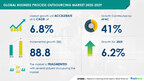
NEW YORK, Jan. 31, 2025 /PRNewswire/ — Report on how AI is redefining market landscape – The global business process outsourcing market size is estimated to grow by USD 88.8 billion from 2025-2029, according to Technavio. The market is estimated to grow at a CAGR of over 6.8%  during the forecast period. Focus on reducing operational costs is driving market growth, with a trend towards rising emphasis on process automation. However, data breaches  poses a challenge. Key market players include Accenture PLC, Alight Inc., Amdocs Ltd., Anderson Business Solutions Pvt. Ltd., Automatic Data Processing Inc., Capgemini Services SAS, Cognizant Technology Solutions Corp., Concentrix Corp., Deloitte Touche Tohmatsu Ltd., HCL Technologies Ltd., Infosys Ltd., International Business Machines Corp., NEC Corp., NTT DATA Corp., Oracle Corp., Sykes Enterprises Inc., Tata Consultancy Services Ltd., Tech Mahindra Ltd., Wipro Ltd., and WNS Holdings Ltd..

Key insights into market evolution with AI-powered analysis. Explore trends, segmentation, and growth drivers- View Free Sample PDF

Business Process Outsourcing Market Scope

Report Coverage

Details

Base year

2024

Historic period

2019 – 2023

Forecast period

2025-2029

Growth momentum & CAGR

Accelerate at a CAGR of 6.8%

Market growth 2025-2029

USD 88.8 billion

Market structure

Fragmented

YoY growth 2022-2023 (%)

6.2

Regional analysis

North America, Europe, APAC, Middle East and Africa, and South America

Performing market contribution

APAC at 41%

Key countries

US, Canada, UK, Germany, China, India, Brazil, France, UAE, and Japan

Key companies profiled

Accenture PLC, Alight Inc., Amdocs Ltd., Anderson Business Solutions Pvt. Ltd., Automatic Data Processing Inc., Capgemini Services SAS, Cognizant Technology Solutions Corp., Concentrix Corp., Deloitte Touche Tohmatsu Ltd., HCL Technologies Ltd., Infosys Ltd., International Business Machines Corp., NEC Corp., NTT DATA Corp., Oracle Corp., Sykes Enterprises Inc., Tata Consultancy Services Ltd., Tech Mahindra Ltd., Wipro Ltd., and WNS Holdings Ltd.

Market Driver

Business Process Outsourcing (BPO) is a trending external service that enables businesses to focus on their core competencies by transferring non-essential tasks to specialized external providers. BPO offers flexibility, reduced costs, and enhanced services in various industries like IT, healthcare, and finance. Technological advancements such as cloud computing, Artificial Intelligence, and standardized platforms drive efficiency and agility. BPO covers voice processing, telemarketing, image editing, virtual staffing, customer care, and more. Outsourcing types include offshore, nearshore, and onshore. Service areas extend to manufacturing, finance and accounting, human resource services, telecommunication, and more. BPO adoption is driven by economic restructuring, merger and acquisition activity, and regulatory bodies like the California Consumer Privacy Act and Anti-Money Laundering. Businesses can achieve competitive advantage through technical improvements, adoption of IoT, and AI technologies. BPO deployment modes include on-premise and cloud, catering to large enterprises and Small and Medium Enterprises (SMEs). Ownership models range from captive to third-party. BPO providers offer bundled services, best-shore solutions, and contract-based agreements. BPO also covers transportation and logistics, travel and hospitality, energy and utilities, and Mediterranean consulting. Talent sourcing, training, and deployment are essential components. Data security, infrastructure equipment, business continuity, and intellectual property protection are critical considerations. 

The Business Process Outsourcing (BPO) market is experiencing significant growth due to the adoption of emerging technologies. Cloud computing, social media, artificial intelligence (AI), and process automation are transforming the industry. BPOs utilize these technologies to minimize costs and boost growth. AI software streamlines processes and enhances efficiency, while cloud storage eliminates excess space and reduces energy consumption. Companies can access the latest technologies through cloud products and Software as a Service (SaaS), leading to increased efficiency and cost savings. BPOs provide various services, including social media management, website design, and customer support, making them an essential partner for businesses aiming to stay competitive. 

Request Sample of our comprehensive report now to stay ahead in the AI-driven market evolution!

 Market Challenges

Business Process Outsourcing (BPO) involves companies contracting external services to manage and operate business processes. This approach offers flexibility, reduced costs, and enhanced services in various industries such as healthcare, IT, finance, and manufacturing. However, challenges persist. Economic restructuring, merger and acquisition activity, and regulatory bodies like California Consumer Protection Act and Anti-Money Laundering require compliance. BPO types include offshore, nearshore, and onshore, with voice processing, telemarketing, image editing, and customer care common services. BPO adoption is driven by efficiency, agility, and competitive advantage. Technological advancements like cloud computing, Artificial Intelligence, and IoT are transforming BPO. BPO service providers offer facilities and administration, product engineering, training, and deployment modes like on-premise and cloud. Large enterprises and SMEs outsource ownership models, including captive and third-party, using best-shore, bundled services, and contract-based approaches. BPO challenges include infrastructure equipment, data security, and intellectual property protection. Service providers must ensure business continuity, adhere to industry standards, and offer flexible deployment modes. BPO adoption requires awareness and investment, especially in industries like transportation and logistics, travel and hospitality, energy and utilities, and Mediterranean consulting.The Business Process Outsourcing (BPO) market involves the transfer of data-intensive business processes to third-party service providers. Data security is a significant concern for BPO companies, as data breaches can result in the illegal transfer of confidential, financial, or personal information. This data is typically stored on electronic devices such as servers and computers and includes proprietary process information, technologies, software codes, and passwords. With the increasing use of technology and Internet services worldwide, safeguarding customer data has become essential. Data breaches pose a significant challenge to the global BPO market, potentially hindering its growth during the forecast period.

Discover how AI is revolutionizing market trends- Get your access now!

Segment Overview 

This business process outsourcing market report extensively covers market segmentation by  

End-userIT And TelecommunicationBFSIRetailHealthcareOthersBusiness SegmentLarge EnterprisesSMEsGeographyNorth AmericaEuropeAPACMiddle East And AfricaSouth America

1.1 IT and telecommunication-  The Business Process Outsourcing (BPO) market’s telecom and IT segment have captured a significant market share, driven by technological advances, increasing data traffic, and rising consumer demand for digital content and communication. Telecom organizations are partnering with IT service providers to develop and market digital solutions, such as 5G-related products and services. To focus on their core offerings, IT and telecom companies outsource customer query management and other operations to service providers. Technological innovations like Robotic Process Automation (RPA), Machine Learning (ML), and Artificial Intelligence (AI) are automating processes, leading to operational excellence and fueling the demand for BPO services during the forecast period. This segment’s growth is expected to continue due to the increasing need for outsourcing customer support services.

Download a Sample of our comprehensive report today to discover how AI-driven innovations are reshaping competitive dynamics

Research Analysis

Business Process Outsourcing (BPO) refers to the practice of an organization delegating external service providers to manage and operate specific business processes. BPO offers flexibility, reduced costs, and enhanced services for various industries, including healthcare and IT. The efficiency and agility gained from BPO enable businesses to focus on their core competencies. Technological improvements, such as cloud computing, IoT, AI technologies, and investment in offshore, nearshore, and onshore locations, have fueled the growth of this market. The adoption of these advanced technologies provides a competitive advantage, enabling businesses to streamline operations, improve customer experience, and reduce operating costs. The BPO market continues to evolve, with the increasing use of AI and automation, making it an essential component of modern business strategies.

Market Research Overview

Business Process Outsourcing (BPO) refers to the practice of an organization transferring non-core business functions to an external service provider. This approach offers flexibility, reduced costs, and enhanced services in various industries such as healthcare, IT, and finance and accounting. BPO providers leverage technological advancements like cloud computing, Artificial Intelligence, and standardized platforms to ensure efficiency and agility. Operating costs are minimized as businesses focus on their core competencies. Security, intellectual property, and economic restructuring are crucial considerations in BPO engagements. Regulatory bodies like the California Consumer Privacy Act and Anti-Money Laundering regulations impact the BPO landscape. Inhouse services, manufacturing, telecommunication, and human resource services are common areas for outsourcing. BPO adoption varies from onshore, nearshore, and offshore models, with voice processing, telemarketing, image editing, and virtual staffing among the popular services. The deployment modes range from on-premise to cloud solutions, catering to organizations of all sizes, from large enterprises to SMEs. Competitive advantage is gained through technical improvements, adoption of IoT, AI technologies, and investment in power transmission, transportation and logistics, travel and hospitality, energy and utilities, and Mediterranean consulting industries.

Table of Contents:

1 Executive Summary
2 Market Landscape
3 Market Sizing
4 Historic Market Size
5 Five Forces Analysis
6 Market Segmentation

End-userIT And TelecommunicationBFSIRetailHealthcareOthersBusiness SegmentLarge EnterprisesSMEsGeographyNorth AmericaEuropeAPACMiddle East And AfricaSouth America

7 Customer Landscape
8 Geographic Landscape
9 Drivers, Challenges, and Trends
10 Company Landscape
11 Company Analysis
12 Appendix

About Technavio

Technavio is a leading global technology research and advisory company. Their research and analysis focuses on emerging market trends and provides actionable insights to help businesses identify market opportunities and develop effective strategies to optimize their market positions.

With over 500 specialized analysts, Technavio’s report library consists of more than 17,000 reports and counting, covering 800 technologies, spanning across 50 countries. Their client base consists of enterprises of all sizes, including more than 100 Fortune 500 companies. This growing client base relies on Technavio’s comprehensive coverage, extensive research, and actionable market insights to identify opportunities in existing and potential markets and assess their competitive positions within changing market scenarios.

Contacts

Technavio Research
Jesse Maida
Media & Marketing Executive
US: +1 844 364 1100
UK: +44 203 893 3200
Email: media@technavio.com
Website: www.technavio.com/

View original content to download multimedia:https://www.prnewswire.com/news-releases/business-process-outsourcing-market-to-grow-by-usd-88-8-billion-2025-2029-focus-on-cost-reduction-boosts-the-market-report-on-ai-impacting-market-trends—technavio-302365289.html

SOURCE Technavio

Continue Reading

Technology

Aura Q3 2026 Earnings Call and Quarterly Results

Published

on

By

BOSTON, Oct. 18, 2026 /PRNewswire/ — Aura (ASX: AXQ), a global leader in online safety and wellbeing, will release its Q3 2026 financial results on Thursday, 12th November 2026 prior to the ASX market opening. In addition, Aura will also release its Appendix 4C and Quarterly Activities Report for the quarter ended 30 September 2026 on Friday, 30th of October.

The company will host a webcast at 10:30 AM AEDT on Thursday, 12th November 2026 to discuss its financial results for Q3 and business outlook.

Q3 2026 Earnings Call Details

November 12, 2026 10:30am AEDT | November 11, 2026 6.30pm ESTLink to register: https://events.q4inc.com/attendee/159132282

A replay of the webcast will be available on Aura’s investor relations website at investors.aura.com.

The release of this announcement was authorized by William Lundregan, Chief Legal Officer and Secretary at Aura. 

Investor Relations:
ir@aura.com 

Press Contact:
media@aura.com 

About Aura

Aura (ASX: AXQ) is a global leader in online safety and wellbeing. Built on the belief that people deserve a trusted, always-on layer of protection, Aura’s AI-powered platform delivers protection for individuals, families and enterprises– from proactive protection against identity theft, financial fraud and online threats to tools that help schools and parents protect children from cyberbullying, harmful content, and threats to their wellbeing. Aura’s platform spans the environments that matter most– home, school and work– empowering people of all ages with end-to-end protection for every aspect of online life. Learn more at aura.com.

CATEGORY: Financial News

View original content to download multimedia:https://www.prnewswire.com/news-releases/aura-q3-2026-earnings-call-and-quarterly-results-302912050.html

SOURCE Aura

Continue Reading

Technology

Faith: The Spark Born by the Yudu Riverside

Published

on

By

BEIJING, Oct. 18, 2026 /PRNewswire/ — An interview from China.org.cn with Wang Xiaohui and David Ferguson on the Long March:

David Ferguson:

This is the Yudu River. One dusk in October, 1934, more than 86,000 soldiers of the Red Army crossed this river and embarked on the Long March, a two-year saga that has left its mark in history.

Yet, lingering here by the river, I am struck by a simple question: If you have faith in a bright future, and reality seems to thwart you at every turn, where do you find the moral strength to keep believing?

Wang Xiaohui:

At dusk on Oct. 17, 1934, an army of more than 86,000 troops gathered along the banks of the Yudu River. Over 800 boats of all sizes floated on the water, bound together with planks collected from villagers’ home gates, timber beams, and even coffin boards reserved for elderly locals. The people of Yudu built this pontoon bridge, determined to help the army led by the Communist Party of China (CPC) cross the river.

At that time, no one knew that the great expedition embarked upon by the banks of the Yudu River would go on to transform China and exert far-reaching influence across the world.

China in the 1920s and 1930s was plagued by chaos and despair.

The Kuomintang (KMT), the ruling party back then, was not capable of unifying the nation, leaving warlords locked in endless fighting. In 1931, Japanese invaders launched an assault on northeastern China, beginning their invasion. Crushed under domestic turbulence and foreign aggression, countless civilians were displaced, with many even starving to death on the streets; in certain regions, severe drought resulted in zero harvests, yet the farmers were forced to pay land taxes assessed for more than a decade into the future.

Amid this turmoil, the only glimmer of hope for the Chinese nation was kindled by the revolution ignited by the Communist Party of China.

The CPC, dedicated to winning liberation for the people and national independence, built contingents of workers’ and peasants’ Red Army troops and revolutionary base areas across the countryside. Impoverished farmers were granted land ownership, as well as unprecedented political dignity. On Nov. 7, 1931, the Chinese Soviet Republic was officially proclaimed in Ruijin, then a small village in southeastern China’s Jiangxi Province, establishing a Soviet system under which workers, peasants and soldiers elected representatives to run regional affairs and make policies.

The communist ideal of a fair society free from exploitation and equality for all blazed like a spark in the darkness; it kindled hopes among impoverished Chinese and became the wellspring of faith that enabled the Red Army — a force made up of poor workers and peasants — to overcome all hardships in the days to come.

Yet, bright as the spark was, it burned thin and fragile at times. Could this flame still endure when the ideals it carried were repeatedly battered by harsh reality?

In September 1933, flocks of warplanes clouded the skies over the Red Army’s revolutionary base areas. By then, Japanese invaders were steadily advancing towards North China, but Chiang Kai-shek’s KMT turned a blind eye to the looming national crisis. They mobilized over a million troops and more than 200 aircraft to launch a massive offensive at the Red Army’s base areas. Over the previous three years, Chiang Kai-shek had mounted four major military “encirclement” campaigns aimed at exterminating the Red Army, but all ended in failure. He was desperate for a pivotal victory to restore his prestige and to wipe out the CPC and the Red Army.

At the time, the commander of the Red Army abandoned mobile warfare tactics pioneered by Mao Zedong and other commanders, opting instead for rigid positional warfare involving conventional head-on clashes. But the reality was, some Red Army units didn’t even possess a single light machine gun; how could they confront the heavily-armed KMT army head-on?

Zhong Ming, a Red Army medic, could never erase the memories of gravely wounded soldiers being carried to his aid station. He remembered how a soldier whose chest was blown open begged his comrades to end his life. At the frontline, a whole battalion of Red Army soldiers religiously followed orders to defend crude earth-and-wood bunkers, but under the constant barrage of KMT artillery and airstrikes, every soldier in the battalion laid down their lives; not a single man survived.

What’s more heart-wrenching is that no matter how fearlessly the Red Army fought, the steep imbalance in military strength, paired with erroneous military command led to irreversible losses. By October 1934, the KMT’s iron-clad encirclement closed menacingly around Ruijin.

Faced with this dead-end, what decision would you make?

This stood as the most agonizing decision for the Red Army. The biggest challenge lay not in sacrificing one’s life for an ideal, but in finding a way to keep the revolutionary cause alive.

To stay meant defeat — the Red Army had no room to maneuver within the Central Revolutionary Base Area. To break through the encirclement, however slim the odds, offered a fighting chance. Preserving the Red Army as a living force mattered much more than clinging to isolated strongholds. Where the spark survives, the path ahead remains lit.

The air already turned chilly in October. Units of the Central Red Army assembled in Yudu to prepare for a strategic shift. The plan was kept strictly classified; none of the soldiers knew they were evacuating the base areas, only sensing an unusual vibe.

At dusk on Oct. 17, crowds lined up at the Yudu riverbank. Tens of thousands of villagers flocked from every corner to see the Red Army off. They walked alongside the marching columns, slipping food like eggs and glutinous rice balls into the soldiers’ pockets, praying for their swift homecoming.

The main force of the Central Red Army set off. Within days, they left behind revolutionary base areas where they had survived, grown and taken root. No one anticipated that the journey they embarked on would become the Long March, a trek spanning over 10 provinces. Still less could anyone imagine that this journey would ultimately pave the way for a brand-new China.

Looking back on this chapter of history, many claim that the Red Army only set out on this expedition because the enemies left them no other choice. To a degree, yes, the Long March was indeed a forced strategic shift, yet this fact does nothing to diminish its greatness and glory.

The ordinary Red Army soldiers had no idea how far they would march, or where they were heading. But they clung firmly to their founding mission: to deliver liberation for the people and independence to the nation. This unswerving conviction kept them from disintegrating through countless perils, sustaining them as they marched into the unknown with resolve.

David Ferguson:

I now realize that faith and ideals untested by harsh reality may have no true substance.

Since its founding, the Communist Party of China has always upheld the realization of communism as its fundamental goal. Despite devastating losses and extreme adversity, the Red Army continued to press forward resolutely and never faltered. Its inner strength came from an unshakable belief in the cause, an unwavering commitment to the founding aspiration, and a profound sense of mission. The Red Army was never fleeing pursuers in search of safety; it was marching forward to a future in which it had a steadfast belief.

Wang Xiaohui:

The Long March went on for two years. The Red Army trekked 25,000 li across some of China’s harshest terrain, but they kept their heads high, seeking hope amid despair and marching towards light through unending darkness. The lofty ideals and sense of mission they upheld have also become the torch that guides generations of CPC members in the following centennial, tempering them into steel as they press forward unswervingly toward national rejuvenation.

That spark lit along the Yudu River has never dimmed since.

China Mosaic
http://www.china.org.cn/video/node_7230027.htm

Faith: The Spark Born by the Yudu Riverside
http://www.china.org.cn/2026-10/16/content_118736835.shtml

View original content to download multimedia:https://www.prnewswire.com/news-releases/faith-the-spark-born-by-the-yudu-riverside-302911977.html

SOURCE China.org.cn

Continue Reading

Technology

Linktel Technologies Highlights Breakthrough 1.6T LPO Performance & Strong Market Pull at OCP 2026

Published

on

By

SAN JOSE, Calif., Oct. 18, 2026 /PRNewswire/ — At the recent 2026 OCP Global Summit, Linktel Technologies showcased its cutting-edge optical interconnect portfolios engineered specifically for next-generation AI computing networks. Among the heavy lineup, Linktel’s 1.6T Linear Pluggable Optics (LPO) solutions commanded immense industry attention, drawing heavy customer interest for their unprecedented energy efficiency, ultra-low latency, and supply-chain resilience.

Spotlight: 1.6T LPO Performance & High Customer Traction

AI data centers face immense scaling pressures, demanding higher bandwidth densities with tighter thermal and power budgets. Linktel’s 1.6T LPO solutions—highlighted by the 1.6T LPO 2DR4—delivered standout performance metrics that captured the spotlight at the summit:

Ultra-Low Power Consumption: Operates with power consumption as low as an impressive 10W, drastically mitigating data center cooling and power loads.Minimal Latency: Features a linear optics architecture that cuts down signal processing delays, making it a critical asset for high-performance AI scale-out fabrics.Enhanced Supply-Chain Resilience: Eliminating the optical DSP mitigates component choke points, ensuring robust scalability for mass deployments.Proven Interoperability: Following its breakthrough performance and multi-switch platform interoperability at the early September 2026 1.6T LPO-MSA Plugfest, Linktel has laid a solid foundation for the 200G-per-wavelength ecosystem.

Surging Market Interest

Throughout OCP 2026, Linktel’s live demonstrations of its 1.6T LPO, LRO, and FRO modules drew crowds of data center architects and industry partners. With volume production already in place, Linktel is fully equipped to meet the exploding market demand for energy-efficient, high-density 1.6T connectivity.

Overview of Other Innovations at OCP 2026

In addition to the heavily requested 1.6T LPO lineup, Linktel showcased two other major high-speed architectural pillars:

12.8T Liquid-Cooled XPO:Featured a live thermal demonstration integrating advanced liquid cooling to guarantee stable operations in high-density AI nodes.As a founding member of the XPO MSA, Linktel is actively scaling XPO series with FRO, LRO, and LPO variants for comprehensive scale-up, scale-out, and scale-across frameworks.6.4T/7.2T NPO Modules:Displayed with covers removed to reveal internal architectural designs supporting both ELS and ILS configurations.Combines compact high density with low power and low latency, backed by an established 6.4T/7.2T NPO roadmap.DMD Technology & Executive Presentation:Linktel Engineer Director Dr. Grace Zhang hosted a heavily attended Executive Session titled “Dispersion Managed Transceiver for Next-Gen AI Fabrics,” detailing cost-effective 800G (20km) and 1.6T (10km) solutions for OCS SuperPOD architectures, as well as the feasibility of 400G per lambda (3km).With its DMD product line already in volume production, Linktel actively calls upon ecosystem partners to join forces in collaborative development. To drive ecosystem maturity, Linktel is open to sharing its U.S.-filed patents, paving the way for industry-wide adoption and advancements in next-gen AI fabrics.

About Linktel Technologies

Linktel Technologies is a global leader in optical transceiver development and manufacturing, supplying high-speed optical I/O connectivity—including pluggable transceivers, optical engines, and ODM/JDM services.

For more information, visit www.linktel.com or follow Linktel Technologies on LinkedIn.

View original content:https://www.prnewswire.com/news-releases/linktel-technologies-highlights-breakthrough-1-6t-lpo-performance–strong-market-pull-at-ocp-2026–302911973.html

SOURCE Linktel Technologies

Continue Reading

Trending