Conducted ahead of America’s 250th anniversary, the survey finds nine in ten Americans (90%) across the political spectrum support funding programs to prevent disease outbreaks abroad, the highest-testing program area in the survey.Those who primarily support President Trump are the least concerned about Ebola spreading to the U.S., yet more than one in two (52%) back restoring U.S. aid to contain the outbreak, along with 60% of Republican-leaners and 89% of Democrat-leaners.
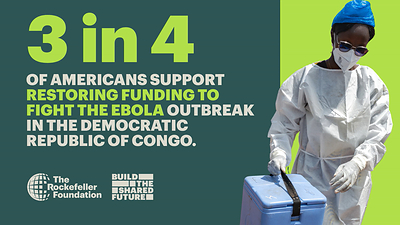
NEW YORK, July 8, 2026 /PRNewswire/ — With the Ebola outbreak the third-largest on record, and growing, survey data from The Rockefeller Foundation and Echelon Insights shows that 75% of Americans – including more than one in two (52%) who primarily support President Trump – agree that the United States should restore disease prevention aid to contain the virus. An American Perspective on Foreign Aid, which evaluated Americans’ opinions on foreign assistance ahead of the nation’s 250th anniversary, also reveals near universal support across political party lines (90%) for funding overseas disease prevention programs. The findings suggest that despite the official closure of the U.S. Agency for International Development (USAID) one year ago this month, Americans across the political spectrum continue to see disease prevention abroad as a core U.S. interest, not a partisan one.
“Twelve years ago, Ebola reminded the world the hard way what happens when we are unprepared. This outbreak is doing the same—and may become far worse,” said Dr. Rajiv J. Shah, President of The Rockefeller Foundation and former USAID Administrator, who led USAID during the 2014 Ebola outbreak in West Africa, one of the costliest in history. “The answer now is not to rebuild the old system but to build a smarter one, pairing AI-powered surveillance and real-time data with strong local health systems where outbreaks spread fastest. This is not charity, it’s national security, and as this data shows, Americans across the political spectrum already know it.”
In May 2026, the Democratic Republic of the Congo (DRC) declared a new Ebola outbreak, caused by the Bundibugyo virus, that has since spread into Uganda. The World Health Organization declared a Public Health Emergency of International Concern on May 17. With more than 1,500 confirmed cases and over 500 deaths reported as of July 5, and counts still climbing, it is already the third-largest Ebola outbreak on record, and the Centers for Disease Control and Prevention (CDC) has warned it could become one of the largest ever recorded. There is no approved vaccine or treatment for the Bundibugyo strain, and conflict and weak health infrastructure in eastern DRC complicate detection and treatment. While U.S. officials consider the domestic risk low, the CDC raised its response to its highest level in late June. Aid workers and former U.S. officials have pointed to U.S. funding cuts for disease surveillance as a factor that hampered detection and response, a characterization the U.S. State Department disputes (see statement).
Americans’ Views on Foreign Aid to Fight Ebola:
More than 2,000 adults were surveyed by U.S.-based Echelon Insights, commissioned by The Rockefeller Foundation’s public charity, RF Catalytic Capital (RFCC), from June 12-16, 2026 across all 50 states, balanced across party, region, age, gender, and race/ethnicity. Three of the questions were directly tied to the Ebola outbreak as follows:
“How concerned are you about the potential spread of Ebola into the United States?” After responding, they were presented with the following information: “For over 20 years, the U.S. government has provided aid to the Democratic Republic of the Congo to combat the spread of Ebola, including surveillance, pandemic response, and healthcare infrastructure. Since 2018, U.S. global health aid to the Congo has prevented the spread of seven outbreaks, saving countless lives. In 2026, the World Health Organization declared a new Ebola outbreak in the Congo, featuring a rare and especially lethal strain of the virus. Health experts have pointed to cuts in U.S. funding for disease monitoring and pandemic response as key factors behind the latest outbreak.””Would you support or oppose restoring U.S. disease prevention aid to help contain this new Ebola outbreak in the Congo?” Immediately following their response, they were asked:”In light of the recent Ebola outbreak, would you support or oppose the U.S. government changing course to restore some or all global health aid?”
Across all three questions, a clear majority favored restoring aid:
Broad Support for Action on the Ebola Outbreak. Three in four Americans (75%) support restoring Ebola-specific aid to DRC, including more than one out of every two who primarily support President Trump (52%, a net +18), 60% among Republican-leaners overall, and 89% among Democrat-leaners. That support holds even though Americans aren’t especially alarmed by the threat at home: more than one in two (54%) are very or somewhat concerned about Ebola spreading to the U.S. Concern is lowest among those who primarily support President Trump (37%) and Republican-leaners (40%), compared with 68% of Democrat-leaners.A Mandate to Restore Global Health Funding. 72% support the U.S. changing course to restore some or all global health funding worldwide in light of the outbreak, including 46% among those who primarily support President Trump, 56% among Republican-leaners overall, and 88% among Democrat-leaners.
“This poll makes clear that Americans remember what too many in Washington forget about outbreaks: diseases don’t check your party registration or your passport,” said Dr. John A. Gans, former Chief Speechwriter at the Pentagon, author of White House Warriors, and current Senior Vice President at The Rockefeller Foundation. “One year after USAID’s razing, three in four Americans, across every political line, understand that stopping deadly diseases at their source is a matter of national security, not just generosity. The lesson for Washington is clear: don’t doubt the generosity and concerns of Americans, act on them.”
Additional Global Health Findings from the Poll Include:
An Overwhelming Mandate for Global Health Security. Nine in ten Americans (90%) support funding overseas disease prevention programs, the single highest-testing program area in the whole survey. Support is 82% among those who primarily support President Trump, 85% among Republican-leaners overall, and 94% among Democrat-leaners. Support for global health funding more broadly reaches 84% overall, including 68% among those who primarily support President Trump, 74% among Republican-leaners overall (81% among Republicans who prioritize the Party over Trump), and 93% among Democrat-leaners.Support Holds When Americans See the Human Cost. When told experts estimate aid cuts could cause over 9 million preventable deaths by 2030, primarily from disease and malnutrition, 70% said they would support restoring aid funding, including 47% among those who primarily support President Trump, 55% among Republican-leaners overall, and 85% among Democrat-leaners.A Proven Success Story Resonates. The story of U.S.-funded tuberculosis programs in Bangladesh, which cut TB deaths by 35% over a decade, was convincing to 77% of Americans, including 58% among those who primarily support President Trump, 65% among Republican-leaners overall, and 88% among Democrat-leaners.
Dr. Shah concludes: “When presented with a real-world example of a fast-moving threat that can easily cross borders and where U.S. foreign aid can save lives, most Americans want their government to help. The findings also point to a path forward. Americans support foreign aid when they understand its purpose, its cost, and its impact.” Read the full Statement from Dr. Rajiv J. Shah, President of The Rockefeller Foundation, on New Public Opinion Research on Foreign Aid Programs.
An American Perspective on Foreign Aid is the latest research commissioned by The Rockefeller Foundation’s Build the Shared Future Initiative, through which the 113-year-old philanthropic organization aims to inspire and inform global cooperation and international development work that matches the challenges of the 21st century, including efforts to align with governments around the world on country-led solutions that maximize every dollar of remaining aid and stimulate new investments.
Recent research includes The Impact of Two Decades of Humanitarian and Development Assistance and the Projected Mortality Consequences of Current Defunding to 2030, which examines the human costs of the historic slashing of official development assistance (ODA) in 2025 by the U.S. and other wealthy nations. Those cuts exceeded the modeling assumptions used in an earlier Rockefeller Foundation-supported study by the Barcelona Institute for Global Health (ISGlobal), published in The Lancet Global Health. That study warned that at least 9.4 million additional people, including 2.5 million children under the age of five, could die by 2030 across 93 low- and middle-income countries.
About The Rockefeller Foundation
Investing $30 billion over the last 113 years to promote the well-being of humanity, The Rockefeller Foundation is a pioneering philanthropy built on unlikely partnerships and innovative solutions that deliver measurable results for people in the United States and around the world. We leverage scientific breakthroughs, artificial intelligence, and new technologies to make big bets across energy, food, health, and finance with our partners and our affiliated public charity, RFCC. For more information, follow us on LinkedIn @the-rockefeller-foundation, X @RockefellerFdn, Instagram @rockefellerfdn, and YouTube @RockefellerFdn, and sign up for our newsletter at www.rockefellerfoundation.org/subscribe.
Note to Editors: Methodology
Echelon Insights conducted a survey on behalf of The Rockefeller Foundation to better understand voters’ attitudes on foreign aid. The survey was fielded online from June 12-16, 2026 in English among a sample of 2,022 voters in the likely electorate nationwide using non-probability sampling, with a base sample of N=1,512 Registered Voters in the Likely Electorate Nationwide and an oversample of N=510 Republican Voters, achieving a total of 1,080 Republican voters in the sample. This oversample was included in order to be able to more closely examine opinions within this cohort of respondents. The sample was drawn from the Lucid sample exchange based on demographic quota targets for registered voters in the likely electorate nationwide, and matched to the L2 voter file to verify respondents’ voter registration status. Measures taken to ensure data quality included measures to prevent duplicate responses, questions designed to disqualify inattentive respondents, and the removal of respondents from the data file who answered more than one-third of the questions they were asked in less than one-third of the median response time per question. The sample was weighted to reflect modeled turnout and demographic characteristics of the population of voters in the 2026 likely electorate nationwide based on a probabilistic model that incorporates data from the U.S. Census Bureau’s American Community Survey and Current Population Survey Voting and Registration Supplement, as well as L2 voter file data. Weighting dimensions included gender, age, race/ethnicity, education, region, and turnout probability, as well as gender by age, education by gender, race by age, race by education, and age by education. The sample was also weighted on party affiliation to reflect an even balance between Republican/Republican-leaning and Democratic/Democratic-leaning voters. Calculated the way it would be for a random sample and adjusted to incorporate the effect of weighting, the margin of sampling error is ± 2.5 percentage points. To download a full copy of An American Perspective on Foreign Aid, visit: https://www.rockefellerfoundation.org/reports/an-american-perspective-on-foreign-aid/.
Note to Editors: Statement From Dr. Rajiv J. Shah, President of The Rockefeller Foundation, on New Public Opinion Research on Foreign Aid Programs
As the United States approaches its 250th anniversary, new polling shows that the American people want an active, engaged relationship with the world. They recognize that helping vulnerable people and building a safer, healthier, and more prosperous world is an investment in America’s own security and prosperity. At a moment when many U.S. and world leaders are pulling back from global engagement, a report published today by Echelon Insights, supported by The Rockefeller Foundation, finds that Americans across political parties back efforts that prevent disease outbreaks, feed hungry children, reduce suffering, and create opportunity. The polling shows that 72% of Americans believe foreign aid keeps the U.S. safer from threats. Support is even stronger for specific types of aid: preventing disease outbreaks (90%), humanitarian and disaster relief (90%) and global health (84%). As an example, after receiving information about the current Ebola outbreak in the Democratic Republic of the Congo respondents overwhelmingly (3 in 4) supported restoring U.S. foreign aid funding to fight the disease. When presented with a real-world example of a fast-moving threat that can easily cross borders and where U.S. foreign aid can save lives, most Americans want their government to help. The findings also point to a path forward. Americans support foreign aid when they understand its purpose, its cost, and its impact. They overwhelmingly favor strengthening and modernizing effective programs rather than eliminating them, and they want resources focused where they can save the most lives and deliver the greatest results. Americans’ support for foreign aid and global engagement remains strong. The opportunity before us is to answer that call by building a more modern model of development — one that is country-led, results-driven, and capable of meeting today’s challenges through innovation, partnership, and impact. In the 21st century, foreign aid should deliver better outcomes for vulnerable communities while continuing to advance America’s long-term interests. Americans are ready to help build what comes next. Their leaders should listen. Available here: https://www.rockefellerfoundation.org/news/statement-from-dr-rajiv-j-shah-president-of-the-rockefeller-foundation-public-opinion-research-foreign-aid-programs/
View original content to download multimedia:https://www.prnewswire.co.uk/news-releases/as-ebola-surges-3-in-4-americans-back-restoring-us-aid-to-fight-it-per-new-echelon-rockefeller-foundation-poll-302820085.html










 Technology5 days ago

 Technology5 days ago

 Technology5 days ago

 Coin Market5 days ago

 Technology4 days ago

 Technology2 days ago

 Technology5 days ago
