Connect with us

Technology

Europe’s congestion is costing fleets millions in wasted fuel, new Geotab data reveals

Published

on

London ranks near bottom for efficiency as stop-start traffic pushes vehicle fuel consumption to the highest level in Geotab study 

LONDON, July 17, 2026 /PRNewswire/ – Geotab, a global leader in connected vehicle and asset management solutions, today revealed that more than 1.58 million litres of fuel were burned while Geotab-connected vehicles sat stationary in traffic across Europe’s major capitals during 2025. Across the vehicles analysed, idle fuel waste reached an estimated €2.6 million over twelve months.

The findings form part of Geotab’s European Urban Freight Efficiency Index, which analysed a full year of connected vehicle data across seven major capitals: London, Berlin, Amsterdam, Dublin, Rome, Paris and Madrid.

The €2.6 million figure reflects 2025’s average European fuel prices. European diesel has risen above €2 per litre in the first half of 2026, a 30% increase triggered by geopolitical instability in the Middle East. These fuel prices would bring the cost of the same volume of idle waste to approximately €3.6 million.

London: Europe’s unpredictable stop-start capital

Across the seven cities in the study, the relationship between congestion and fuel efficiency diverges sharply depending on how traffic moves, not just how much of it there is. The most congested city is not necessarily the one costing fleets the most in fuel.

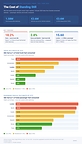
London represents one of the most challenging operating environments for fuel efficiency among the seven cities. Ranked sixth (out of seven) in the Index, its stop-start traffic patterns prevent engines from reaching operating temperature, while its unpredictability compounds the problem. London recorded the highest passenger vehicle fuel consumption of any city analysed, at 15.60 litres per 100 kilometres, almost two-and-a-half times higher than Paris.

Of every litre of fuel burned in London by passenger vehicles, 13.6% is consumed while stationary. Commercial trucks idle at 11.1% of total fuel consumed. Lower than the passenger rate, but still among the higher truck figures across the study, reflecting the loading restrictions, bus lane exclusions and concentrated delivery windows that make London uniquely challenging for commercial vehicle operations.

The findings also show that slow traffic and wasteful traffic are not always the same thing. Berlin leads the overall Index and records lower truck idle waste than London, at 8.5% compared with 11.1%, while Amsterdam ranks second and keeps passenger vehicle idle waste to 10.5%, below London’s 13.6%. Dublin sits third overall but shows a similar passenger vehicle idling issue to London, with 12.9% of fuel consumed while stationary, although its trucks perform better at 5.8%. Rome and Madrid are the clearest counterpoints: both record just 2.8% truck idle waste, the lowest in the study, because traffic may be slow but continues to move. Paris shows the reverse pattern, with predictable journey times but the highest truck idle waste rate in the study, as commercial vehicles lose almost one in every five litres of fuel while stationary.

Edward Kulperger, Senior Vice President, EMEA at Geotab, said: “Congestion has traditionally been measured through the lens of time. How long journeys take, how busy roads become and how delays affect operations. What this analysis shows is that there is another layer of cost sitting beneath that discussion.

“When vehicles are idling, fleets are effectively burning money. Our data shows it costs them millions: fuel consumed with engines running and wheels going nowhere. Every litre of that is also an emissions cost. Beyond the time lost, the burden of congestion is financial and environmental. The fleets navigating it best are those with the clearest picture of where those costs are falling.”

Read the full report here.

Methodology

The European Urban Freight Efficiency Index scores each city on a scale of 0 to 100, based on two dimensions evaluated separately for passenger vehicles and trucks, then combined using a 60/40 weighting (passenger/truck) to reflect that most road demand comes from passenger vehicles while the truck component captures logistics efficiency specifically.

The first dimension, how traffic flows, accounts for 75% of each vehicle score and measures three things: congestion burden (cumulative congestion across the day, 50% weight), uncongested windows (hours per day of free-flowing traffic, 25% weight), and travel time variability (journey time predictability, 25% weight). The second dimension, what congestion costs, accounts for the remaining 25%, measuring mid-trip vehicle idling as a proxy for waste produced by the system. Higher idle ratios indicate congestion, poor signal timing and bottlenecks.

Idle fuel costs were estimated using 2025 average pump prices from the European Commission’s Weekly Oil Bulletin for EU cities, and the UK Government’s Weekly Road Fuel Prices dataset for London, converted at the 2025 average GBP/EUR rate of 1.185.

All scores are based on full-year 2025 data (January–December) from Geotab’s connected vehicle platform across seven cities: Berlin, Amsterdam, Dublin, Rome, Paris, London and Madrid. Scores represent normalised, relative comparisons from a sample of connected vehicles, not a census.

About Geotab
Geotab is a global leader in connected operations, video telematics and AI-powered insights. Trusted by more than 100,000 customers — from small and mid-size fleets to Fortune 500 enterprises and public-sector organisations, including the U.S. federal government, Geotab connects approximately 6 million vehicles and assets and processes 100 billion data points daily. With ISO/IEC 27001:2022, SOC2, FIPS 140-3 and FedRAMP authorisations, Geotab’s open platform and 700+ partner ecosystem unify safety, compliance and operations in a single system. Our mission: a safer, more efficient and more sustainable world in motion.

View original content to download multimedia:https://www.prnewswire.co.uk/news-releases/europes-congestion-is-costing-fleets-millions-in-wasted-fuel-new-geotab-data-reveals-302828490.html

Continue Reading

Technology

TimePayment Names Joanna Markos as Chief Revenue Officer

Published

on

By

The Equipment Financing Veteran Has Returned to Continue the Growth Story She Began

WOBURN, Mass., Sept. 27, 2026 /PRNewswire-PRWeb/ — TimePayment, an award-winning fintech company specializing in commercial equipment financing, has elevated Joanna Markos to the role of Chief Revenue Officer.

She understands our business, our partners, and the opportunities ahead of us as we continue building.

Markos has over 13 years’ experience in the equipment financing industry. She joined TimePayment in 2013 as an Account Executive and over the next decade rose to become its Vice President of Sales. Along the way, she founded TimePayment’s Water unit, building it to $4MM in monthly sales. Markos left TimePayment in 2023 for a fresh leadership role in the equipment lease financing space, but returned in 2025 as TimePayment’s Director of Growth.

That story continues as she steps into her new position as Chief Revenue Officer. “In recent years, we’ve been very focused on efficiency, process, and becoming even better at what we do—and we’ve succeeded,” Markos explains. “Now we’re all about growth. So I’m leading the charge to build out our sales team, expand the verticals we serve, and make growth the focus of our decision-making.”

“What Joanna brings is that track record, that proven leadership that makes her uniquely positioned to lead our sales organization at this important point in our growth,” says Alyce Reilly, TimePayment’s Chief Operating Officer. “As we sharpen our focus on growing originations, expanding our partner relationships, and reaching more businesses with the financing solutions we provide, Joanna’s leadership will be instrumental in turning that strategy into results.”

Markos’ strength as a relationship-builder is also paramount, Reilly adds. “She’s someone our customers really value working with. I’ve seen firsthand the energy, experience, and commitment she brings to TimePayment and to the people around her. She understands our business, our partners, and the opportunities ahead of us as we continue building for our next phase.”

Visit TimePayment.com to learn more about TimePayment’s commercial equipment financing products and technology support for B2B equipment dealers and brokers. To contact Joanna Markos about strategic growth opportunities, connect with her on LinkedIn or visit the Contact page at TimePayment.com.

Media Contact
Noelle Cook
TimePayment
1 (480) 332-2042
noelle.cook@timepayment.com
https://timepayment.com

View original content to download multimedia:https://www.prweb.com/releases/timepayment-names-joanna-markos-as-chief-revenue-officer-302890854.html

SOURCE TimePayment

Continue Reading

Technology

AI Memory & Storage: The 5th GMIF2026 Innovation Summit Successfully Concludes in Shenzhen

Published

on

By

SHENZHEN, China, Sept. 26, 2026 /PRNewswire/ — On September 23, the 5th GMIF2026 Innovation Summit successfully concluded at the Renaissance Shenzhen Bay Hotel. Co-hosted by the Shenzhen Memory Industry Association (SMIA) and School of Integrated Circuits at Peking University, the summit, themed “The Future Built on AI Memory and Storage,” has brought together industry forces from IDMs, controllers, and memory solution providers to OSATs, equipment and material suppliers, server and AI infrastructure vendors, automotive electronics companies, AI applications developers, academic institutions, and investors. In-depth discussions explored the evolution of memory and storage technologies, industry trends, and application innovations in the AI era.

As AI training and inference workloads continue to scale, the boundaries of memory and storage technology and its applications keep expanding — from storage media and controllers to system architecture and AI applications themselves. GMIF 2026 approached the industry through the lens of the token economy, spotlighting inference efficiency, enterprise-grade storage, cloud-edge-device coordination, industrial capital, and the shifting global competitive landscape.

Five Years of GMIF: A Platform Built Around the Memory & Storage Industry

The summit officially kicked off with an opening remarks from Rixin Sun, President of the Shenzhen Memory Industry Association (SMIA). He looked back on GMIF’s growth since its founding in 2019. Now in its fifth consecutive year, the summit has steadily expanded in scale, industry reach, and influence, with its agenda consistently tracking the pulse of the storage sector.

President Sun said GMIF will continue to pursue a more specialized and differentiated approach going forward — staying close to frontier industry trends and supply-chain coordination, while connecting storage companies with adjacent players in AI compute and end-user applications to drive technical exchange, supply-demand matching, and ecosystem collaboration.

As AI Inference Accelerates, Memory & Storage’s Value Climbs

Daniel Yen, Executive Director at Morgan Stanley, opened the technical discussion with a look at how generative and agentic AI are reshaping infrastructure demands. As model weight loading, KV cache management, and data read/write scheduling grow more complex, Daniel noted that AI capital expenditure keeps rising — and memory and storage’s share of that investment, and its strategic value, are rising with it. He pointed to the “memory wall” as a defining challenge now driving fresh innovation in storage architecture, advanced packaging, and related technologies.

Yimao Cai, Dean of School of Integrated Circuits at Peking University, addressed the topic from the angle of AI inference architecture, discussing the growing role of high-bandwidth storage and multi-media integration. As large model inference drives up demand for capacity, bandwidth, and cost efficiency, Prof. Cai suggested that high-bandwidth flash (HBF) and heterogeneous multi-media storage architectures stand to play a larger role — combining HBM, NAND, and RRAM to strike a better balance between performance, capacity, and cost for AI inference.

Global IDMs Race to Meet the Demands of Agentic AI

Kevin Yoon, CVP & CTO of Samsung Memory China at Samsung Electronics, discussed memory architecture in the age of agentic AI. As agentic AI drives token generation and KV cache volumes to new heights, AI systems are placing greater demands on capacity, bandwidth, and energy efficiency. He outlined Samsung’s progress on Z-NAND, PCIe Gen6 SSDs, and ultra-high-capacity data center SSDs, and discussed how tiering across different storage media can more efficiently support KV cache and model weight storage.

Maya Zhang, Senior Director of Product Marketing at Sandisk, focused on data storage needs in the age of AI inference. As multimodal models, long-context processing, and increasingly sophisticated agents continue to grow KV cache demands, she noted, NAND flash is becoming ever more central to AI infrastructure. She added that more flexible data tiering and reuse across SSDs can improve efficiency for different AI workloads, and that high-density technologies like QLC are set to see broader adoption in AI use cases.

Benny Ni, GAR Sales VP at Solidigm, addressed enterprise SSDs’ role in AI infrastructure amid growing data volumes and operational demands. As model size, token counts, and inference complexity all continue to climb, he said, memory offloading and data tiering are becoming core components of AI system architecture — with high-capacity QLC SSDs paired with high-performance storage offering a more efficient, cost-effective data foundation for inference.

Cloud, Edge, and Device: AI Opens New Ground for Memory & Storage

John Xavier Lionel, Head of Global Storage Business at Arm, spoke on system-level coordination in AI inference, noting that inference spans compute, memory, storage, and data movement — all of which require holistic architectural optimization. As small models, quantization, and heterogeneous NPUs continue to advance, he said, AI deployment will increasingly span cloud, edge, and device, with local storage taking on a larger role in hosting model weights, knowledge bases, and application data.

Stanley Huang, AVP at Silicon Motion, focused on storage requirements in multi-agent, concurrent-use scenarios, where differing tasks demand tailored QoS, latency, and resource allocation. He described how Silicon Motion’s controller and resource-scheduling technologies improve storage efficiency under complex workloads, spanning enterprise SSDs, server storage, mobile UFS, autonomous driving, and robotics applications.

Sam Sun, Chairman at BIWIN, discussed how AI is simultaneously driving storage demand across data centers, edge, and endpoint devices — each with distinct requirements. In data centers, he noted, AI training and inference are pushing up demand for enterprise SSDs and server memory; at the edge and endpoint, applications like AI/AR glasses, AI PCs, smart vehicles, and industrial equipment are pushing storage toward smaller form factors, lower power consumption, higher reliability, and tighter system integration. Sam Sun said BIWIN continues to leverage its integrated solutions and manufacturing capability across enterprise, embedded, PC and mobile, industrial, and automotive product lines — with innovations like Mini SSDs, ultra-compact embedded storage, and wide-temperature industrial SSDs opening new ground in the AI era.

From Compute Infrastructure to Token Production, Deeper System-Level Integration

Tao Zhou, General Manager of the Server Division at Lenovo ISG China, discussed the concept of the “token factory.” As enterprise AI moves from proof-of-concept to large-scale deployment, he said, improving the efficiency of AI infrastructure and sustaining stable token output have become critical industry priorities. He also described how top-level design, data governance, compute optimization, and security management — combined with pooled training/inference resources and hardware-software coordination — are helping enterprise AI infrastructure evolve from simple compute buildout into systematic operations.

Fan Zhang, Chief Computing Architect at NEXWISE, discussed integrated management and scheduling across cloud, compute, and storage resources from an operations standpoint, showing how coordination across compute, storage, and software platforms can improve overall infrastructure efficiency.

Wei Xiong, CTO of Infplane, focused on storage tiering in large model inference, explaining how hot/cold data tiering and intelligent scheduling can shift more inference workload onto SSDs — reducing memory footprint and improving token output efficiency.

Across servers, AI computing centers, and storage systems, deeper coordination among compute, memory, storage, networking, and software scheduling is emerging as a defining trend in AI infrastructure.

From Core Technology to Real-World Application, AI Memory & Storage Ecosystem is Converging Fast

As AI continues to move into automotive, robotics, and enterprise applications, the connection between the storage industry and AI use cases keeps deepening.

Junjia Chen, AI Product Director at SYNCORE, discussed the application of agent architecture in automotive scenarios, focused on smart cockpits and vehicle-wide intelligence.

Lusha Chen, General Manager for APAC at Dify, introduced a “workflow plus agent” model for enterprise AI, connecting large models, corporate knowledge bases, business systems, and end-user applications to embed AI more deeply into enterprise workflows.

Gongjie Liu, Regional Director for Central & Southern China & General Manager of Branch Office at Paratera, discussed multi-model access, unified management, and enterprise AI services built around a MaaS platform.

Zhen Li, VP of Genstoraige, spoke to the concept of “storage-powered compute,” covering data hosting, high-speed interconnects, and intelligent scheduling within AI systems.

Yunjie Ye, Chairman of Numbers Law, presented the company’s work on next-generation mechanical storage architectures for large-capacity data storage.

Ming Zhao, General Manager of OKN Technology, addressed testing requirements for the AI era, describing how test equipment is evolving to support higher speeds, more complex scenarios, and real-world workload simulation for PCIe 6.0 SSDs, memory, and increasingly demanding AI applications — laying the groundwork for the development and large-scale deployment of next-generation storage products.

The Future Built on AI Memory & Storage

From AI inference to agentic AI, from emerging storage media to enterprise SSDs, from data centers to edge and endpoint devices, and from controllers, packaging, and testing equipment to servers, AI computing platforms, and applications, GMIF 2026 highlighted the technological innovation and industry transformation taking place across the memory and storage ecosystem in response to AI.

The massive volumes of data that AI generates, retrieves, and moves are steadily elevating memory and storage’s role within the broader computing stack. Demand for high-capacity, high-bandwidth, and high-reliability storage in data centers continues to climb, while emerging endpoints — AI PCs, smart vehicles, AI/AR glasses, robotics — keep opening new application space. Together, cloud, edge, and device are shaping a richer and more complex set of storage requirements for the AI era.

Meanwhile, the technology itself keeps moving — HBM, HBF, NAND flash, enterprise SSDs, and a handful of newer media all advancing in parallel, with controllers, packaging, testing, and software scheduling evolving alongside them into tighter, more coordinated systems.

Now in its fifth successful year, GMIF has established itself as a leading platform for exchange across the global memory and storage industry. Looking ahead, GMIF will continue to focus on technological innovation, industry trends, and supply-chain collaboration — bringing together key players from across the global industry, pursuing an increasingly specialized and differentiated event model, and fostering deeper exchange and cooperation across the storage value chain.

Media Contact:

Carina Gu
wenjing.gu@gmif.com.cn 

View original content to download multimedia:https://www.prnewswire.com/news-releases/ai-memory–storage-the-5th-gmif2026-innovation-summit-successfully-concludes-in-shenzhen-302890873.html

SOURCE Shenzhen Memory Industry Association (SMIA)

Continue Reading

Technology

NonPublic eclipses US$500M in assets, becomes one of Australia’s fastest-growing private markets investment platforms

Published

on

By

NonPublic has grown assets under administration to over US$500 million in under four years, giving Australian wholesale and sophisticated investors direct exposure to pre-IPO companies including SpaceX, Perplexity, and Groq.

SYDNEY, Sept. 27, 2026 /PRNewswire-PRWeb/ — Private markets technology investment platform NonPublic has grown assets under administration (AUA) across the Group to more than US$500 million in under four years, making it one of the fastest-growing private markets investment platforms in Australia.

Our task over the next 12 months is to deepen that access for Australian investors, broaden the sectors we cover, and build the secondary market functions that give investors a genuine path in and out of these positions.

It has achieved this growth by building a portfolio that spans some of the most closely watched private technology companies globally, including the likes of SpaceX, Shield AI, Groq, Ayar Labs, Perplexity, Tenstorrent, Discord, and more.

NonPublic uses a unique structure that pools capital from Australian wholesale and sophisticated investors, giving individual investors exposure to a single private company.

This gives individual investors access to minimum commitments of US$1 million to US$5 million and United States Securities and Exchange Commission (SEC) accreditation thresholds that would otherwise be out of reach for most Australians investing directly.

NonPublic has positions in sectors including defence, robotics, and energy generation. The platform has also launched a secondary market that lets investors sell an eligible position before a company lists publicly.

Over the next 12 months, NonPublic plans to deepen its Australian investor base including across family offices and financial advisers, while also exploring expansion into international jurisdictions.

The fact that the platform is expanding into new sectors and markets signals growing Australian investor appetite for pre-IPO access to private US technology companies, according to NonPublic.

Milan Reinartz, founder and CEO of NonPublic, said: “Four years ago, Australian wholesale investors had almost no structured way to access the private US technology companies driving the next wave of global growth. Reaching over US$500 million in assets under administration in that time reflects how quickly that gap has closed, and how much appetite there is among sophisticated investors for deal-by-deal access, where they choose exactly which company they back with each vehicle.

“Our growth has been built one company at a time, from Tenstorrent and Perplexity through to SpaceX and Groq, and it shows how quickly Australian investor appetite for this kind of access is growing. Our task over the next 12 months is to deepen that access for Australian investors, broaden the sectors we cover, and build the secondary market functions that give investors a genuine path in and out of these positions.”

NonPublic (www.nonpublic.com) is an Australian-licensed investment platform providing sophisticated/accredited and professional investors with curated access to exclusive pre-IPO and private market opportunities, with a focus on leading US technology companies. Through a transparent, technology-enabled platform, NonPublic connects investors with high-growth private companies, secondary transactions, and alternative investment opportunities that have traditionally been difficult to access. NonPublic Pty Ltd holds Australian Financial Services Licence (AFSL) 482668.

*This article does not constitute investment advice.

Media Contact
Priyanka Dogra, NonPublic, 61 0410593587, priyanka@thirdhemisphere.agency, www.nonpublic.com 

View original content to download multimedia:https://www.prweb.com/releases/nonpublic-eclipses-us500m-in-assets-becomes-one-of-australias-fastest-growing-private-markets-investment-platforms-302889069.html

SOURCE NonPublic

Continue Reading

Trending