Connect with us

Technology

Wistron Celebrates Grand Opening of First U.S. Smart Factory Marking Milestone in Global Smart Manufacturing Strategy

Published

on

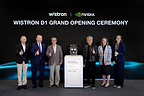
FORT WORTH, Texas, July 21, 2026 /PRNewswire-HISPANIC PR WIRE/ — Wistron Corporation (“Wistron”) celebrated the grand opening of its D1 AI smart facility in Fort Worth, Texas, the site where the first NVIDIA GB300 Grace Blackwell Ultra Superchip was built and mass-produced in the United States. The US$ 700 million facility, spanning approximately 324,000 square foot, was officially unveiled during a ceremony led by Wistron Chairman Simon Lin and NVIDIA Founder and CEO Jensen Huang. Jessica Rogers, Director of the Economic Development Department for the City of Fort Worth, and Alexander Tah-ray Yui, Taiwan’s Representative to the United States, were among the government officials and business leaders who attended, marking a milestone in the expansion of Wistron’s global footprint and advanced manufacturing capabilities.

This is a key hub in Wistron’s global AI infrastructure manufacturing network. The facility runs on NVIDIA accelerated computing and integrates NVIDIA’s Nemotron and Cosmos open frontier models and Omniverse and Metropolis libraries, using digital twin technology to optimize factory design, production workflows, and operational efficiency. It is Wistron’s first U.S.-based manufacturing facility, established to serve customers locally and produce NVIDIA’s most advanced and cutting-edge products. Wistron Chairman Simon Lin said “The operation here is not typical manufacturing. It is new, very comprehensive, and high-tech. Right now we produce the NVIDIA GB300 Grace Blackwell Ultra Superchip, and beyond, we are also going to produce the NVIDIA Vera Rubin Superchip here. In the next couple of years, this location will be one of the most important, as we build AI infrastructure here in the United States. I think this is the reason we say that there will be the next chapter, and we are going to empower AI from Texas.”

Responding to Customer Needs: Texas, the Newest Global Manufacturing Hub
At this pivotal moment for global AI infrastructure, Wistron is drawing on decades of global manufacturing experience to expand its footprint in Texas, a state with a well-established ecosystem for logistics, talent recruitment, and advanced manufacturing. The new D1 facility produces the NVIDIA GB300 Grace Blackwell Ultra Superchip and soon, the NVIDIA Vera Rubin Superchip — critical to powering the next generation of AI computing. The new Fort Worth facility strengthens a critical upstream layer of the AI infrastructure supply chain by expanding domestic capacity to assemble and test NVIDIA AI systems. These servers can be integrated into NVIDIA DSX infrastructure, with DSX providing the common architecture and technologies needed to deploy and operate energy-efficient AI factories at scale.

One-Stop Operational Ecosystem Strengthens U.S. AI Supply Chain Resilience
Behind every breakthrough in AI computing lies the manufacturing capability to scale it. Wistron is expanding its AI server production capabilities from Taiwan to the United States, guided by a vision of precision, efficiency, and sustainability. This reflects a broader industry shift: AI leadership is determined not only by technological breakthroughs, but also by the operational capability to transform innovation into high-volume production with consistent quality, supply chain resilience, and predictable delivery. By establishing AI infrastructure manufacturing capacity in the United States, Wistron is building a one-stop operational ecosystem spanning manufacturing and after-sales service — shortening delivery timelines and customer support cycles, strengthening supply chain resilience, and laying the foundation for long-term competitive advantage as AI infrastructure continues to scale.

Partnering with NVIDIA to Pioneer a New Model for Smart Manufacturing and Energy Optimization
As the era of physical AI begins, Wistron is extending its smart manufacturing capabilities to the United States, creating a new model for AI infrastructure production built on digital manufacturing, energy optimization, and local operations. Jensen Huang said: “The largest infrastructure buildout in history is underway. Demand for AI factories—the engine of this next industrial revolution—is incredible, and they must be produced everywhere. Together, NVIDIA and Wistron are restoring US advanced manufacturing capacity in Texas, creating skilled jobs and strengthening America’s AI supply chain.” As demand for advanced manufacturing grows in Texas, smarter planning of production loads and energy use will give the plant greater control and flexibility over its electricity needs.

Turning Global Experience into Scalable AI Infrastructure
Simon Lin stressed that the speed the AI era demands comes with its own responsibility. “In the AI era, the pressure of speed is also a form of responsibility,” Lin said. “We don’t just need to build fast; we need to build right.”

The Fort Worth plant will serve as the core engine of Wistron’s U.S. manufacturing operations, the company said, connecting its global production network with ecosystem partners as it scales advanced AI manufacturing. Wistron said that the investment reflects efforts to deepen its technical capabilities, strengthen the resilience and efficiency of global supply chains, and support the next phase of AI infrastructure development.

About Wistron:
Wistron Corporation is a leading global technology service provider delivering advanced ICT products, AI infrastructure, and manufacturing solutions to technology brands worldwide. With more than 63,000 employees across North America, Europe, and Asia, Wistron continues to expand its AI, cloud, and advanced manufacturing capabilities to support the next generation of intelligent computing. For more information about Wistron, please visit the official website at www.wistron.com. Additional information about the event is available on the event website.

Media Contact:
Joyce WL Chou
joyce_wl_chou@wistron.com

SOURCE Wistron Corporation

Continue Reading

Technology

Wulcea Elevates Consumer Trust in Heated Apparel Through Multi-National Safety Certifications and Rigorous Technical Testing

Published

on

By

NEW YORK, Oct. 31, 2026 /PRNewswire/ — As smart heated clothing gains broader adoption, consumers are paying closer attention to the safety and reliability of the technology behind these products. Wulcea, a brand specializing in graphene-powered heated apparel, combines its flexible GrapheneNano™ heating technology with documented safety compliance and durability testing for its heating components and battery systems.

“Trust in smart heated apparel goes beyond warmth—it comes down to confidence in battery safety and heating element reliability,” said John C, Founder of Wulcea. “Our goal is to give users peace of mind through certified technical standards.”

Advanced Graphene Heating Elements Supported by Global Standards

At the core of Wulcea’s thermal architecture is its GrapheneNano™ heating technology. Engineered to eliminate garment stiffness, Wulcea integrates flexible graphene elements that deliver balanced warmth across key upper-body zones while preserving natural garment drape and full freedom of movement.

Wulcea supports its heating components with applicable compliance documentation for major markets. These include CE and FCC compliance documentation addressing relevant electrical and electromagnetic compatibility requirements, as well as PSE compliance for applicable products in Japan. RoHS compliance further addresses restrictions on specified hazardous substances in applicable electrical and electronic components.

Multi-Certified Battery System for Dependable Power

To power its heating elements, Wulcea pairs its heated apparel with rechargeable battery systems designed for convenient everyday use. Featuring a compact design and housed in dedicated interior pockets, the batteries provide portable power while maintaining a streamlined garment profile and comfortable fit.

Wulcea backs its battery options with comprehensive third-party accreditations. UL certification demonstrates that the battery system has been evaluated against recognized power bank safety requirements, covering key areas such as overcharge protection, short-circuit protection, and thermal safety. The battery systems are also supported by applicable CE and FCC compliance documentation, addressing relevant regulatory requirements for electrical and electromagnetic compatibility.

For daily handling and travel, RoHS compliance validates that the battery system meets stringent global standards for material safety. The battery models have also undergone applicable UN 38.3 testing, supporting compliance with international requirements for lithium battery transportation.

Real-World Durability and Practical Usability

Component compliance forms Wulcea’s foundation, but reliability is defined by real-world performance. Built for high-flex endurance, Wulcea’s flexible graphene heating elements are tested through 10,000 active flexing cycles to maintain steady thermal output through repeated bending and everyday body movement.

Everyday convenience is equally essential. Built for hassle-free care, Wulcea’s heating elements withstand 100 machine-wash cycles under standard care guidelines, maintaining internal conductivity and structural stability under repeated laundering.

Integrated NTC temperature sensors provide thermal monitoring and are designed to stop heating if temperatures exceed 131°F (55°C). Combined with runtime of up to 10 hours on the low setting and a discreet interior control button, these features support practical everyday use in cold-weather conditions.

Aligning Technical Standards with Everyday Warmth

By combining graphene-based heating technology with documented battery safety compliance and durability testing, Wulcea continues to focus on the technical foundations of dependable heated apparel. This approach reflects the brand’s emphasis on bringing together safety considerations, practical functionality, and everyday comfort for cold-weather use.

View original content to download multimedia:https://www.prnewswire.com/news-releases/wulcea-elevates-consumer-trust-in-heated-apparel-through-multi-national-safety-certifications-and-rigorous-technical-testing-302925554.html

SOURCE Wulcea

Continue Reading

Technology

NIDS Co., Ltd. Confirms CES 2027 Participation, Pursues Expansion of Global Supply Chain for Environmental Sensors

Published

on

By

Company introduced optical and gas sensors at SEDEX and is strengthening its composite sensor business for robotics, home appliances, automotive, and smart building applications

SEOUL, South Korea, Oct. 31, 2026 /PRNewswire/ — Environmental sensor manufacturer NIDS Co., Ltd. has confirmed its participation in CES 2027 and is moving to expand its global business-to-business (B2B) supply chain. Building on its experience supplying sensors to domestic and international home appliance and automotive companies, the company aims to secure overseas customers and extend its applications into smart building HVAC and robotics.

NIDS recently participated in the Korea Semiconductor Industry Association’s Sensor Pavilion at SEDEX 2026, held at COEX in Seoul, where it introduced its next-generation sensor modules. The company said the exhibition allowed it to raise awareness of its technology among domestic home appliance and electronic component industry professionals and to lay the groundwork for collaboration in the sensor field.

The company will use CES 2027 as its next stage. NIDS plans to firm up discussions on sensor module supply with global home appliance makers, HVAC specialists, and robotics companies. It aims to extend the industry contacts gained at the domestic exhibition overseas and to convert product introductions into actual supply opportunities.

Founded in 2000, NIDS develops and manufactures environmental sensors and air quality management solutions. According to the company, it has supplied more than 10 million sensors cumulatively to domestic and international companies, including Dyson, Samsung Electronics, and Hyundai Motor. Drawing on this supply track record, the company intends to showcase its precision sensing technology and mass-production capabilities to overseas customers.

Its main products include particulate matter sensors, optical gas sensors based on non-dispersive infrared (NDIR) technology, composite environmental sensors, and electronic nose sensor modules. The particulate matter sensors measure PM1.0, PM2.5, and PM10, while the gas sensor lineup targets carbon dioxide (CO₂), carbon monoxide (CO), and other gases. The electronic nose is used for detecting everyday odors, gas leaks, and fires. The company said it designs the core components required for air quality measurement in-house and has a system in place to mass-produce 5 million units annually.

The area where NIDS will expand development and supply going forward is next-generation composite sensor modules. The company has been pursuing a sensor business that responds to industry-specific demand in home appliances, automotive, and smart building HVAC, and is now concentrating its capabilities on markets such as robotics, industrial safety, and odor detection based on this technology. Building on its experience supplying individual components, NIDS plans to continue developing and supplying, on a B2B basis, modules that handle multiple types of environmental data.

The company will also highlight its sensor product lineup and its newly developed ultra-compact MEMS sensor technology at the exhibition. NIDS plans to introduce its optical and gas sensor lineup along with examples of their application in actual air quality management systems. By explaining both the measurement functions of its components and its experience operating sensors for finished-product services, the company aims to broaden the scope of partnership discussions.

NIDS explained that, because it owns its precision sensors, it can control sensor sensitivity and tune algorithms to suit the system in which they are applied. Drawing on this technical operating experience, the company plans to pursue partnerships with customers and to promote its business capabilities extending from sensor components to air quality and odor management and industrial safety management.

NIDS will also leverage its existing branch network in its overseas market development. Through its overseas bases in the United States, Japan, and China, the company plans to widen its touchpoints with buyers and seek new supply opportunities in conjunction with its CES participation. Its goal is to generate export results by combining exhibition participation with its local networks.

The company intends to keep expanding the global supply of sensor components as a core pillar of its business. Building on the supply experience accumulated in home appliances and automotive, it will broaden its partners to robotics, HVAC, and smart buildings, and respond to industry-specific air quality measurement demand through the development of next-generation modules.

“We plan to continue expanding the development and B2B supply of next-generation composite sensor modules needed across a range of industries, including home appliances, automotive, and smart building HVAC,” NIDS said.

View original content to download multimedia:https://www.prnewswire.com/news-releases/nids-co-ltd-confirms-ces-2027-participation-pursues-expansion-of-global-supply-chain-for-environmental-sensors-302925577.html

SOURCE NIDS Co., Ltd.

Continue Reading

Technology

Towards Buddha Co., Ltd. and ICP DAS Showcase iTLC Intelligent Traffic Control Solutions at APTA 2026 in Chicago

Published

on

By

Advancing smart intersection technologies and expanding international market opportunities through strategic collaboration

CHICAGO, Oct. 31, 2026 /PRNewswire/ — Towards Buddha Co., Ltd., an overseas distributor of the iTLC Intelligent Traffic Control System, joined its technology partner ICP DAS at APTA 2026 TRANSform & EXPO in Chicago, USA, to showcase the iTLC-9000 Series and its applications in intelligent traffic management.

The exhibition highlighted innovative traffic control technologies designed to support reliable, secure, and integrated smart intersection operations, while providing opportunities to connect with international transportation professionals and explore emerging market needs.

Innovative Traffic Control Solutions

Under the theme “Innovative Traffic Control System,” the exhibition featured the iTLC-9000 Series, highlighting four key capabilities: modular and redundant design, secure networking, traffic signal integration, and active alert systems.

These technologies are designed to support system reliability, communication security, and efficient traffic infrastructure management, addressing the evolving requirements of modern intelligent transportation systems.

As cities worldwide continue to modernize transportation infrastructure, integrated and adaptable traffic control solutions are becoming increasingly important for smart intersection development.

Strengthening International Market Connections

As an overseas distributor of iTLC solutions, Towards Buddha Co., Ltd. plays an important role in connecting traffic control technologies with international markets.

During APTA 2026, Towards Buddha Co., Ltd. and ICP DAS engaged with transportation professionals, system integrators, and industry representatives to introduce iTLC technologies, exchange industry insights, and explore potential business opportunities.

“APTA 2026 provided a valuable platform to connect with the global transportation industry,” said a representative of Towards Buddha Co., Ltd. “Together with ICP DAS, we look forward to expanding international awareness of iTLC solutions and developing new opportunities in intelligent traffic control.”

Looking Ahead

Building on its participation at APTA 2026, Towards Buddha Co., Ltd. will continue collaborating with ICP DAS to promote iTLC solutions, strengthen international partnerships, and explore new opportunities in the global intelligent transportation market.

About Towards Buddha Co., Ltd.

Towards Buddha Co., Ltd. is an overseas distributor of the iTLC Intelligent Traffic Control System, focused on international market development and connecting advanced traffic control technologies with transportation industry needs.

Media Contact

Towards Buddha Co., Ltd.
Contact: Michael Chen
Email: Towardsbuddhaincorporation@gmail.com
Website: https://www.towardsbuddha.com 

SOURCE Towards Buddha Co., Ltd.

Continue Reading

Trending