Connect with us

Technology

Consortium launches cross-regional pilot on post-quantum security with participation from banks and regulatory stakeholders

Published

on

Convened by the Responsible Fintech Institute with Safeheron as technology partner, to evaluate and eventually open-source quantum-resilient infrastructure for wallet generation and digital asset transfers in a regulated, cross-jurisdiction setting.

SINGAPORE, Aug. 23, 2026 /PRNewswire/ — The Responsible Fintech Institute (RFI) and Safeheron have launched a pilot initiative to evaluate post-quantum cryptography for digital asset transactions, with participation from selected financial institutions and regulatory stakeholders across multiple jurisdictions. The initiative is designed to move quantum-safe financial infrastructure from concept into practical testing with participating institutions.

The pilot will focus on a post-quantum cryptography (PQC) research program built around a multi-party computation (MPC) protocol that supports ML-DSA-65, the NIST FIPS 204 digital signature standard, with participant testing covering wallet generation and on-chain transfer activity on the quantum-resistant NEAR testnet. The initiative brings together banks and regulators from multiple jurisdictions to examine cross-border interoperability, operational resilience and governance considerations in parallel with technical evaluation.

“No single bank, vendor, or regulator solves this alone,” said Chia Hock Lai, Chairman of the Responsible Fintech Institute. “By bringing policymakers and financial institutions across jurisdictions together to test the same post-quantum architecture, and transparently sharing that research with every participant, we are building a compliance and security reference the whole industry can stand on — and a standard we all helped write.”

“AI is accelerating the pace of change and likely bringing the quantum threat closer to reality — quantum-ready infrastructure has never been more critical, and the time to act is now,” said Jag Foo, Chief Security & Policy Officer at Safeheron. “By integrating NIST’s post-quantum signature standard with advanced MPC technology, we are building the architecture required to secure the next generation of financial networks. Safeheron has long advocated for open-source cryptography, because accountability and good governance demand it. We intend to open-source our PQC code. Cryptography securing institutional assets should stand up to independent scrutiny, not ask for trust.”

“As the financial sector prepares for future cybersecurity challenges, initiatives that encourage collaboration and knowledge-sharing among industry participants are increasingly important,” said António Henriques, CEO of Bison Bank. “We are pleased to support discussions around post-quantum security and to contribute to broader industry understanding of how financial institutions can prepare for the evolving risk landscape.”

“We welcome the industry’s initiative to identify a reliable protocol that safeguards digital asset transactions,” said David Peters, Managing Director of the Gelephu Financial Services Office. “Ensuring the continuing integrity of these transactions and protecting client funds is critical to the smooth functioning of the investment market.”

“Preparing for the potential impact of quantum computing on the financial system requires early engagement, collaboration and a better understanding of how post-quantum technologies can operate in practice,” said Alan Decelis, Head of Supervisory ICT Risk and Cybersecurity at the Malta Financial Services Authority. “The MFSA welcomes initiatives that bring together regulators, financial institutions and technology experts to explore these challenges in a controlled environment. Participating in this initiative provides a valuable opportunity to contribute a supervisory perspective while developing our understanding of the operational, governance and resilience considerations associated with the transition towards quantum-safe financial services.”

Why quantum-safe infrastructure matters

Quantum computing is widely expected to create long-term risks for the public-key cryptography that underpins large parts of today’s financial system, and financial-sector transition planning has become increasingly important. As noted in a 2025 paper on quantum-readiness for the financial system published by the Bank for International Settlements (BIS), the transition requires coordinated planning, cryptographic agility and phased migration, rather than a simple algorithm swap.

At the same time, regulators are sharpening their focus on AI- and quantum-driven cyber risks. In July 2026, the Monetary Authority of Singapore (MAS) and the Association of Banks in Singapore (ABS) announced the AI-Driven Cyber and Technology Risk Taskforce (ACT), an industry-wide initiative to strengthen collective cyber and technology resilience against emerging threats from frontier AI models. Regionally, the Hong Kong Monetary Authority (HKMA) has embedded quantum readiness into its Fintech 2030 strategy, launching a Quantum Preparedness Index and whitepaper to benchmark banks’ transition to post-quantum cryptography and signalling an ambition to achieve full sectoral quantum-ready status by 2030.

Within this pilot, participating institutions will test a shared application environment that enables quantum-resistant MPC signing under consistent conditions, while regulators take part in an observer role during the first phase and contribute to a governance workstream in the next stage. The proof of concept also envisages publication of a whitepaper covering the research, protocol design and testing findings so that the wider market can assess and build on the results, reinforcing the sector’s collective learning and preparedness. Furthermore, the underlying protocol technology will eventually be open-sourced to maximize transparency, encourage independent security auditing, and promote accountable, industry-wide standards.

About the pilot

The proof of concept is positioned as a collaborative effort for regulated financial institutions, with Safeheron leading protocol and engineering work and the Responsible Fintech Institute leading governance, convening and cross-jurisdiction stakeholder coordination. Current participants include regulators such as Abu Dhabi Global Market (ADGM), Gelephu Financial Services Office (GFSO) and Malta Financial Services Authority (MFSA) alongside participating banks including Bison Bank and DK Bank, with additional institutions in discussion to join.

Participating financial institutions will contribute to the evaluation of operational, governance and interoperability considerations associated with post-quantum cryptographic approaches. Levels of participation may vary depending on the role and scope agreed by each institution.

The pilot has been structured to stay close to real institutional operating models, including a tentative non-custodial 2-of-2 MPC participation design intended to minimize operational burden while preserving institutional control over key ownership. Its broader objective is to help the market better understand how secure digital asset transaction flows could evolve across regions as financial institutions prepare for a quantum-safe future, in alignment with evolving supervisory expectations on cyber resilience and quantum readiness.

About the Responsible Fintech Institute

The Responsible Fintech Institute is an independent nonprofit organization focused on bridging traditional and decentralized finance through standards, governance and responsible adoption. In this pilot, it convenes regulators, banks and market infrastructure stakeholders across jurisdictions and supports governance and publication of the initiative’s research findings.

About Safeheron

Safeheron is a digital asset custody and operating system infrastructure provider focused on advanced cryptographic infrastructure, including multi-party computation and trusted execution environment capabilities. In this pilot, it is responsible for the PQC-enabled MPC protocol, ML-DSA-65 signing implementation and testing application used by approved participants.

View original content to download multimedia:https://www.prnewswire.com/news-releases/consortium-launches-cross-regional-pilot-on-post-quantum-security-with-participation-from-banks-and-regulatory-stakeholders-302857693.html

SOURCE Responsible Fintech Institute (RFI)

Continue Reading

Technology

Tencent Cloud and Teleport Collaborate to Advance AI-Powered Cross-Border Logistics from China

Published

on

By

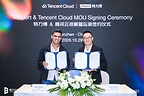
SHENZHEN, China, Nov. 13, 2026 /PRNewswire/ — At the 2026 Tencent Global Digital Ecosystem Summit, Tencent Cloud, the cloud business of global technology company Tencent, signed a Memorandum of Understanding (MOU) with Teleport, Capital A’s logistics venture and leading Southeast Asian eCommerce logistics specialist. Under the MOU, Tencent Cloud will provide the cloud infrastructure for Teleport’s operations in China, while Teleport will leverage Tencent Cloud’s artificial intelligence (AI) to build smarter, more automated logistics operations for cross-border movement from China.

The Teleport Network: Built for Cross-Border eCommerce

Teleport moves eCommerce and cargo on Southeast Asia’s largest air network, moving up to 1.25 million parcels a day across the Teleport Network, connecting China, Southeast Asia, Oceania and the Middle East by leveraging the freighter and belly capacity of over 55 airline partners. Operating at this scale demands seamless orchestration, which begins with ensuring every single parcel moves with verified, accurate data. The partnership with Tencent Cloud anchors shipment data on a reliable digital foundation from the first mile and ensures every subsequent process from customs clearance to mid-mile multi-airline transfers runs on timely, accurate information.

Supporting the Next Phase of Growth for Cross-Border Logistics

As global cross-border e-commerce accelerates, managing operational complexity requires moving beyond passively monitoring shipments. Backed by deep ecosystem experience in China and across global markets, the partnership with Tencent Cloud will make it easier for Chinese marketplaces, shippers and regional partners to integrate and collaborate seamlessly. This establishes a unified, single source of truth across the supply chain, giving Teleport, its airline partners and its eCommerce customers identical real-time tracking from origin to destination.

Accelerating AI Adoption Across Logistics Operations

Building on this Cloud data foundation, Teleport is exploring a suite of Tencent Cloud AI solutions to advance operational efficiency.

Tencent Cloud Agent Development Platform (ADP): Enables Teleport to build and deploy purpose-built AI agents across core operational workflows, including automated route optimisation, customs document processing, dynamic capacity planning, and real-time disruption recovery.TokenHub: Provides flexible access to different AI models, helping Teleport balance capability, responsiveness and cost efficiency across AI applications.WorkBuddy: Enhances internal operations and knowledge access through multi-agent workflows, enabling teams to collaborate more efficiently.eKYC & identity verification: Strengthens verification and onboarding workflows for cross-border merchants, air cargo partners, and ground handling agents, reinforcing compliance and security across the network.

Poshu Yeung, Senior Vice President of Tencent Cloud and Head of Tencent Cloud International, said: “As cross-border commerce continues to create new opportunities across Asia and beyond, logistics providers are increasingly looking for technologies that can help improve efficiency, strengthen resilience and support growth across multiple markets. Through our collaboration with Teleport, we are combining Tencent Cloud’s infrastructure and AI capabilities with Teleport’s logistics expertise to help move the Teleport Network beyond visibility towards intelligent decision-making and execution, enabling greater operational agility across its cross-border logistics network.”

Milan Dhingra, Chief Product Technology Officer of Teleport, said: “Teleport will always be a physical air logistics business, but we run digital first. Therefore it is key that we work with the right partners in the right market where mission critical cargo data need to flow, where their expertise is unmatched. China has its own digital ecosystem and we wanted a partner that understands Teleport’s vision for seamless orchestration and intelligence while being purpose-built for local requirements. Tencent Cloud is that partner for us in China.”

Making the Teleport Network Smarter

This strategic collaboration reflects a shared commitment to advance the development of cross-border logistics through cloud and AI technologies. By pairing Teleport’s logistics expertise with Tencent Cloud’s infrastructure and AI capabilities, both companies aim to turn operational data into real-time, actionable intelligence across the Teleport Network enabling reliable, scalable eCommerce movement across the region.

About Tencent Cloud

Tencent Cloud, one of the world’s leading cloud companies, is committed to creating innovative solutions to resolve real-world issues and enabling digital transformation for smart industries. Through our extensive global infrastructure, Tencent Cloud provides businesses across the globe with stable and secure industry-leading cloud products and services, leveraging technological advancements such as cloud computing, Big Data analytics, AI, IoT, and network security. It is our constant mission to meet the needs of industries across the board, including the fields of gaming, media and entertainment, finance, healthcare, property, retail, travel, and transportation. 

About Teleport

Teleport is an integrated eCommerce logistics specialist operating the largest, yet asset-light, air network in Southeast Asia. We are on a mission to move things across the region faster, cheaper and better than anyone else – by giving access to affordable and reliable cross-border delivery for all big and small businesses, as fast as next-day. Teleport is a logistics venture of Capital A, with a presence across Malaysia, Singapore, Thailand, Indonesia, Philippines, Chinese Mainland, Chinese Hong Kong and India.

For more information, please visit teleport.it or our social media on LinkedIn, and Instagram.

View original content to download multimedia:https://www.prnewswire.com/apac/news-releases/tencent-cloud-and-teleport-collaborate-to-advance-ai-powered-cross-border-logistics-from-china-302938831.html

SOURCE Tencent Cloud

Continue Reading

Technology

DATA.BET Now Powers Sportradar’s Unified Odds Feed

Published

on

By

Delivering a full esports betting toolset, from Tier-1 majors to Tier-4 tournaments across key disciplines

LIMASSOL, Cyprus, Nov. 13, 2026 /PRNewswire/ — DATA.BET, a trusted sportsbook solution supplier, has signed a deal with Sportradar, a leading global sports technology company, to become one of the partnered providers for its expanded offering.

Through the integration, Sportradar receives DATA.BET’s esports data content and performance-boosting toolset cover 1,800+ tournaments and 94,000+ matches annually across 60+ markets. Widgets and Streaming are set to follow, giving operators a fuller esports experience around headline events and niche competitions.

As a part of the deal, DATA.BET covers Counter-Strike 2, Dota 2, League of Legends, from Tier-1 to Tier-4 tournaments, with Valorant and other titles set to follow shortly. For DATA.BET, the deal marks a significant step in its global expansion and reinforces its position as a trusted esports Odds Feed supplier to the largest names in the industry.

“Becoming a supplier for Sportradar’s esports offering reflects the trust that the industry’s biggest players place in our content and products,” said Otto Bonning, Head of Sales at DATA.BET. “We’re confident in our coverage depth, speed, and trading expertise. This deal also opens a new route for our content, from Tier-1 majors to lower-tier tournaments running around the clock, to reach users around the world.”

Roman Garin, SVP, Innovation at Sportradar, said: “Esports’ fully digital nature creates an expectation for fast, deep live betting experiences. The providers that have built the market across Counter-Strike 2, Dota 2 and League of Legends each bring their own strengths and trading style, and the best fit can differ from title to title. By bringing them together through our Unified Odds Feed, we’re giving operators greater choice and flexibility through a single integration, and we’ll continue adding providers and titles as the market evolves.” 

About DATA.BET

DATA.BET is a sportsbook technology supplier established in 2017, delivering solution across sports, esports, virtual competitions, and prediction markets. Its portfolio includes Odds Feed, Risk Management, Single Page Application (iFrame), Bet Builder, Widgets, Streaming, and a range of player-engaging features. The company combines AI-powered capabilities with 24/7 in-house trading expertise, 99.99% system uptime, 97% markets uptime, and licensed content. DATA.BET provides coverage of 100+ disciplines, 150k+ monthly events, and 3,000+ markets, supporting betting operators, online casinos, and platform providers with scalable offerings and reliable sportsbook infrastructure.

About Sportradar

Sportradar Group AG (NASDAQ: SRAD), founded in 2001, is a leading global sports technology company creating immersive experiences for sports fans and bettors. Positioned at the intersection of the sports media and betting/gaming industries, Sportradar provides betting and iGaming operators, media and technology companies, prediction market partners, and sports federations with a best-in-class range of solutions to help grow their businesses. Trusted by the world’s leading global sports organizations, including the ATP, NBA, WNBA, NHL, MLB, MLS, PGA TOUR, UEFA, FIFA, CONMEBOL, AFC, and the Bundesliga, and global clients including Flutter, DraftKings, Google, Microsoft, Kalshi, and Polymarket, Sportradar covers more than a million events annually across all major sports. Sportradar is not just redefining the sports fan experience; it also safeguards sports through its Integrity Services division and advocacy for an integrity-driven environment for all involved.

View original content to download multimedia:https://www.prnewswire.com/news-releases/databet-now-powers-sportradars-unified-odds-feed-302938369.html

SOURCE DATA.BET

Continue Reading

Technology

Biel Crystal Named to 2025 Forbes China Novel Intelligent Economy Selection

Published

on

By

HONG KONG, Nov. 13, 2026 /PRNewswire/ — Forbes, the global business magazine, has named Biel Crystal to its “2025 Forbes China Novel Intelligent Economy Selection,” citing the company’s deep implementation and innovation breakthroughs in smart manufacturing and industrial large models.

Biel Crystal, a leading global provider of exterior structural components and module solutions for smart devices, operates nine smart manufacturing bases worldwide. It has more than 100,000 employees and annual capacity of more than 2.5 billion units. The company has fully deployed industrial AI large models using an architecture purpose-built for industrial scenarios, embedding industrial characteristics at the foundation and spanning R&D and design, manufacturing, finished-product inspection, operations management and maintenance services.

The most representative applications are in three industrial scenarios: production, R&D and quality inspection. In production, Biel Crystal has more tightly integrated machine learning with industrial simulation to enable automatic, dynamic optimization of coating machine parameters and automatic tool compensation for CNC machine tools, improving overall efficiency by at least 10%. In R&D, coordinated use of structural, fluid/thermal, motion and electromagnetic simulations allows product designs to identify and resolve more than 80% of potential problems during the R&D stage, cutting R&D cycles by 30% to 50% and reducing physical prototypes by more than 60%. In quality inspection, its self-developed automated optical inspection (AOI) technology combines multimodal inspection, few-shot learning and millisecond-level real-time feedback, lowering the missed-detection rate to 0.05% and reducing manual re-inspection workload by 50%.

Notably, Biel Crystal did not rely on general-purpose large models. Instead, it adopted an architecture purpose-built for industrial scenarios, embedding industry’s stringent requirements for real-time performance, determinism and reliability into model design from the ground up. The company says this ensures the models are “usable, stable and precise” on production lines and drives manufacturing from “single-point automation” toward “plant-wide intelligence.”

View original content to download multimedia:https://www.prnewswire.com/apac/news-releases/biel-crystal-named-to-2025-forbes-china-novel-intelligent-economy-selection-302938838.html

SOURCE Biel Crystal

Continue Reading

Trending