Connect with us

Technology

China’s BCI Race Accelerates: Gestala Raises US$84 Million in Six Months

Published

on

SHANGHAI and CHENGDU, China, Aug. 26, 2026 /PRNewswire/ — Gestala officially launched on January 1, 2026. Six months later, the company had completed two financing rounds totaling RMB 570 million, or approximately US$84 million.

The financing reflects growing investor interest in alternatives to implantable electrode-based BCIs—particularly approaches that aim to cover larger areas of the brain, reach deep neural circuits and reduce invasiveness.

Six Months at Startup Speed

Gestala was co-founded by Phoenix Peng and Tianqiao Chen, founder of Shanda Group and the Tianqiao and Chrissy Chen Institute.

Peng holds a doctorate from Fudan University’s Institute of Science and Technology for Brain-Inspired Intelligence and is a Principal Investigator (PI) at Tianfu Jincheng Laboratory. Gestala is his sixth startup.

The company has moved at an unusually fast pace since its launch. In March, Gestala completed a RMB 150 million angel round. Between April and May, a former Neuralink clinical lead and senior R&D and regulatory leaders from Nano Retina, a leading visual BCI company, joined the team.

In June, Gestala’s global headquarters and the first phase of its ultrasound BCI superfactory began operations in Chengdu. In July, the company opened its Shanghai headquarters and completed a RMB 420 million Angel+ round.

The latest round included participation from HSG, Lens Technology, Sinovation Ventures and C Capital. Existing shareholders including Dalton Venture, Seas Capital, Tsing Song Capital and Gobi Partners made follow-on investments.

Gestala has done more than raise capital. Within six months, the company has simultaneously developed capabilities in fundamental research, ultrasound engineering, medical-device manufacturing, clinical trials and AI.

It has also assembled an interdisciplinary team of 29 scientists and engineers and plans to expand the team to approximately 45 by the end of the year.

That pace raises a question: Why does a company whose first product is still in development and clinical preparation need to build research, manufacturing, clinical and AI capabilities at such an early stage?

The answer lies in how Peng defines the company. In his view, Gestala is not simply developing a medical device. It aims to become a bridge between neuroscience and AI — and a “Neolab” for the life sciences.

From Electrical BCIs to Ultrasound

Peng previously co-founded NeuroXess, a BCI company pursuing an invasive approach. His move to ultrasound does not mean he dismisses the value of electrodes.

Invasive electrodes can record localized neural activity at high temporal resolution and have already demonstrated clinical potential in motor and speech decoding.

But if the goal expands from controlling a cursor or an external device to understanding higher-order functions such as memory, emotion, language and movement planning, is it enough to observe only a small number of neurons or isolated brain regions?

Higher-order brain functions generally emerge from interactions across multiple brain regions and neural circuits. Electrodes are well suited to capturing localized electrical signals. Functional magnetic resonance imaging can observe activity across broader areas of the brain, but the equipment is large and its temporal response is relatively slow.

Ultrasound offers another possibility. Functional ultrasound imaging can observe brain function through changes in cerebral blood flow associated with neural activity. Focused ultrasound, meanwhile, has the potential to act on specific brain regions, including deep neural circuits.

This also explains the name Gestala, which is derived from Gestalt psychology, a school of thought that originated in Germany and holds that the whole is greater than the sum of its parts.

The company’s long-term goal is to build a platform with the potential for whole-brain “read and write” capabilities: decoding activity across large areas of the brain while precisely modulating selected neural circuits.

That goal, however, remains some distance from clinical reality.

Ultrasound-based readout measures hemodynamic changes associated with neural activity rather than recording neuronal firing directly. Differences in skull thickness and anatomy can also attenuate, scatter and distort acoustic waves.

AI is therefore central to whether an ultrasound-based BCI can decode and modulate the brain. Gestala plans to develop a multimodal brain foundation model that identifies relationships among neural activity, cerebral blood flow, medical imaging and observable behavior.

As foundation models continue to evolve, a growing number of researchers are recognizing that the human brain remains the only known general-intelligence system validated through natural evolution.

Understanding the brain could not only lead to new treatments for neurological disorders, but also provide new theoretical foundations and technical paradigms for the next generation of artificial intelligence.

In Peng’s view, neuroscience and artificial intelligence are two sides of the same coin. One helps us understand intelligence; the other helps us create it. Gestala aims to connect the two.

“Brain-computer interfaces, ultrasound, artificial intelligence and life sciences are all different paths toward understanding human intelligence,” Peng said. “Our true subject of study is human intelligence itself.”

The Tests That Follow the Funding

A broad technological vision still needs to begin with specific clinical problems.

Gestala has selected chronic pain as its first target indication and plans to explore other neurological and psychiatric conditions, including depression, obsessive-compulsive disorder and stroke rehabilitation.

According to the company’s current plan, its first-generation ultrasound BCI product and brain foundation model will be unveiled by the end of 2026. The product will subsequently need to progress through clinical trials and medical-device registration.

Completing the financing therefore does not mean the technology has been proven. The real tests are only beginning.

The first is an engineering test: Can the system consistently target specific brain regions across individuals with different skull anatomies and produce reproducible readout and neuromodulation results?

The second is a clinical test: Can ultrasound neuromodulation deliver meaningful and durable benefits to patients while remaining safe over time?

The third is an AI test: Can Gestala’s brain foundation model bring electrical signals, cerebral blood flow, medical imaging and behavioral data into a unified representation? Can it establish verifiable relationships among neural activity, cognition, intention and behavior, while generalizing across individuals, tasks and diseases?

Gestala’s Chengdu headquarters is responsible for product development, engineering, manufacturing and industrial translation. Its Shanghai headquarters connects fundamental research, brain foundation model development, clinical resources and scientific collaboration.

Building on its existing dual-headquarters structure, Gestala also plans to establish an overseas headquarters in either Singapore or Hong Kong. The new location will connect the company with international research, talent and industry resources while supporting global collaboration and overseas development.

Through this structure, Gestala is building an integrated operation spanning technology development, engineering, manufacturing, clinical validation, AI models and international collaboration.

But regardless of how much capital it raises or how far its global footprint expands, Gestala’s ability to join the front ranks of the global BCI industry will depend on more than reproducible clinical data. It will also depend on whether the company can turn complex, multimodal brain data into a verifiable and generalizable brain foundation model.

The former will determine whether the technology can deliver meaningful benefits to patients. The latter will determine whether Gestala can establish a shared language through which neuroscience and artificial intelligence can explain one another.

About Gestala

Gestala is China’s first life sciences company dedicated to ultrasound-based brain-computer interface technology. Guided by the vision of “Better Brain for Better Humanity,” Gestala is committed to building an ultrasound-based BCI platform with whole-brain read and write capabilities. Beyond developing innovative therapies for a wide range of neurological disorders, the company is dedicated to decoding the brain and exploring a future in which neuroscience and artificial intelligence evolve in deep convergence. For more information, please visit www.gestala.com

View original content to download multimedia:https://www.prnewswire.com/news-releases/chinas-bci-race-accelerates-gestala-raises-us84-million-in-six-months-302860300.html

SOURCE Gestala

Continue Reading

Technology

Tencent Cloud and Teleport Collaborate to Advance AI-Powered Cross-Border Logistics from China

Published

on

By

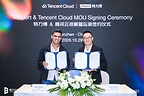
SHENZHEN, China, Nov. 13, 2026 /PRNewswire/ — At the 2026 Tencent Global Digital Ecosystem Summit, Tencent Cloud, the cloud business of global technology company Tencent, signed a Memorandum of Understanding (MOU) with Teleport, Capital A’s logistics venture and leading Southeast Asian eCommerce logistics specialist. Under the MOU, Tencent Cloud will provide the cloud infrastructure for Teleport’s operations in China, while Teleport will leverage Tencent Cloud’s artificial intelligence (AI) to build smarter, more automated logistics operations for cross-border movement from China.

The Teleport Network: Built for Cross-Border eCommerce

Teleport moves eCommerce and cargo on Southeast Asia’s largest air network, moving up to 1.25 million parcels a day across the Teleport Network, connecting China, Southeast Asia, Oceania and the Middle East by leveraging the freighter and belly capacity of over 55 airline partners. Operating at this scale demands seamless orchestration, which begins with ensuring every single parcel moves with verified, accurate data. The partnership with Tencent Cloud anchors shipment data on a reliable digital foundation from the first mile and ensures every subsequent process from customs clearance to mid-mile multi-airline transfers runs on timely, accurate information.

Supporting the Next Phase of Growth for Cross-Border Logistics

As global cross-border e-commerce accelerates, managing operational complexity requires moving beyond passively monitoring shipments. Backed by deep ecosystem experience in China and across global markets, the partnership with Tencent Cloud will make it easier for Chinese marketplaces, shippers and regional partners to integrate and collaborate seamlessly. This establishes a unified, single source of truth across the supply chain, giving Teleport, its airline partners and its eCommerce customers identical real-time tracking from origin to destination.

Accelerating AI Adoption Across Logistics Operations

Building on this Cloud data foundation, Teleport is exploring a suite of Tencent Cloud AI solutions to advance operational efficiency.

Tencent Cloud Agent Development Platform (ADP): Enables Teleport to build and deploy purpose-built AI agents across core operational workflows, including automated route optimisation, customs document processing, dynamic capacity planning, and real-time disruption recovery.TokenHub: Provides flexible access to different AI models, helping Teleport balance capability, responsiveness and cost efficiency across AI applications.WorkBuddy: Enhances internal operations and knowledge access through multi-agent workflows, enabling teams to collaborate more efficiently.eKYC & identity verification: Strengthens verification and onboarding workflows for cross-border merchants, air cargo partners, and ground handling agents, reinforcing compliance and security across the network.

Poshu Yeung, Senior Vice President of Tencent Cloud and Head of Tencent Cloud International, said: “As cross-border commerce continues to create new opportunities across Asia and beyond, logistics providers are increasingly looking for technologies that can help improve efficiency, strengthen resilience and support growth across multiple markets. Through our collaboration with Teleport, we are combining Tencent Cloud’s infrastructure and AI capabilities with Teleport’s logistics expertise to help move the Teleport Network beyond visibility towards intelligent decision-making and execution, enabling greater operational agility across its cross-border logistics network.”

Milan Dhingra, Chief Product Technology Officer of Teleport, said: “Teleport will always be a physical air logistics business, but we run digital first. Therefore it is key that we work with the right partners in the right market where mission critical cargo data need to flow, where their expertise is unmatched. China has its own digital ecosystem and we wanted a partner that understands Teleport’s vision for seamless orchestration and intelligence while being purpose-built for local requirements. Tencent Cloud is that partner for us in China.”

Making the Teleport Network Smarter

This strategic collaboration reflects a shared commitment to advance the development of cross-border logistics through cloud and AI technologies. By pairing Teleport’s logistics expertise with Tencent Cloud’s infrastructure and AI capabilities, both companies aim to turn operational data into real-time, actionable intelligence across the Teleport Network enabling reliable, scalable eCommerce movement across the region.

About Tencent Cloud

Tencent Cloud, one of the world’s leading cloud companies, is committed to creating innovative solutions to resolve real-world issues and enabling digital transformation for smart industries. Through our extensive global infrastructure, Tencent Cloud provides businesses across the globe with stable and secure industry-leading cloud products and services, leveraging technological advancements such as cloud computing, Big Data analytics, AI, IoT, and network security. It is our constant mission to meet the needs of industries across the board, including the fields of gaming, media and entertainment, finance, healthcare, property, retail, travel, and transportation. 

About Teleport

Teleport is an integrated eCommerce logistics specialist operating the largest, yet asset-light, air network in Southeast Asia. We are on a mission to move things across the region faster, cheaper and better than anyone else – by giving access to affordable and reliable cross-border delivery for all big and small businesses, as fast as next-day. Teleport is a logistics venture of Capital A, with a presence across Malaysia, Singapore, Thailand, Indonesia, Philippines, Chinese Mainland, Chinese Hong Kong and India.

For more information, please visit teleport.it or our social media on LinkedIn, and Instagram.

View original content to download multimedia:https://www.prnewswire.com/apac/news-releases/tencent-cloud-and-teleport-collaborate-to-advance-ai-powered-cross-border-logistics-from-china-302938831.html

SOURCE Tencent Cloud

Continue Reading

Technology

DATA.BET Now Powers Sportradar’s Unified Odds Feed

Published

on

By

Delivering a full esports betting toolset, from Tier-1 majors to Tier-4 tournaments across key disciplines

LIMASSOL, Cyprus, Nov. 13, 2026 /PRNewswire/ — DATA.BET, a trusted sportsbook solution supplier, has signed a deal with Sportradar, a leading global sports technology company, to become one of the partnered providers for its expanded offering.

Through the integration, Sportradar receives DATA.BET’s esports data content and performance-boosting toolset cover 1,800+ tournaments and 94,000+ matches annually across 60+ markets. Widgets and Streaming are set to follow, giving operators a fuller esports experience around headline events and niche competitions.

As a part of the deal, DATA.BET covers Counter-Strike 2, Dota 2, League of Legends, from Tier-1 to Tier-4 tournaments, with Valorant and other titles set to follow shortly. For DATA.BET, the deal marks a significant step in its global expansion and reinforces its position as a trusted esports Odds Feed supplier to the largest names in the industry.

“Becoming a supplier for Sportradar’s esports offering reflects the trust that the industry’s biggest players place in our content and products,” said Otto Bonning, Head of Sales at DATA.BET. “We’re confident in our coverage depth, speed, and trading expertise. This deal also opens a new route for our content, from Tier-1 majors to lower-tier tournaments running around the clock, to reach users around the world.”

Roman Garin, SVP, Innovation at Sportradar, said: “Esports’ fully digital nature creates an expectation for fast, deep live betting experiences. The providers that have built the market across Counter-Strike 2, Dota 2 and League of Legends each bring their own strengths and trading style, and the best fit can differ from title to title. By bringing them together through our Unified Odds Feed, we’re giving operators greater choice and flexibility through a single integration, and we’ll continue adding providers and titles as the market evolves.” 

About DATA.BET

DATA.BET is a sportsbook technology supplier established in 2017, delivering solution across sports, esports, virtual competitions, and prediction markets. Its portfolio includes Odds Feed, Risk Management, Single Page Application (iFrame), Bet Builder, Widgets, Streaming, and a range of player-engaging features. The company combines AI-powered capabilities with 24/7 in-house trading expertise, 99.99% system uptime, 97% markets uptime, and licensed content. DATA.BET provides coverage of 100+ disciplines, 150k+ monthly events, and 3,000+ markets, supporting betting operators, online casinos, and platform providers with scalable offerings and reliable sportsbook infrastructure.

About Sportradar

Sportradar Group AG (NASDAQ: SRAD), founded in 2001, is a leading global sports technology company creating immersive experiences for sports fans and bettors. Positioned at the intersection of the sports media and betting/gaming industries, Sportradar provides betting and iGaming operators, media and technology companies, prediction market partners, and sports federations with a best-in-class range of solutions to help grow their businesses. Trusted by the world’s leading global sports organizations, including the ATP, NBA, WNBA, NHL, MLB, MLS, PGA TOUR, UEFA, FIFA, CONMEBOL, AFC, and the Bundesliga, and global clients including Flutter, DraftKings, Google, Microsoft, Kalshi, and Polymarket, Sportradar covers more than a million events annually across all major sports. Sportradar is not just redefining the sports fan experience; it also safeguards sports through its Integrity Services division and advocacy for an integrity-driven environment for all involved.

View original content to download multimedia:https://www.prnewswire.com/news-releases/databet-now-powers-sportradars-unified-odds-feed-302938369.html

SOURCE DATA.BET

Continue Reading

Technology

Biel Crystal Named to 2025 Forbes China Novel Intelligent Economy Selection

Published

on

By

HONG KONG, Nov. 13, 2026 /PRNewswire/ — Forbes, the global business magazine, has named Biel Crystal to its “2025 Forbes China Novel Intelligent Economy Selection,” citing the company’s deep implementation and innovation breakthroughs in smart manufacturing and industrial large models.

Biel Crystal, a leading global provider of exterior structural components and module solutions for smart devices, operates nine smart manufacturing bases worldwide. It has more than 100,000 employees and annual capacity of more than 2.5 billion units. The company has fully deployed industrial AI large models using an architecture purpose-built for industrial scenarios, embedding industrial characteristics at the foundation and spanning R&D and design, manufacturing, finished-product inspection, operations management and maintenance services.

The most representative applications are in three industrial scenarios: production, R&D and quality inspection. In production, Biel Crystal has more tightly integrated machine learning with industrial simulation to enable automatic, dynamic optimization of coating machine parameters and automatic tool compensation for CNC machine tools, improving overall efficiency by at least 10%. In R&D, coordinated use of structural, fluid/thermal, motion and electromagnetic simulations allows product designs to identify and resolve more than 80% of potential problems during the R&D stage, cutting R&D cycles by 30% to 50% and reducing physical prototypes by more than 60%. In quality inspection, its self-developed automated optical inspection (AOI) technology combines multimodal inspection, few-shot learning and millisecond-level real-time feedback, lowering the missed-detection rate to 0.05% and reducing manual re-inspection workload by 50%.

Notably, Biel Crystal did not rely on general-purpose large models. Instead, it adopted an architecture purpose-built for industrial scenarios, embedding industry’s stringent requirements for real-time performance, determinism and reliability into model design from the ground up. The company says this ensures the models are “usable, stable and precise” on production lines and drives manufacturing from “single-point automation” toward “plant-wide intelligence.”

View original content to download multimedia:https://www.prnewswire.com/apac/news-releases/biel-crystal-named-to-2025-forbes-china-novel-intelligent-economy-selection-302938838.html

SOURCE Biel Crystal

Continue Reading

Trending