Connect with us

Technology

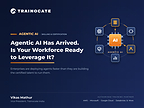
Agentic AI Has Arrived. Is Your Workforce Ready to Leverage It?

Published

on

Enterprises are deploying AI agents faster than they are building the certified talent to run them. Closing that gap is now the real differentiator.

Authored by, Vikas Mathur, Vice President, Trainocate India

MUMBAI, India, Sept. 1, 2026 /PRNewswire/ — Across the enterprise programs we run every week at Trainocate, the conversation has changed. A year ago, leaders asked us what generative AI could do. Today they ask why their agentic pilot has not reached production. Agentic AI has arrived — the question is no longer whether it works, but whether the workforce is ready to leverage it.

The platforms have done their part. AWS, Microsoft, Google Cloud, Databricks and others have moved agent frameworks, orchestration layers and governance tooling into general availability. What has not kept pace is the workforce. Adoption forecasts keep climbing; the cancellation forecasts climb with them, and for reasons that have little to do with the models themselves.

40%+

of agentic AI projects are forecast to be scrapped by the end of 2027 — on escalating cost, unclear business value and inadequate risk controls.

Source: Gartner

Our own view, formed across thousands of enterprise learners, is simpler than any forecast: Technology is not the constraint. The certified, deployment-ready workforce is.

India’s AI Talent Equation: One Million Roles, One in Six Skilled

India has the demand and the ambition. The constraint is supply. Estimates put the national AI talent pool at 1.25 million by 2027 — real growth, but well short of a market compounding at 25–35% a year. On current trajectories the gap widens before it closes.

We see the consequence directly in client conversations. Skills mismatch, not headcount, is what delays deployment — and on most enterprise shortlists, demonstrable and certified capability now outranks the degree.

Figure: The agentic readiness gap — adoption is outpacing certified capability.

From Prompt Engineering to Agent Orchestration: Three Capability Shifts

From operator to orchestrator. Every prior automation wave asked people to use a tool. Agentic AI asks them to direct one. The working skill is decomposition — mapping a process into the steps an agent may own, the tool-calling boundaries it must respect and the human-in-the-loop checkpoints between them. That is delegation and process design before it is programming, which makes it teachable well beyond the engineering bench.

From reviewing output to governing outcomes. When AI drafts an email, a human reads it before it goes. When an agent provisions infrastructure or triggers a payment, reading it afterwards is too late. Enterprises need people fluent in least-privilege identity, data lineage and governance, evaluation harnesses, escalation thresholds, observability and cost control. In our experience, this is where most agentic programs are thinnest.

From individual courses to cross-functional readiness. One production agentic workflow touches data engineering, application development, identity and security, LLMOps and the business function it serves. Certifying one persona while the rest stand still guarantees the pilot dies at handover. The unit of skilling must become the team.

What we see

Agentic pilots rarely stall on model quality. They stall because too few people can scope what an agent may own, design its guardrails, and stay accountable when it acts alone.

Trainocate enterprise delivery experience

Why Vendor-Authorized Certification Is the New Deployment Prerequisite

Credentials are often said to date quickly in a field moving this fast. We find the opposite. Agentic concepts are universal; implementation is not. Identity and access design, data governance, retrieval and grounding, model selection, evaluation and cost management behave differently on AWS, Microsoft Azure, Google Cloud and Databricks — and those differences decide whether an agent survives production.

Vendor-authorized certification remains the only independently verifiable proof that an engineer can build and operate on a given stack. Foundational credentials also give HR, finance, risk and procurement a shared vocabulary with engineering — and agentic decisions are risk decisions as much as technical ones.

2 in 5

Employers now prefer demonstrable AI skills and certifications over academic degrees. Skills-based hiring is no longer emerging — it is the default.

Source: NASSCOM–Indeed India AI Talent Report, 2026

Experiential Learning: Turning Training Investment into Production Capability

Nobody learns to supervise an autonomous system from a slide. Trainocate’s Experiential Learning Model was built on that premise — one continuous journey rather than a catalog of courses:

Learn from practitioners. Instructor-led and virtual instructor-led training delivered by vendor-authorized, actively certified instructors.Reinforce on demand. Self-paced digital learning and curated learning paths that keep pace with quarterly platform releases.Build in live environments. Hands-on labs in real cloud sandboxes — agents, tool-calling, guardrails and failure modes, not screenshots.Prove it on real work. Capstone projects mapped to the organization’s own agentic and cloud use cases.Certify the capability. Structured exam preparation and readiness checks that convert learning into a verifiable credential.Measure the outcome. Governance dashboards tracking completion, certification attainment and skill progression for L&D and business sponsors.

That model now runs through our AI Mastery Program, which spans foundational to advanced tracks for both business and technical roles across AWS, Microsoft, Google Cloud, Databricks and vendor-neutral content — with agentic system design, multi-agent orchestration and AI governance sitting in the advanced tiers, and sandbox labs and industry capstones throughout.

The results hold up: Close to 80% certification attainment across enterprise programs and a 4.90/5.00 delivery CSAT. As an authorized training partner for AWS, Microsoft, Google Cloud, Databricks and more, operating across 24 countries, we have run this model at scale — over one lakh professionals certified within a single global enterprise account, and agentic AI labs delivered across six Indian cities this year. Four consecutive AWS Global Training Partner of the Year awards and six appearances on the Training Industry Top 20 suggest the model travels.

30%

of enterprise application software revenue will be driven by agentic AI by 2035 — up from 2% in 2025.

Source: Gartner

A Twelve-Month Skilling Blueprint for CHROs and L&D Leaders

Assess against use cases, not catalogs. Benchmark capability against the specific agentic workflows the business intends to run.Build a spine, not a stack. Foundational AI and cloud fluency organization-wide; certified specialization for those who will design, secure and govern agents.Skill the workflow, not the individual. Move cross-functional cohorts together — data, application, security, business — so nothing stalls at handover.Instrument on outcomes. Track certification attainment, time-to-productivity and pilot-to-production conversion. Seat-hours measure activity, not readiness.

Two Budget Cycles: The Window for Workforce Readiness

15%

of day-to-day work decisions will be made autonomously by 2028 — up from effectively zero in 2024.

Source: Gartner

That is not a distant horizon. It is two budget cycles away.

Models are becoming a commodity; every enterprise buys them at roughly the same price. The durable differentiator is the depth of certified talent that can point those models at the right problems and stay accountable for what they do. Treat skilling as infrastructure — continuous, measured, certified — and your agents scale. Treat it as an event and the pilot stays a pilot.

Agentic AI has arrived. The question every board should be asking is whether its workforce is ready to leverage it.

Build a Certified, Agent-Ready Workforce

Trainocate partners with enterprises to build agentic AI and cloud capability at scale — from foundational fluency to certified specialization across AWS, Microsoft, Google Cloud, Databricks and more, delivered through our Experiential Learning Model and AI Mastery Program. To design a skilling roadmap for your workforce, write to cloudacademy@trainocate.com or call +91 9223361686.

About Trainocate

Trainocate is a global IT training and workforce skilling organization and an authorized training partner for AWS, Microsoft, Google Cloud, Databricks and more, operating across 24 countries. Trainocate delivers cloud, data and AI capability to enterprises through its Experiential Learning Model and AI Mastery Program, combining instructor-led training, self-paced digital learning, hands-on sandbox labs, industry capstones and vendor-authorized certification. The company is a four-time consecutive AWS Global Training Partner of the Year and has appeared six times on the Training Industry Top 20. Trainocate India operates as Networks India Pvt Ltd. For more information, visit www.trainocate.com/in.

About the Author

Vikas Mathur is Vice President at Trainocate India, where he leads the Cloud, Data & AI competency business. He works with enterprise L&D and technology leaders across India and Asia on cloud and AI workforce readiness, and can be reached at cloudacademy@trainocate.com or +91 9223361686.

Data sources referenced: Gartner (agentic AI adoption, project cancellation, governance maturity, autonomous-decision and market-share forecasts, 2025–26); McKinsey (State of AI, agent pilot-to-production); NASSCOM and MeitY (India AI job demand and AI-skilled share); NASSCOM–Deloitte (AI talent pool projection); NASSCOM–Indeed India AI Talent Report 2026 (skills-based hiring). Trainocate figures are from our own enterprise delivery data.

Contact: cloudacademy@trainocate.com | +91 9223361686

View original content to download multimedia:https://www.prnewswire.com/in/news-releases/agentic-ai-has-arrived-is-your-workforce-ready-to-leverage-it-302865800.html

Continue Reading
Click to comment

Leave a Reply

Your email address will not be published. Required fields are marked *

Technology

Gemtek and Dixon Advance Strategic Collaboration to Expand Optical Connectivity Business in India

Published

on

By

Combining photonic integration expertise with localized manufacturing to address growing demand for high-speed optical connectivity across Broadband, Telecom and AI Infrastructure

TAIPEI, Sept. 1, 2026 /PRNewswire/ — Gemtek Technology Co., Ltd. (“Gemtek”) and Dixon Technologies (India) Limited (“Dixon”) are advancing their strategic collaboration through their joint venture in India, expanding manufacturing and market opportunities for Optical Transceivers, BOSA (Bidirectional Optical Sub-Assembly) and other high-speed optical connectivity solutions.

The collaboration combines Gemtek’s expertise in optical communications, photonic integration and product development with Dixon’s manufacturing scale, supply-chain capabilities and market presence in India, creating a scalable platform to serve Broadband, Telecom, Cloud, Data Center and AI Infrastructure markets in India and globally.

Expanding Next-Generation Optical Connectivity

Gemtek is expanding its optical connectivity portfolio with solutions spanning 1G to 1.6T, including Optical Transceivers, SFPs, BOSA and high-speed optical connectivity solutions.

Leveraging EIC-PIC photonic integration and advanced manufacturing capabilities, Gemtek is advancing its roadmap toward 800G, 1.6T and next-generation photonic integration technologies to address growing demand for high-bandwidth and high-performance connectivity driven by AI, cloud and data center infrastructure.

Strengthening Local Manufacturing and Supply-Chain Resilience in India

The collaboration supports India’s growing focus on local manufacturing of Optical Transceivers, BOSA and other high-speed optical solutions. By combining Gemtek’s technology and product development expertise with Dixon’s local manufacturing and supply-chain capabilities, the partnership enables scalable production in India while complementing Gemtek’s global manufacturing footprint, strengthening geographic diversification and overall supply-chain resilience.

Gemtek to Showcase Optical Connectivity at IMC 2026

Gemtek will participate in India Mobile Congress (IMC) 2026, taking place October 7–10, 2026, at Yashobhoomi, New Delhi, India, Hall 2, Booth B1.

Gemtek will showcase its 1G-to-1.6T Optical Connectivity portfolio and solutions for Broadband, Telecom and AI Data Center applications, including Optical Transceivers, BOSA and next-generation high-speed optical connectivity technologies.

About Gemtek

Gemtek Technology is a global provider of networking and communications solutions across Broadband, Wi-Fi, Fiber, 5G, Optical Connectivity and AI-enabled Networking. Combining photonic integration, product innovation and advanced manufacturing capabilities, Gemtek continues to expand its high-speed optical connectivity technologies and solutions.

About Dixon

Dixon Technologies (India) Limited is a leading Indian design-focused and manufacturing company serving consumer electronics, telecommunications, IT hardware and other technology sectors, with extensive capabilities in product design, engineering, large-scale manufacturing and supply-chain management.

View original content to download multimedia:https://www.prnewswire.co.uk/news-releases/gemtek-and-dixon-advance-strategic-collaboration-to-expand-optical-connectivity-business-in-india-302865904.html

Continue Reading

Technology

Haut.AI Launches AI-Powered Hair Analysis for Beauty Brands Worldwide

Published

on

By

New technology turns a smartphone selfie and short questionnaire into personalized hair profiles and product recommendations for beauty brands and retailers

NEW YORK, Sept. 1, 2026 /PRNewswire/ — Haut.AI, a SaaS technology company specializing in AI-powered skin intelligence and personalized skincare, today announced the commercial launch of Hair Analysis, a B2B AI-powered hair assessment technology that enables beauty brands and retailers to deliver personalized haircare recommendations through digital commerce experiences.

Hair Analysis combines a smartphone selfie with a short questionnaire to create a personalized hair profile. The technology evaluates six visible hair characteristics, combines those findings with information about a consumer’s routine and concerns and connects the resulting profile with relevant products from a brand’s catalog. Hair Analysis is now commercially available to beauty and retail companies worldwide.

The launch expands Haut.AI’s personalization platform beyond skincare, allowing brands to offer AI-powered skin and hair experiences through the same SaaS infrastructure.

“Haircare has faced a longstanding personalization challenge: hair is highly individual, yet product discovery still often relies on broad categories and trial and error,” said Anastasia Georgievskaya, CEO & Co-founder of Haut.AI. “Hair Analysis addresses that gap by combining visual assessment with consumer-provided insights to help brands connect people with more relevant products.”

How Haut.AI Hair Analysis Works

Consumers can complete a Hair Analysis assessment in less than one minute. After answering a short questionnaire about their hair, styling habits and concerns, they take a smartphone selfie that is analyzed using Haut.AI’s computer-vision technology.

The system evaluates six visible characteristics:

Hair curvatureHair densityHair volumeFrizz levelHair colorColor uniformity

Those findings are combined with questionnaire responses to create a personalized hair profile. The combined inputs support recommendations across 19 hair concerns, including dryness, frizz, split ends, hair loss, chemical damage, dandruff, lack of volume and oily or greasy hair.

Hair Analysis spans 12 product categories, from shampoos and conditioners to treatments, masks, oils, and styling products.

How Hair Analysis Helps Beauty Brands Personalize Haircare

Hair Analysis is delivered through Haut.AI’s SaaS platform and can be integrated into beauty brands’ and retailers’ digital commerce experiences. Brands can manage product catalogs, configure recommendation logic, connect individual hair profiles with relevant products from their own portfolios, and access consumer insights generated from hair analysis data to better understand customer needs and preferences.

Companies already using Haut.AI for skin analysis can add hair personalization through the same platform, creating a unified technology foundation for personalized skin and hair experiences.

Hair Analysis Builds on Haut.AI’s Beauty Personalization Technology

Hair Analysis was initially co-developed with Grupo Boticário following the Brazilian beauty company’s strategic investment in Haut.AI. The collaboration combined Haut.AI’s computer-vision and AI-powered personalization capabilities with Grupo Boticário’s experience in haircare science, consumer insights and diverse hair needs. Grupo Boticário served as Haut.AI’s launch partner for the technology, which is now available to beauty brands and retailers worldwide.

“As an early partner in the development of Hair Analysis, we’ve seen firsthand how this technology can make haircare discovery intuitive for consumers,” said Gustavo Dieamant, Executive Director of R&D at Grupo Boticário. “Hair needs are incredibly diverse, and Haut.AI has developed a solution that translates that complexity into an experience that helps consumers identify products suited to their individual needs. We’re excited to see Haut.AI now bring this technology to beauty brands around the world.”

With Hair Analysis joining Haut.AI’s Face Analysis 3.0 and recently launched Body Analysis, Haut.AI now provides AI-powered personalization across face, body and hair. This broad coverage enables beauty brands, pharmacy groups and retailers with diverse product portfolios to use a unified technology platform. It helps them address a wider range of consumer needs, deliver more personalized product recommendations and create connected beauty experiences across digital and in-store channels.

Learn more about Hair Analysis, visit https://haut.ai/products/hair-analysis.

Try the Hair Analysis demo at: https://haut.ai/hair-analysis-demo.

Press images and assets can be downloaded here.

About Haut.AI

Haut.AI is a SaaS technology company at the forefront of generative AI-powered skincare personalization and skin intelligence. Founded by scientists and AI innovators, the company has built proprietary technology that turns skin data into objective, quantifiable intelligence across all skin tones and body regions. Haut.AI collaborates with leading global beauty and wellness brands, including Neutrogena, Beiersdorf, Ulta Beauty, and Grupo Boticário, enabling them to deliver science-backed, hyper-personalized skincare experiences that drive measurable consumer engagement and business impact. For more information, visit www.haut.ai.

Media contact:
Michael Tebo
Gabriel Marketing Group (for Haut.AI)
Phone: 571-835-8775
Email: michaelt@gabrielmarketing.com 

View original content to download multimedia:https://www.prnewswire.com/news-releases/hautai-launches-ai-powered-hair-analysis-for-beauty-brands-worldwide-302865372.html

SOURCE Haut.AI

Continue Reading

Technology

AI is a Mirror, Not a Replacement: Bionic Artist Viktoria Modesta Challenges the Core of Human Value in the Machine Age

Published

on

By

Groundbreaking Futurist and Former MIT Media Lab Fellow Joins C. M. (Cathy) Rubin on AI for a Better World—Produced by the Planet Classroom Network—to Reframe the Emerging AI Identity Crisis for the Next Generation

NEW YORK, Sept. 1, 2026 /PRNewswire/ — As artificial intelligence shifts from a corporate automation tool into an intimate part of daily identity, a profound psychological question is emerging: If machines can replicate human intelligence, what happens to the value of human experience?

In a landmark new episode of AI For A Better World, host C. M. (Cathy) Rubin—in the acclaimed series produced by the Planet Classroom Network—sits down for an in-depth conversation with internationally recognized multimedia artist, futurist, and former MIT Media Lab Fellow Viktoria Modesta to explore how emerging technology is reshaping identity, creativity, and human agency.

“We’ve spent centuries using technology to change the world around us,” Rubin states. “But AI is doing something entirely different—it is beginning to change us. It forces us to ask: what does it truly mean to be human when the baseline of intelligence is automated?”

Dismantling the Apex Predator Fallacy

Born in the USSR within a rigid societal value system obsessed with biological perfection, Modesta has spent two decades upending conventional narratives around disability and beauty by transforming her prosthetic limb into an iconic cultural symbol of bionic potential. In her dialogue with Rubin, she notes that AI’s rapid disruption is forcing a much-needed re-evaluation of how society measures human worth.

“What’s interesting about AI is that it’s creating a juxtaposition to what is human value for the first time at scale,” Modesta explains. “We’ve valued in the past biology, abilities with sports, and intelligence. We’re now left with having to really look at the foundation… I think that it’s super exciting because for the first time, I think we will start having a little bit more appreciation for things like nature and animals, which we’ve discarded historically because it’s not the apex predator.”

AI as an Intimate Mind Prosthetic

Rather than viewing AI with existential dread, Modesta frames the technology through her unique perspective on physical augmentation, defining AI as a “prosthetic of the mind.”

“This is a relationship question,” Modesta tells Rubin. “We have created a technology that is much closer to a musical instrument. It’s something that responds to our emotions… It’s no longer just functional. This is a vehicle for our intention, it’s a vehicle for our emotion, for our aspiration of what we would like to have for ourselves and the world.”

Modesta argues that because technology adaptation is a deeply intimate, individual process, the mystery and fear dissipate when individuals actively decide what internal cognitive gaps they want the tool to expand.

The Tyranny of Uniformity and the Rise of the “Edges”

Addressing Rubin’s concerns regarding technological conformity among youth growing up alongside AI companions, Modesta delivers an optimistic counter-narrative. She argues that the flat, homogenized outputs of current Large Language Models (LLMs) will naturally expose the absurdity of uniformity.

“We’re noticing how absurd it is for LLM systems to just kind of flatline all the information and remove all the kind of edges,” says Modesta. “If you have a resume by 20 people who all use the same models, there is no meaning. There is no differentiation. We should actually end up in a better place where for the first time somebody’s just like, ‘Well, wait a minute. What are my ideas? What is my lived experience?'”

Prototyping the Future Without Permission

Through her latest project, Metabodies—an AI-powered visual framework exploring human identity across Earth, space, and virtual environments—Modesta is using AI to democratize how future human forms are imagined. Rather than relying on corporate Hollywood or scientific pillars to dictate tomorrow’s aesthetics, she uses AI to fast-track representation across body shapes, ability, race, and gender.

Reflecting on the generations entering adulthood by 2050, Modesta notes that younger builders no longer view technology through the lens of a human-versus-machine divide. To them, the integration is fluid, and the historical barriers are dissolving. “I will be talking to somebody about why disability is actually innovation,” Modesta smiles, “and they’re like, ‘Yeah, sure. I get that.'”

Key Takeaways from the Interview:

The Redefinition of Value: Why the automation of routine intelligence will push humanity to value raw intuition, emotional depth, and ecological interconnectedness.The Cognitive Instrument: Reframing AI as a fluid, responsive medium for human intention rather than a cold threat to human agency.The Power of the Non-Standard: Why the flattening effect of AI writing and design tools will create an economic premium on distinct lived experiences and “imperfect” creative edges.Democratic World-Building: How individual creators are bypassing massive institutional gatekeepers to prototype diverse futures in digital and aerospace environments.

Rubin concludes: “Viktoria reminds us that if AI is a prosthetic for the mind, it is ultimately a vehicle for human intention. AI is not a threat to what makes us human; it is a mirror that forces us to discover it. As machines automate the routine and flatline the standard, our unique perspectives, lived experiences, and creative edges become humanity’s greatest assets.

Watch AI for a Better World: What Does It Mean to Be Human in the Age of AI?

About Viktoria Modesta

Viktoria Modesta is an internationally acclaimed British-Latvian multimedia artist, creative director, futurist, and the world’s first Bionic Pop Artist. A former MIT Media Lab Fellow, her multidisciplinary work spans bionic wearables, human-machine interaction, and aerospace research with partners including NASA JPL, the Aurelia Institute, and Mission AstroAccess. Her current project, Metabodies, uses AI to explore future human identity across real and virtual environments.

About C. M. (Cathy) Rubin

C. M. (Cathy) Rubin is Co-Founder and CEO of Planet Classroom and Founder of CMRubinWorld. A multimedia journalist, author, and regular Forbes contributor who has published over 800 interviews with global leaders, her work focuses on human-centered AI strategy, institutional innovation, and the future of global education.

View original content to download multimedia:https://www.prnewswire.com/news-releases/ai-is-a-mirror-not-a-replacement-bionic-artist-viktoria-modesta-challenges-the-core-of-human-value-in-the-machine-age-302865716.html

SOURCE Planet Classroom Network

Continue Reading

Trending