Connect with us

Technology

Connected Retail Is Widening the Cyber Attack Surface While Security Ownership Remains Fragmented, Info-Tech Research Group Warns

Published

on

Store systems, cloud platforms, IoT devices, vendor connections, and customer applications now operate as a connected ecosystem, while security accountability remains divided across technology domains and teams. Info-Tech Research Group’s Build Cyber Resilience in Connected Retail blueprint helps CIOs and security leaders set clear decision boundaries, align ownership, and prioritize threats according to operational and business impact.

ARLINGTON, Va., Sept. 3, 2026 /CNW/ — Retail technology environments are becoming more interconnected while the decisions that protect them remain fragmented. Legacy point-of-sale (POS) systems, IoT devices, cloud platforms, e-commerce applications, and third-party services are often owned and managed by different teams, leaving no single function with full visibility or end-to-end authority over cyber risk.

To help retail leaders address these gaps, Info-Tech Research Group, a global research and advisory firm, has published its Build Cyber Resilience in Connected Retail blueprint. The resource provides a three-phase methodology and supporting threat and risk assessment tool to help organizations identify assets, map threats and vulnerabilities, evaluate potential business impact, and establish clear priorities for action.

“Retail leaders understand the cyber risks in their environment. The breakdown happens when no one can make, enforce, and explain decisions across stores, platforms, and vendors,” says Donnafay MacDonald, research director at Info-Tech Research Group. “Cyber resilience is strengthened when organizations are able to clearly define decision-making responsibilities and assign accountable owners.”

Why Connected Retail Security Decisions Break Down

According to Info-Tech’s research, connected retail environments introduce structural constraints that prevent organizations from making consistent and defensible security decisions. The blueprint identifies three central challenges:

Fragmented systems limit decision authority: Legacy POS systems, IoT devices, cloud platforms, and customer-facing applications were often deployed by different teams at different times. No single owner has sufficient visibility or control to make and enforce decisions across the entire environment.Compliance complexity makes consistency harder: Retailers must account for overlapping requirements governing payment information, personal data, and customer privacy. Applying these requirements across shared systems, markets, and channels can create conflicting expectations and inconsistent controls.Attack speed outpaces traditional governance: Identity compromise, third-party access, and lateral movement can spread quickly through connected environments. Traditional escalation processes often move too slowly, increasing reliance on reactive and ad hoc decisions.

The firm advises retail CIOs and security leaders to build an operating model around five connected decision domains: visibility, control boundaries, decision ownership, risk prioritization, and response coordination. Together, these domains help organizations determine where exposure exists, how far a compromise could spread, who has authority to act, which threats matter most, and how teams and partners should respond.

Info-Tech’s Three-Phase Framework for Building Cyber Resilience in Connected Retail
The Build Cyber Resilience in Connected Retail blueprint moves organizations from defining their assessment criteria to producing a prioritized risk register ready for treatment decisions. The three phases include:

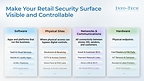
Phase 1: Define What Risk Matters in the Organization’s Environment. Establish data classifications, risk tolerance, and severity scales before identifying and documenting the assets under assessment. Assets are organized across four categories: software, hardware, networks, and physical sites.

Phase 2: Determine Where Exposure Exists. Identify vulnerabilities within each system component, evaluate applicable threats, and develop concise risk scenarios that connect technical weaknesses to credible operational and business consequences. Generative AI can assist with scenario development when its outputs are reviewed and validated by subject matter experts.

Phase 3: Decide Which Security Risks Justify Action. Assess existing controls, estimate the likelihood and impact of each scenario, and compare severity scores against the organization’s risk tolerance. Leaders can then prioritize treatment decisions, assign owners, and establish timelines for the most significant exposures.

“Just because two systems are in the same store doesn’t mean they’re equally important. A problem with the payment system could stop sales, while a problem with a digital sign might just be an inconvenience. Risk assessments help businesses separate the critical issues from the minor ones, so they can prioritize what really needs attention,” explains MacDonald. “That discipline helps teams address the right risks instead of allowing the loudest or most visible issue to dictate priorities.”

The Build Cyber Resilience in Connected Retail blueprint includes the Retail Security Threat and Risk Assessment Tool, which gives security and IT leaders a structured view of threats across stores, platforms, IoT devices, and customer data. The tool maps exposures to affected systems and owners, evaluates likelihood and impact, and produces a prioritized risk register to guide investment, segmentation, and response decisions.

By applying Info-Tech’s approach, retail organizations can strengthen accountability across IT, store operations, and vendors, contain the potential spread of an incident, and direct security resources toward the exposures most likely to disrupt the business or damage customer trust.

For exclusive and timely commentary from Info-Tech’s experts, including Donnafay MacDonald, and access to the complete Build Cyber Resilience in Connected Retail blueprint, please contact pr@infotech.com.

About Info-Tech Research Group
Info-Tech Research Group is the “get things done” partner for over 30,000 IT, HR, and marketing leaders worldwide. The fastest growing research and advisory firm, Info-Tech enables leaders to make well-informed decisions and transform their organizations through AI, strategic foresight, step-by-step methodologies, practical tools, industry-leading advisory, and training programs. For nearly 30 years, tens of thousands of private and public organizations have trusted Info-Tech to lead their most important initiatives through periods of change and deliver outcomes that truly matter.

To learn more about Info-Tech’s HR research and advisory services, visit McLean & Company, and for data-driven software buying insights and vendor evaluations, visit the firm’s SoftwareReviews platform.

Media professionals can register for unrestricted access to research across IT, HR, and software, and hundreds of industry analysts through the firm’s Media Insiders program. To gain access, contact pr@infotech.com.

For information about Info-Tech Research Group or to access the latest research, visit infotech.com and connect via LinkedIn and X.

View original content to download multimedia:https://www.prnewswire.com/news-releases/connected-retail-is-widening-the-cyber-attack-surface-while-security-ownership-remains-fragmented-info-tech-research-group-warns-302869497.html

SOURCE Info-Tech Research Group

Continue Reading

Technology

Vobile Signs Strategic Cooperation and Commercial Agreements with UNN to Build AI Factories in Brunei Darussalam

Published

on

By

SANTA CLARA, Calif., Sept. 4, 2026 /PRNewswire/ — Vobile, a global leader in digital content protection and transaction services, has signed strategic cooperation and commercial agreements with Unified National Networks Sdn Bhd (UNN), an integrated national telecommunication network operator of Brunei Darussalam.

Christopher Phan, Acting Chief Executive Officer of UNN, and Yangbin Wang, Chief Executive Officer of Vobile, Inc., signed the agreements at a ceremony held at UNN’s Tungku Submarine Cable Landing Station on September 3, 2026. The ceremony was witnessed by Yang Mulia Haji Hairul Mohd Daud bin Haji Abd Karim, Deputy Permanent Secretary (Infocommunications), Ministry of Transport and Infocommunications, and UNN Board Director.

“The development of AI-ready infrastructure is of critical importance, not only for our two organizations but also for the future growth of Brunei’s digital economy,” said Heiko Trost, Chief Digital Officer of UNN, at the signing ceremony. “We view this relationship with Vobile as far more than a conventional customer-provider engagement. We see it as a partnership built on shared ambition, innovation and mutual success. Together, we have the opportunity to create meaningful value for Brunei, strengthen the nation’s digital capabilities, and explore new opportunities across the region.”

“DreamMaker helps film and television studios, independent producers and creators use AI technologies to create video entertainment while protecting their intellectual property and finding new ways to generate revenue from their work. This is especially important as AI transforms the global creative industry,” said Ben Smith, Executive Vice President of Vobile. “By combining UNN’s infrastructure with Vobile’s AI capabilities, we can help establish Brunei as a leading AI economy in Southeast Asia while delivering sustainable economic growth for the nation.”

UNN’s new AI-capable data center, designed with liquid cooling and high power density to support NVIDIA’s latest GPU systems, will allocate 25MW of capacity to Vobile. An additional 25MW is reserved for Vobile’s future expansion. This enables Vobile to run AI factories that scale its DreamMaker platform and related services to meet growing demand from clients including film and television studios, independent producers, and content creators.

About Vobile

Vobile is the global leader in digital content protection and transaction services, trusted by the world’s premier entertainment companies, platforms, music labels, sports leagues, and publishers. Using AI technologies, Vobile’s solutions make creative content more valuable. Founded in Silicon Valley, Vobile has operations across North America, Asia, Australia, and Europe. For more information, visit www.vobile.com.

Contact:
Vobile
PR@vobile.com

View original content to download multimedia:https://www.prnewswire.com/news-releases/vobile-signs-strategic-cooperation-and-commercial-agreements-with-unn-to-build-ai-factories-in-brunei-darussalam-302870397.html

SOURCE Vobile, Inc.

Continue Reading

Technology

MongoDB, Inc. to Present at Upcoming Investor Conferences

Published

on

By

NEW YORK, Sept. 4, 2026 /PRNewswire/ — MongoDB, Inc. (NASDAQ: MDB) today announced that it will present at three upcoming investor conferences:

Citi 2026 Global TMT Conference. The presentation is scheduled for Wednesday, September 9, 2026 at 8:50 AM Eastern Time.Goldman Sachs Communacopia + Technology Conference 2026. The presentation is scheduled for Thursday, September 10, 2026 at 10:10 AM Pacific Time (1:10 PM Eastern Time).Piper Sandler Growth Frontiers Conference. The presentation is scheduled for Tuesday, September 15, 2026 at 11:30 AM Central Time (12:30 PM Eastern Time).

A live webcast of each presentation will be available on the Events page of the MongoDB investor relations website at https://investors.mongodb.com/news-events/events. A replay of the webcasts will also be available for a limited time.

About MongoDB

MongoDB is the real-time, intelligent data platform for modern applications in the multi-cloud and AI era. Headquartered in New York, MongoDB helps organizations move faster, build smarter, and simplify complex architectures on a unified platform for operational data, search, real-time analytics, and AI-powered retrieval, coupled with MongoDB Voyage AI’s industry-leading embedding and reranking models. The platform is available as a fully managed service with MongoDB Atlas or self-managed with MongoDB Enterprise Advanced or Community Edition. Millions of developers and more than 70,000 customers, including approximately 75% of the Fortune 100, rely on MongoDB for their most important customer-facing applications. To learn more, visit mongodb.com

Investor Relations
Jess Lubert
ir@mongodb.com

Media Relations
MongoDB
press@mongodb.com

View original content to download multimedia:https://www.prnewswire.com/news-releases/mongodb-inc-to-present-at-upcoming-investor-conferences-302870403.html

SOURCE MongoDB, Inc.

Continue Reading

Technology

AI Can Help CIOs Reclaim Capacity as 83% of IT Spend and 66% of Staff Time Go Toward Keeping the Lights On, Says Info-Tech Research Group

Published

on

By

IT teams are expected to drive innovation, strengthen resilience, and support growth while most of their time and budget remain committed to maintaining existing systems and services. Info-Tech Research Group’s recent blueprint, Harness AI to Reduce the Cost and Effort of KTLO in IT Operations, helps CIOs identify where targeted AI investments can reduce the KTLO burden, reclaim capacity for higher-value work, and build practical AI skills.

ARLINGTON, Va., Sept. 4, 2026 /CNW/ — Routine IT operations and maintenance consume 82.6% of IT spend and 66% of IT teams’ time and effort, according to Info-Tech Research Group’s IT Spend & Staffing Benchmarking data. That allocation leaves only a fraction of IT capacity available for new technology initiatives, operational improvements, and transformation.

To help organizations address this imbalance, Info-Tech has published its Harness AI to Reduce the Cost and Effort of KTLO in IT Operations blueprint. The resource helps CIOs identify AI-enabled opportunities to reduce the cost and effort of keeping the lights on (KTLO), quantify their potential value, assess organizational readiness and risk, and build a portfolio of initiatives for launch.

“KTLO has always been treated as an unavoidable tax on IT, but that mindset is outdated,” says Fred Chagnon, principal research director at Info-Tech Research Group. “Targeted AI investments can help CIOs reduce low-value manual work, reclaim budget and staff time, and reinvest both in innovation. The result is an IT organization that runs smarter and has more capacity to deliver value.”

Info-Tech cautions that common cost-cutting responses can deepen the KTLO problem. Running hardware and software beyond end of life can increase technical debt and security risk; using outsourcing primarily as a cost-reduction strategy can overlook its value in reclaiming capacity and accessing specialized expertise; and eliminating growth or transformation initiatives can starve the business of future value.

Five AI Tactics for Reducing KTLO Cost and Effort
Info-Tech’s research identifies five AI-enabled tactics that IT leaders can assess based on their operational priorities, technology environment, and organizational readiness:

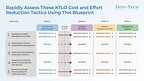
Intelligent incident management and AIOps: Detect anomalies, correlate events across operational silos, support predictive maintenance, and automate common remediation activities.Autonomous patch and vulnerability management: Automate patch prioritization, deployment, and verification to reduce manual effort and support more consistent compliance.Smart data classification, cleaning, and curation: Reduce duplicate and outdated data, storage bloat, and manual data management while strengthening the governed data foundation required for AI.Generative AI service desk and conversational self-service: Deflect routine Tier 1 requests, improve access to support, and free service desk staff to focus on more complex work.AI-assisted script, documentation, and code generation: Accelerate scripting and documentation, preserve knowledge about legacy systems, and reduce the effort required to maintain them.

Info-Tech’s Four-Step Framework for AI-Enabled KTLO Reduction
Identifying a potential use case is only the starting point. CIOs also need to understand its expected value, implementation requirements, and organizational risks before committing resources. To guide that evaluation, the Harness AI to Reduce the Cost and Effort of KTLO in IT Operations blueprint applies a four-step assessment process across all five tactics:

Uncover opportunities. Identify manual, repetitive, and resource-intensive KTLO activities that could benefit from AI and automation.Quantify the value. Estimate the labor time and costs associated with each activity, then project potential cost reductions, reclaimed effort, and time to value.Assess readiness and risk. Evaluate organizational constraints such as data quality, integration requirements, process maturity, skills, change readiness, and implementation risk.Blueprint for launch. Define viable initiatives, accountable teams, expected outcomes, and actionable milestones, then consolidate them into a Quantified KTLO Reduction Initiative Portfolio.

KTLO reduction can also serve as a workforce development opportunity. Applying AIOps, automation, and generative AI to familiar, measurable processes gives IT teams practical experience in a controlled environment and prepares them to lead broader AI initiatives across the organization.

The Harness AI to Reduce the Cost and Effort of KTLO in IT Operations blueprint and its supporting Quantified KTLO Reduction Initiative Portfolio provide CIOs with practical guidance for turning assessed opportunities into executive-level investment proposals. By connecting projected cost and effort reductions with readiness, risk, time to value, and implementation milestones, the research helps leaders move KTLO discussions from short-term cost cutting to measurable reinvestment in innovation.

For exclusive and timely commentary from Info-Tech’s experts, including Fred Chagnon, and access to the complete Harness AI to Reduce the Cost and Effort of KTLO in IT Operations blueprint, please contact pr@infotech.com.

About Info-Tech Research Group
Info-Tech Research Group is the “get things done” partner for over 30,000 IT, HR, and marketing leaders worldwide. The fastest growing research and advisory firm, Info-Tech enables leaders to make well-informed decisions and transform their organizations through AI, strategic foresight, step-by-step methodologies, practical tools, industry-leading advisory, and training programs. For nearly 30 years, tens of thousands of private and public organizations have trusted Info-Tech to lead their most important initiatives through periods of change and deliver outcomes that truly matter.

To learn more about Info-Tech’s HR research and advisory services, visit McLean & Company, and for data-driven software buying insights and vendor evaluations, visit the firm’s SoftwareReviews platform.

Media professionals can register for unrestricted access to research across IT, HR, and software, and hundreds of industry analysts through the firm’s Media Insiders program. To gain access, contact pr@infotech.com.

For information about Info-Tech Research Group or to access the latest research, visit infotech.com and connect via LinkedIn and X.

View original content to download multimedia:https://www.prnewswire.com/news-releases/ai-can-help-cios-reclaim-capacity-as-83-of-it-spend-and-66-of-staff-time-go-toward-keeping-the-lights-on-says-info-tech-research-group-302870414.html

SOURCE Info-Tech Research Group
Continue Reading

Trending