Connect with us

Technology

Brandi AI Research: Most-Cited Human-Written Pages Earn Nearly Six Times More AI Citations Than Most-Cited AI-Written Pages

Published

on

Amid concerns about “AI slop,” Brandi AI’s study of approximately 900,000 AI answers finds that top-performing human-written content has a significant advantage in earning AI citations

MCLEAN, Va., Sept. 16, 2026 /PRNewswire/ — Brandi AI, the leading enterprise platform for Brand Intelligence, AI visibility and Generative Engine Optimization (GEO), today announced new research findings revealing that the most-cited human-written webpages appear as sources in artificial intelligence (AI) answers nearly six times as often as the most-cited AI-written webpages.

The Brandi AI study analyzed approximately 900,000 AI-generated answers to determine citation frequency and source authority between human-written and AI-written content. As the internet fills with “AI slop”—low-quality, mass-produced AI-generated content—the findings show that AI-written content can earn citations, but the highest-performing human-written pages captured substantially more citations.

Conducted in the second quarter of 2026, the research sampled responses across ChatGPT, Google AI Mode, Google Gemini and Microsoft Copilot, tracking 4,210 individual webpages linked as supporting sources. For the study, a citation was defined as an AI platform referencing or linking to a webpage as a source supporting its answer. Citation frequency measured how often a specific webpage appeared as a cited source across the dataset.

The results reveal a substantial gap between the best human-written and AI-written content:

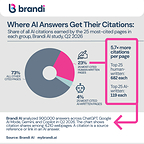
Average citation volume: The 25 most-cited human-written webpages averaged 682 citations per page, 5.7 times the 119 citations averaged by the 25 most-cited AI-written webpages.Top human-written performance: The 25 most-cited human-written webpages received 17,050 citations. Although they represented only 0.6% of the more than 4,000 webpages studied, they accounted for 23% of all citations in the dataset.Top AI-written performance: The 25 most-cited AI-written webpages received 2,975 citations. They also represented 0.6% of the webpages studied but captured just 4% of all citations.

“The scale of this gap points to a fundamental truth about the future of content: as AI makes content easier, cheaper and faster to produce, human intelligence becomes a premium,” said Leah Nurik, CEO and co-founder of Brandi AI. “In a world increasingly filled with derivative content, distinctly human contributions will determine which sources LLMs recognize, trust and cite most frequently.”

Human-Written Pages Capture a Greater Share of AI Citations

Across multiple performance thresholds, human-written webpages captured a substantially larger share of AI citations than AI-written webpages. The gap was most pronounced among the highest-performing pages.

Key findings include:

Top 1% of pages: The highest-performing 1% of human-written pages captured 27% of all citations, while the highest-performing 1% of AI-written pages captured less than 1%.Top 25 pages: The 25 most-cited human-written pages generated 23% of all citations, compared with 4% for the 25 most-cited AI-written pages.Top 250 pages: The 250 most-cited human-written pages captured 51% of all citations, compared with 10% for their AI-written counterparts.Sustained citation activity: Among pages still receiving citations during the study’s final month, human-written pages averaged 37% more citations per day than AI-written pages — 1.80 versus 1.31.

Brandi AI researchers also examined characteristics shared by the most-cited human-written pages to identify factors that may help explain the performance gap. The most-cited human-written pages frequently included information that is difficult to reproduce with generic content generation, such as original research, proprietary data, firsthand experience, subject-matter expertise, expert analysis, and distinctive conclusions.

While the Brandi AI study did not establish causation, the identified citation patterns challenge the common assumption that publishing more content alone increases a brand’s visibility in AI answers. Generative AI can dramatically increase content output, but Brandi AI’s data suggests that citation visibility is concentrated among pages that offer distinctive information, evidence or expertise.

For brands and publishers, the implication is that GEO increasingly depends on creating source material that contributes something new, specific or difficult to reproduce elsewhere.

Why the Growth of AI-Generated Content is Increasing the Value of Original Human Expertise

Brandi AI’s findings come amid mounting concerns about the high volume of inexpensive AI-written material appearing online, also known as “AI slop” when it is repetitive, derivative or produced primarily for scale rather than usefulness.

A Pew Research analysis of 10,000 webpages found that 10% showed significant signs of AI authorship. The share increased to more than one-third among pages published after ChatGPT’s release in late 2022, indicating a sharp upward trend in AI-generated web content. A May 2026 analysis by Graphite of 55,400 English-language articles found that 49.9% of online articles published in the first quarter of 2026 were primarily AI-generated. Separately, academic research published in April 2026 found that approximately 35% of newly published websites were AI-generated or AI-assisted.

“AI is making content abundant, but human expertise is what makes content valuable to AI,” said Nurik. “For publishers, journalists and marketers confronting an internet where generating another article has never been easier, the competitive advantage is creating genuinely original information worth citing. Brands and publishers that bring new evidence, expertise and thinking to the market give AI systems a stronger reason to cite them and a better chance to shape the answers people see.”

How Brands and Publishers Can Increase Their Chances of Earning AI Citations

The Brandi AI findings suggest that increasing content output alone is unlikely to be sufficient to earn AI citations. Instead, Brandi AI recommends that organizations use AI to improve research, organization, structure, optimization and production while concentrating human expertise on distinctive, evidence-based information that AI cannot easily reproduce.

For public relations, content, Search Engine Optimization (SEO), digital marketing and product marketing teams, GEO involves creating and strengthening source material to help AI systems answer specific questions accurately. Content that clearly answers a question, supports claims with evidence and contributes information or analysis that is not readily reproduced by AI gives an AI system more substantive material to reference.

Study Methodology and Content Classification Criteria

Brandi AI analyzed 4,210 cited webpages across 1,830 prompts and approximately 900,000 AI answers from ChatGPT, Google AI Mode, Google Gemini and Microsoft Copilot during the second quarter of 2026. The webpages were randomly sampled and filtered to those cited throughout the study period.

Brandi AI then used a proprietary multi-signal process to assess linguistic characteristics associated with human- or AI-written content. Pages classified as Highly Likely Human or Semi-Likely Human were grouped as human-written, while pages classified as Semi-Likely AI or Highly Likely AI were grouped as AI-written.

The Brandi AI classifications reflect signals present in the finished text and should not be interpreted as verified authorship. The methodology does not determine whether AI was used during research, outlining, drafting, editing, restructuring or optimization. Accordingly, “human-written” and “AI-written” describe the study’s classifications of the finished webpages and do not constitute independently verified accounts of how each webpage was produced.

The study measured citation frequency, depth, longevity, retention, continuing activity and concentration among the highest-performing pages.

About Brandi AI
Brandi AI™ is the leading platform for enterprise Brand Intelligence, AI visibility and Generative Engine Optimization (GEO). Built on a powerful intelligence layer, Brandi helps organizations stay visible as online discovery shifts from search engines to AI answer engines like ChatGPT, Google AI Overviews and Perplexity, revealing where brands stand in this new landscape. Brandi tracks the high-intent questions buyers ask AI and shows whether — and how — a brand is mentioned or cited in AI answers. With this foundation, Brandi AI provides data-driven guidance and optimization tools to help marketers refine existing web content and create new AI-ready content designed to earn brand mentions and citations in AI answer engines. Used by Fortune 500s, global agencies and mid-market brands across B2C and B2B industries, Brandi AI supports CMOs and product marketers in defining category strategy and content, and PR, SEO, and digital marketing teams in driving visibility. For more information, visit mybrandi.ai.

Media contact:
Michael Tebo
Gabriel Marketing Group (for Brandi AI)
Email: michaelt@gabrielmarketing.com

SOURCE Brandi AI

Continue Reading

Technology

Research Solutions Launches Article Galaxy Plugin In The ChatGPT Plugin Directory, Bringing Rights-Cleared Article Access To AI Research Workflows

Published

on

By

Researchers Can Now Check Article Availability, Confirm Access & Reuse Rights, & Order Scientific Literature Through Their Article Galaxy Account Within The ChatGPT Conversation

HENDERSON, Nev., Sept. 16, 2026 /PRNewswire/ — Research Solutions (NASDAQ: RSSS), a leading provider of AI-powered scientific research tools, announces the availability of Article Galaxy as a ChatGPT plugin. The release brings the company’s scientific article access and document delivery capabilities directly into ChatGPT conversations, where a growing share of research work now begins.

With the Article Galaxy plugin, researchers can mention @Article Galaxy in any ChatGPT prompt to check whether an article is available through their organization’s entitlements, verify access and reuse rights, place document orders, and track order status with download links. Ordered PDFs are delivered through the researcher’s Article Galaxy account, preserving the compliant, rights-respecting workflow organizations already trust.

“AI platforms have become remarkably good at surfacing the literature, but they cannot resolve who has the right to use it. That capability lives in the entitlements, publisher agreements, and acquisition workflows our customers manage through Article Galaxy,” states Chris Atwood, Vice President of Product Development & Implementations at Research Solutions. “This plugin puts that infrastructure at the point where research now begins, so compliant access is a native part of AI-assisted work instead of a step outside it.”

As AI becomes part of more research workflows, it creates more opportunities for researchers to engage with the scientific literature. AI-assisted research can generate additional searches, article requests, and document acquisitions, increasing activity across the scholarly content ecosystem. For Research Solutions and its publishing partners, growing AI adoption has the potential to increase the volume of literature transactions flowing through the existing infrastructure.

Part Of A Wider AI Ecosystem Strategy

The ChatGPT plugin directory listing extends Research Solutions’ work in making its products available wherever research happens. Article Galaxy also connects to Claude and other MCP-compatible AI assistants through the company’s Model Context Protocol server. Scite, which grounds AI answers in over 300M scientific articles, is available through the ChatGPT plugin directory and as a Claude Connector.

That reach also provides continuity. The subscriptions, licenses, and rights workflows organizations have spent years assembling now apply across the assistants their researchers use, with a single governed process instead of a new compliance surface for each AI platform.

Availability

The Article Galaxy plugin is available now in the ChatGPT plugin directory. An Article Galaxy account with MCP access is required. Setup instructions are available here.

About Article Galaxy

Article Galaxy is a scientific literature access platform that gives R&D teams and academic institutions on-demand access to 80M+ full-text, peer-reviewed journal articles. Article Galaxy routes every request through the most cost-effective compliant path, whether an existing subscription, open access, or one-time purchase, with article-level re-use rights built into each transaction. Researchers can order full text directly from PubMed, Google Scholar, and 70+ other discovery environments. For more information, visit https://www.articlegalaxy.com/. Article Galaxy is a product of Research Solutions (NASDAQ: RSSS).

About Research Solutions

Research Solutions, Inc. (NASDAQ: RSSS) is a holding Company providing software and AI solutions for enterprise R&D teams and academic institutions. Through proprietary data, integrated workflows, and access infrastructure, the Company gives modern researchers and their AI systems the infrastructure to find, trust, and act on scientific research faster.

For more information about Research Solutions, visit: www.researchsolutions.com | LinkedIn | Facebook | X

View original content to download multimedia:https://www.prnewswire.com/news-releases/research-solutions-launches-article-galaxy-plugin-in-the-chatgpt-plugin-directory-bringing-rights-cleared-article-access-to-ai-research-workflows-302879890.html

SOURCE Research Solutions, Inc.

Continue Reading

Technology

Data Center Capex Grew 92 Percent in 2Q 2026, Driven by Surging AI Demand and Memory Costs, According to Dell’Oro Group

Published

on

By

US and China Hyperscalers Double Spending as Server Costs Rise

REDWOOD CITY, Calif., Sept. 16, 2026 /PRNewswire/ — According to a recently published report by Dell’Oro Group, the trusted source for market information about the telecommunications, security, networks, and data center industries, the worldwide data center capital expenditures accelerated sharply in 2Q 2026. Continued AI infrastructure investment supported growth across compute, storage, networking, and physical infrastructure, while rising memory and storage prices significantly increased server average selling prices.

“Data center capex growth broadened in the second quarter as investment accelerated across both established Cloud service providers and emerging AI infrastructure customers,” said Baron Fung, Vice President of Research at Dell’Oro Group. “Spending remained concentrated in NVIDIA Blackwell Ultra and hyperscaler custom accelerators, while agentic AI created incremental demand for general-purpose compute, storage, and complementary networking. Neocloud providers and AI model builders are also becoming increasingly important contributors to infrastructure investment. These companies are rapidly expanding their own capacity while deepening partnerships with cloud service providers.

“Looking ahead, ongoing accelerator deployments and emerging agentic AI and AI-related storage workloads should sustain strong capex growth through the remainder of 2026 and beyond, although supply constraints could limit the pace at which planned infrastructure is deployed,” explained Fung.

Additional highlights from the 2Q 2026 Data Center IT Capex Quarterly Report:

Neocloud and AI Model Builder capex grew the fastest among the customer segments, reflecting the early stages of their infrastructure buildouts.Higher memory and storage prices provided an additional lift to capex by driving server average selling prices higher.Dell led server OEM revenue, followed by Supermicro and Lenovo, while white-box server revenue reached a record high.

About the Report
Dell’Oro Group’s Data Center IT Capex Quarterly Report details the data center infrastructure capital expenditures of the largest hyperscale cloud service providers, AI Model Builders, Neocloud, Rest of Cloud, Telco, and Enterprise customer segments. It provides the allocation of data center infrastructure capex for general-purpose and accelerated servers, storage systems, and other auxiliary data center equipment. The report also discusses market trends, drivers of the leading cloud service providers’ capex growth during the quarter, and the outlook for the next year. To purchase this report, please contact us at dgsales@delloro.com.

About Dell’Oro Group
Dell’Oro Group is a market research firm that specializes in strategic competitive analysis in the telecommunications, security, enterprise networks infrastructure, and data center markets. Our firm provides in-depth quantitative data and qualitative analysis to facilitate critical, fact-based business decisions. For more information, contact Dell’Oro Group at +1.650.622.9400 or visit www.delloro.com.

View original content to download multimedia:https://www.prnewswire.com/news-releases/data-center-capex-grew-92-percent-in-2q-2026-driven-by-surging-ai-demand-and-memory-costs-according-to-delloro-group-302879910.html

SOURCE Dell’Oro Group

Continue Reading

Technology

A Better Road Forward Campaign Launches to Champion Safer Streets and Autonomous Vehicle Innovation Across New York

Published

on

By

NEW YORK, Sept. 16, 2026 /PRNewswire/ — Today, A Better Road Forward, a new 501(C)(4) advocacy coalition, launched its campaign to champion fully autonomous passenger vehicle technology in the State of New York.

A Better Road Forward is a statewide coalition of New Yorkers who believe fully autonomous passenger vehicles, when scaled responsibly, will make our streets safer, our transportation networks more sustainable, our neighborhoods easier to get around, and our communities more connected.

Though fully autonomous passenger vehicles are currently unable to operate on New York streets, the state Department of Motor Vehicles has overseen an AV testing program since 2017. Most recently, AV testing permits have been awarded to operators who successfully tested in communities like Buffalo and New York City.

Said Basil Seggos, Chair of the ABRF Advisory Board & Former Commissioner of the NYS Department of Environmental Conservation, “This campaign is about bringing New Yorkers into the conversation about the future of autonomous passenger vehicles on our streets. As this technology continues to grow and communities across the country explore its benefits, and its potential, New York has a chance to seize the moment on innovation and sustainability. A Better Road Forward is here to be an educational platform for community engagement, helping New Yorkers understand the opportunities this technology presents.”

The full ABRF Advisory Board includes representatives from across NYS:

Basil Seggos of Albany, Partner, Foley Hoag LLP and former Commissioner of NYS Department of Environmental ConservationChristine Quinn of NYC, President and CEO of Win (formerly Women in Need)Rev. Mark E. Blue of Buffalo, President of the Buffalo Branch of the NAACPKenny Burgos of NYC, CEO of the NY Apartment Association & former Assembly Member who championed AV-authorization in the State LegislatureMark Schroeder of Buffalo, former Commissioner of the NYS Department of Motor VehiclesJulie Samuels of NYC, Executive Director of Tech:NYC

ABRF will leverage its members’ statewide presence to host community events to educate New Yorkers about autonomous vehicle technology. The coalition’s website will also serve as a testimonial hub where New Yorkers can share their experiences with AVs in other cities, and how it could benefit their communities. Additionally, the coalition will use public polling and paid media to support its efforts.

Said Rev. Mark E. Blue, President of the Buffalo Branch of the NAACP, “The promise of autonomous vehicles to make our streets safer and lift up our neighborhoods deserves serious attention in New York. Too often, it is communities of color across the state – including places like Buffalo and Western New York – that bear the burden of transportation deserts and unequal access to safe, reliable public transportation.” Continued Rev. Blue, who also sits on the Board of Erie County Medical Center, “As New Yorkers, we should meaningfully explore the potential of autonomous vehicles as part of the solution to expanding transportation access, especially for those who rely on paratransit services.”

Said Christine Quinn, President and CEO of Win (formerly Women in Need), “For too many New Yorkers, safe and reliable ways to get around still depend on where you live. The women and families I work with know that better than anyone — a late shift, a subway that doesn’t come, a stretch of street you don’t want to walk alone at night. The potential for AVs to better connect our neighborhoods, improve mobility for New Yorkers who can’t drive themselves, and make our streets measurably safer is too great to ignore.”

Said Kenny Burgos, CEO of the NY Apartment Association & former Assembly Member who championed AV-authorization in the State Legislature, “I first introduced AV legislation in the Assembly three years ago because I believe this technology can not only help make our streets dramatically safer, but give New Yorkers better access to transit in the neighborhoods that need it most. We started a conversation back then, but there’s still so much New Yorkers don’t know about AVs, and that’s exactly the gap A Better Road Forward is going to close.”

Said Mark Schroeder, former Commissioner of the NYS Department of Motor Vehicles, “Over nearly a decade at the helm of the NYS DMV, I saw firsthand just how steep the toll of our street safety crisis can be. I’ve also seen how new technologies, from autonomous vehicles to speed cameras can make our streets safer across the board. There’s never been a more critical time to double down on advancing every tool we have to make New York’s roads as safe as they can be.”

“Autonomous vehicles have moved well beyond the theoretical. They have the potential to make streets safer, close gaps in our transportation system and give more New Yorkers greater independence,” said Julie Samuels, President and CEO, Tech:NYC. “Other states and cities across the country have worked to proactively regulate this technology and take advantage of its benefits. New York can’t afford to fall behind. We should be leading the nation in championing technology that not only makes streets safer, but fills in the gaps our current transit system has left behind.”

A Better Road Forward is a registered 501(C)(4) Advocacy organization committed to supporting efforts in Albany to authorize the responsible introduction of autonomous passenger vehicles in the State of New York.

CONTACT: info@abetterroadforward.com

View original content to download multimedia:https://www.prnewswire.com/news-releases/a-better-road-forward-campaign-launches-to-champion-safer-streets-and-autonomous-vehicle-innovation-across-new-york-302879850.html

SOURCE A Better Road Forward

Continue Reading

Trending