Connect with us

Technology

FANUC America Brings AI-Powered Robotics and Intelligent Packaging Automation to PACK EXPO International 2026

Published

on

ROCHESTER HILLS, Mich., Oct. 6, 2026 /CNW/ — FANUC America, a global industrial automation leader, will demonstrate how artificial intelligence, collaborative robotics and machine vision are helping packaging and processing companies tackle labor shortages, simplify product handling and automate more of the packaging process at PACK EXPO International 2026 in Chicago.

In Booth N25217, visitors will experience live demonstrations ranging from package verification and food-grade processing to integrated packaging and palletizing applications.

“Whether companies are automating product handling, packaging, food processing or palletizing applications, they’re looking for solutions that are easy to implement, simple to operate and capable of delivering value quickly,” said James Cooper, FANUC America Vice President, U.S. General Industry Sales. “Our PACK EXPO exhibit highlights automation technologies that can be applied across a wide range of manufacturing environments, helping companies reduce manual tasks, improve operational efficiency and accelerate their automation journey.”

Flexible Automation for Today’s Packaging Challenges

A key focus of the FANUC exhibit is how automation can help manufacturers address workforce challenges while simplifying robot deployment.

Robot Operation by Generative AI with Vibe Coding: One of the most innovative demonstrations in the booth showcases a FANUC CRX-20iA collaborative robot operating through natural-language commands. Equipped to handle 20 kg payloads, the CRX-20iA allows attendees to verbally request specific production configurations while Generative AI translates those instructions into AI-generated Python code and robot actions. The application demonstrates how AI-assisted programming can simplify deployment, reduce programming complexity and make robotic automation more accessible to a wider range of users.Keep Production Moving with Dynamic Proximity Monitoring: This interactive application demonstrates how productivity can be maintained when people and robots share the same workspace. The FANUC CRX-10iA/L collaborative robot uses dynamic motion planning, machine vision and barcode verification to present packages for scanning while automatically adjusting its path around workers to keep production moving.

New Collaborative Automation Solutions for Packaging Operations

FANUC will exhibit collaborative automation solutions that streamline packaging workflows while adapting to changing production requirements.

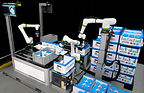
Three Cobots. One Complete Packaging Process: A coordinated work cell featuring FANUC CRX-20iA/L, CRX-10iA and CRX-5iA collaborative robots demonstrate an end-to-end packaging workflow. Combining vision-guided picking, label orientation verification, packing and palletizing in a single automated process, the application shows how manufacturers can use collaborative automation to streamline material flow, maximize floor space and increase production flexibility.High-Payload Collaborative Palletizing: With a new 40 kg payload capacity, the FANUC CRX/30-18A collaborative robot demonstrates how cobots are expanding into heavier-duty palletizing applications. Equipped with integrated 3D vision guidance and a dual-case gripper, the system efficiently handles larger loads while maintaining the ease of deployment and intuitive programming flexibility that have made collaborative robots increasingly popular across manufacturing operations.

Food-Grade Robotics Deliver Proven Performance

FANUC will also showcase one of the industry’s broadest portfolios of food-grade automation technologies with applications spanning primary food handling, packaging and palletizing.

Coordinated Food Packaging with Delta and SCARA Robots: This demo shows the DR-3iB/6 Stainless IP69K-rated delta robot and a food-grade SR-12iA/C SCARA robot coordinating high-speed placing of sausage links in packages. Supporting sanitation standards, the system uses vacuum grippers and FANUC’s iRPickTool for accurate placement in high-pressure washdown environments.Vision-Guided Case Packing of Frozen Protein Products: The FANUC LR Mate Food Clean robot demonstrates automated case packing of frozen protein products. Utilizing FANUC iRVision technology and iRPickTool software, the system identifies randomly oriented packages on a moving conveyor and accurately places them into cases. The application reveals how food processors can improve packing efficiency, increase throughput and reduce repetitive manual handling operations through automation.Automated Food-Grade Palletizing: The FANUC M-710/50-26D Food Option robot shows automated palletizing food products using FANUC PalletTool 3 software. With a 50 kg payload capacity, food industry design options, and NVIDIA Isaac Sim digital twin visualization, the robot efficiently handles product crates, helping manufacturers increase productivity, reduce repetitive manual tasks and build stable pallet loads for storage and shipment.  

High-Speed Packaging Automation

Circular Line Tracking with SCARA Robotics: Featuring a compact footprint and high-speed performance, the FANUC SR-9iA/R SCARA robot combines vision guidance and visual conveyor tracking in a circular line-tracking application. After picking moving parts and placing them into trays, the robot automatically changes tooling to transfer parts into cartons. The demonstration shows how manufacturers can maximize throughput while conserving valuable space on the production floor.

Advanced Automation Technologies

Across the exhibit, FANUC will showcase advanced automation technologies including Generative AI, iRVision®, iRPickTool®, PalletTool® 3, visual conveyor tracking and the latest R-50iA and R-30iB Mini Plus controller platforms. Together, these technologies help manufacturers simplify deployment, increase flexibility and maximize automation performance.

About FANUC America Corporation

FANUC America Corporation is a subsidiary of FANUC CORPORATION in Japan and provides industry‑leading CNC systems, robotics, and ROBOMACHINEs. FANUC’s innovative technologies help manufacturers maximize productivity, reliability, and profitability. Headquartered in Rochester Hills, Michigan, FANUC America has facilities throughout North and South America. Learn more at www.fanucamerica.com or explore collaborative robots at crx.fanucamerica.com.

Media Contact:
media@fanucamerica.com

View original content to download multimedia:https://www.prnewswire.com/news-releases/fanuc-america-brings-ai-powered-robotics-and-intelligent-packaging-automation-to-pack-expo-international-2026-302899949.html

SOURCE Fanuc America Corporation

Continue Reading

Technology

Government of Canada introduces legislation to accelerate defence procurement, strengthen Canadian industry, and reinforce Canadian sovereignty

Published

on

By

OTTAWA, ON, Oct. 6, 2026 /CNW/ — The world is more dangerous and divided. The international rules-based order is fading, and global conflict rages on. Canada’s Government is focused on what we can control: rebuilding, rearming, and reinvesting in the Canadian Armed Forces (CAF). In October 2025, Canada’s new government established the Defence Investment Agency (DIA) to overhaul and streamline our defence procurement. Since then, the DIA has facilitated key purchases that strengthen Canada’s strategic autonomy. In a rapidly changing world, Canada must move quicker to keep Canadians safe.

That is why, today, the Government of Canada introduced Bill C-40: Strengthening Canada’s Defence Sector, to establish the DIA as a Crown corporation. This reform will provide the DIA with the authorities, operational flexibility, specialized expertise and organizational structure needed to deliver critical capabilities quicker. The DIA will have greater commercial flexibility and more autonomous approvals, allowing it to work better with industry and deliver better value for money. It will maximise Canada’s generational defence investments to strengthen our industrial base, supply chains, and sovereign capabilities.

This legislation:

Creates the Canadian Corporation for Defence Investment, which will continue to operate under its existing name, the Defence Investment Agency. It will have more independence, its own Board of Directors, and greater authority to negotiate and manage contracts;Empowers the DIA to engage in defence production, procurement, and investment activities in support of national defence and the operational priorities, capability requirements and acceptance criteria established by the National Defence (DND) and the Canadian Armed Forces (CAF);Maintains the Government of Canada’s oversight of the new Crown Corporation;Amends the National Defence Act to create an Associate Minister of National Defence for Procurement, who will be responsible to Parliament for the DIA, consolidate procurement and commercial authorities and strengthen accountability for procurement delivery within the National Defence portfolio, andIntegrates the DIA with the National Defence portfolio to further reduce red tape that slows procurement down and ensures that defence procurement in Canada is focused on equipping the National Defence and CAF with the tools they need to defend Canada.

Bill C-40: Strengthening Canada’s Defence Sector represents the next step in the Government of Canada’s modernization and transformation of Canadian defence procurement.

The DIA was launched to accelerate procurement and use defence spending to strengthen Canadian industry, build sovereign capabilities, and catalysing investment in the Canadian defence sector. As a Crown corporation it will have the commercial tools to deliver on its mandate. It will support Canada’s security and long-term economic growth, while remaining accountable to Parliament, and the Government of Canada.

The DIA will continue to strengthen Canada’s ability to work with allies and security partners. The Corporation would support joint defence procurement programs, including initiatives aligned with Canada’s participation in Security Action for Europe (SAFE) and Readiness 2030. Greater international collaboration will improve interoperability, provide Canadian suppliers with greater access to allied markets and supply chains, capitalize on economies of scale, and support Canada’s broader security and diplomatic objectives.

Canada is making generation investments to transform our defence sector. Empowered as a Crown corporation, the DIA will harness defence investment to catalyse industry, secure critical supply chains, and drive innovation and investment. In a rapidly changing world Canada’s government is building a stronger, more self-reliant country. One that is fully ready for the future. One that guarantees Canadians have tools needed to protect our country.

Quote

“Canada is making a generational investment in our defence and security, and we need institutions built to match the scale and urgency of that ambition. Establishing the Defence Investment Agency as a Crown corporation would give it the flexibility and specialized expertise to move faster, make strategic investments and deliver the capabilities our Armed Forces need. Just as importantly, it would allow us to use our defence investments to strengthen our sovereignty while building a robust Canadian defence industry, attracting investment and creating lasting economic opportunities and good jobs here at home.”

The Honourable Stephen Fuhr
Secretary of State (Defence Procurement)

“We look forward to continued collaboration with the Defence Investment Agency to further strengthen defence procurement. As a Crown corporation within the National Defence portfolio, the DIA will have the direct authorities and added flexibility to streamline procurement so that the Canadian Armed Forces and Canadian Coast Guard have more secure, reliable and quicker access to the capabilities they need to protect our sovereignty and keep Canadians safe.”

The Honourable David J. McGuinty
Minister of National Defence

“In a more dangerous and divided world, Canada is taking action and establishing a clear and compelling path forward. With the introduction of this legislation, we are making clear that large-scale, agile defence production and procurement is here to stay. Procurement and investment must live together, by connecting the capabilities our armed forces need with the investments that will deliver them and the industrial capacity that will sustain them. As a Crown corporation, the Defence Investment Agency will integrate these priorities, delivering critical capabilities to our armed forces more efficiently while strengthening Canadian industry, driving innovation and creating economic opportunity for years to come.”

The Honourable Joël Lightbound
Minister of Government Transformation, Public Works and Procurement and Quebec Lieutenant

“Establishing the Defence Investment Agency as a Crown corporation is an important step in building the organization Canada needs to meet today’s defence and security challenges. It will give the DIA the tools, flexibility, and expertise to move faster and make strategic investments that deliver capabilities for the Canadian Armed Forces and the Canadian Coast Guard. Our responsibility will be to turn Canada’s defence investments into results, strengthening our industrial base, building sovereign capacity, deepening partnerships with industry, and creating economic opportunities at home. I am proud of what the DIA team has accomplished since our launch, and I look forward to leading this transition and the organization’s next chapter.”

Doug Guzman 
Chief Executive Officer, Defence Investment Agency

Quick facts

The DIA was initially established as a Special Operating Agency within Public Services and Procurement Canada, allowing the organization to begin operations while the Government of Canada developed its longer-term organizational model.Establishing the DIA as a Crown corporation within the National Defence portfolio is intended reduce handoffs, consolidate procurement and commercial authorities and strengthen accountability for procurement delivery.By consolidating responsibility and expertise within one organization, the DIA will reduce duplication, streamline decision-making, and accelerate procurement from validated requirement definition to contract award, while DND, the CAF and the CCG retain responsibility for defining capability requirements, operational priorities and acceptance criteria.  The DIA is a central delivery partner for Canada’s Defence Industrial Strategy and its Build–Partner–Buy approach to defence procurement.The proposed Corporation will be accountable to the Government of Canada through a responsible Minister and subject to legislated governance, financial, audit, reporting and parliamentary oversight requirements.

Associated links

Backgrounder: Introduction of legislation to strengthen Canada’s Defence SectorDefence Investment AgencyCanada’s Defence Industrial Strategy

Follow us on X (Twitter)
Follow us on Facebook

SOURCE Defence Investment Agency

Continue Reading

Technology

Ampersand closes generation gap between agents and the enterprise software stack, backed by $15 million from Bessemer Venture Partners

Published

on

By

Ampersand lets agentic applications read and write inside legacy systems of record, removing the integration work that has stalled AI projects industry-wide.

SAN FRANCISCO, Oct. 6, 2026 /PRNewswire/ — Ampersand today announced a $15 million Series A led by Bessemer Venture Partners, with participation from existing investors Matrix and Flex Capital. New investors participating in this round also include Yelp, Tenacity Capital, CTO Fund, Mana Ventures, and prominent angel investors. Lauri Moore, Bessemer Partner, will be joining Ampersand’s board. Ampersand is building integration infrastructure for enterprise agents, so agentic applications can read and write inside the CRM, ERP, and other systems of record that power the enterprise.

While enterprises are ready to adopt agentic software, they are running into a practical issue: legacy systems of record. CRMs and ERPs in different verticals have been around for decades, and every implementation is highly customized. AI-native software vendors looking to sell to the enterprise are faced with needing deep domain expertise on how these systems function before they can deliver value to enterprise customers. This practical reality slows AI adoption for the enterprise and limits the market size for AI vendors.

“With Ampersand, we’re able to serve new customers that were previously unavailable to us because of their complex integration requirements,” said John Pena, CTO at Hatch, an AI communications platform for service businesses, acquired by Yelp in 2026. “Now we’ve expanded our total addressable market without taking on months of maintenance headaches.”

Ampersand is closing the gap between legacy systems and agentic products by making every customers’ system legible to agents. Ampersand’s approach to legacy systems allows every end customer to adopt a custom data model that can handle custom fields, objects, permissions, and workflows so agents have the right context. Then enabling agents to take deep, bi-directional actions in these systems of record.

“We’re in this fascinating moment where AI has the potential to transform the enterprise, but CTOs are still faced with the old problem of systems of record,” said Ayan Barua, co-founder and CEO of Ampersand. “Our bet is that the saasapocalypse is overstated and systems of record like Salesforce and NetSuite aren’t going anywhere. Ampersand is designed to sit between these two generations of software and make them legible to each other.”

Ampersand’s mission is to provide a complete integration solution for AI-native companies. This includes integration infrastructure, deep domain expertise, forward-deployed expertise, and agentic support. Ampersand announced the beta release of its AI integration agent, Andi. Andi helps developers with the implementation work required to get their products running in each customer’s environment.

Ampersand’s founders bring decades of integration experience to the problem. Ayan Barua was CTO and co-founder of Siftery, later acquired by G2, and then VP of Engineering at G2, where CRM and ERP integration work routinely consumed the majority of his engineering team’s time. Lauren Long built Firebase Extensions at Google, connecting Firebase apps to third-party APIs at a scale that grew to billions of executions a day. The two spoke with more than 100 companies building integrations before writing Ampersand’s first line of code.

“An agent is only as useful as the systems it can reach. MCP enables agents to describe a tool. It didn’t address what happens at runtime, when tokens expire, schemas drift, and every customer’s Salesforce looks a little different,” said Lauri Moore, Partner at Bessemer Venture Partners. “Connecting an agent to a system of record is a demo. Keeping that connection alive across hundreds of customers, with writes you can’t afford to get wrong, is much harder. That’s what Ampersand is building.”

About Ampersand
Ampersand is integration infrastructure for enterprise agents. With Ampersand, AI-native software vendors are able to bridge the generation gap between their customers’ legacy systems of record, CRMs, and ERPs, and the agentic capabilities in their software. Founded by Ayan Barua and Lauren Long, Ampersand is based in San Francisco. Learn more at ampersand.ai

View original content to download multimedia:https://www.prnewswire.com/news-releases/ampersand-closes-generation-gap-between-agents-and-the-enterprise-software-stack-backed-by-15-million-from-bessemer-venture-partners-302900006.html

SOURCE Ampersand

Continue Reading

Technology

SOUTHWEST AIRLINES LAUNCHES FIRST-OF-ITS-KIND U.S. AIRLINE PLUGIN IN CHATGPT

Published

on

By

Customers can discover Southwest destinations and plan flights in an experience powered by OpenAI and Amazon Web Services 

DALLAS, Oct. 6, 2026 /PRNewswire/ — Southwest Airlines Co. (NYSE: LUV) today launched a first-of-its-kind U.S. airline plugin in ChatGPT, marking the first step in a phased AI-powered booking approach with OpenAI and Amazon Web Services (AWS) that allows travelers to discover and shop for Southwest flights in ChatGPT.

By launching the Southwest® plugin in ChatGPT, the airline can appear earlier in the Customer journey and offer a simpler, more direct path from inspiration and discovery to booking options with Southwest.

“Customers are evolving how they plan their travel, and Southwest is helping to shape what comes next,” said Sabrina Callahan, Chief Digital and Marketing Officer at Southwest Airlines®. “It is a meaningful example of how we test and learn with AI innovation to continue the Customer-first approach that defines our brand.”

“We’re putting the right technology in place to support what our Customers need today with flexibility to build what they’ll need tomorrow,” said Lauren Woods, Executive Vice President & Chief Information Officer at Southwest Airlines. “By creating a secure, scalable foundation for AI, we can add new capabilities more quickly and thoughtfully, making it easier to serve Customers across their journey.”

Southwest is working with OpenAI and AWS to combine leading AI and cloud technologies with Southwest’s deep understanding of its Customers. With OpenAI and AWS, Southwest is creating more intuitive travel planning while thoughtfully expanding AI-powered capabilities over time.

Learn more about the Southwest plugin in ChatGPT at Southwest.com/chatgpt.

ABOUT SOUTHWEST AIRLINES CO.
Southwest Airlines Co. operates one of the world’s most admired and awarded airlines, offering its one-of-a-kind value and Hospitality at 120 airports across 12 countries. Southwest took flight in 1971 to democratize the sky through friendly, reliable, and low-cost air travel and now carries more air travelers flying nonstop within the United States than any other airline¹. By empowering its more than 73,000². People to deliver unparalleled Hospitality, the maverick airline cherishes a passionate loyalty among more than 134 million Customers carried in 2025. Southwest leverages a unique legacy and mission to serve communities around the world including harnessing the power of its People and Purpose to put communities at the Heart of its success. Learn more by visiting Southwest.com/citizenship. 

1. Based on U.S. Dept. of Transportation quarterly Airline Origin & Destination Survey as of Q4 2025.
2. Fulltime-equivalent active Employees as of June 30, 2026.

Cautionary Statement Regarding Forward-Looking Statements
This news release contains forward-looking statements within the meaning of Section 27A of the Securities Act of 1933, as amended, and Section 21E of the Securities Exchange Act of 1934, as amended. Specific forward-looking statements include, without limitation, statements related to the Company’s expectations with respect to its digital evolution, technology capabilities, including artificial intelligence capabilities, and Customer needs and expectations. These forward-looking statements are based on the Company’s current estimates, intentions, beliefs, expectations, goals, strategies, and projections for the future and are not guarantees of future performance. Forward-looking statements involve risks, uncertainties, assumptions, and other factors that are difficult to predict and that could cause actual results to vary materially from those expressed in or indicated by them. Factors include, among others, (i) the impact of geopolitical conflicts, fears or actual outbreaks of diseases, extreme or severe weather and natural disasters, actions of competitors (including, without limitation, pricing, scheduling, capacity, and network decisions, and consolidation and alliance activities), governmental actions, consumer perception, consumer uncertainties with respect to trade policies, tariffs, or government shutdowns, economic conditions, fears or actual acts of terrorism or war, sociodemographic trends, and other factors beyond the Company’s control, on consumer behavior and the Company’s results of operations and business decisions, plans, strategies, and results; (ii) the Company’s ability to timely and effectively implement, transition, operate, maintain, and protect the technology systems, cybersecurity measures, artificial intelligence and other emerging technology capabilities, and infrastructure necessary to support its operations and initiatives; (iii) the Company’s ability to effectively execute and evolve its strategic plans, initiatives, product offerings, and policies, including related consumer behavior and response; (iv) the impact of fuel price changes, fuel price volatility, and fuel availability on the Company’s business plans and results of operations; (v) the impact of the Federal Aviation Administration and other governmental regulations and actions, including with respect to government shutdowns and Air Traffic Control staffing shortages and inefficiencies, as well as the Company’s ability to obtain any required governmental approvals, on the Company’s business plans, results, and operations; (vi) the Company’s dependence on The Boeing Company (“Boeing”) and Boeing suppliers with respect to the Company’s aircraft deliveries, fleet and capacity plans, operations, maintenance, strategies, and goals; (vii) the Company’s dependence on other third parties, including with respect to technology, revenue management, distribution channels, operational reliability, fuel supply, maintenance, and the impact on the Company’s operations and results of operations of any third-party delays or nonperformance; (viii) the impact of labor matters on the Company’s business decisions, plans, strategies, and results; (ix) the Company’s ability to obtain and maintain adequate infrastructure and equipment to support its operations and initiatives; (x) the Company’s dependence on its workforce, including its ability to employ and retain sufficient numbers of qualified Employees with appropriate skills and expertise to effectively and efficiently maintain its operations and execute the Company’s plans; (xi) the cost and effects of the actions of activist shareholders; and (xii) other factors, as described in the Company’s filings with the Securities and Exchange Commission, including the detailed factors discussed under the heading “Risk Factors” in the Company’s Annual Report on Form 10-K for the fiscal year ended December 31, 2025.


View original content to download multimedia:https://www.prnewswire.com/news-releases/southwest-airlines-launches-first-of-its-kind-us-airline-plugin-in-chatgpt-302900018.html

SOURCE Southwest Airlines Co.

Continue Reading

Trending