Connect with us

Technology

Industry Report Shows 64% of Life Sciences Leaders Taking Action to Establish AI Governance

Published

on

Research points to trust as the real barrier to scaling agentic AI, with 58% saying the industry still lacks clear standards for responsible AI

TORONTO and NEW YORK, Oct. 28, 2026 /PRNewswire/ — Life sciences organizations are putting governance in place to scale agentic AI across commercial, medical, and patient-facing work, according to the Responsible AI in Life Sciences (RAIL) Report 2026. The new industry research is based on roundtables and a survey of senior leaders at pharmaceutical, biotech, and medical device companies. Two-thirds (64%) surveyed say their organization has an AI governance process either fully established or in development.

The research, from ACTO, finds an industry ready to use AI but still working to trust it. Governance is the AI concern leaders cite most often. It is also the one they admit they have most neglected in practice. More than one-third still either have no defined governance or rely on a one-time IT approval.

Trust is the barrier to adoption at scale

The findings suggest trust will decide how far and how fast life sciences scales AI. Technology no longer appears to be the main obstacle. Leaders rank regulatory, legal, or compliance hesitation (21%) as the biggest internal barrier to scaling AI, while technical readiness ranks near the bottom (9%). Asked which measure matters most when judging an AI pilot, leaders put trust and adoption (24%) ahead of efficiency (23%), a signal that expectations are evolving.

Leaders trust AI more in their own hands than in their organizations’. More than two-thirds of leaders (68%) are involved in an AI project at their organization, and 69% rate their personal comfort with AI as high. But more than half (54%) remain concerned about how AI is being used in their own organizations. Fifty-eight percent say life sciences has no clear industry standard for responsible AI.

“The discussions reflected a wide range of perspectives and experiences related to AI understanding, adoption, and oversight across the industry,” said Lisa DeMarco, general counsel and chief business officer at Arctic Therapeutics and a moderator at the RAIL roundtables hosted by ACTO. “An important theme in the conversations was the need for practical guidance to help organizations assess AI trustworthiness while maintaining a focus on patient safety.”

Governance builds the foundation for trust

Leaders described governance as an ongoing operating model that continues well past initial approval. It needs named business owners, clear escalation paths, and standard operating procedures (SOPs), as well as the ability to deploy and revoke an AI agent and governance enforced at both the agent and sub-agent level. A challenge is that ownership is still unsettled. Asked who should be held ultimately accountable for the actions an AI agent takes, leaders name the end user (34%), legal and compliance (28%), the third-party AI vendor (22%), and IT (16%).

The data suggests responsibility falls to the end user because so much AI use happens outside approved systems. Nearly a quarter of organizations (23%) don’t monitor or discuss employee use of unauthorized AI agents, and roundtable leaders described employees already building their own agents with no governance in place. The gap between AI adoption and AI oversight is where trust seems to be breaking down across the industry.

Industry quickly moving from where to start to what to build next

Leaders want AI to raise performance and to be judged fairly. Four in five (79%) agree AI risk and ROI should be measured against how people do the work today, with its own error rate. Improved results and outcomes (29%) ranked as the top expected benefit, well ahead of budgetary savings (10%) and reduced risk (8%).

The leaders furthest along with AI sort each use case by its value and how hard it is to govern. Most start with easier-to-govern work such as review and approval cycles, pre-call preparation, insight logging, triage, and coaching. With two-thirds already running AI projects, attention is turning to harder work: connecting systems, supporting a full product launch, and chaining multiple agents together. An agent supporting a field rep or medical science liaison has to work across many systems and with the AI agents already built into each one. That raises new questions about what to trust and who answers for the result.

People remain the hardest part of adoption. The issue of change management was a common challenge raised at every roundtable. Asked which skill humans most need to keep, 45% chose judgment, followed by human connection (31%) and strategy (24%). The report recommends redrawing roles in detail, separating what an AI agent handles from what the human keeps.

Introducing a Common Standard for Trust: The RAIL Score

To give the industry a shared bar, the RAIL Score provides a rubric that grades any agentic AI system on six components of responsible AI, including governance, security, testing and certification, human centricity, value creation, and orchestration. Each component is scored “high” and trustworthy enough for use in life sciences, “medium” with specific gaps to close first, and “low” and not fit for use. The report also includes tools to put the score to work. These include a self-grading scorecard, a vendor-grading checklist, an AI agent job description template, and a 90-day launch checklist.

“The industry has moved past whether to use agentic AI. Leaders now want to know which systems they can trust enough to scale, and today there’s no shared bar to answer that,” said Parth Khanna, co-founder and CEO of ACTO. “Any agentic AI system has to get security and governance right. The RAIL Score gives teams a consistent way to grade systems against the standard a regulated industry demands, so trust can rest on evidence instead of vendor claims.”

Methodology

The Responsible AI in Life Sciences (RAIL) Report 2026 draws on eight in-person executive roundtables with 80 senior leaders across North America and Europe, held February through April 2026, as well as an online survey of 135 leaders at pharmaceutical, biotech, and medical device companies, fielded June 8 through July 17, 2026. Nearly all survey respondents (97%) hold director-level roles or above across commercial, medical affairs, legal and compliance, learning and development, and marketing functions.

The complimentary RAIL Report 2026 and related tools are available now at acto.com/RAIL.

To hear more about the findings, register for the upcoming webinar, “Responsible AI in Life Sciences: What Leaders Say About Scaling Agentic AI,” on Wednesday, November 4 at 11:00am Eastern.

About ACTO

ACTO helps life sciences companies bring therapies to patients after regulatory approval. Its AI-powered Field Excellence Platform and AI SuperAgents speed product launches, strengthen field execution, and deepen customer engagement for commercial and medical teams. ACTO elevates training and coaching and agentifies up to 30% of the work in customer-facing roles. That frees reps, medical science liaisons, and their leaders to focus on human connection, judgment, and strategic execution. Fourteen of the top 50 pharmaceutical companies use ACTO, along with high-growth biotechs and leading medtech organizations. ACTO is FDA 21 CFR Part 11 validated, SOC 2 Type II certified, and a Veeva Gold Product Partner. Learn more at www.acto.com.

Research Highlights
Responsible AI in Life Sciences (RAIL) Report 2026

The RAIL Report 2026 draws on eight executive roundtables with 80 senior leaders across North America and Europe and an online survey of 135 leaders at pharmaceutical, biotech, and medical device companies. Nearly all respondents (97%) are director level or above. The research examines how life sciences organizations evaluate, govern, and scale agentic AI in commercialization.

Governance Is the Defining Issue

Nearly two-thirds (64%) say their organization has an AI governance process fully established (22%) or in development (42%).More than a third (36%) have no defined governance (21%) or rely on a one-time approval gate (15%).Governance was the most-cited AI concern across the roundtables, and leaders called it the most neglected in practice.Accountability is unsettled. Leaders are split on who owns an AI agent’s actions: the end user (34%), legal and compliance (28%), the AI vendor (22%), and IT (16%).Nearly a quarter (23%) don’t monitor or discuss employee use of unauthorized AI agents. Another 37% view it as a severe security violation.

Trust May Be the Real Barrier to Scale

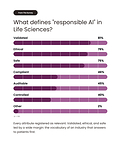
Over half (58%) say the life sciences industry lacks clear standards for responsible AI.More than half (54%) are concerned about how AI is used in their organization, even though 69% report high personal comfort with AI.Leaders define responsible AI as validated (81%), ethical (79%), and safe (75%). Fewer chose compliant (46%), auditable (45%), or controlled (40%).Four in five (79%) agree AI risk and ROI should be measured against today’s human-led baseline.Trust and adoption (24%) narrowly lead efficiency (23%), risk (21%), and ROI (18%) as the most critical measure of a pilot’s success.

From Where to Start to What to Build Next

Two-thirds (68%) are already involved in an AI project at their organization.Start now (high value, easy to govern): review and approval cycles, pre-call prep, insight logging, triage, coaching.Build next (high value, harder to govern): connecting systems, supporting a full product launch, chaining multiple agents.Defer or constrain: anything that could reach a patient or regulator without a human in between.Improved results and outcomes (29%) lead efficiency (25%) and productivity (24%) as the most important expected benefit. Budgetary savings (10%) rank far lower, and reduced risk ranks last among the listed benefits (8%).

Barriers Are Organizational

The top barriers to scaling are regulatory, legal, or compliance hesitation (21%) and a lack of comparative ROI metrics (20%). Technical readiness ranks near the bottom (9%).Leaders named three pressures driving AI adoption: more to commercialize, tighter budgets, and pressure to adopt AI even without a clear strategy.Workforce redesign is the real bottleneck to scaling. Leaders say judgment (45%), human connection (31%), and strategy (24%) are the skills humans most need to keep.

The RAIL Score

The RAIL Score grades any agentic AI system on six components: Governance, Security, Testing & Certification, Human Centricity, Value Creation, and Orchestration.Each component is scored from 1 to 3, for a total out of 18: High (16–18), Medium (12–15), or Low (below 12).Security and Governance are hard floors. A score below 3 on either caps the system at Low.

The complimentary RAIL Report 2026 and related tools are available now at acto.com/RAIL.

To hear more about the findings, register for the upcoming webinar, “Responsible AI in Life Sciences: What Leaders Say About Scaling Agentic AI,” on Wednesday, November 4 at 11:00am Eastern.

View original content to download multimedia:https://www.prnewswire.co.uk/news-releases/industry-report-shows-64-of-life-sciences-leaders-taking-action-to-establish-ai-governance-302921671.html

Continue Reading

Technology

In HelloNation, Jewelry Expert Mike Littlejohn Explains What to Expect From Jewelry Repair and Ring Resizing

Published

on

By

The article outlines how repair services and resizing work and what factors affect timing, cost, and results.

AUBURN, Ind., Oct. 30, 2026 /PRNewswire/ — Can damaged or ill-fitting jewelry be restored instead of replaced? That question is answered in a HelloNation article, featuring insights from Jewelry Expert Mike Littlejohn of Carbaugh Jewelers.

The HelloNation article explains that jewelry repair and ring resizing are practical ways to restore both the function and appearance of worn pieces. It notes that everyday issues such as broken chains, worn prongs, and loose clasps are common and can often be fixed successfully when addressed early.

According to the article, jewelry repair services cover a wide range of problems caused by regular wear. Fixing these issues promptly can help prevent more serious damage and extend the life of the piece. The article emphasizes that early attention often leads to better outcomes.

Ring resizing is another key service discussed. The ring resizing process involves adjusting the band so that the ring fits securely and comfortably again. Changes in finger size over time or due to temperature can make resizing necessary. The article explains that the goal is to maintain the original look while improving wearability.

Not all rings can be resized in the same way. The article describes how simple bands are easier to adjust, while more detailed designs may require careful handling. Rings with stones set along the band can limit how much resizing is possible. The article notes that understanding these factors helps set clear expectations before starting any work.

Metal type also plays an important role in both jewelry repair and resizing. The article explains that gold is commonly used and responds well to standard techniques. Platinum is denser and more durable, which can make it harder to adjust but also longer lasting. These differences can affect the time and complexity of the repair.

Stone settings require special attention during any jewelry repair services. The article notes that loose stones can often be secured, and missing stones may be replaced if a close match is available. Careful handling helps maintain both the safety and appearance of the piece.

Timing varies depending on the type of repair. The article explains that simple fixes may be completed quickly, while more detailed work takes additional time. The ring resizing process may also take longer if a significant size change is needed. Understanding the timeline helps manage expectations.

Cost is another factor addressed in the article. Jewelry repair cost depends on the level of work required, the condition of the item, and the materials involved. Basic repairs are usually more affordable, while complex work can increase the overall cost. Clear estimates help avoid surprises.

Preventive care is also important. The article encourages regular checks for loose parts or signs of wear so that issues can be handled early. This reduces the need for more extensive repairs and helps maintain the condition of the jewelry over time.

In some cases, repair may not be the best option. The article explains that severe damage or delicate designs can limit what can be safely restored. Alternative solutions, such as redesigning the piece, may be considered when repair is not practical. The article highlights the importance of understanding these limits.

In the end, the article emphasizes that jewelry repair and ring resizing remain valuable options for maintaining meaningful items. By understanding jewelry repair services, the ring resizing process, jewelry repair cost, and how metal type affects the work, individuals can make informed decisions and extend the life of their jewelry.

Can Jewelry Be Repaired or Resized, and What Should You Expect? Features insights from Mike Littlejohn, Jewelry Expert of Auburn, Indiana, in HelloNation.

About HelloNation

HelloNation is America’s Good News Network, a premier media platform built on the idea that good news travels faster when real people tell real stories. Through its community-focused digital publications and innovative “edvertising” approach, HelloNation delivers expert-driven, good-news content that informs, inspires, and spotlights the leaders making a meaningful impact in their communities.

View original content to download multimedia:https://www.prnewswire.com/news-releases/in-hellonation-jewelry-expert-mike-littlejohn-explains-what-to-expect-from-jewelry-repair-and-ring-resizing-302924992.html

SOURCE HelloNation

Continue Reading

Technology

INSEAD establishes Thrive Lab with US$3 million funding from Google.org and Google DeepMind

Published

on

By

Launched at INSEAD AI Forum Asia, the new Lab is set to advance global academic research on the impact of AI on human connectivity, meaning and wellbeing in work and life

FONTAINEBLEAU, France and SINGAPORE and SAN FRANCISCO, Oct. 30, 2026 /PRNewswire/ — INSEAD, The Business School for the World, today announced it has received US$3 million in funding from Google.org and Google DeepMind. The funding will support the Research Lab for Human and Organisational Thriving (INSEAD Thrive Lab), aimed at accelerating global research on how people and organisations can flourish in an era of continuous technological transformation.

Artificial intelligence is emerging as the most consequential technology that profoundly shapes how people learn, work, live and interact with one another. While it presents near limitless possibilities, we need to give careful attention to the potential risks. How can we strengthen our human, social and psychological capital amid relentless technological change? And how must our ecosystems of learning – spanning educational, community, and professional spheres – evolve to build this capital? These are the central questions that the INSEAD Thrive Lab will focus on.

“We want to understand how people can expand their capabilities, build economically viable and psychologically meaningful working lives, and cultivate strong relationships with others in the age of artificial intelligence. Through rigorous, multidisciplinary research, INSEAD Thrive Lab aims to have real-world impact and generate actionable insights into what enables people and organisations not just to adapt to a rapidly changing world, but to thrive in it,” said Winnie Jiang, Academic Director of INSEAD Thrive Lab and Associate Professor of Organisational Behaviour at INSEAD.

Housed under INSEAD’s Human and Machine Intelligence Institute (HUMII) – a cross-disciplinary research institute that counts the 2025 Nobel Laureate in Economics Philippe Aghion and 2025 Oskar Morgenstern Medallist Phanish Puranam as part of its core academic team – INSEAD Thrive Lab will focus on three interconnected domains: Learning, Working and Relating.

“The success of artificial intelligence won’t be measured solely by efficiency or productivity gains, but by whether it empowers people to live more fulfilling lives. Navigating this rapid transformation requires thoughtful research and an unwavering commitment to human well-being. We are proud to support the launch of INSEAD Thrive Lab, which will explore some of the most pressing questions shaping the future of work and help people adapt, stay resilient, and thrive alongside AI,” said Sepi Hejazi Moghadam, Head of Foundations of Science, Google.org.

“We are incredibly grateful for the generous fund from Google.org and Google DeepMind. At HUMII, our goal is to conduct research on all branches of artificial intelligence for the ultimate purpose of expanding human capacities and human agency. The Lab’s work will be core to HUMII and to our society,” says Lily Fang, Academic Director of HUMII and Dean of Research and Innovation at INSEAD.

Click here to view video about the INSEAD Thrive Lab

INSEAD Thrive Lab will build on the school’s mission to develop responsible leaders who transform organisations and society, serving as a global hub for research, dialogue and innovation around the human dimension of progress. To this end, it will train emerging scholars working on the theme of human meaning and human flourishing through its PhD research award and postdoctoral fellowship and bring the wider research community together at its annual global conference. Research-to-practice partnerships with organisations, schools and governments, as well as a series of workshops, talks and dialogues are designed to translate insights into practice, and ultimately, help people flourish.

The announcement was made during the INSEAD AI Forum Asia, held at the INSEAD Asia Campus in Singapore. The event serves as a platform for dialogue between researchers, business leaders, policymakers and the public with the goal of advancing the beneficial and responsible use of artificial intelligence to benefit business and society. Part of the global INSEAD AI Forum series, the Asia edition comes after Europe and America, with the next edition taking place in UAE from 27 to 28 January 2027.

To learn more about INSEAD Thrive Lab, participate in the programme, or support the

school’s ongoing mission, visit INSEAD Thrive Lab or follow #INSEADAI.

Media contact: news@insead.edu

###

About INSEAD, The Business School for the World 

As one of the world’s leading and largest graduate business schools, INSEAD brings together people, cultures and ideas to develop responsible leaders who transform business and society. Our research, teaching and partnerships reflect this global perspective and cultural diversity. Our global perspective and unparalleled cultural diversity are reflected in our research, teaching, partnerships; as well as in our alumni network of over 73,000 members representing 176 nationalities across 183 countries.

With locations in Europe (France), Asia (Singapore), the Middle East (Abu Dhabi), and North America (San Francisco), INSEAD’s business education and research spans four regions. Our 162 renowned Faculty members from 40 countries inspire more than 1,700 degree participants annually in our Master in Management, MBA, Global Executive MBA, Specialised Master’s degrees (Executive Master in Finance and Executive Master in Change) and PhD programmes. In addition, more than 21,000 executives participate in INSEAD Executive Education programmes each year.

INSEAD continues to conduct cutting-edge research and innovate across all our programmes. We provide business leaders with the knowledge and awareness to operate anywhere. Our core values drive academic excellence and serve the global community as The Business School for the World.

For more information, visit www.insead.edu. 

View original content to download multimedia:https://www.prnewswire.com/news-releases/insead-establishes-thrive-lab-with-us3-million-funding-from-googleorg-and-google-deepmind-302924894.html

SOURCE INSEAD

Continue Reading

Technology

nbkc bank Announces Agreement to Assume Consumer BaaS Programs of LSBX, a Division of Lincoln Savings Bank

Published

on

By

Transaction to Boost nbkc’s Banking as a Service Business and Deposit Base

KANSAS CITY, Mo., Oct. 30, 2026 /PRNewswire/ — nbkc bank today announced that it filed an application with the FDIC to assume the consumer-focused Banking as a Service (BaaS) portfolio maintained by LSBX, Lincoln Savings Bank’s BaaS division, which would increase the scale of its BaaS business and overall deposit base.

The transaction is anticipated to close in early 2027 subject to regulatory approval. Terms were not disclosed. It follows a September announcement that Lincoln Savings Bank parent Lincoln Bancorp, Reinbeck, Iowa, will merge with and into Equity Bancshares, Inc., headquartered in Wichita, Kan.

“This transaction is a natural fit for nbkc and is a great opportunity to continue growing our BaaS business,” said Michael Bartkoski, president and CEO of nbkc bank. “It allows us to further strengthen our deposit base and build upon an established program with significant momentum.” Bartkoski said he expects the LSBX offering to be merged into nbkc’s BaaS business and to go to market under the nbkc brand.

“We believe nbkc is an excellent successor and home for our LSBX customers,” said Sean Willett, CEO of Lincoln Savings Bank. “nbkc has built an exceptional Banking as a Service capability, and they are well known for effectively combining technology and a human touch. We believe in that approach and are confident it will serve our customers very well.”

Through BaaS offerings, banks provide nonbank fintech companies, which do not have banking charters, the opportunity to provide banking products such as deposits, checking, debit cards and personal loans to their customers. Fintech companies’ clients interact with the fintech company’s app on the front end, and their accounts are opened with the partner bank, typically on a private label basis. Fintech companies gain the ability to offer banking products, and banks offering BaaS gain access to those companies’ retail customers.

nbkc bank has developed meaningful scale in its BaaS business, with approximately 13 BaaS relationships with fintech companies, approximately 3.6 million BaaS customers and 30 dedicated BaaS employees.

“Our investment in our BaaS offering enables us to take on a transaction of this scale with confidence in our ability to provide a seamless, excellent customer experience,” Bartkoski said.

About nbkc bank

Having celebrated 25 years in 2024, nbkc bank is a Kansas City-based community bank with a nationwide online presence. Known for pairing intuitive technology with personal support, nbkc delivers digital solutions for mortgage, consumer, and business banking, plus Banking as a Service (BaaS) for companies nationwide. The bank also founded Fountain City Fintech®, an accelerator for growing fintech startups. nbkc remains committed to leading the industry toward simpler, more transparent banking. Member FDIC. Equal Housing Lender.

Media Contact
Melissa.Beltrame@nbkc.com

View original content to download multimedia:https://www.prnewswire.com/news-releases/nbkc-bank-announces-agreement-to-assume-consumer-baas-programs-of-lsbx-a-division-of-lincoln-savings-bank-302924452.html

SOURCE nbkc bank

Continue Reading

Trending