Connect with us

Technology

Business resiliency gaps wider than anticipated, study reveals

Published

on

New data collected from SAS’ resiliency assessment tool identifies speed and agility as executives’ biggest resiliency challenges

CARY, N.C., Nov. 9, 2023 /PRNewswire/ — Executives across industries are aware their organizations are not as resilient as they need to be, citing speed and agility as the biggest issue, followed closely by challenges in creating a culture of data literacy. These are among the new findings from AI and analytics leader SAS’ resiliency assessment tool, an online instrument enabling business leaders to appraise their companies’ resiliency. Participants also demonstrated that, while a “resiliency gap” may still exist in their organizations, many are taking steps to close it.  

Experience the full interactive Multichannel News Release here:  https://www.multivu.com/players/English/8827855-sas-resiliency-rules-report/

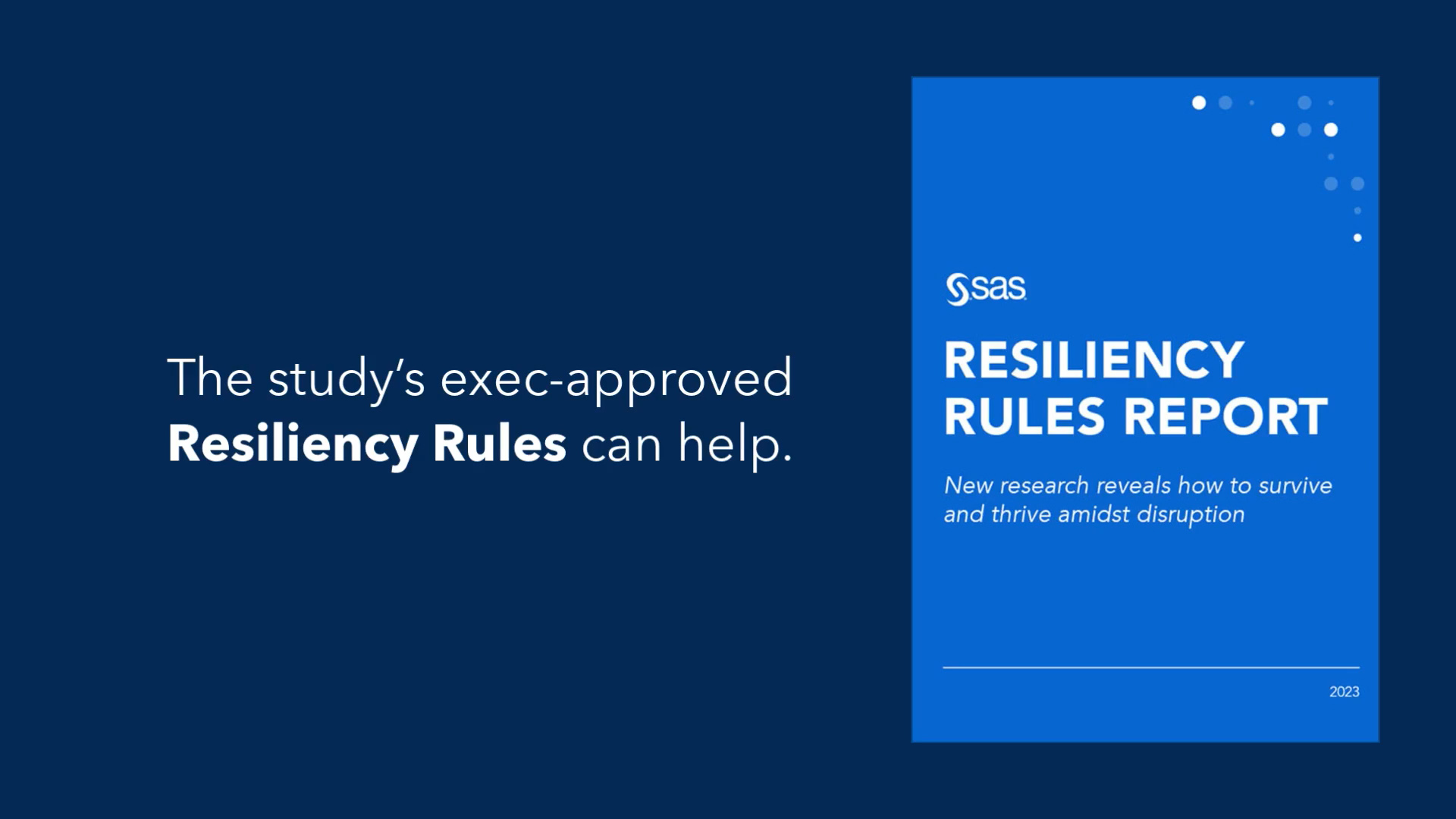
Earlier this year, SAS published its global Resiliency Rules report, which analyzed the current state of business resiliency and what steps companies in industries like financial services, retail, manufacturing, health care and government are taking to navigate change and seize opportunity. Since the report was released in March, SAS has collected data from the resilience assessment tool to capture companies’ resiliency over time, based on the five core “resiliency rules” explored in the study.  

“In the months we’ve spent gathering data using the Resiliency Rules assessment tool we’ve learned organizations are less resilient – especially as it concerns speed and agility – on average than the original Resiliency Rules sample population,” said Jay Upchurch, SAS Executive Vice President and CIO. “Understanding where your organization stands today is the first step in building a strategy to sustain long-term change.”

Resiliency Assessment Tool
The Resiliency Assessment Tool is a free, online assessment enabling business leaders to appraise their own company’s resiliency quotient based on the five core resiliency rules explored in the Resiliency Rules survey: Curiosity, Innovation, Speed and Agility, Data Culture and Literacy, and Equity and Responsibility.   

Among the executives who used the Assessment Tool, 39% identified their organizations as low resilience, compared to 26% in the Resiliency Rules sample. Fewer rated themselves as either moderate- or high-resilience. These differences may be because executives at less-resilient organizations were more likely to engage in the Assessment Tool.   

The new data also shows that while about one-third of respondents rate their organizations as strong across the five resiliency rules, 60% of respondents said there is room for improvement or growth in each of these areas. The struggle was greater in two key areas: Speed and Agility and Data Culture and Literacy. However, the organizations also said they were in the process of improving these pieces.

Speed and Agility  
Results from the Assessment Tool suggest speed and agility remains a challenge: Only about one-fifth of Assessment Tool respondents said their organizations are strong in this area, 44% indicated that there is room for improvement, and 33% identified as being on their way, but not quite there yet.   

In the global Resiliency Rules sample, nearly all executives (96%) said speed and agility was a priority. Many were using data and AI to improve in this area, especially at highly resilient organizations: 80% of high-resiliency executives were using data and AI to improve speed and agility versus 69% and 48% of moderate- and low-resiliency executives, respectively.   

“Innovation moves at the speed of information,” says Steven Bakalar, Vice President of IT Digital Transformation at Georgia-Pacific and a SAS customer. “And the faster you can acquire, share, and leverage information, the better off you’re going to be. You’ll be developing insights or learnings that then you can translate into actionable steps.”   

Data Culture and Literacy
Executives using the Assessment Tool also said Data Culture and Literacy remains a struggle: 40% of respondents said there is room for improvement in this area, with an additional 29% saying they were on their way, but not there yet.   

Data Culture and Literacy was an area of focus in Resiliency Rules, with high-resiliency executives more likely to believe prioritizing data is important to their company’s culture (88%) compared to moderate- (59%) and low-resiliency (24%) executives. These executives also cited data scientist shortages at their companies, especially those most interested in resilience: 56% of executives with a strong interest in resiliency identified a data scientist shortage versus just 35% who didn’t rate resiliency as important.   

“To be resilient in the face of disruptions, organizations are investing in core data science across business units,” says Gautam Khera, industry consultant and advanced manufacturing executive. “This enables them to predict what’s needed for that organization, whether manufacturing a widget, developing supply chain, or trying to understand customer response. Having that flow of data and teams of people – engineers, citizen scientists, business analysts and data scientists – enabled and ready is really the key to being resilient.”  

Executives who are struggling in this area can also seek out software and services that bridge the gap, so their business users gain as much value out of data and AI/analytics as data scientists.  

Unlocking Resiliency
The Resiliency Assessment Tool is still available for executives interested in gauging their organization’s resilience. To access it and read the full Resiliency Rules report, visit blogs.sas.com/content/resiliency/

About SAS
SAS is a global leader in AI and analytics software, including industry-specific solutions. SAS helps organizations transform data into trusted decisions faster by providing knowledge in the moments that matter. SAS gives you THE POWER TO KNOW®.

SAS and all other SAS Institute Inc. product or service names are registered trademarks or trademarks of SAS Institute Inc. in the USA and other countries. ® indicates USA registration. Other brand and product names are trademarks of their respective companies. Copyright © 2023 SAS Institute Inc. All rights reserved.

Editorial Contacts:
Suzanne Sprajcar
suzanne.sprajcar@sas.com
+1-416-307-4634

sas.com/news

Danny Finlay


View original content:https://www.prnewswire.com/news-releases/business-resiliency-gaps-wider-than-anticipated-study-reveals-301983040.html

SOURCE SAS Institute

Continue Reading

Technology

Trimble for Government Achieves ‘Initial Implementation’ Status for FedRAMP Class C (Moderate) Certification

Published

on

By

Milestone accelerates secure cloud adoption for federal, state and local entities managing infrastructure, spatial data and capital assets 

WESTMINSTER, Colo., Oct. 20, 2026 /PRNewswire/ — Trimble today announced that Trimble for Government is listed as ‘Initial Implementation’ status for Federal Risk and Authorization Management Program (FedRAMP®) Class C (Moderate) certification and is now listed on the FedRAMP Marketplace. In conjunction with seeking FedRAMP certification, Trimble is also pursuing GovRAMP authorization to support state, local and education (SLED) customers with reciprocal cybersecurity compliance standards.

This dual milestone marks a critical step forward in delivering a software as a service (SaaS) cloud environment built within a secure Government Community Cloud. Designed specifically for U.S. Federal Government departments, state and local agencies, and defense and civilian contractors, Trimble for Government provides a unified ecosystem for managing infrastructure, spatial data, capital projects, permitting and facility assets across their entire lifecycle.

Achieving FedRAMP Class C (Moderate) and GovRAMP alignment will enable public sector entities and Department of Defense (DoD) contractors to comply with stringent security mandates — including Cybersecurity Maturity Model Certification (CMMC) alignment — while modernizing digital engineering and asset management.

“Federal, state and local agencies face the dual challenge of modernizing critical infrastructure while maintaining uncompromising cybersecurity standards,” said Mark Schwartz, group president, AECO at Trimble. “Achieving ‘Initial Assessment’ status reflects our commitment to delivering mission-critical spatial, capital project and asset management capabilities inside a secure, audit-ready cloud boundary across all levels of government.”

Integrated cloud solutions built for government operations

The in-scope environment brings together Trimble’s proven field execution, asset, project and permitting software into four modular packages designed to support specific public sector outcomes:

Trimble® Field Collaboration: Delivers field data services using foundational spatial database infrastructure and GIS integration to support high-security field operations, map assets, and enable seamless field-to-cloud workflows across Trimble’s core Field Systems portfolio.Trimble Project Management powered by Trimble ProjectSight® software: Connects design-to-build workflows in the field, providing precision data layout, project tracking, collaboration and quality assurance across construction projects.Trimble Asset Management powered by Trimble Unity™ Maintain software: Serves as a centralized facilities data core for federal, state, and local government agencies, military installations, and public infrastructure — such as public buildings, utilities, and transportation networks — to optimize maintenance and long-term capital planning.Trimble Permit Management powered by Trimble Unity Permit software: Streamlines end-to-end management of permitting, licensing, land use and infrastructure rights-of-way in a fully compliant cloud environment.

The unifying in-scope element across all four packages is the Trimble Connect® platform, providing collaboration and a common data environment (CDE) across the Trimble for Government platform.

With assessment processes underway, Trimble continues to advance toward full FedRAMP and GovRAMP authorizations to ensure public sector customers can innovate with confidence.

About Trimble
Trimble is a global technology company that connects the physical and digital worlds, transforming the ways work gets done. With relentless innovation in precise positioning, modeling and data analytics, Trimble enables essential industries including construction, geospatial and transportation. Whether it’s helping customers build and maintain infrastructure, design and construct buildings, optimize global supply chains or map the world, Trimble is at the forefront, driving productivity and progress. For more information about Trimble, visit: www.trimble.com.

GTRMB

View original content to download multimedia:https://www.prnewswire.com/news-releases/trimble-for-government-achieves-initial-implementation-status-for-fedramp-class-c-moderate-certification-302913499.html

SOURCE Trimble

Continue Reading

Technology

Delta Development Team and The Good Drone Company Awarded U.S. Army Contract for Aerial Blood Delivery

Published

on

By

TUCSON, Ariz., Oct. 20, 2026 /PRNewswire/ — Delta Development Team (DDT), a leader in prehospital blood storage and cold chain technology, and The Good Drone Company (GDC) have been awarded a U.S. Army contract to develop a drone-based blood delivery capability for the Army Blood Link (ABL) program.

The program is part of the broader Armed Services Blood Program (ASBP), which supplies blood products to U.S. military forces worldwide. Army Blood Link is designed to support battlefield medical logistics through rapid, temperature-controlled delivery of lifesaving blood products to the field, providing an additional resupply option when traditional ground transportation is unavailable, delayed, or unsafe. Under the contract, The Good Drone Company will provide two U.S.-built prototypes of its hybrid vertical takeoff and landing (VTOL) cargo drone, each designed to transport up to six units of blood, while DDT will provide the temperature-controlled storage capability through its Delta ICE 2L Smart Blood Cooler.

The companies are combining commercial off-the-shelf (COTS) technologies to create a U.S.-sourced aerial blood delivery system capable of transporting blood directly to the point of need.

To meet ABL program requirements, DDT will supply six Delta ICE 2L Smart Blood Coolers, each designed to maintain two units of blood within the required temperature range for three hours of aerial delivery in high-humidity environments with ambient temperatures ranging from 15°F to 120°F. Built-in temperature monitoring and data recording, along with Bluetooth and cellular connectivity, support cold-chain oversight and blood accountability. The program extends DDT’s blood storage and monitoring capabilities into aerial delivery.

“Getting blood to the point of need is only part of the challenge. It must also remain within the required temperature range throughout the journey,” said Montgomery Leija, CEO of Delta Development Team. “This program brings DDT’s experience in blood storage and cold chain management into a new operational environment, taking the blood supply chain from the ground to the air.”

The prototype system is designed to deliver blood within 10 meters of a designated target during both day and night operations. It will feature a communications range of up to 30 miles and semi-autonomous waypoint navigation. It is intended for single-person operation with minimal training and is built on GDC’s existing commercial cargo drone technology to accelerate development and fielding while meeting U.S.-sourcing requirements.

“We have seen strong interest in middle-mile drones in emerging markets for some time, from both public and private sector customers spanning healthcare to third-party logistics,” said Jake Vander Ploeg, CEO of The Good Drone Company. “This program is a great example of how the military is adopting commercial technology like our cargo drones to quickly test new ideas in the field without starting a full aircraft development program.”

The collaboration combines GDC’s expertise in commercial drone platforms and aerial delivery with DDT’s temperature-controlled blood storage and transport capabilities to support:

Rapid resupply: Delivering blood when conventional ground transportation is unavailable or unsafe.Cold chain protection: Maintaining required blood temperatures during aerial transport.U.S.-sourced capability: Supporting domestic defense supply chain objectives.Accelerated development: Combining GDC’s existing commercial cargo drone technology with DDT’s established blood storage solutions.

The ABL effort addresses the challenge of delivering critical medical supplies in contested and austere environments. When terrain, damaged infrastructure, or tactical conditions prevent conventional resupply, aerial delivery combined with temperature-controlled storage can expand options for getting lifesaving blood products to service members when and where they are needed.

About Delta Development Team

Delta Development Team (DDT) is a U.S.-based medical technology company headquartered in Tucson, Arizona, specializing in blood storage, transport, monitoring, and logistics solutions for military and prehospital environments. DDT develops technology designed to keep blood available, traceable, and mission-ready from the blood bank to the point of injury. Its portfolio includes the APRU 6L, Delta ICE 2L, TBS 40L, and BloodCOMM® blood management platform.

Media Contact: info@deltadevteam.com | www.deltadevteam.com

About The Good Drone Company

The Good Drone Company (GDC) is an aerospace company headquartered in Tempe, Arizona, that designs and builds autonomous hybrid VTOL cargo drones for middle-mile logistics. GDC’s aircraft take off and land vertically without a runway, carry up to 55 lb (25 kg) of payload, and fly more than 300 miles (500 km) at speeds up to 93 mph (150 km/h). GDC is deploying in Kenya to close the middle-mile transportation gap for public and private sector customers, working closely with its local partner ThatcherX and the Kenyan government to change how goods move around the country.

Media Contact: info@thegooddronecompany.com | www.thegooddronecompany.com

View original content to download multimedia:https://www.prnewswire.com/news-releases/delta-development-team-and-the-good-drone-company-awarded-us-army-contract-for-aerial-blood-delivery-302913294.html

SOURCE Delta Development Team

Continue Reading

Trending