Organizations are increasingly focused on modernizing their digital presence to meet rising user expectations, yet many still rely on decentralized content models, inconsistent governance, and legacy platforms. New findings from Info-Tech Research Group show that without a structured web experience management (WEM) strategy, web initiatives often fail to align with business goals and user needs. The firm’s blueprint Develop Your Web Experience Management Strategy provides a five-phase framework and tools to help IT leaders strengthen governance and align web priorities with organizational objectives.
ARLINGTON, Va., July 24, 2026 /CNW/ — Organizations continue to invest in digital platforms and web modernization efforts, but progress is often limited by unclear priorities, inconsistent ownership, and a lack of shared performance measures. New insights from Info-Tech Research Group indicate that without a clear understanding of web experience maturity and readiness, digital investments fail to translate into consistent and measurable outcomes. The global research and advisory firm’s recently published blueprint, Develop Your Web Experience Management Strategy, provides a structured five-phase methodology to assess current-state capabilities, define priority audiences and journeys, and build a practical roadmap for evolving the web ecosystem in alignment with organizational objectives.
“Web experience management has moved beyond basic websites to become a core driver of growth and engagement,” says Hriday Gulrajani, senior research analyst at Info-Tech Research Group. “CIOs and IT leaders need to align marketing, data, and technology teams under clear governance and a structured roadmap to deliver consistent, scalable digital experiences.”
Info-Tech’s blueprint shows that many organizations treat web modernization as a technology upgrade rather than a coordinated experience strategy. As a result, content operations remain decentralized, integration between core systems such as CMS, CRM, and analytics platforms is inconsistent, and governance responsibilities are not clearly defined. While capabilities such as personalization, automation, and advanced analytics offer opportunities to improve engagement and operational efficiency, organizations often lack a structured framework for prioritizing initiatives and measuring progress across the web ecosystem.
Key Challenges IT Leaders Face in Web Experience Management
Despite ongoing investment in digital platforms and experience initiatives, many organizations encounter structural and operational barriers that limit progress. Info-Tech’s research highlights several persistent challenges:
Content decisions are often made in silos, resulting in inconsistent messaging, fragmented governance, and unclear ownership across teams.Limited integration between CMS, CRM, analytics, and other core systems restricts visibility into user behavior and makes it difficult to measure and improve web experience performance.Legacy platforms and constrained architectures limit personalization, automation, accessibility, and multichannel delivery capabilities.Misalignment between marketing, IT, and data teams slows decision-making and weakens the organization’s ability to evolve its web ecosystem strategically.
Info-Tech’s Practical Framework for Web Experience Management
To address these challenges, Info-Tech recommends a structured five-phase approach that connects organizational strategy, customer experience priorities, and web execution. The Develop Your Web Experience Management Strategy blueprint outlines the following priorities for CIOs and IT leaders:
Phase 1: Define Vision & Success Criteria – Align WEM objectives to organizational strategy, define strategic outcomes, and establish experience KPIs to measure performance across digital touchpoints.
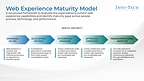
Phase 2: Assess Current State & Readiness – Use a web experience maturity model to evaluate capabilities across people, process, technology, and performance, and identify integration gaps and readiness risks.
Phase 3: Understand Audiences & Experience Priorities – Define priority personas, map end-to-end journeys, and translate organizational goals into structured web experience use cases prioritized by value and feasibility.
Phase 4: Architect & Govern the Ecosystem – Establish architecture principles, design the target-state WEM ecosystem, and define governance structures and operating models that clarify roles, ownership, and decision rights.
Phase 5: Launch, Communicate, & Measure – Develop a phased roadmap aligned to key value drivers, implement performance measurement frameworks, and enable continuous optimization across the web ecosystem.
Info-Tech’s Develop Your Web Experience Management Strategy blueprint is supported by a Web Experience Management Business Case Template and a Web Experience Initiatives Prioritization and Roadmap Planning Tool. These resources are designed to help CIOs and IT leaders build a clear case for modernization, prioritize initiatives based on value and feasibility, and develop phased roadmaps aligned to organizational objectives. By applying this framework and its supporting tools, organizations can strengthen governance, improve cross-functional alignment, and evolve their web ecosystem in a measurable and scalable way.
For exclusive and timely commentary from Info-Tech’s experts, including Hriday Gulrajani, and access to the complete Develop Your Web Experience Management Strategy blueprint, please contact pr@infotech.com.
About Info-Tech Research Group
Info-Tech Research Group is one of the world’s leading and fastest-growing research and advisory firms, serving over 30,000 IT, HR, and marketing professionals around the globe. As a trusted product and service leader, the company delivers unbiased, highly relevant research and industry-leading advisory support to help leaders make strategic, timely, and well-informed decisions. For nearly 30 years, Info-Tech has partnered closely with teams to provide everything they need, from actionable tools to expert guidance, ensuring they deliver measurable results for their organizations.
To learn more about Info-Tech’s HR research and advisory services, visit McLean & Company, and for data-driven software buying insights and vendor evaluations, visit the firm’s SoftwareReviews platform.
Media professionals can register for unrestricted access to research across IT, HR, and software, as well as hundreds of industry analysts through the firm’s Media Insiders program. To gain access, contact pr@infotech.com.
For information about Info-Tech Research Group or to access the latest research, visit infotech.com and connect via LinkedIn and X.
View original content to download multimedia:https://www.prnewswire.com/news-releases/fragmented-web-strategies-leave-organizations-exposed-as-digital-expectations-rise-warns-info-tech-research-group-302834308.html
SOURCE Info-Tech Research Group









 Coin Market5 days ago
 Technology5 days ago
 Technology4 days ago
 Technology5 days ago
 Technology4 days ago

 Technology4 days ago