New York City (101 hours) topped the 2023 Global Traffic Scorecard, followed by Mexico City and London.Americans lost an average of 42 hours to congestion, up 11% from 2022, costing $733 per driver.Midday trips in the U.S. have increased 23% compared to 2019, with nearly as many trips taken at 12:00 PM as there are at 5:00 PM.Trip analysis indicates 10:00 AM to 4:00 PM is the new ‘9-to-5.’The most congested road in America was Orlando’s I-4 Westbound from Beachline Expressway to Western Beltway, followed LA’s I-5, I-95 in Stamford, and New York’s I-278.
KIRKLAND, Wash., June 25, 2024 /PRNewswire/ — Today, INRIX, Inc., a global leader in transportation data and analytics, released the 2023 Global Traffic Scorecard that identified and ranked congestion and commuting trends in nearly 1,000 cities, across 37 countries. New York City once again topped the global ranking, followed by Mexico City and London. U.S. cities held two spots in the top five and four in the top 10.
“Traffic congestion is both a bane and a barometer of economic health; it symbolizes bustling activity yet simultaneously hampers it,” said Bob Pishue, transportation analyst at INRIX. “Reflecting on 2023 and early 2024, the surge in traffic congestion in urban areas indicated a revival of economic hubbub post-COVID, but it also led to billions of dollars in lost time for drivers.” Despite signs of recovery, though, some aspects of the pandemic are sticking around. Pishue continued, “Although congestion is returning to pre-COVID levels, we’re seeing interesting changes in congestion patterns due to the lingering effects of the pandemic. The continuation of hybrid and remote work is creating new travel peaks from what we’ve seen previously.”
America’s Gridlock is Worse Than Ever
New York City is followed by Chicago (96 hours) and Los Angeles (89 hours) as the most congested cities in the United States. This is New York City’s second year in the top spot, despite a 4% reduction in overall congestion. The typical U.S. driver lost 42 hours to traffic congestion and lost $733 worth of time, up nearly $100 from last year.
Table 1: 10 Most Congested Urban Areas in the U.S.
2023 US
Rank
(2022
Rank)
Urban Area
2023
Delay
(2022)
Compared
to
Pre-
COVID
2023
Cost per
Driver
2023
Cost
per
City
Downtown
Speed
(mph)
Q1 2024
vs Q1
2023
1 (1)
New York City, NY
101 (105)
11 %
$1,762
$9.1 B
11
-11 %
2 (2)
Chicago, IL
96 (87)
18 %
$1,672
$6.1 B
11
-8 %
3 (3)
Los Angeles, CA
89 (78)
-4 %
$1,545
$8.3 B
19
-5 %
4 (4)
Boston, MA
88 (78)
-1 %
$1,543
$2.9 B
10
-10 %
5 (6)
Miami, FL
70 (66)
18 %
$1,219
$3.1 B
14
-1 %
6 (5)
Philadelphia, PA
69 (67)
2 %
$1,209
$2.9 B
11
-9 %
7 (8)
Washington, DC
63 (52)
-9 %
$1,095
$2.7 B
11
-4 %
8 (7)
Houston, TX
62 (55)
1 %
$1,082
$3.2 B
17
-1 %
9 (9)
Atlanta, GA
61 (51)
-3 %
$1,066
$2.6 B
16
-4 %
10 (12)
Seattle, WA
58 (46)
-11 %
$1,010
$1.6 B
17
-1 %
In addition to being the most congested urban area, New York City saw a staggering 13% increase in downtown trips in 2023 compared to 2022, followed by Atlanta, Philadelphia, and Washington D.C. (7%). Nine out of 10 of the United States’ largest metros saw a year-over-year increase in downtown trips. Trip analysis also revealed the traditional 9-to-5 workday has transformed into to a new 10-to-4 schedule. The shift in off-peak commuting and workday hours are likely fueled by the continued prevalence of remote and hybrid work.
A New Midday Rush Hour
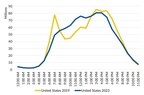
The uptick in congestion comes alongside the emergence of a new phenomenon: the midday rush hour. As Graph 1 illustrates, morning hourly commute trips in 2023 were down about 12% compared to 2019 and the PM peak (3-6 PM) was down just 9%. However, average hourly traffic during the midday was up an astonishing 23%, a trend that has continued to remain since 2020.
Overall, the data shows that per hour, nearly the same number of trips start during the midday as the evening commute period, typically the most congested period of the day.
The Most Congested Corridors in the U.S.
Across the United States, traffic delays on the busiest corridors have generally improved since 2022. Notably, the highest peak delay in 2023 was 2.5 hours less than the peak delay in 2022. A striking example of changing patterns is the I-4 in Orlando, Florida, which surged from 10th place in 2022 to the top in 2023. During peak hours, drivers lost 31 minutes on the I-4 westbound, on par with Los Angeles’ notorious I-5 congestion.
In Stamford, Connecticut, the I-95 corridor demonstrated significant congestion in both directions, earning it the third and fourth spots on the list of most congested U.S. corridors. Northbound travelers on the 30-mile stretch of I-95 lost an average of 29 minutes daily, while those heading southbound faced a slightly lower but still substantial delay of 28 minutes each day.
Table 1: 10 Most Congested U.S. Roads in 2023
Rank
Urban Area
Road Name
From
To
Peak Hour
2023 Peak
Minutes
Lost
2023
Hours
Lost
1
Orlando, FL
I-4 W
Beachline Expy
Western Bltwy
5:00 PM
31
124
2
Los Angeles, CA
I-5 S
I-10
I-605
5:00 PM
31
122
3
Stamford, CT
I-95 N
Sherwood Isl Conn
Warren St
4:00 PM
29
116
4
Stamford, CT
I-95 S
Compo Road S
Indian Field Rd
8:00 AM
28
111
5
New York, NY
I-278 W
I-495
Tillary St
4:00 PM
21
82
6
Miami, FL
I-95 N
NW 46th St
NW 151st St
5:00 PM
20
82
7
Boston, MA
I-93 S
Zakim Bridge
Pilgrim’s Hwy
3:00 PM
20
81
8
Baton Rouge, LA
I-10 E
N Lobdell Hwy
I-12
4:00 PM
17
70
9
Stamford, CT
I-95 N
Indian Field Rd
Compo Road S
5:00 PM
17
68
10
Chicago, IL
I-94 E
I-290
I-57
4:00 PM
17
66
Congestion Climbs Worldwide
New York, Mexico City, London, Paris, and Chicago were the top five most congested urban areas in the Global Congestion Impact Ranking. Out of the top 100 ranked urban areas, 98 experienced more delay than in 2022, and in 71 areas, that delay grew by more than 10%. Just under half, however, have reached their 2019, pre-COVID level of delay.
Table 2: 10 Most Congested Cities in the World in 2023
2023
Impact
Rank
(2022 Rank)
Urban Area
Country
2023 Delay
per Driver
(hours)
Change from
2022
Change
from Pre-
COVID
Downtown
Speed (mph)
Q1
2024
Change
1 (1)
New York City,
NY
USA
101
-4 %
11 %
11
-11 %
2 (4)
Mexico City
MEX
96
13 %
-11 %
12
-5 %
3 (2)
London
UK
99
2 %
3 %
10
-10 %
4 (3)
Paris
FRA
97
4 %
1 %
10
-3 %
5 (5)
Chicago IL
USA
96
10 %
18 %
11
-8 %
6 (6)
Istanbul
TUR
91
12 %
20 %
13
5 %
7 (7)
Los Angeles CA
USA
89
13 %
-4 %
19
-5 %
8 (8)
Boston MA
USA
88
14 %
-1 %
10
-10 %
9 (13)
Cape Town
ZAF
83
32 %
-10 %
12
7 %
10 (16)
Jakarta
IDN
65
33 %
-24 %
13
16 %
The Road to Combatting Congestion
Access to reliable data is the first step in tackling congestion. Applying big data to create intelligent transportation systems is key to solving urban mobility problems. INRIX data and analytics on mobility, traffic signals, parking and population movement help city planners and engineers make data-based decisions to prioritize spending to maximize benefits and reduce costs now and into the future.
The key findings of the INRIX 2023 Global Traffic Scorecard provide a quantifiable benchmark for governments and cities across the world to measure progress to improve urban mobility and track the impact of spending on smart city initiatives.
Please visit www.inrix.com/scorecard for:
Full 2023 Global Traffic Scorecard reportInteractive webpage with data and information for nearly 1,000 cities and 37 countriesComplete methodology
Notes to Editors:
Data Sources
INRIX aggregates anonymous data from diverse datasets – such as phones, cars, trucks and cities – that leads to robust and accurate insights. The data used in the 2023 Global Traffic Scorecard is the congested or uncongested status of every segment of road for every minute of the day, as used by millions of drivers around the world that rely on INRIX-based traffic services.
Data used to complete the 2023 Scorecard and Q1 Update spans more than 15 months. The Scorecard incorporated three years of historical data to provide a complete year-over-year comparison of congestion and mobility. A multi-year approach enables the identification of trends in the world’s largest urban areas and provides a basis for comparison.
Research Methodology
The 2023 Global Traffic Scorecard provides the most up-to-date methodology to better understand movement in urban areas across the world. The 2023 Scorecard continues to include travel delay comparisons, collision trends and last-mile speeds based on the unique commuting patterns within each metro area, yet the latest origin-and-destination patterns accommodate the latest commuting behavior shifts.
Commute times were calculated by looking exclusively at the time it takes to get to and from major employment centers within an urban area from surrounding commuting neighborhoods. Our newest methodology, updated for this Scorecard, more accurately estimates commute distance using actual, observed trips. In general, this has placed downward pressure on commuting delays versus prior Scorecards, as observed trips tended to be shorter than previously estimated.
These changes were run for the years 2019, 2022 and 2023, along with the Q1 Update provided in this document. Q1 update is a special update for this version of the Global Traffic Scorecard and measures the change in average peak period travel times between January-March 2024 and January-March 2023.
Economic costs are calculated based on the following hourly values of time, which were based on U.S. Federal Highway Administration’s Revised Departmental Guidance on Valuation of Travel Time for Economic Analysis, 2016. Adjusted for inflation, the rates are the following: $17.45 per hour in the U.S., £9.12 per hour in the U.K. and 10.67 € per hour in Germany. Individual urban areas may have higher, or lower, values of time depending on local economic conditions.
The 2023 Scorecard values time lost by analyzing peak speed and free-flow speed data for the busiest commuting corridors and sub areas as identified by origin and destination patterns unique to that area. Total time lost is the difference in travel times experienced during the peak periods compared to free-flow conditions on a per driver basis. In other words, it is the difference between driving during commute hours versus driving at night with little traffic.
About INRIX
Founded in 2004, INRIX pioneered intelligent mobility solutions by transforming big data from connected devices and vehicles into mobility insights. For nearly two decades, INRIX has harnessed machine learning and artificial intelligence to deliver precise and actionable mobility data. This revolutionary approach enabled INRIX to become one of the leading providers of data and analytics into how people move. By empowering cities, businesses, and people with valuable insights, INRIX is helping to make the world smarter, safer, and greener. With partners and solutions spanning across the entire mobility ecosystem, INRIX is uniquely positioned at the intersection of technology and transportation – whether its keeping road users safe, improving traffic signal timing to reduce delay and greenhouse gasses, optimizing last-mile delivery, or helping uncover market insights. Learn more at INRIX.com.
View original content to download multimedia:https://www.prnewswire.com/news-releases/inrix-remote-and-hybrid-work-shift-cant-curb-congestion-302181067.html
SOURCE INRIX, Inc.










 Technology4 days ago
 Technology4 days ago
 Technology4 days ago
 Technology1 day ago
 Technology4 days ago
 Coin Market4 days ago

 Technology5 days ago