Connect with us

Technology

Artificial Intelligence (AI) Chips Market size is set to grow by USD 389.25 billion from 2024-2028, Increasing adoption of AI chips in data centers to boost the market growth, Technavio

Published

on

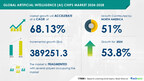
NEW YORK, July 9, 2024 /PRNewswire/ — The global artificial intelligence (AI) chips market is estimated to grow by USD 389.25 billion from 2024-2028, at a CAGR of over 68.13%, according to Technavio. Increasing adoption of AI chips in data centers and the convergence of AI and IoT are driving market growth. However, a dearth of technically skilled workers poses a challenge. Key players include Advanced Micro Devices Inc., Alphabet Inc., Baidu Inc., Broadcom Inc., Cerebras, Fujitsu Ltd., Graphcore Ltd., Huawei Technologies Co. Ltd., Intel Corp., and NVIDIA Corp., the leader in the AI chip market.

Get a detailed analysis on regions, market segments, customer landscape, and companies – Click for the snapshot of this report

Forecast period

2024-2028

Base Year

2023

Historic Data

2018 – 2022

Segment Covered

Product (ASICs, GPUs, CPUs, and FPGAs), End-user (Media and advertising, BFSI, IT and telecommunication, and Others), and Geography (North America, Europe, APAC, South America, and Middle East and Africa)

Region Covered

North America, Europe, APAC, South America, and Middle East and Africa

Key companies profiled

Advanced Micro Devices Inc., Alphabet Inc., Baidu Inc., Broadcom Inc., Cerebras, Fujitsu Ltd., Graphcore Ltd., Huawei Technologies Co. Ltd., Intel Corp., International Business Machines Corp., MediaTek Inc., Microchip Technology Inc., NVIDIA Corp., NXP Semiconductors NV, Qualcomm Inc., SambaNova Systems Inc., Samsung Electronics Co. Ltd., SenseTime Group Inc., Taiwan Semiconductor Manufacturing Co. Ltd., and Tesla Inc.

Key Market Trends Fueling Growth

The Internet of Things (IoT) market is experiencing significant growth due to the numerous advantages it offers in various industries, including aerospace and defense, automotive, consumer electronics, healthcare, and others. IoT devices, which include cameras, drones, smart speakers, smartphones, smart TVs, and more, are increasingly integrating Human-Machine Interface (HMI) technologies. This integration leads to the deployment of Artificial Intelligence (AI) chips in IoT devices, enabling power-efficient data processing and machine learning computation. The demand for IoT devices is escalating due to the focus on smart city projects and automation in homes and enterprises. Market players are collaborating to develop software and hardware solutions to integrate AI technology in IoT devices, driving the growth of the AI chips market in the forecast period. 

Artificial Intelligence (AI) chips are making waves in various industries by powering innovative applications in personalized health and treatment devices for the elderly population. Machine Learning (ML) and Deep Learning (DL) are driving this trend, with computer vision technologies like pose detection and behavioral pattern recognition becoming increasingly important. Structured data from IoT devices, Industry 4.0 manufacturing, wearable devices, smart homes, and connected cars are fueling this growth. AI chips are being integrated into processors, GPUs, FPGAs, CPUs, ASICs, DSPs, microcontrollers, and programmable logic chips to handle the demands of AI applications. These chips enable high-quality images, animations, and videos in mobile phones, embedded systems, personal computers, gaming consoles, and more. The theoretical and algorithmic basis of AI is being transformed by automatic analysis, extraction, and estimation of single images and sequences of images. 

Discover 360° analysis of this market. For complete information, schedule your consultation- Book Here!

Market Challenges

The AI chips market is witnessing significant growth due to the potential revenue benefits that companies can derive from investing in artificial intelligence. However, the implementation of AI comes with challenges, particularly the shortage of skilled workers with expertise in AI technology. This talent gap poses a major obstacle for enterprises seeking to integrate AI into their operations. The high R&D costs associated with AI and the lack of available talent are hindering the growth of the market. To overcome this hurdle, organizations must prioritize talent acquisition and retention, recruiting professionals with strong technical backgrounds and investing in skill development programs. The shortage of AI engineers and technicians is hindering the deployment of AI in enterprises, thereby limiting market growth during the forecast period.The Artificial Intelligence (AI) Chips Market is experiencing significant growth due to the increasing demand for energy-efficient solutions for AI applications in various industries such as healthcare, retail, finance, automotive, and IoT devices. Companies like Nvidia and Huawei are leading the market with their AI chip lines, including the Nvidia A100 chip and Huawei Ascend 910B chipset. However, challenges such as energy efficiency, latency, and ethical concerns remain. Centralized cloud servers from Microsoft Azure, Amazon Web Services, Google Cloud, and Oracle Cloud Infrastructure offer high computing power but face challenges with real-time applications and big data processing. Edge computing and Edge devices are gaining popularity for their ability to process data locally, reducing latency and improving performance. Patent filing and system failure are also concerns for companies investing in AI chips. Specific integrated circuits like CPU, FPGA, GPU, and system on chip, multichip module, and high computing parallel computing are essential for AI data centers, cognitive computing, machine intelligence, image recognition, and other AI applications. Ethical concerns around AI use in mobile applications, health monitoring, and health information access are becoming increasingly important. The market for AI chips is expected to continue growing, with continued innovation and investment in this area.

For more insights on driver and challenges – Download a Sample Report

Segment Overview 

This artificial intelligence (AI) chips market report extensively covers market segmentation by

Product 1.1 ASICs1.2 GPUs1.3 CPUs1.4 FPGAsEnd-user 2.1 Media and advertising2.2 BFSI2.3 IT and Telecommunication2.4 OthersGeography 3.1 North America3.2 Europe3.3 APAC3.4 South America3.5 Middle East and Africa

1.1 ASICs-  Artificial Intelligence (AI) chips, specifically Application-Specific Integrated Circuits (ASICs), are driving innovation in the tech industry. ASICs are customized, non-configurable chips that offer faster performance than GPUs and FPGAs for parallel algorithms. Their use in cloud-based data centers is increasing, as ASIC-based AI chips, like Google’s Tensor Processing Unit (TPU), provide superior speed and efficiency. TPUs, a network of software and hardware, are designed for deep neural networks and can learn specific tasks with large data sets. Data centers are integrating these ASICs into servers to manage data effectively. TPUs have an instruction set that allows TensorFlow programs to be modified, enabling new algorithms to be developed. As an open-source machine learning library, TensorFlow’s data flow graph structure simplifies complex computations, making ASICs a preferred choice for AI applications. The market for ASIC-based AI chips is expected to grow significantly due to their performance advantages.

For more information on market segmentation with geographical analysis including forecast (2024-2028) and historic data (2018 – 2022)  – Download a Sample Report

Research Analysis

Artificial Intelligence (AI) Chips Market: The global AI Chips Market is experiencing significant growth due to the increasing adoption of AI technologies in various industries. Deep learning and machine learning algorithms require specialized hardware components, leading to the development of AI chips. These chips are designed to accelerate AI workloads and improve the performance of AI applications. AI chips include specific integrated circuits like CPUs, GPUs, FPGAs, and system on chips. Quantum computing is also emerging as a potential technology to enhance AI capabilities. The market for AI chips is expanding across sectors such as healthcare, retail, finance, automotive, autonomous vehicles, IoT devices, and more. However, ethical concerns surrounding AI and its impact on jobs are raising questions about the future of this technology. High bandwidth memory and Trainium2 chip are some of the advanced hardware components driving the market. The market is segmented into cloud and edge computing, with the edge computing segment expected to grow due to the increasing demand for real-time AI processing.

Market Research Overview

Artificial Intelligence (AI) Chips Market: An Overview The AI Chips Market is witnessing significant growth due to the increasing demand for advanced AI technologies, such as deep learning and machine learning, in various industries. AI chips are specialized hardware components designed to accelerate AI algorithms and technologies, including neural networks, quantum computing, and cognitive computing. These chips are essential for powering AI applications in robotics, computer vision, natural language processing, and generative AI. The market for AI chips includes a range of hardware components, such as CPUs, GPUs, FPGAs, and system on chips, each with unique advantages in terms of energy efficiency, parallel computing, and high computing power. Major applications of AI chips include data processing in centralized cloud servers and edge devices, real-time applications, big data analysis, and AI applications in healthcare, retail, finance, automotive, and IoT devices. Ethical concerns surrounding AI technologies and potential system failures or malfunctioning are also driving the development of more energy-efficient and reliable AI chips. Some of the emerging trends in the AI Chips Market include the development of AI chip lines, such as Nvidia’s A100 chip and Ascend 910B chipset, and H200 chipset, as well as the integration of high bandwidth memory and quantum computing technologies. The market is also witnessing the growth of edge computing and the increasing use of AI in industries such as manufacturing, wearable devices, smart homes, and connected cars. In conclusion, the AI Chips Market is a dynamic and rapidly evolving field, driven by the increasing demand for AI technologies in various industries and the need for more energy-efficient and reliable hardware components. The market is expected to continue growing in the coming years, with new innovations and applications emerging in areas such as healthcare, finance, and autonomous vehicles.

Table of Contents:

1 Executive Summary
2 Market Landscape
3 Market Sizing
4 Historic Market Size
5 Five Forces Analysis
6 Market Segmentation

ProductASICsGPUsCPUsFPGAsEnd-userMedia And AdvertisingBFSIIT And TelecommunicationOthersGeographyNorth AmericaEuropeAPACSouth AmericaMiddle East And Africa

7 Customer Landscape
8 Geographic Landscape
9 Drivers, Challenges, and Trends
10 Company Landscape
11 Company Analysis
12 Appendix

About Technavio

Technavio is a leading global technology research and advisory company. Their research and analysis focuses on emerging market trends and provides actionable insights to help businesses identify market opportunities and develop effective strategies to optimize their market positions.

With over 500 specialized analysts, Technavio’s report library consists of more than 17,000 reports and counting, covering 800 technologies, spanning across 50 countries. Their client base consists of enterprises of all sizes, including more than 100 Fortune 500 companies. This growing client base relies on Technavio’s comprehensive coverage, extensive research, and actionable market insights to identify opportunities in existing and potential markets and assess their competitive positions within changing market scenarios.

Contacts

Technavio Research
Jesse Maida
Media & Marketing Executive
US: +1 844 364 1100
UK: +44 203 893 3200
Email: media@technavio.com
Website: www.technavio.com/

View original content to download multimedia:https://www.prnewswire.com/news-releases/artificial-intelligence-ai-chips-market-size-is-set-to-grow-by-usd-389-25-billion-from-2024-2028–increasing-adoption-of-ai-chips-in-data-centers-to-boost-the-market-growth-technavio-302191673.html

SOURCE Technavio

Continue Reading
Click to comment

Leave a Reply

Your email address will not be published. Required fields are marked *

Technology

Sokin and Adyen Partner to Give US Businesses a Single Solution for Ecommerce Payments and Treasury Operations

Published

on

By

The partnership will provide Sokin clients with advanced global payment acceptance capabilities, combined with multi-currency accounts, FX, and treasuryTogether, Sokin and Adyen will support Sokin clients across the world, including US, Canada, UK, mainland Europe, UAE, Singapore and Australia

NEW YORK, April 29, 2026 /PRNewswire/ — Sokin, the cross-border business payments and financial platform, today announced a strategic global partnership with Adyen, the global financial technology platform of choice for leading businesses. The partnership adds global payment acceptance to Sokin’s existing multi-currency accounts, FX, and treasury infrastructure, giving businesses a single platform to manage their entire cross-border financial stack.

The offering, now live in the US, will also support clients across Canada, UK, mainland Europe, UAE, Singapore and Australia. Businesses can accept payments through Sokin’s checkout and payment links functionality across more than 35 payment methods, over 170 countries and territories, and charge and settle in multiple currencies.

Most businesses operating internationally run their payment acceptance and their treasury operations on different platforms. That creates reconciliation overhead, high FX costs, and gaps in visibility that compound as transaction volumes grow. The Sokin and Adyen partnership removes that split, unifying payment acceptance with treasury management in a single platform. In an agentic environment, where AI needs to decide, approve, execute, and settle within a single programmable infrastructure, a fragmented payments infrastructure is a structural barrier.

“Businesses growing internationally have always had to stitch together multiple providers just to manage the basics of getting paid and paying out. This partnership closes that gap. One platform, one relationship, one view of your entire cross-border stack. That matters more than ever as AI becomes part of how finance teams actually work,” said Vroon Modgill, founder and CEO of Sokin.

“Expanding into new markets always brings complexity around how businesses can accept and optimise local payments. By partnering with Sokin, we’re helping to remove those barriers and give growing businesses the ability to scale internationally with the confidence that their payment experience is built to perform in every market,” said Adrian Davis, Managing Director Financial Services & Insurance at Adyen. “Through our global network and data-driven insights, our partnership with Sokin will help global businesses continuously optimise how they accept payments, meeting their customers wherever they are.”

The partnership launches as Sokin continues a period of significant growth. The company has grown revenues more than eightfold since 2022, closed a Series B funding round in late 2025, and secured a $100 million debt facility in January 2026. Sokin launched its stablecoin capabilities in March 2026, creating a unified finance platform for digital assets and traditional currencies. The company is backed by Morgan Stanley Expansion Capital, Prysm Capital and counts PayPal veterans among its board and investor group.

About Sokin

Sokin was founded in 2019 with a simple vision to remove borders, barriers and burdens associated with international payments. Today it enables global businesses to send and exchange more than 70 currencies and hold balances in 26 currencies with its multi-currency IBAN and local currency accounts — all through one comprehensive platform that streamlines cross-border accounts payable, receivable, and treasury operations. Headquartered in the United Kingdom, the company has offices in the United States, Canada, United Arab Emirates, Singapore, Mexico, Norway and India. For more information, visit www.sokin.com.

About Adyen

Adyen (AMS: ADYEN) is the financial technology platform of choice for leading companies. By providing end-to-end payments capabilities, data-driven insights, and financial products in a single global solution, Adyen helps businesses achieve their ambitions faster. With offices around the world, Adyen works with the likes of Meta, Uber, H&M, eBay, and Microsoft. The cooperation with Sokin as described in this merchant update underlines Adyen’s continuous growth with existing and new customers over the years.

Media Contact

James Hannaford
Chief Growth Officer
James.hanaford@sokin.com

View original content to download multimedia:https://www.prnewswire.com/news-releases/sokin-and-adyen-partner-to-give-us-businesses-a-single-solution-for-ecommerce-payments-and-treasury-operations-302756603.html

SOURCE Sokin

Continue Reading

Technology

VERSABANK ANNOUNCES INDUSTRY BREAKTHROUGH INNOVATION IN POINT-OF-SALE FINANCING WITH START OF PILOT PROGRAM FOR AI-ENABLED REAL-TIME STRUCTURED RECEIVABLE PROGRAM

Published

on

By

– Industry First Real-Time SRP Capability Significantly Expands VersaBank’s Addressable Point-of-Sale Market in Both Canada and United States; Provides Immediate Economic Benefit to Existing Partners –

– Real-Time Funding Capability Significantly Strengthens Bank’s Competitive Advantage by Providing Immediate Incremental Economic Benefit to Existing Partners –

LONDON, ON, April 29, 2026 /CNW/ – VersaBank (TSX: VBNK) (NASDAQ: VBNK) (“VersaBank” or the “Bank”) a North American leader in business-to-business digital banking, as well as technology solutions for cybersecurity, today announced it has commenced a pilot program with one of its major Structured Receivable Program partner, FinanceIt Canada Inc. (“FinanceIt”), for the Bank’s new Real-Time Structured Receivable Program (“Real-Time SRP”) (the “Pilot Program”). The purpose of the Pilot Program is to demonstrate the functionality and operational integrity of the Real-Time SRP in a limited-scale, real-world scenario to refine the solution for full implementation by FinanceIt and simultaneous roll out to all VersaBank’s current and prospective SRP partners in both Canada and the United States.

VersaBank’s Real-Time SRP is a breakthrough innovation in point-of-sale financing, providing the same reliable, economically attractive funding solution as the Bank’s existing SRP, with the additional benefit of eliminating the need for SRP partners to warehouse multiple receivables over a period of time (typically from five to 30 or more days). This enables the Bank’s SRP partners to finance individual loans within just hours, reducing the overall financing cost and the need for warehouse financing. It also further strengthens VersaBank’s exceptional risk mitigation capabilities by enabling the Bank to better leverage its own, internal AI platform through evaluation of the partner loans underlying the SRP receivables on an individual basis.

“VersaBank’s Real-Time Structured Receivable Program takes our unique and highly successful digital point-of-sale financing solution to a whole new level, further extending our competitive advantage and, more importantly, significantly expanding the addressable market for our SRP on both sides of the border,” said David Taylor, Founder and President, VersaBank. “In Canada, we expect the launch of our Real-Time SRP to enable us to win additional financing business with our existing partners while enabling us to acquire new partners with more specialized financing needs that we were previously unable to address. In the United States, where our current SRP has been very well received by the point-of-sale industry and demand is exceeding our expectations, the addition of real-time capability will enable us to further capture market share from securitized financing providers, expanding our growth potential there.”

Mr. Taylor continued, “Our Real-Time SRP is yet another in our long track record of firsts in the banking industry. We are, as we always have been, as much a software and technology company as we are a national, federally licensed bank. The Real-Time SRP is the result of our relentless pursuit of continuous innovation to address underserved markets in the banking industry based on our internally developed, proprietary core banking software, which is now being supercharged by the addition of our own AI technology.”

“We are especially proud to be bringing this cutting-edge innovation to this time in support of both the Canadian Federal Government’s and the Office of the Superintendent of Financial Institutions’ stated desire to support the economic activity of both small business and consumers.”

“VersaBank’s Real-Time SRP is a game changer. The ability to instantly finance individual loans significantly enhances the efficiency and economics of our long-standing strategic relationship with VersaBank and is aligned with our own long term innovation objectives.” said Casper Wong, CEO of FinanceIt. “For more than a decade, VersaBank’s Structured Receivable Program has been foundational to our growth and success. We look forward to the significant additional benefits that the Real-Time SRP will generate for our business.”

ABOUT VERSABANK’S STRUCTURED RECEIVABLE PROGRAM

VersaBank’s Structured Receivable Program (“SRP”) is an innovative and highly attractive digital funding solution for finance companies that lend money to consumers and small businesses for what are typically “big ticket” purchases (e.g. consumer home improvement/HVAC projects and a wide variety of commercial equipment). It was specifically designed to address an unmet need in the market for consistently available, readily accessible financing with economically attractive capital designed to maximize return on equity while employing VersaBank’s proprietary, state-of-the-art banking technology.

As of January 31, 2026, VersaBank’s SRP portfolio exceeded CAD$4.4 billion (US$3.2 billion) and has grown at a compounded annual rate of 33% over the last five years. The Bank’s SRP was launched into the United States in late fiscal 2024 and completed US$310 million in fundings in its first year, surpassing the Bank’s first year target of US$290 million. Since VersaBank’s RPP was first launched 2010, the Bank has provided more than CAD$14 billion (US$10 billion) in funding to North American financing companies. The SRP is designed to provide scalable, capital‑efficient growth for the Bank with strong credit performance and attractive risk‑adjusted returns.

ABOUT VERSABANK

VersaBank is a North American bank with a difference. Federally chartered in both Canada and the U.S., VersaBank has a branchless, digital, business-to-business model based on its proprietary state-of-the-art technology that enables it to profitably address underserved segments of the banking industry in a significantly risk mitigated manner. Because VersaBank obtains substantially all of its deposits and undertakes the majority of its funding activities electronically through financial intermediary partners, it benefits from significant operating leverage that drives efficiency and return on common equity. In August 2024, VersaBank launched its unique Structured Receivable Program funding solution for point-of-sale finance companies, which has been highly successful in Canada for over 15 years, to the underserved multi-trillion-dollar U.S. market. VersaBank also owns Minnesota-based DRT Cyber Inc., a North American leader in the provision of cyber security services to address the rapidly growing volume of cyber threats challenging financial institutions, multi-national corporations and government entities. Through DRT Cyber Inc., VersaBank owns proprietary intellectual property and technology to enable the next generation of digital assets for the banking and financial community, including the Bank’s revolutionary and proprietary Real Bank Tokenized DepositsTM.

VersaBank’s common shares trade on the Toronto Stock Exchange and NASDAQ under the symbol VBNK.

Visit our website at: www.versabank.com

Follow VersaBank on Facebook, Instagram, LinkedIn and X.

View original content to download multimedia:https://www.prnewswire.com/news-releases/versabank-announces-industry-breakthrough-innovation-in-point-of-sale-financing-with-start-of-pilot-program-for-ai-enabled-real-time-structured-receivable-program-302757090.html

SOURCE VersaBank

Continue Reading

Technology

LTS Expands CDMO Portfolio with Ophthalmic Drug Delivery Solutions

Published

on

By

ANDERNACH, Germany, April 29, 2026 /PRNewswire/ — LTS LOHMANN Therapie-Systeme AG (“LTS”), a leading pharmaceutical technology company specializing in advanced drug delivery systems, today announced the expansion of its service portfolio to include CDMO services for ophthalmic drug delivery solutions, with manufacturing capacities located in the United States at LTS’ Lakewood, New Jersey facility.

The new offering focuses initially on product development through clinical manufacturing of sterile ophthalmic products, filled in preservative–free multidose devices. Leveraging its established commercial aseptic manufacturing capabilities in nasal sprays and vials, LTS is well positioned to meet the high quality and regulatory demands of ophthalmic treatments, including products for chronic and acute eye conditions.

Building on decades of experience in drug delivery technologies, LTS ultimately plans to offer end–to–end CDMO services for ophthalmic drug products, ranging from formulation development through commercial manufacturing. All activities will be conducted in compliance with global regulatory standards, supporting both U.S. and international market requirements.

“Ophthalmic drug delivery presents unique challenges in terms of sterility, efficacy, and patient safety,” said Bas van Buijtenen, CEO at LTS. “Our aseptic manufacturing capabilities in Lakewood, are the perfect foundation to build industry-leading CDMO capabilities and capacity for ophthalmics, powering the future of drug delivery in this field in North America. We look forward to extending our purpose – We CARE. We CREATE. We DELIVER -towards an even wider group of customers, therapies and patients.”

The expanded CDMO services are intended to support pharmaceutical and biotech companies seeking a reliable U.S.-based manufacturing partner for ophthalmic drug delivery solutions. By combining development expertise, sterile manufacturing infrastructure, and a strong quality culture, LTS aims to act as a long–term partner across the entire product lifecycle.

This portfolio expansion reflects LTS’s strategic commitment to continuously broaden its technology and service offerings and to address growing demand for specialized drug delivery solutions in sensitive therapeutic areas.

About LTS Lohmann Therapie-Systeme AG
At LTS, our purpose drives everything we do: We CARE for patients, our partners, employees and communities, we CREATE innovative drug delivery solutions, and we DELIVER high-quality products to global markets with an exceptional track record in commercial manufacturing. As a global CDMO, we offer end-to-end development and manufacturing services for pharmaceutical and biotech companies.

Our technology portfolio spans transdermal patches, oral thin films, nasal and sterile drug delivery products, wearable drug delivery devices as well as microneedle array patches. With over 40 commercial products and 50+ active development programs, we combine deep expertise with patient-centric innovation to advance small molecules, biologics, and vaccines.
Operating from five global sites in the US, Germany and Israel and a representative office in China, LTS powers the future of drug delivery.

For further information, please contact:

LTS Lohmann Therapie-Systeme AG
Dr Iris Schnitzler: iris.schnitzler@ltslohmann.com
+492632-992589

SOURCE LTS Lohmann Therapie-Systeme AG

Continue Reading

Trending