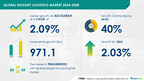
NEW YORK, July 10, 2024 /PRNewswire/ — The global military logistics market is projected to expand by USD 971.1 million from 2024 to 2028, growing at a CAGR of 2.09%. This growth is fueled by increasing demand for international peacekeeping operations and the globalization of military activities. However, challenges such as growing regulatory compliance related to logistics are noted. Key players in the market include AECOM, Agility Public Warehousing Co. K.S.C.P, BAE Systems Plc, Lockheed Martin Corp., and others. Regions expected to experience significant growth in military logistics include North America, Europe, and the Asia-Pacific, driven by geopolitical tensions and defense modernization efforts.
Get a detailed analysis on regions, market segments, customer landscape, and companies – Click for the snapshot of this report
Forecast period
2024-2028
Base Year
2023
Historic Data
2018 – 2022
Segment Covered
End-user (Army, Navy, and Airforce), Type (Logistics and distribution, Facility management, and Services), and Geography (North America, Europe, APAC, South America, and Middle East and Africa)
Region Covered
North America, Europe, APAC, South America, and Middle East and Africa
Key companies profiled
AECOM, Agility Public Warehousing Co. K.S.C.P, Amentum Services Inc., Anham Fzco LLC, BAE Systems Plc, CACI International Inc., CLAXTON LOGISTICS SERVICES LLC, CMA CGM SA Group, Colak Group, Crane Worldwide Logistics, Crowley Maritime Corp., Fluor Corp., General Dynamics Corp., KBR Inc., Lockheed Martin Corp., ManTech International Corp., One Network Enterprises Inc., SEKO Logistics, Thales Group, and Wincanton Plc
Key Market Trends Fueling Growth
The military logistics market has witnessed a notable growth trend due to the increasing globalization of military operations. Over the past decade, there has been a rising trend towards multinational military collaborations to tackle common security concerns. This was evident during military interventions in Afghanistan and the subsequent withdrawal, where logistics played a pivotal role. Furthermore, the ongoing fight against terrorism and extremism has led to multinational military operations in various global regions, such as the G5 Sahel Joint Force in Africa. This globalization trend is driving demand for military logistics services that can operate across multiple regions and countries. Companies with international experience and cultural understanding, as well as those with a global presence, are well-positioned to meet this demand. As a result, the global military logistics market is expected to experience significant growth due to the increasing globalization of military operations.
Military logistics plays a crucial role in ensuring the timely support and upkeep of armed forces during conflicts and natural disasters. This market involves planning, coordinating, and executing the movement and supply of resources, including troops, maintenance, and operational capabilities. Key trends include integration of artificial intelligence for situational awareness and tracking systems, expansion of automation in maritime, air, and land transportation, and the use of new technology in combat support, such as biofuel and power-generating capabilities. Market categories include logistics and distribution, facility management, medical services, and more. Military logistics applications require portability, reliability, and the ability to adapt to various conflict and disaster scenarios. The market is constantly evolving, with a focus on improving operational capabilities and deployment efficiency.
Discover 360° analysis of this market. For complete information, schedule your consultation- Book Here!
Market Challenges
• The global military logistics market faces significant challenges due to complex regulatory requirements. Export control regulations vary by country and region, restricting the export of sensitive military equipment, technologies, and software. Customs regulations add to the complexity, necessitating detailed documentation and compliance with procedures. Logistics companies must also adhere to various national and international laws, including labor, environmental, and anti-corruption laws. These regulations increase operational costs and require robust compliance programs and risk management strategies. According to reports by the World Customs Organization and the Financial Times, regulatory compliance costs have risen sharply in recent years, posing a potential challenge to the growth of the global military logistics market.
• The Military Logistics Market faces numerous challenges in supporting military activities. With increasing military spending worldwide, there is a growing demand for efficient and effective logistics solutions. Communication networks must remain secure against cyber threats, while environmental impacts call for the adoption of eco-friendly technologies and energy-efficient transport. Budget constraints and geopolitical tensions create uncertainties, leading to disrupted supply chains. Technological proliferation brings advanced technologies like drones, automation, IoT, and blockchain into play. Delivery time is critical on the battlefield, requiring agile and connected logistics systems. Military personnel and supplies must be transported via airways, seaways, and land ways, with air transport being a priority for rapid response. Conflicts and emergencies necessitate strategic collaborations and defense sector partnerships. Military organizations must navigate these challenges to provide essential logistic service offerings and ensure the acquisition of armaments and supplies for their forces.
For more insights on driver and challenges – Download a Sample Report
Segment Overview
This military logistics market report extensively covers market segmentation by
End-user 1.1 Army1.2 Navy1.3 AirforceType 2.1 Logistics and distribution2.2 Facility management2.3 ServicesGeography 3.1 North America3.2 Europe3.3 APAC3.4 South America3.5 Middle East and Africa
1.1 Army- The military logistics market’s army segment involves three distinct military supply chains. The first chain focuses on the swift transportation of light commodities like food, medicine, and clothing. The second chain handles the movement and maintenance of major weapon systems over an extended period. Lastly, the deployment chain facilitates the quick movement of large troop bodies in a short timeframe. To enhance supply chain efficiency, digitalizing inventories, employing advanced technology for monitoring, and outsourcing supply and maintenance are recommended. Commercial transport moves over 85% of all materials, but the field supply chain relies heavily on service transport due to challenging conditions. Minimizing the need for a large fleet of service vehicles through the use of civil sector technology and resources is a significant growth driver for the army segment in the global military logistics market.
For more information on market segmentation with geographical analysis including forecast (2024-2028) and historic data (2018 – 2022) – Download a Sample Report
Research Analysis
The Military Logistics Market plays a crucial role in ensuring the smooth and efficient execution of military activities. It involves the planning, coordinating, and executing of movement, storage, supply, and maintenance of resources for armed forces. Timely support is essential for the success of military operations, making effective logistics a key factor. Communication networks are a critical component of military logistics, enabling real-time information exchange and coordination. Eco-friendly technologies and energy-efficient transport are becoming increasingly important to reduce environmental impact and address budget constraints. However, military logistics faces challenges such as disrupted supply chains and technological proliferation, requiring continuous adaptation and innovation. The market is continually evolving to meet the changing needs of military operations.
Market Research Overview
Military logistics refers to the planning, coordinating, and executing of the movement, storage, and supply of resources for armed forces. It plays a crucial role in ensuring timely support for troops through transportation and upkeep of operational capabilities during deployment in conflicts or natural disasters. Military logistics encompasses various branches and organizations, including air, sea, and land logistics, and involves the integration of artificial intelligence, situational awareness, and tracking systems for expansion and automation. Military logistics applications include logistics and distribution, facility management, medical services, and hospitalization, among others. The market is divided into regional divisions, with market performance influenced by factors such as military spending, communication networks, and regulatory standards. Competitors in the industry face challenges from budget constraints, geopolitical tensions, and uncertainties, leading to disrupted supply and technological proliferation. New technologies, such as hydrogen-powered railways, triangulation, and advanced technologies like drones, are transforming military logistics, offering portability, energy efficiency, and eco-friendly practices. Military logistics faces various challenges, including cyber threats, safety concerns, and environmental impacts, necessitating the adoption of sustainable practices and energy-efficient transport. Industry development is further influenced by factors such as military activities, combat requirements, and the integration of new technologies like communication networks and connected technologies. Despite these challenges, military logistics remains a critical component of military operations, ensuring the readiness and effectiveness of armed forces.
Table of Contents:
1 Executive Summary
2 Market Landscape
3 Market Sizing
4 Historic Market Size
5 Five Forces Analysis
6 Market Segmentation
End-userArmyNavyAirforceTypeLogistics And DistributionFacility ManagementServicesGeographyNorth AmericaEuropeAPACSouth AmericaMiddle East And Africa
7 Customer Landscape
8 Geographic Landscape
9 Drivers, Challenges, and Trends
10 Company Landscape
11 Company Analysis
12 Appendix
About Technavio
Technavio is a leading global technology research and advisory company. Their research and analysis focuses on emerging market trends and provides actionable insights to help businesses identify market opportunities and develop effective strategies to optimize their market positions.
With over 500 specialized analysts, Technavio’s report library consists of more than 17,000 reports and counting, covering 800 technologies, spanning across 50 countries. Their client base consists of enterprises of all sizes, including more than 100 Fortune 500 companies. This growing client base relies on Technavio’s comprehensive coverage, extensive research, and actionable market insights to identify opportunities in existing and potential markets and assess their competitive positions within changing market scenarios.
Contacts
Technavio Research
Jesse Maida
Media & Marketing Executive
US: +1 844 364 1100
UK: +44 203 893 3200
Email: media@technavio.com
Website: www.technavio.com/
View original content to download multimedia:https://www.prnewswire.com/news-releases/military-logistics-market-size-is-set-to-grow-by-usd-971-1-million-from-2024-2028–growing-demand-for-international-peacekeeping-operations-to-boost-the-market-growth-technavio-302192961.html
SOURCE Technavio









 Technology5 days ago
 Coin Market5 days ago
 Coin Market5 days ago
 Coin Market5 days ago
 Coin Market5 days ago
 Technology5 days ago
 Near Videos4 days ago
 Technology4 days ago