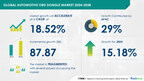
NEW YORK, July 25, 2024 /PRNewswire/ — The global automotive OBD dongle market size is estimated to grow by USD 87.87 billion from 2024-2028, according to Technavio. The market is estimated to grow at a CAGR of 18.52% during the forecast period. Usage-based insurance (UBI) model to drive utility value of OBD dongles is driving market growth, with a trend towards advanced analytics on telematics data to reduce risk severity. However, privacy and hacking concerns with onboard diagnostics poses a challenge. Key market players include AutoPi.io ApS, BAFX Products, BorgWarner Inc., Continental AG, Danlaw Inc., Geotab Inc., Huawei Technologies Co. Ltd., Intel Corp., iWave Systems Technologies Pvt. Ltd., Legion Autodata JSC, Moj.io Inc., OBD Solutions LLC, Prizmos Ltd., Robert Bosch GmbH, ShenZhen CheBoTong Technology Co. Ltd., TomTom NV, Veepeak, Verizon Communications Inc., Zubie Inc., and Zymbia Interactive Technologies Pvt. Ltd..
Get a detailed analysis on regions, market segments, customer landscape, and companies – Click for the snapshot of this report
Forecast period
2024-2028
Base Year
2023
Historic Data
2018 – 2022
Segment Covered
Vehicle Type (Passenger cars and Commercial vehicles), Type (Bluetooth and WiFi), and Geography (North America, APAC, Europe, South America, and Middle East and Africa)
Region Covered
North America, APAC, Europe, South America, and Middle East and Africa
Key companies profiled
AutoPi.io ApS, BAFX Products, BorgWarner Inc., Continental AG, Danlaw Inc., Geotab Inc., Huawei Technologies Co. Ltd., Intel Corp., iWave Systems Technologies Pvt. Ltd., Legion Autodata JSC, Moj.io Inc., OBD Solutions LLC, Prizmos Ltd., Robert Bosch GmbH, ShenZhen CheBoTong Technology Co. Ltd., TomTom NV, Veepeak, Verizon Communications Inc., Zubie Inc., and Zymbia Interactive Technologies Pvt. Ltd.
Key Market Trends Fueling Growth
In the automotive industry, data transparency and personalized solutions are becoming key priorities for both Original Equipment Manufacturers (OEMs) and insurers. With growing concerns around data privacy and security, some customers are hesitant to adopt connected features in their vehicles. To address these concerns, OEMs are partnering with telecom service providers to apply advanced analytics to telematics data. This data enables real-time monitoring of vehicle health, recall issues, and customer behavior, providing opportunities for personalized solutions and improved customer experience. Insurers, too, are leveraging telematics data to identify high- and low-risk clients, offering customized coverage and enhancing their relationship with customers. Cloud-based solutions, including Over-the-Air (OTA) software updates, infotainment, security monitoring, and Usage-Based Insurance (UBI), are driving the growth of the automotive OBD dongle market.
The Automotive OBD (On-Board Diagnostics) Dongle market is experiencing significant growth due to increasing trends in vehicle safety and emissions standards. OBD systems help monitor engine performance, fuel consumption, and identify diagnostic trouble codes in real-time. Aftermarket suppliers provide both wired and wireless OBD Dongles for usage-based insurance, fleet management solutions, and insurers. Real-time data on driving behavior, efficiency, and connectivity offer data-driven insights for fleet operators and insurers. However, cybersecurity concerns, such as hacking, unauthorized access, and cyber threats, require encryption protocols, authentication mechanisms, firmware updates, and cybersecurity measures. Industry standards, including passenger cars, Bluetooth, WiFi, and the OBD port, are crucial for IoT technology, vehicle tracking, and telematics solutions. Automotive manufacturers utilize OBD systems for preventive maintenance and insurance models.
Discover 360° analysis of this market. For complete information, schedule your consultation- Book Here!
Market Challenges
The automotive onboard diagnostics market holds potential for enhancing Customer Relationship Management (CRM) by providing valuable vehicle data to manufacturers and service centers. However, customer concerns regarding security and privacy breaches pose significant challenges to the market’s growth. Instances of unauthorized vehicle tracking and data collection without consent have raised privacy concerns, leading to a loss of customer confidence. General Motors faced negative publicity when they were ordered to stop collecting car-generated data after customers canceled their OnStar subscriptions. This was due to the collection and sharing of user data with third-party suppliers without consent. Moreover, malware can infiltrate in-vehicle entertainment and information systems, linking them to critical vehicle functions through the Controller Area Network (CAN) bus. Hackers can seize control of a vehicle’s engine and brakes by connecting to the onboard diagnostic port using a laptop or mobile device. Advanced systems require the exchange of personal information between drivers or passengers and automobile manufacturers, which can be vulnerable to hacking. Furthermore, the insertion of multiple web applications and Bluetooth connectivity in automobiles creates additional security vulnerabilities, giving hackers access to users’ personal information, such as passwords and usernames, leading to potential data losses. These security concerns can hinder the growth of the automotive OBD dongle market in the forecast period.The Automotive OBD (On-Board Diagnostics) Dongle market is experiencing significant growth due to the increasing demand for vehicle connectivity and diagnostics. Telematics services, wireless communication technology, and vehicle-to-everything communications are driving this market forward. However, challenges such as vehicle warranty voidance concerns and the need for advanced technologies like artificial intelligence and machine learning are hindering growth. Connected car technologies, including Bluetooth and Wi-Fi dongles, smartphones, tablets, and computers, are enabling remote monitoring and fleet management operations. OEMs and aftermarket channels, including retail outlets, online platforms, independent workshops, and the OEM channel, are offering various cellular data plans and Wi-Fi hotspots to cater to this demand. Vehicle performance data, fault codes, and vehicle health are key areas of focus for automotive IoT technologies. These technologies provide valuable insights into vehicle diagnostics, fuel efficiency, maintenance alerts, and driving experiences. Connectivity technologies like cellular networks and mobile applications are essential for data transmission and web-based applications. Road safety, traffic management, smart mobility, autonomous vehicles, and vehicle electrification are also major trends in the automotive industry, and OBD dongles play a crucial role in enabling these technologies. The market is expected to continue growing as more vehicles become connected and the demand for real-time vehicle data increases.
For more insights on driver and challenges – Download a Sample Report
Segment Overview
This automotive obd dongle market report extensively covers market segmentation by
Vehicle Type1.1 Passenger cars1.2 Commercial vehiclesType 2.1 Bluetooth2.2 WiFiGeography 3.1 North America3.2 APAC3.3 Europe3.4 South America3.5 Middle East and Africa
1.1 Passenger cars- The passenger car segment holds the largest share in the global automotive OBD dongle market due to its significant volume and value in the automotive industry. This segment’s growth is closely linked to economic development, as sales of passenger cars correlate with industrial output, economic progress, and population demographics. The demand for passenger cars is expected to continue dominating the market, driven by strong demand from emerging countries and the revival of developed economies. Telematics offerings are becoming standard fitments in most cars, enhancing the passenger cars’ share in the market. The growth of the e-hailing market is also contributing to the wider adoption of OBD dongles through aftermarket offerings. There is a growing need for telematics service providers to track vehicles and driving behavior to determine insurance claims. Consumers demand innovative features and services that seamlessly integrate into their digitized lifestyles. Traditional automotive players are adapting their business models to meet changing demands and increase cost-effectiveness. Prominent OEMs, such as Ford Motor Company and General Motors, have introduced embedded systems in mass-segment vehicles. During the forecast period, the passenger cars segment is expected to grow, driven by improving economic conditions and the launch of new vehicles with advanced features. For instance, Chinese EV manufacturer BYD’s Seal U electric SUV, launched in May 2024, is equipped with all the features of electric driving. The Indian automotive market has experienced slow growth in the last 18 months, but the connected car segment has remained stable due to the introduction of additional features such as vehicle-to-vehicle (V2V) connectivity, navigation, safety alerts, and remote tracking. The growing adoption of luxury vehicles, equipped with automotive OBD dongles as standard fitment, will benefit both the volume and revenue growth of the passenger cars segment in the global automotive OBD dongle market.
For more information on market segmentation with geographical analysis including forecast (2024-2028) and historic data (2018 – 2022) – Download a Sample Report
Learn and explore more about Technavio’s in-depth research reports
The global Commercial Vehicle Fleet Management System market is experiencing significant growth, driven by advancements in telematics and the increasing demand for efficient fleet operations. Key players are leveraging AI and IoT technologies to enhance fleet productivity and safety. Concurrently, the global E-axle market is expanding due to the rising adoption of electric vehicles (EVs) and stringent emission regulations. Innovations in e-axle design are pivotal in improving EV performance and efficiency. Both markets are poised for robust expansion, reflecting the broader trend towards digitalization and sustainability in the automotive industry.
Research Analysis
The Automotive OBD (On-Board Diagnostics) Dongle market is witnessing significant growth due to the increasing demand for real-time vehicle monitoring and diagnostics. OBD dongles, which plug into the OBD port of passenger cars, enable Bluetooth and WiFi connectivity for engine performance analysis, fuel consumption monitoring, and diagnostic trouble code reading. These devices offer preventive maintenance alerts, trip tracking, and telematics solutions for both personal vehicles and commercial fleets. Automotive manufacturers are integrating OBD dongles into their vehicles to enhance vehicle connectivity and provide vehicle health data for telematics services and insurance models. OBD dongles use various connectivity technologies, including Wi-Fi, data transmission, mobile applications, and web-based applications, to offer real-time vehicle diagnostics, fuel efficiency analysis, and driving experiences.
Market Research Overview
The Automotive OBD (On-Board Diagnostics) Dongle Market is a rapidly growing sector within the automotive industry, focusing on Passenger Cars equipped with an OBD port. These dongles enable Bluetooth, WiFi, and cellular communication, allowing real-time monitoring of engine performance, fuel consumption, diagnostic trouble codes, and vehicle health. Telematics solutions offer trip tracking, fleet management operations, and vehicle-to-everything communications for personal vehicles and commercial fleets. Connected car technologies, including Bluetooth OBD dongles, smartphone, tablet, and computer compatibility, provide access to vehicle performance data, fault codes, and maintenance alerts. Wireless communication technology, such as Wi-Fi dongles and cellular OBD dongles, enable remote monitoring and fleet management through cellular networks. Aftermarket channels, including retail outlets, online platforms, independent workshops, and OEM channels, offer various OBD dongle options. Usage-based insurance and fleet management solutions utilize real-time data for driving behavior analysis, efficiency improvements, and vehicle safety. Emissions and environmental standards are driving the adoption of OBD systems and automotive IoT technologies. Vehicle electrification and autonomous vehicles are expected to further expand the market, as OBD dongles play a crucial role in monitoring and managing the unique requirements of these vehicles. The integration of artificial intelligence and machine learning enhances the diagnostic capabilities and driving experiences, providing data-driven insights for preventive maintenance, insurers, fleet operators, and automotive manufacturers.
Table of Contents:
1 Executive Summary
2 Market Landscape
3 Market Sizing
4 Historic Market Size
5 Five Forces Analysis
6 Market Segmentation
Vehicle TypePassenger CarsCommercial VehiclesTypeBluetoothWiFiGeographyNorth AmericaAPACEuropeSouth AmericaMiddle East And Africa
7 Customer Landscape
8 Geographic Landscape
9 Drivers, Challenges, and Trends
10 Company Landscape
11 Company Analysis
12 Appendix
About Technavio
Technavio is a leading global technology research and advisory company. Their research and analysis focuses on emerging market trends and provides actionable insights to help businesses identify market opportunities and develop effective strategies to optimize their market positions.
With over 500 specialized analysts, Technavio’s report library consists of more than 17,000 reports and counting, covering 800 technologies, spanning across 50 countries. Their client base consists of enterprises of all sizes, including more than 100 Fortune 500 companies. This growing client base relies on Technavio’s comprehensive coverage, extensive research, and actionable market insights to identify opportunities in existing and potential markets and assess their competitive positions within changing market scenarios.
Contacts
Technavio Research
Jesse Maida
Media & Marketing Executive
US: +1 844 364 1100
UK: +44 203 893 3200
Email: media@technavio.com
Website: www.technavio.com/
View original content to download multimedia:https://www.prnewswire.com/news-releases/automotive-obd-dongle-market-size-is-set-to-grow-by-usd-87-87-billion-from-2024-2028–usage-based-insurance-ubi-model-to-drive-utility-value-of-obd-dongles-to-boost-the-market-growth-technavio-302205643.html
SOURCE Technavio








 Technology4 days ago
 Technology4 days ago
 Technology5 days ago
 Coin Market4 days ago
 Technology4 days ago
 Technology2 days ago
 Technology5 days ago