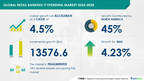
NEW YORK, Aug. 5, 2024 /PRNewswire/ — The global retail banking IT spending market size is estimated to grow by USD 13.57 billion from 2024-2028, according to Technavio. The market is estimated to grow at a CAGR of 4.5% during the forecast period. Growing need for greater customer satisfaction is driving market growth, with a trend towards incorporation of analytics into third-party banking software. However, issues related to data privacy and security poses a challenge. Key market players include Accenture Plc, Atos SE, Capgemini Service SAS, CGI Inc., Cisco Systems Inc., Cognizant Technology Solutions Corp., Dell Technologies Inc., Fidelity National Information Services Inc., Fujitsu Ltd., Genpact Ltd., HCL Technologies Ltd., Hitachi Ltd., HP Inc., Infosys Ltd., Intel Corp., International Business Machines Corp., Microsoft Corp., NetApp Inc., Oracle Corp., SAP SE, Wipro Ltd., and WNS Holdings Ltd..
Get a detailed analysis on regions, market segments, customer landscape, and companies – Click for the snapshot of this report
Forecast period
2024-2028
Base Year
2023
Historic Data
2018 – 2022
Segment Covered
Type (IT services, IT hardware, and IT software) and Geography (North America, Europe, APAC, Middle East and Africa, and South America)
Region Covered
North America, Europe, APAC, Middle East and Africa, and South America
Key companies profiled
Accenture Plc, Atos SE, Capgemini Service SAS, CGI Inc., Cisco Systems Inc., Cognizant Technology Solutions Corp., Dell Technologies Inc., Fidelity National Information Services Inc., Fujitsu Ltd., Genpact Ltd., HCL Technologies Ltd., Hitachi Ltd., HP Inc., Infosys Ltd., Intel Corp., International Business Machines Corp., Microsoft Corp., NetApp Inc., Oracle Corp., SAP SE, Wipro Ltd., and WNS Holdings Ltd.
Key Market Trends Fueling Growth
In the retail banking sector, customers are increasingly utilizing mobile devices and digital technologies to engage with enterprises and access banking services. This shift has resulted in a significant expansion of customer data within banking organizations. Analyzing this data allows enterprises to make quicker and more informed decisions, enhancing efficiency across their business. Consequently, there is a growing preference for banking software with analytics capabilities. These solutions contribute to increased profitability, enhanced decision-making, reduced risk, and valuable customer insights. Integration with CRM and other systems enables employees to work more efficiently and make astute decisions. Vendors like Temenos Headquarters SA provide analytics solutions alongside their retail banking software, offering analytically driven KPIs, pre-built models, applications, dashboards, and reports, along with predictive analytics and real-time data. These factors are fueling expansion opportunities for vendors in the global retail banking IT spending market.
Retail banks continue to invest in IT to enhance customer experience and stay competitive. According to Celent, global IT spending in retail banking is projected to reach USD71.5 billion by 2023. Interest rates and inflationary pressure impact net interest margins, pushing banks to innovate and adapt. IT spending includes infrastructure, cloud, production volume, and technological advancements to meet consumer preferences in a globalized market. Regulatory changes and economic developments require diversification strategies to protect revenue streams and improve customer satisfaction. Banks invest in IT workforce, hardware, software, networks, customer support, online transaction systems, mobile banking, and digital banking for operational efficiency and value proposition. Risks related to sustainability, resilience, and external stimuli necessitate continuous innovation and adaptation. IT services, including IT technology, are crucial to retail banking’s competitive position and success.
Discover 360° analysis of this market. For complete information, schedule your consultation- Book Here!
Market Challenges
The retail banking IT spending market faces significant challenges due to data privacy and security risks. Traditional banking systems rely on various patchworks of open-source codes in their IT infrastructure, making data vulnerable to unauthorized access. Cloud infrastructure, with its shared resources and open architecture, is particularly susceptible to glitches and hacking attempts. With the increasing digitization of financial data, the protection of customer information from misuse is a major concern. Financial enterprises are cautious about deploying banking software due to these concerns, limiting market growth. Data security and privacy are critical issues, as vendors handle sensitive customer information. The potential consequences of data breaches, including fraud and intellectual property theft, can significantly impact a business’s reputation and bottom line. Consequently, the retail banking IT spending market may experience slower growth due to the limited adoption of banking software caused by data privacy and security concerns.Retail banking faces significant challenges in the IT spending market, requiring innovation and adaptation to external stimuli. Operational efficiency is crucial, and retail banks invest in IT services, networks, hardware, and software to enhance productivity. Customer support is key, with online transaction systems, mobile banking, and digital banking becoming cutting-edge expectations. Consumer expectations demand a digital transformation, with artificial intelligence and data analytics driving value proposition. The cloud native ecosystem, Infrastructure as Code, and cloud migration are essential for agility and scalability. Containerization technologies streamline application deployment, while threat detection and prevention technologies secure data. Data encryption, blockchain technology, and fraud protection are critical components of IT spending for retail banking, ensuring identity management and maintaining trust with customers. The IT landscape is continuously evolving, requiring retail banks to stay ahead and meet the needs of an increasingly digital consumer base.
For more insights on driver and challenges – Download a Sample Report
Segment Overview
This retail banking it spending market report extensively covers market segmentation by
Type 1.1 IT services1.2 IT hardware1.3 IT softwareGeography 2.1 North America2.2 Europe2.3 APAC2.4 Middle East and Africa2.5 South America
1.1 IT services- The retail banking IT spending market’s IT services segment primarily focuses on application development and maintenance, system integration, IT consulting, software deployment and support, and hardware deployment and support. IT consulting services assist companies in aligning IT strategies with business objectives, driving IT initiatives in business processes. Microsoft’s recent launch of a new consulting services organization, focusing on Azure Cloud and AI, has boosted the adoption of IT consulting service operating models. Additionally, system integration and hardware and software deployment and support services are gaining traction due to cloud-based deployment and the need for skilled workforces. Retail banks often lack the in-house technical expertise to implement advanced technologies, leading them to engage IT consulting firms. Factors like cost reduction, increased operational efficiencies, and competition for talent are driving the need for advanced technologies and IT services, consequently fueling the growth of the retail banking IT spending market in the IT services segment.
For more information on market segmentation with geographical analysis including forecast (2024-2028) and historic data (2018 – 2022) – Download a Sample Report
Research Analysis
Retail banking IT spending continues to be a significant area of investment for financial institutions, driven by the need to enhance customer experience, improve operational efficiency, and adapt to external stimuli such as inflationary pressure and changing customer preferences. Net interest income remains a key revenue stream, but banks must also explore new technology spending to stay competitive. Celent research indicates that retail banks will continue to invest in IT services, networks, and hardware to support their service propositions and meet evolving customer needs. Innovation, sustainability, resilience, and adaptation are critical factors shaping IT spending decisions. Banks face risks in their IT investments, including cybersecurity threats, regulatory compliance, and the need to balance short-term costs with long-term strategic goals. Technology spending is essential to maintain a competitive position, but banks must also ensure that their IT investments align with their value proposition and contribute to customer satisfaction. Inflationary pressure can impact net interest income and IT spending, making it essential for retail banks to prioritize operational efficiency and cost management. Ultimately, IT spending decisions must be informed by a deep understanding of customer needs, market trends, and the competitive landscape.
Market Research Overview
Retail banking IT spending continues to grow as institutions invest in technology to meet changing customer preferences, regulatory requirements, and economic developments. Net interest margins are under pressure due to inflationary pressure and low interest rates, making IT a crucial area of investment for retail banks. Celent reports that technology spending in retail banking is expected to reach new heights, driven by infrastructure needs, cloud spending, and the adoption of cutting-edge technologies. The IT workforce plays a vital role in implementing and maintaining these technological advancements. Retail banks are focusing on operational efficiency, value proposition, and customer satisfaction to maintain a competitive position. External stimuli such as globalization, regulatory changes, and economic developments require retail banks to adapt quickly, leading to diversification strategies and new revenue streams. Digital transformation is a key focus area, with online transaction systems, mobile banking, and digital banking becoming the norm. Consumer expectations are high, and retail banks are investing in artificial intelligence, data analytics, and cloud-native ecosystems to provide personalized services and improve customer relationship management. Infrastructure as Code, cloud migration, containerization technologies, threat detection, prevention technologies, data encryption, blockchain technology, and fraud protection are some of the areas where retail banks are spending to ensure resilience, sustainability, and innovation. The IT services market is booming, with hardware, software, customer support, and productivity all seeing significant investment. Networks, production volume, and operational efficiency are also critical areas of focus.
Table of Contents:
1 Executive Summary
2 Market Landscape
3 Market Sizing
4 Historic Market Size
5 Five Forces Analysis
6 Market Segmentation
TypeIT ServicesIT HardwareIT SoftwareGeographyNorth AmericaEuropeAPACMiddle East And AfricaSouth America
7 Customer Landscape
8 Geographic Landscape
9 Drivers, Challenges, and Trends
10 Company Landscape
11 Company Analysis
12 Appendix
About Technavio
Technavio is a leading global technology research and advisory company. Their research and analysis focuses on emerging market trends and provides actionable insights to help businesses identify market opportunities and develop effective strategies to optimize their market positions.
With over 500 specialized analysts, Technavio’s report library consists of more than 17,000 reports and counting, covering 800 technologies, spanning across 50 countries. Their client base consists of enterprises of all sizes, including more than 100 Fortune 500 companies. This growing client base relies on Technavio’s comprehensive coverage, extensive research, and actionable market insights to identify opportunities in existing and potential markets and assess their competitive positions within changing market scenarios.
Contacts
Technavio Research
Jesse Maida
Media & Marketing Executive
US: +1 844 364 1100
UK: +44 203 893 3200
Email: media@technavio.com
Website: www.technavio.com/
View original content to download multimedia:https://www.prnewswire.com/news-releases/retail-banking-it-spending-market-size-is-set-to-grow-by-usd-13-57-billion-from-2024-2028–growing-need-for-greater-customer-satisfaction-to-boost-the-market-growth-technavio-302211118.html
SOURCE Technavio








 Coin Market5 days ago
 Coin Market4 days ago
 Technology4 days ago
 Coin Market5 days ago
 Near Videos4 days ago
 Coin Market5 days ago
 Technology5 days ago
 Technology5 days ago