Technology
Chunghwa Telecom Reports Un-Audited Consolidated Operating Results for the Second Quarter of 2024
Published
2 years agoon
By
TAIPEI, Aug. 6, 2024 /PRNewswire/ — Chunghwa Telecom Co., Ltd. (TAIEX: 2412, NYSE: CHT) (“Chunghwa” or “the Company”) today reported its un-audited operating results for the second quarter of 2024. All figures were prepared in accordance with Taiwan-International Financial Reporting Standards (“T-IFRSs”) on a consolidated basis.
(Comparisons throughout the press release, unless otherwise stated, are made with regard to the prior year period.)
Second Quarter 2024 Financial Highlights
Total revenue increased by 1.2% to NT$ 54.12 billion.Consumer Business Group revenue increased by 2.6% to NT$ 33.60 billion.Enterprise Business Group revenue decreased by 3.7% to NT$ 16.89 billion.International Business Group revenue increased by 21.8% to NT$ 2.64 billion.Total operating costs and expenses increased by 2.4% to NT$ 42.19 billion.Operating income decreased by 2.7% to NT$ 11.93 billion.EBITDA decreased by 1.7% to NT$ 21.81 billion.Net income attributable to stockholders of the parent decreased by 1.0% to NT$ 9.82 billion.Basic earnings per share (EPS) was NT$1.27.Operating income, EBITDA, net income attributable to stockholders of the parent, and EPS all exceeded our proposed guidance.
“The year-over-year improvements in the second quarter underscored the strength of our strategic execution and operational excellence,” stated Mr. Shui-Yi Kuo, Chairman and CEO of Chunghwa Telecom. “Chunghwa Telecom is delivering industry-leading, best-in-class service to our customers. As a result, we have proudly set a new record for total revenue for the same period since 2018, increasing our mobile revenue market share and subscriber share in the new market landscape. Our postpaid mobile ARPU has continued to outperform peers, demonstrating the highest YoY growth in the Taiwanese telecom industry for six consecutive quarters. Additionally, our fixed broadband service has seen a remarkable uptick as the number of subscribers opting for services of 300Mbps or higher continued to grow, resulting in revenue increase.”
“Regarding our three business groups, the Consumer Business Group sustained its growth trajectory, primarily due to mobile revenue growth driven by ongoing 5G migration and an increase in postpaid subscribers, as well as fixed broadband revenue growth. As a testament of our successful investment in media content, we saw our video platform subscriptions exceeded three million in the first week of broadcasting the Olympic Games, further expanding our lead in the industry as the largest video platform in Taiwan. Our Enterprise Business Group’s revenue decreased due to the higher base from the large ICT project revenue recognized last year, offset by increased IDC and cybersecurity revenues this quarter. A noteworthy highlight is the 10 consecutive quarters of year-over-year growth in our cybersecurity business driven by growing demand. Furthermore, we are impressed with the performance of our International Business Group, where revenue increased by 21.8% year-over-year, mainly driven by overseas ICT business.”
“Targeting the vast AI opportunities, we constructed AI Data Centers, GPU Cloud, and CHT AI Factory. These efforts support enterprise and government clients in facilitating AI transformation. Additionally, to strategically enhance our overall group’s market value, we focused on carving out subsidiaries for spin-offs and continuously evaluating potential M&A opportunities. Our subsidiary, CHT Security and International Integrated Systems Inc., will complete their listing on Taiwan’s Emerging Stock Market Board by the second half of 2024. Looking ahead, we remain confident that the consistent execution of our strategies will enable us to achieve our long-term goals for superior value creation for all our stakeholders,” Mr. Kuo concluded.
Revenue
Chunghwa Telecom’s total revenues for the second quarter of 2024 increased by 1.2% to NT$ 54.12 billion.
Consumer Business Group’s revenue for the second quarter of 2024 increased by 2.6% YoY to NT$ 33.60 billion. Mobile service revenue increased 3.8% YoY, mainly due to ongoing 5G migration and increase in postpaid subscriber. Fixed broadband revenue continued to grow year over year owing to the successful upsell of speed upgrade. Sales revenue increased 2.4% YoY mainly due to the strong sales of iPhone series. CBG’s income before tax decreased 1.6% YoY, mainly due to the increase of personnel expenses resulting from the company’s salary raises rolled out this year
Enterprise Business Group’s revenue for the second quarter of 2024 decreased 3.7% YoY to NT$ 16.89 billion, due to last year’s high base from large ICT projects and the deferral of revenue that was expected to be recognized in the second quarter. ICT business revenue remained on track when excluding those factors. Mobile service revenue slightly decreased due to the higher base of prepaid card project in the same period of last year, while 5G migration, international roaming revenue and text message revenue continued to grow. Fixed-line revenue slightly decreased year-over-year due to that the decline in fixed voice revenue offset the growth of broadband access revenue and data communication revenue. This was the main cause of the 9.6% year-over-year decrease in EBG’s income before tax.
International Business Group’s revenue for the second quarter of 2024 increased by 21.8% to NT$ 2.64 billion, while its income before tax increased 8.2% YoY. The positive growth was mainly due to overseas ICT business growth driven by clients’ global expansion.
Operating Costs and Expenses
Total operating costs and expenses for the second quarter of 2024 increased by 2.4% to NT$ 42.19 billion, mainly due to higher manpower cost and electricity expenses.
Operating Income and Net Income
Operating income for the second quarter of 2024 decreased by 2.7% to NT$ 11.93 billion. The operating margin was 22.0%, as compared to 22.9% in the same period of 2023. Net income attributable to stockholders of the parent decreased by 1.0% to NT$ 9.82 billion. Basic earnings per share was NT$1.27.
Cash Flow and EBITDA
Cash flow from operating activities, as of June 30th, 2024, increased by 3.0% year over year to NT$ 29.32 billion, mainly due to a rise in unearned revenue from ICT projects.
Cash and cash equivalents, as of June 30th, 2024, decreased by 24.2% to NT$ 37.71 billion as compared to that as of June 30th, 2023.
EBITDA for the second quarter of 2024 was NT$ 21.81 billion, decreasing by 1.7% year over year. EBITDA margin was 40.31%, as compared to 41.51% in the same period of 2023.
Business Highlights
Mobile
As of June 30th, 2024, Chunghwa Telecom had 13.42 million mobile subscribers, representing a 4.5% year-over-year increase. In the second quarter, total mobile service revenue increased by 3.5% to NT$ 16.73 billion, while mobile post-paid ARPU excluding IoT SIMs grew 2.0% year over year to NT$ 556.
Fixed Broadband/HiNet
As of June 30th, 2024, the number of broadband subscribers slightly increased by 0.6% to 4.41 million. The number of HiNet broadband subscribers increased by 1.3% to 3.72 million. In the second quarter, total fixed broadband revenue grew 4.4% year over year to NT$ 11.39 billion, while ARPU increased 2.0% to NT$ 790.
Fixed line
As of June 30th, 2024, the number of fixed-line subscribers was 9.02 million.
Financial Statements
Financial statements and additional operational data can be found on the Company’s website at http://www.cht.com.tw/en/home/cht/investors/financials/quarterly-earnings
NOTE CONCERNING FORWARD-LOOKING STATEMENTS
This press release contains forward-looking statements. These statements constitute “forward-looking” statements within the meaning of Section 27A of the Securities Act of 1933, as amended, and Section 21E of the Securities Exchange Act of 1934, as amended, and as defined in the U.S. Private Securities Litigation Reform Act of 1995. These forward-looking statements can be identified by terminology such as “will,” “expects,” “anticipates,” “future,” “intends,” “plans,” “believes,” “estimates” and similar statements. Statements that are not historical facts, including statements about Chunghwa’s beliefs and expectations, are forward-looking statements. Forward-looking statements involve inherent risks and uncertainties that could cause actual results to differ materially from the forward-looking statements. A number of important factors could cause actual results to differ materially from those contained in any forward-looking statement. Investors are cautioned that actual events and results could differ materially from those statements as a result of a number of factors including, but not limited to the risks outlined in Chunghwa’s filings with the U.S. Securities and Exchange Commission on Forms F-1, F-3, 6-K and 20-F, in each case as amended. The forward-looking statements in this press release reflect the current belief of Chunghwa as of the date of this press release and Chunghwa undertakes no obligation to update these forward-looking statements for events or circumstances that occur subsequent to such date, except as required under applicable law.
This press release is not an offer of securities for sale in the United States. Securities may not be offered or sold in the United States absent registration or an exemption from registration. Any public offering of securities to be made in the United States will be made by means of a prospectus that may be obtained from the issuer or selling security holder and that will contain detailed information about the company and management, as well as financial statements.
NON-GAAP FINANCIAL MEASURES
To supplement the Company’s consolidated financial statements presented in accordance with International Financial Reporting Standards pursuant to the requirements of the Financial Supervisory Commission, or T-IFRSs, Chunghwa Telecom also provides EBITDA, which is a “non-GAAP financial measure”. EBITDA is defined as consolidated net income (loss) excluding (i) depreciation and amortization, (ii) total net comprehensive financing cost (which is comprised of net interest expense, exchange gain or loss, monetary position gain or loss and other financing costs and derivative transactions), (iii) other income, net, (iv) income tax, (v) (income) loss from discontinued operations.
In managing the Company’s business, Chunghwa Telecom relies on EBITDA as a means of assessing its operating performance because it excludes the effect of (i) depreciation and amortization, which represents a non-cash charge to earnings, (ii) certain financing costs, which are significantly affected by external factors, including interest rates, foreign currency exchange rates and inflation rates, which have little or no bearing on our operating performance, (iii) income tax (iv) other expenses or income not related to the operation of the business.
CAUTIONS ON USE OF NON-GAAP FINANCIAL MEASURES
In addition to the consolidated financial results prepared under T-IFRSs, Chunghwa Telecom also provide non-GAAP financial measures, including “EBITDA”. The Company believes that the non-GAAP financial measures provide investors with another method for assessing its operating results in a manner that is focused on the performance of its ongoing operations.
Chunghwa Telecom’s management believes investors will benefit from greater transparency in referring to these non-GAAP financial measures when assessing the Company’s operating results, as well as when forecasting and analyzing future periods. However, the Company recognizes that:
these non-GAAP financial measures are limited in their usefulness and should be considered only as a supplement to the Company’s T-IFRSs financial measures;these non-GAAP financial measures should not be considered in isolation from, or as a substitute for, the Company’s T-IFRSs financial measures;these non-GAAP financial measures should not be considered to be superior to the Company’s T-IFRSs financial measures; andthese non-GAAP financial measures were not prepared in accordance with T-IFRSs and investors should not assume that the non-GAAP financial measures presented in this earnings release were prepared under a comprehensive set of rules or principle.
Further, these non-GAAP financial measures may be unique to Chunghwa Telecom, as they may be different from non-GAAP financial measures used by other companies. As such, this presentation of non-GAAP financial measures may not enhance the comparability of the Company’s results to the results of other companies. Readers are cautioned not to view non-GAAP results as a substitute for results under T-IFRSs, or as being comparable to results reported or forecasted by other companies.
About Chunghwa Telecom
Chunghwa Telecom (TAIEX 2412, NYSE: CHT) (“Chunghwa” or “the Company”) is Taiwan’s largest integrated telecommunications services company that provides fixed-line, mobile, broadband, and internet services. The Company also provides information and communication technology services to corporate customers with its big data, information security, cloud computing and IDC capabilities, and is expanding its business into innovative technology services such as IoT, AI, etc. Chunghwa has been actively and continuously implemented environmental, social and governance (ESG) initiatives with the goal to achieve sustainability and has won numerous international and domestic awards and recognitions for its ESG commitments and best practices. For more information, please visit our website at www.cht.com.tw
Contact: Angela Tsai
Phone: +886 2 2344 5488
Email: chtir@cht.com.tw
View original content:https://www.prnewswire.com/news-releases/chunghwa-telecom-reports-un-audited-consolidated-operating-results-for-the-second-quarter-of-2024-302215307.html
SOURCE Chunghwa Telecom
You may like
Technology
PayKings Offers Free Statement Analyzer That Shows High-Risk Merchants the Rate They Actually Pay
Published
4 minutes agoon
November 25, 2026By
A merchant quoted 2.6% can pay 3.5% once every fee is counted. The free tool finds the real number in about a minute.
LEHI, Utah, Nov. 25, 2026 /PRNewswire/ — PayKings, a high-risk merchant services provider, offers a free Statement Analyzer that shows merchants the actual rate they pay to accept cards. Merchants upload a statement from any U.S. processor and receive their effective rate, total fees, and a line-by-line breakdown in about a minute.
Most merchants know the rate printed on their contract, but the effective rate tells a different story. Calculated by dividing total processing fees by total card volume, it includes charges that contract rates may leave out, such as per-transaction, monthly, and PCI fees. A merchant quoted 2.6% can end up paying 3.5%. The analyzer works with any U.S. merchant statement, including those from CBD, firearms, nutraceutical, and telemedicine businesses PayKings specializes in.
“Most merchants we talk to have never seen their real processing rate,” said Kyle Hall, CEO of PayKings. “They see one number on a contract and assume that’s what they’re paying, but the reality is often much more complicated. We believe every business owner deserves complete transparency into their processing fees so they can understand exactly where their money is going and make informed decisions about their business.”
How it works:
Upload: Submit a processor PDF statement or a clear photo or scan of a paper statement.Read: The tool reviews percentage, per-transaction, monthly, and other processing fees.Breakdown: Merchants see their effective rate, total fees, categorized charges, and fees that may warrant a closer look.
Account and routing numbers are masked in every result. The tool is free, requires no obligation, and can also be used by anyone reviewing a statement shared by a merchant.
The Statement Analyzer is available at https://paykings.com/tools/statement-analyzer/?utm_source=prnewswire&utm_medium=press_release&utm_campaign=statement_analyzer.
About PayKings
Founded in 2011, PayKings has offices in Lehi, Utah, and St. Petersburg, Florida. The company specializes in payment processing for high-risk businesses, with more than 20 acquiring bank relationships and service across 50+ industries, including CBD, firearms, nutraceuticals, and telemedicine. PayKings approves 86% of merchants who apply. Learn more at https://paykings.com/. PayKings, 2901 Bluegrass Blvd, Suite 200-338, Lehi, UT 84043.
Media Contact
Mia Tandingan
Email Marketing Specialist
PayKings
Email: mia@813mgt.com
Phone: (801) 899-7255
Website: https://paykings.com/
View original content:https://www.prnewswire.com/news-releases/paykings-offers-free-statement-analyzer-that-shows-high-risk-merchants-the-rate-they-actually-pay-302950687.html
SOURCE PayKings
Technology
New McLean & Company Guide Helps HR Accelerate Job Architecture With AI
Published
4 minutes agoon
November 25, 2026By
A new resource from global HR advisory and research firm McLean & Company shows HR leaders how to practically use AI to develop and maintain job leveling criteria and structures. It keeps organizational context, key player input, and human oversight at the center of every decision as HR organizations continue to adopt ever-evolving technology.
TORONTO, Nov. 25, 2026 /CNW/ — According to McLean & Company’s new Guide to Accelerating Job Architecture With AI, AI can streamline HR’s job architecture work by analyzing organizational documentation, surfacing patterns and inconsistencies, generating alternatives, and testing assumptions. This support gives HR more capacity to focus on the decisions that require organizational knowledge, calibration, and judgment. The new AI-focused resource from the global HR research and advisory firm provides practical guidance for HR leaders so they can use AI in conjunction with human judgment to develop and refine job leveling criteria. It also helps them evaluate level structures, prepare for leadership discussions, and keep the framework relevant over time.
“AI can accelerate the work behind job architecture, but it cannot determine what is right for an organization,” says Lexi Hambides, director, HR Research & Advisory Services, at McLean & Company. “HR must bring organizational context, involve the right key players, and apply human judgment to every output. The strongest frameworks use AI to expand and test options while keeping people accountable for the final decisions.”
The guide explains that job architecture supports consistent decisions across talent management, career progression, workforce planning, and total rewards. However, developing and maintaining the framework requires extensive analysis, iteration, and input from key players.
In the resource, McLean & Company emphasizes that AI should support rather than replace HR expertise. The firm recommends HR leaders and their teams start with clear objectives and reviewing organizational and HR strategy, structure, job families, and supporting data to assess whether AI-generated recommendations align with business needs.
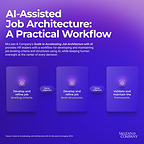
The Guide to Accelerating Job Architecture With AI outlines a practical workflow for developing and sustaining job leveling criteria and structures:
Develop and refine job leveling criteria. First, HR leaders can use AI to analyze organizational documents, identify recurring dimensions of work, and recommend clear criteria and definitions.
Develop and refine job level structures. Next, AI can be used to generate and compare level structure options, draft descriptors that differentiate work across levels, and identify gaps or inconsistencies before finalizing the framework.
Validate and maintain the framework. Finally, HR needs to prepare senior leaders to review major choices and trade-offs, confirm organizational fit, and establish a cadence for reassessing criteria and structures as work and business needs evolve.
The guide reinforces the importance of combining AI-enabled analysis with human judgment to develop job architecture frameworks that reflect organizational needs. McLean & Company advises that, by accelerating time-intensive design activities, AI can enable HR leaders to focus on evaluating options, strengthening decisions, and maintaining framework relevance as work evolves.
To access the insights, visit McLean & Company’s Guide to Accelerating Job Architecture With AI page. The resource can be paired with the firm’s Develop a Job Architecture Framework blueprint for end-to-end guidance on building and implementing a job architecture framework.
For support with alternative career tracks, HR leaders can explore McLean & Company’s Develop an Integrated Career Pathing Framework resource.
Media seeking research-backed insights or commentary from McLean & Company experts on job architecture, career frameworks, AI-supported HR work, or workforce planning can contact pr@mcleanco.com.
About McLean & Company
McLean & Company is a global HR research and advisory firm and trusted partner to people leaders navigating today’s most pressing workforce challenges. Informed by its work with thousands of HR professionals and executives, the firm provides evidence-based research, diagnostics, practical tools, hands-on support, and services spanning advisory, learning, and coaching. From workforce strategy and leadership to culture, engagement, retention, and AI adoption, McLean & Company helps leaders move from direction to execution and deliver measurable results for their people and organizations.
McLean & Company is a division of Infotech.
Media professionals can register for unrestricted access to research across IT, HR, and software, and hundreds of industry analysts through the firm’s Media Insiders program. To gain access, contact pr@mcleanco.com.
View original content to download multimedia:https://www.prnewswire.com/news-releases/new-mclean–company-guide-helps-hr-accelerate-job-architecture-with-ai-302946165.html
SOURCE McLean & Company
Technology
ASU research expenditures climb to nearly $1.14 billion, fueled by advances in engineering, health and national security
Published
4 minutes agoon
November 25, 2026By
University’s research enterprise grows 13.4%, strengthening its role in developing technologies and solutions that benefit Arizona and the nation
TEMPE, Ariz., Nov. 25, 2026 /PRNewswire/ — Arizona State University’s research enterprise continues to grow at a remarkable pace, reaching $1.137 billion in annual research expenditures in fiscal year 2025 — an increase of $134 million over the previous year.
This growth reflects the university’s expanding role in tackling some of the nation’s most pressing challenges, from strengthening national security and developing advanced semiconductor technologies to improving health care and securing Arizona’s water future.
The National Science Foundation on Tuesday released its annual Higher Education Research and Development, or HERD, survey, which collects research expenditure information from hundreds of institutions nationwide. In the latest survey reflecting fiscal year 2025, ASU ranked No. 33 overall, ahead of MIT, Purdue University, Michigan State University and the University of Arizona.
ASU ranked No. 4 among institutions without a medical school, ahead of MIT, Purdue University, UC Boulder and Princeton University. After the survey period, ASU officially launched the John Shufeldt School of Medicine and Medical Engineering, which received preliminary accreditation and an inaugural class of 36 students who began last summer.
The research growth builds on ASU’s historic achievement of surpassing $1 billion in annual research expenditures in fiscal year 2024, and joining the prestigious Association of American Universities (AAU).
This year also marks the first time that ASU has surpassed the University of Arizona in total research expenditures.
“We continue to build a new model of a great American research university, one that is committed to being accessible to students from every background and every conceivable pathway,” ASU President Michael Crow said.
Research expenditures measure the amount of funding used to conduct research each year. ASU receives funding from federal agencies, state and local grants, businesses and other private organizations, often awarded over multi-year periods. Research expenditures are the most effective way to measure research activity and compare the vitality of American research universities.
A top-tier national research university
The latest results continue a dramatic transformation of ASU’s research enterprise. Since Crow took office in 2002, the university has grown into one of the nation’s leading public research institutions, building a research model focused on scientific discovery, technological innovation and societal benefit. Consider that ASU ranked:
No. 5 out of 440 in federal funding from the Department of Health and Human Services among universities without a medical school, ahead of Purdue University, Georgia Institute of Technology, UC Boulder and Princeton.No. 9 out of 651 in National Science Foundation funding ahead of Columbia University, MIT, UC Berkeley and Purdue University.No. 9 out of 453 in NASA funding ahead of MIT, UCLA, UT Austin and Stanford University.No. 15 out of 576 in funding from state and local government, ahead of Ohio State University, the University of Minnesota, UC San Diego and UC Berkeley.
“ASU has a diverse funding portfolio, with support from federal agencies, industry partners, local governments and philanthropists who all have a vital interest in bringing ASU innovation to their communities,” said Sally C. Morton, executive vice president of ASU Knowledge Enterprise and chief research and innovation officer. “Our rapid growth reflects their confidence in our ability to deliver valuable results that benefit Americans.”
Engineering tomorrow’s technologies
Engineering research was the single largest contributor to ASU’s growth in fiscal year 2025.
Research expenditures in engineering reached $349.2 million, a 25.9% increase over the previous year. Engineering alone accounted for more than half of the university’s total research expenditure increase.
The growth reflects rising demand for technologies that can strengthen America’s national security, improve manufacturing, support advanced computing and accelerate the development of next-generation electronics.
One of the major contributors was the ASU-led Southwest Advanced Prototyping (SWAP) Hub, an industry-scale, professionally staffed semiconductor prototyping facility. Part of the Department of War’s Microelectronics Commons initiative, SWAP Hub delivers cutting-edge technologies that are critical to U.S. security and defense.
SWAP Hub’s Spaceborne Low Energy SI Computing (SLEAC) project brings together ASU, Sandia National Laboratories, Raytheon and university partners to develop efficient, radiation-hardened neural network processing for defense satellites. The technology uses less power, generates less heat and maintains the high computing performance needed to support real-time decision-making.
In its first two years, the team produced two radiation-tolerant prototype chips with object-tracking capabilities, moving the technology from the lab toward commercial fabrication.
Industry giant IBM also recently ordered from SWAP Hub a shipment of prototype wafers, the discs used to build microchips. ASU engineers designed, created and delivered the proof-of-concept products, which were used to demonstrate a process to build multiple structures on a molded wafer.
Powering national security
National defense emerged as one of the most important drivers of ASU’s research growth. Combined research expenditures supported by the Navy, Defense Advanced Research Projects Agency (DARPA) and Army increased by approximately $43.8 million between fiscal years 2024 and 2025.
ASU recently entered a 10-year agreement with the U.S. Army Installation Management Command that allows the university to provide energy services to Army installations across the continental U.S. Fort Huachuca, a military cybersecurity hub in Cochise County, Arizona, will be the first installation to participate.
The partnership builds on a pilot energy assessment that ASU’s Energy Efficiency Center conducted at Fort Huachuca in 2023, which showed how these assessments could address the installation’s needs. The center is part of the U.S. Department of Energy’s Industrial Training and Assessment Centers program.
Under the agreement, students with the Energy Efficiency Center, joined by students from Cochise College, will conduct detailed meter readings and evaluate energy use and efficiency. Their reports will help Fort Huachuca identify potential improvements to reliability, efficiency and operating costs.
The experience will prepare students for careers in energy efficiency while helping build a pool of trained workers near the installation.
Advancing health and medicine
Health-related research was another major source of growth. National Institutes of Health funded research expenditures increased $17.1 million over the previous year, helping scientists understand the human body to improve medical care.
Human blood contains a wealth of information about past infections, vaccinations and the health of the immune system. Researchers at ASU’s Biodesign Institute are developing powerful new tools to unlock that information, with support from the National Cancer Institute.
The researchers use a technology called the Multiplex In-Solution Protein Array, or MISPA, to measure antibody responses to hundreds of viruses and bacteria simultaneously. The technique allows scientists to track changes in immune responses over time, revealing evidence of exposure to pathogens and other immune challenges. It also makes it practical to conduct these tests on thousands of people in a single experiment.
In a recent study, the team identified special markers called sentinel antibodies that may provide a window into a person’s overall immune health. Individuals with stronger sentinel antibody responses generally mounted stronger responses to vaccination, suggesting a potential way to predict vaccine effectiveness.
The approach also generates enormous amounts of information that researchers can analyze using AI. By analyzing more than 2 million data points, the team uncovered patterns in immune responses that conventional testing might have missed.
ASU’s growing biomedical research enterprise is also advancing work in aging, cancer, infectious diseases, diagnostics, AI and personalized medicine.
Finding solutions to Arizona’s water challenges
As the Southwest confronts long-term drought, rising temperatures, population growth and increasing demands on limited water supplies, the need for new approaches to water management has never been more urgent.
In 2022, ASU’s Julie Ann Wrigley Global Futures Laboratory and Ira A. Fulton Schools of Engineering launched the Arizona Water Innovation Initiative, supported by $40 million from the state of Arizona. The initiative brought together researchers and partners to address water challenges facing Arizona and the broader Southwest.
The program connected ASU researchers with communities, agencies, industry, agriculture, tribal partners, municipalities and water leaders to accelerate practical, evidence-based solutions. Since its inception, AWII launched six technology test beds, advanced six patents, supported 10 startup companies and trained nearly 300 water professionals.
The initiative has built a foundation of research and relationships that will extend far beyond its four-year funding period. For example, AWII partners have supported rural groundwater resilience workshops and a peer-to-peer Rural Groundwater Resilience Exchange; released research on capturing precipitation, runoff and urban stormwater to replenish aquifers; and developed the AZ Water Blueprint’s “About My Water” app, which brings trusted, publicly-sourced data together in one place to provide a clear view of local water providers, groundwater conditions and water sources.
Leadership in key disciplines
ASU also achieved top 15 rankings for expenditures within many academic disciplines, including:
No. 1 out of 279 in anthropology, ahead of the University of Michigan, Harvard University, UA and the University of Massachusetts.No. 1 out of 372 in visual and performing arts, ahead of Florida State, University of Michigan, Syracuse University and Harvard University.No. 1 out of 593 in all non-science and engineering, ahead of Harvard University, University of Michigan, UT Austin, UC Berkeley.No. 2 out of 492 in education, ahead of the University of Virginia, UCLA, Stanford University and Harvard University.No. 3 out of 403 in business management and business administration, ahead of Harvard University, UC Berkeley, Cornell University and the University of Minnesota.No. 4 out of 338 in engineering, other, ahead of the University of Michigan, Purdue University, Johns Hopkins University and MIT.No. 4 out of 380 in geological and earth sciences, ahead of UT Austin, UC San Diego, Johns Hopkins University and Stanford University.No. 5 out of 174 in engineering, industrial and manufacturing, ahead of Pennsylvania State University, Ohio State University, Texas A&M and Purdue University.No. 6 out of 290 in civil engineering, ahead of Purdue University, UC Berkeley, Georgia Tech and the University of Michigan.No. 6 out of 376 in social sciences, political science and government, ahead of Indiana University, UCLA, Stanford University and NYU.No. 7 out of 313 in engineering, electrical, electronic, and communications, ahead of Purdue University, University of Michigan, University of Arizona and the University of Washington.No. 7 out of 212 in social work, ahead of University of Connecticut, University of Michigan, USC and Ohio State University.No. 8 out of 459 in geosciences, atmospheric sciences and ocean sciences, ahead of Columbia University, Johns Hopkins University, UT Austin and UCLA.No. 8 out of 314 in communication and communications technologies, ahead of Northwestern University, UC Berkeley, Georgia Tech and UCLA.No. 10 out of 522 in computer and information sciences, ahead of UNC Chapel Hill, Purdue University, Ohio State University and Cornell University.No. 13 out of 458 in humanities, ahead of University of Arizona, Notre Dame University, Syracuse University and UT Austin.
Turning research investments into real-world impact
Research expenditures do more than drive discoveries and inventions. They also support the local and regional economy. In fiscal year 2025, ASU research provided more than $77 million to Arizona-based vendors and subcontractors and more than $44 million to small businesses.
ASU’s growing research enterprise also creates opportunities for students to participate directly in scientific discovery and technological innovation, gaining experience that prepares them for careers in emerging industries.
“Our research mission works hand-in-hand with our educational mission,” Morton said. “Our students work on the cutting edge of science with leading researchers in their fields. We encourage hands-on learning and an entrepreneurial mindset. These are the skills they need for their own success and to make a positive impact.”
View original content to download multimedia:https://www.prnewswire.com/news-releases/asu-research-expenditures-climb-to-nearly-1-14-billion-fueled-by-advances-in-engineering-health-and-national-security-302950697.html
SOURCE Arizona State University – Media Relations
PayKings Offers Free Statement Analyzer That Shows High-Risk Merchants the Rate They Actually Pay
New McLean & Company Guide Helps HR Accelerate Job Architecture With AI
ASU research expenditures climb to nearly $1.14 billion, fueled by advances in engineering, health and national security
Send Rakhi to UK swiftly with UK Gifts Portal
Whiteboard Series with NEAR | Ep: 45 Joel Thorstensson from ceramic.network
Nullmax and Renesas Forge Strategic Partnership to Deliver Competitive ADAS Solutions for the Global Market
Why You Should Build on #NEAR – Co-founder Illia Polosukhin at CV Labs
Whiteboard Series with NEAR | Ep: 45 Joel Thorstensson from ceramic.network
NEAR End of Year Town Hall 2021: The Open Web World, MetaBUILD 2 Hackathon and 2021 recap
Trending
-
Near Videos5 days agoIllia Polosukhin on post-quantum keys and crypto agility | Solana Breakpoint 2026
-
Technology5 days agoAllooloo Tops 100M Capital Markets AI Agent Traffic a Month
-
Technology5 days agoAllooloo Tops 100M Capital Markets AI Agent Traffic a Month
-
Technology4 days agoHEARTBOT AI Wins Chunghwa Telecom Special Award at Meet Neo Star 2026
-
Coin Market5 days agoSky Protocol sees $2 billion in stablecoin withdrawals, disputes illicit fund claims
-
Coin Market5 days agoWrapped Monero token crashes 99.8% amid suspected $13.5M exploit
-
Technology5 days agoZiehm-Orthoscan Announces Executive Leadership Transition Following 18 Years of Significant Growth
-
Technology4 days agoA Seattle Startup Brings Your Pet to Life on Your Phone and Laptop With the Avatar Mirroring Their Every Move in Real Time