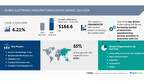
NEW YORK, Aug. 26, 2024 /PRNewswire/ — The global electronics manufacturing service market size is estimated to grow by USD 164.6 billionn from 2024-2028, according to Technavio. The market is estimated to grow at a CAGR of almost 6.21% during the forecast period. Increasing number of electronics manufacturing services providers in economies with low hourly wages is driving market growth, with a trend towards collaborative co-innovation partnership with electronics manufacturing services providers. However, risk of intellectual property theft and misuse poses a challenge. Key market players include Accton Technology Corp., Benchmark Electronics Inc., Celestica Inc., Compal Electronics Inc., Creation Technologies LLC, Data IO Corp., Elbit Systems Ltd., ESCATEC Sdn. Bhd., First International Computer Inc., Flex Ltd., Hon Hai Precision Industry Co. Ltd., Integrated Micro Electronics Inc., Jabil Inc., Key Tronic Corp., Kimball Electronics Inc., Kitron ASA, Neo Tech Inc., Plexus Corp., Sanmina Corp., and Venture Corp. Ltd..
Get a detailed analysis on regions, market segments, customer landscape, and companies- View the snapshot of this report
Electronics Manufacturing Service Market Scope
Report Coverage
Details
Base year
2023
Historic period
2018 – 2022
Forecast period
2024-2028
Growth momentum & CAGR
Accelerate at a CAGR of 6.21%
Market growth 2024-2028
USD 164.6 billion
Market structure
Fragmented
YoY growth 2022-2023 (%)
5.75
Regional analysis
APAC, North America, Europe, South America, and Middle East and Africa
Performing market contribution
APAC at 55%
Key countries
China, US, Taiwan, Japan, and Germany
Key companies profiled
Accton Technology Corp., Benchmark Electronics Inc., Celestica Inc., Compal Electronics Inc., Creation Technologies LLC, Data IO Corp., Elbit Systems Ltd., ESCATEC Sdn. Bhd., First International Computer Inc., Flex Ltd., Hon Hai Precision Industry Co. Ltd., Integrated Micro Electronics Inc., Jabil Inc., Key Tronic Corp., Kimball Electronics Inc., Kitron ASA, Neo Tech Inc., Plexus Corp., Sanmina Corp., and Venture Corp. Ltd.
Market Driver
Electronics Manufacturing Services (EMS) outsourcing partnerships require a collaborative approach, with both customer organizations and service providers sharing risks and creating value through joint functioning. Co-innovation is a key aspect of these relationships, enabling the exchange of knowledge to develop new solutions and products. Despite the increasing challenges and risks in EMS adoption, successful outsourcing relationships continue. EMS providers function as integrated strategic partners, with customer companies investing in their offshore operations and monitoring for optimal quality. Apple, for example, outsources electronics manufacturing to Chinese providers, leveraging their expertise while maintaining quality control. Airtel, an Indian telecom company, collaborates extensively with IBM, Ericsson, Nokia, and Siemens, under shared risk and reward contracts. These collaborations and co-innovations are expected to foster a favorable market ecosystem, driving growth in the EMS market.
The Electronics Manufacturing Services (EMS) market is experiencing significant trends in various industries. In healthcare, there’s a growing demand for advanced medical equipment. Automotive sector sees a surge in sub-assembly manufacturing, testing, and component assembly for electric vehicles. Industrial output is boosted by the adoption of new technologies like virtual reality, 3D printing, and structural electronics. The coronavirus pandemic has disrupted the electronics supply chain, highlighting the need for cybersecurity and resilience. Capacitors, connectors, LCD panels, and other components are in high demand. EMS providers offer engineering services and logistics to OEMs in Consumer Electronics, Aerospace & Defense, IT and Telecom, IoT, and 3D technologies. E-waste recycling and Greener Electronic Devices are crucial for a circular economy and Zero-waste nation. Global E-waste Monitor 2020 reports an increase in e-waste generation. New technologies like 5G, AI, and IoT-enabled cars drive productivity levels. Urban and population growth fuel demand for smart home products, smartphones, televisions, and more. EMS providers play a key role in the electronics industry, from manufacturing electronic equipment to providing engineering services and logistics. They help OEMs navigate the complexities of the industry, ensuring high-quality products and on-time delivery. The future of EMS lies in the adoption of new technologies, structural electronics, and the circular economy.
Explore a 360° Analysis of the Market: Unveil the Impact of AI. For complete insights- Request Sample!
Market Challenges
The electronics manufacturing services market faces a significant challenge in the form of intellectual property (IP) theft. Many electronics businesses keep their manufacturing designs confidential and have strict policies against outsourcing manufacturing to EMS providers due to IP concerns. Despite thorough documentation before contract award, customers remain apprehensive about potential IP technology and design leakage, data theft, and misuse at EMS providers. Laws and contracts aim to prevent such breaches, but proving a violation is challenging due to differences in IP protection laws between home countries and service providers’ locations. Techniques used for IPR infringement include forced technology transfer, corporate espionage, and direct data theft through hacking. The continuous evolution of technologies and cyberattacks, as well as the increasing use of cloud technology by EMS providers, make it difficult to completely eliminate the risk of unauthorized access to confidential data. This concern limits the adoption of electronics manufacturing services in certain industries, such as military and defense, thereby impeding market growth.The electronics manufacturing industry faces several challenges as new technologies like IoT, 3D technologies, and structural electronics gain popularity. E-waste recycling and producing greener electronic devices are becoming essential for businesses to address sustainability concerns. The Global E-waste Monitor 2020 reports an increasing amount of e-waste from consumer electronics, aerospace & defense, IT and telecom, and urban growth. EMS providers must adapt to these trends and offer logistics and engineering services to help OEMs meet the demands of the circular economy and zero-waste nation. Structural electronics penetration is growing in smart home products, smartphones, televisions, and even high-end autos and space vehicles. EMS providers must keep up with the latest trends to meet the needs of various industries, including automotive electronics manufacturers and IoT-enabled cars. Electric vehicle sales are surging, leading to a rise in demand for electronic equipment manufacturing. The challenges are significant, but with innovation and collaboration, the electronics manufacturing industry can meet these demands and contribute to a sustainable future.
For more insights on driver and challenges – Request a sample report!
Segment Overview
This electronics manufacturing service market report extensively covers market segmentation by
End-user 1.1 Computing and consumer appliances1.2 Telecommunication1.3 Industrial1.4 Automotive1.5 OthersService Type2.1 Electronics design and engineering2.2 Electronics assembly2.3 Electronics manufacturing2.4 OthersGeography 3.1 APAC3.2 North America3.3 Europe3.4 South America3.5 Middle East and Africa
1.1 Computing and consumer appliances- The Electronics Manufacturing Services (EMS) market is a significant sector in the global electronics industry. Companies in this market provide services such as design, manufacturing, testing, and assembly of electronic components and systems for various industries. EMS providers help businesses reduce costs, improve product quality, and shorten time-to-market. They use advanced technologies and processes to ensure high-quality production and efficient supply chain management. The EMS market is expected to grow due to increasing demand for electronic devices and the trend towards outsourcing manufacturing services.
For more information on market segmentation with geographical analysis including forecast (2024-2028) and historic data (2017-2021) – Download a Sample Report
Research Analysis
The Electronics Manufacturing Services (EMS) market encompasses a wide range of services, including healthcare and automotive sub-assembly manufacturing, testing, component assembly and re-engineering, and engineering services. These services play a crucial role in the production of various electronics, from industrial output to consumer goods such as smartphones, smart home products, and virtual reality devices. New technologies, such as structural electronics and 3D printing, are revolutionizing the electronics manufacturing industry, leading to increased productivity levels and cost savings. Capacitors, connectors, LCD panels, and other components are integral parts of these manufacturing processes. E-waste recycling is a growing concern for the industry, as the demand for new electronics continues to rise. OEMs are increasingly turning to EMS providers for help in managing their e-waste responsibly. The automotive sector is a significant contributor to the EMS market, with the demand for advanced driver assistance systems (ADAS) and electric vehicle components driving growth. Low-income individuals also benefit from the affordability and accessibility of electronics manufacturing services, making technology more accessible to a wider audience. Overall, the EMS market is a dynamic and evolving industry, driven by new technologies and the demands of various sectors, including healthcare, automotive, and consumer electronics.
Market Research Overview
The Electronics Manufacturing Services (EMS) market is a critical sector in the global electronics industry, catering to various end-use industries such as healthcare, automotive, and consumer electronics, among others. The market encompasses sub-assembly manufacturing, testing, component assembly & re-engineering, and more. New technologies like virtual reality, 3D printing, and structural electronics are driving innovation in the industry. The coronavirus pandemic has disrupted the electronics supply chain, highlighting the need for cybersecurity measures. Industrial output is a significant factor in the EMS market, with sectors like aerospace & defense, IT and telecom, and IoT driving demand for electronics. Capacitors, connectors, LCD panels, and other components are essential building blocks of electronic devices. Productivity levels are a key focus area for EMS providers, with new technologies like 3D technologies and electric vehicles driving growth. The circular economy and zero-waste initiatives are gaining momentum, with E-waste recycling and Greener Electronic Devices becoming essential. The Global E-waste Monitor 2020 reported that over 53.6 million tons of e-waste were generated in 2019. The electronics manufacturing industry is also addressing the challenges of urban growth and population growth, providing solutions for low-income individuals. Structural electronics penetration is increasing, with applications in high-end autos, space vehicles, smart home products, and smartphones. Logistics services and engineering services are crucial for OEMs to ensure timely delivery and quality. The EMS market is also witnessing the demand for IoT-enabled cars and electric car sales. The future of the EMS market lies in the adoption of new technologies and the transition towards a circular economy.
Table of Contents:
1 Executive Summary
2 Market Landscape
3 Market Sizing
4 Historic Market Size
5 Five Forces Analysis
6 Market Segmentation
End-userComputing And Consumer AppliancesTelecommunicationIndustrialAutomotiveOthersService TypeElectronics Design And EngineeringElectronics AssemblyElectronics ManufacturingOthersGeographyAPACNorth AmericaEuropeSouth AmericaMiddle East And Africa
7 Customer Landscape
8 Geographic Landscape
9 Drivers, Challenges, and Trends
10 Company Landscape
11 Company Analysis
12 Appendix
About Technavio
Technavio is a leading global technology research and advisory company. Their research and analysis focuses on emerging market trends and provides actionable insights to help businesses identify market opportunities and develop effective strategies to optimize their market positions.
With over 500 specialized analysts, Technavio’s report library consists of more than 17,000 reports and counting, covering 800 technologies, spanning across 50 countries. Their client base consists of enterprises of all sizes, including more than 100 Fortune 500 companies. This growing client base relies on Technavio’s comprehensive coverage, extensive research, and actionable market insights to identify opportunities in existing and potential markets and assess their competitive positions within changing market scenarios.
Contacts
Technavio Research
Jesse Maida
Media & Marketing Executive
US: +1 844 364 1100
UK: +44 203 893 3200
Email: media@technavio.com
Website: www.technavio.com/
View original content to download multimedia:https://www.prnewswire.com/news-releases/electronics-manufacturing-services-market-to-grow-by-usd-164-6-billion-from-2024-2028–expansion-in-low-wage-economies-fuels-growth-report-on-ais-role-in-market-transformation–technavio-302230314.html
SOURCE Technavio








 Technology5 days ago
 Coin Market5 days ago

 Technology5 days ago
 Technology5 days ago
 Technology5 days ago
