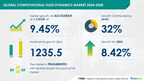
NEW YORK, Aug. 27, 2024 /PRNewswire/ — Report on how AI is redefining market landscape- The global computational fluid dynamics market size is estimated to grow by USD 1.23 billion from 2024-2028, according to Technavio. The market is estimated to grow at a CAGR of over 9.45% during the forecast period. Growing need for reduction in product design time and cost is driving market growth, with a trend towards increasing shift toward cloud based CFD. However, growing concerns about software and data privacy poses a challenge. Key market players include Altair Engineering Inc., ANSYS Inc., Autodesk Inc., Bentley Systems Inc., Cadence Design Systems Inc., COMSOL AB, Convergent Science Inc., CPFD Software LLC, Dassault Systemes SE, Flow Science Inc., Fluidyn Group, Hexagon AB, Kitware Inc., Mechartes Researchers Pvt. Ltd., PTC Inc., Siemens AG, SimScale GmbH, Synopsys Inc., The MathWorks Inc., and ZeusNumerix Pvt. Ltd..
Get a detailed analysis on regions, market segments, customer landscape, and companies- View the snapshot of this report
Computational Fluid Dynamics Market Scope
Report Coverage
Details
Base year
2023
Historic period
2018 – 2022
Forecast period
2024-2028
Growth momentum & CAGR
Accelerate at a CAGR of 9.45%
Market growth 2024-2028
USD 1235.5 million
Market structure
Fragmented
YoY growth 2022-2023 (%)
8.42
Regional analysis
North America, Europe, APAC, South America, and Middle East and Africa
Performing market contribution
APAC at 32%
Key countries
US, China, Germany, UK, and Canada
Key companies profiled
Altair Engineering Inc., ANSYS Inc., Autodesk Inc., Bentley Systems Inc., Cadence Design Systems Inc., COMSOL AB, Convergent Science Inc., CPFD Software LLC, Dassault Systemes SE, Flow Science Inc., Fluidyn Group, Hexagon AB, Kitware Inc., Mechartes Researchers Pvt. Ltd., PTC Inc., Siemens AG, SimScale GmbH, Synopsys Inc., The MathWorks Inc., and ZeusNumerix Pvt. Ltd.
Market Driver
The global Computational Fluid Dynamics (CFD) market is experiencing significant growth due to increasing demand for digitization, overall connectivity, and ease of use. Rising Research and Development (R&D) expenditure and product complexity are also driving market expansion. Vendors are responding to the growing adoption of cloud-based services by developing feature-rich Product Lifecycle Management (PLM) solutions. Cloud-based CFD offers advantages such as zero start-up time, guided workflows, and constant online support. The OpenFOAM Foundation Ltd., a leading CFD vendor, provides a complete OpenFOAM cloud computing platform using Amazon Web Services (AWS) EC2. This platform supports Elastic Network Adapter and C5n instances for effective scaling on clusters. These factors are expected to boost the growth of the global CFD market during the forecast period.
The Computational Fluid Dynamics (CFD) market is experiencing significant growth due to increasing trends in equation solving for complex fluid dynamics problems. Reduced testing time and product design cycles are key benefits, enabling faster analysis and optimization. Physical prototypes are being replaced with digital twins, reducing costs and improving sustainability. Data security and cybersecurity are crucial considerations, especially in industries like aerospace and energy. External factors, such as regulatory standards and sustainability metrics, are driving the adoption of green design principles and global supply chains. High-fidelity simulation and virtual prototyping are essential for optimizing manufacturing costs and improving efficiency. CFD software, hardware, and high-performance computing are essential tools for industries like renewable energy, healthcare, and biotechnology. Simulation capabilities are expanding to include industry applications like wind farms and circuit boards, with efficient product design and optimization at the forefront. Model calibration, boundary conditions, turbulence modeling, and mesh quality are critical elements of CFD analysis. Overall, the market is focused on delivering efficient, cost-effective, and sustainable solutions for various industries.
Explore a 360° Analysis of the Market: Unveil the Impact of AI. For complete insights- Request Sample!
Market Challenges
In the Computational Fluid Dynamics (CFD) market, data security and privacy concerns are increasingly important for businesses. With the adoption of cloud-based CFD software, there is a risk of data being accessed or mishandled by third-party service providers. Standard attacks, such as Man-in-the-Middle (MiTM), can affect the object storage component. Vendors are concerned that clients may not verify the Certificate Authority (CA) credential of the server before executing a secure socket layer connection, potentially leading to data leakage. Cloud solutions are more accessible for data sharing but come with risks such as distributed denial-of-service (DDoS) attacks, data breaches, unsecured application programming interfaces (APIs), data loss, and account hijacking. Software piracy, where a purchased license is shared with other end-users, also poses a threat to the privacy of CFD software. These issues may hinder the growth of the global CFD market during the forecast period.The Computational Fluid Dynamics (CFD) market is growing rapidly due to the increasing demand for efficient product design and optimization in various industries. CFD software helps businesses improve their manufacturing costs by simulating fluid flows and mechanics before actual production. However, the high cost of hardware and high-performance computing (HPC) requirements pose challenges. Cloud-based solutions and HPC are addressing these challenges by offering affordable simulation capabilities. Industries like Aerospace, Energy, Healthcare, Renewable Energy, Biotechnology, and Automotive Manufacturing are major consumers of CFD technology. The market is segmented into industries like Electrical and Electronics, Industrial Machinery, and Electric vehicles. CFD’s real-world performance in design and manufacturing processes is crucial for developed economies in sectors like Automobile and Industrialization. The growth rate of the CFD market is driven by sustainability initiatives, artificial intelligence, and environmental concerns. Earlier, coding practices involved the use of punched paper tapes and cards, but now software packages have streamlined the process. The deployment model choices include cloud-based and on-premises. CFD’s application in fluid flows and mechanics is essential for industries to ensure product efficiency and sustainability.
For more insights on driver and challenges – Request a sample report!
Segment Overview
This computational fluid dynamics market report extensively covers market segmentation by
End-user 1.1 Aerospace and defense industry1.2 Automotive industry1.3 Electrical and electronics industry1.4 OthersDeployment 2.1 Cloud2.2 On-premisesGeography 3.1 North America3.2 Europe3.3 APAC3.4 South America3.5 Middle East and Africa
1.1 Aerospace and defense industry- The aerospace segment of the global Computational Fluid Dynamics (CFD) market is projected to expand significantly during the forecast period due to the increasing demand for operational efficiency, cost reduction, and compliance with standards in the aerospace sector. Before the advent of CFD, aircraft manufacturing companies relied on wind tunnel testing and flight-testing methods to evaluate product performance. However, with the advent of powerful computers, these traditional methods have been replaced by numerical simulation methods based on the Navier-Stokes equation. CFD is now widely used in various stages of aircraft design and research and development. It is employed in designing external aerodynamics, fuel systems, engine core compartments, missiles, cockpit and cabin ventilation, and submarines. CFD significantly contributes to designing turbine engines and increasing engine fan efficiency. Advancements in CFD have led to increased bypass ratios using CFD codes and a reduced number of blades in aircraft engine turbines. The evolution of CFD codes from 2-D Euler models to current 3-D Navier-Stokes models has resulted in highly efficient and fewer-blade turbines, reducing blade costs. Engineering simulation software, such as SimScale’s cloud-based CAE platform, allows for powerful CFD simulations from any device, streamlining the design process and reducing the need for physical prototypes. In the aerospace industry, Mentor, a Siemens AG subsidiary, offers Capital Load Analyzer software to simplify aircraft electrical design compliance and certification. With the growth of digitization in manufacturing and product design, traditional tools have been replaced by more efficient CFD simulation software based on the Navier-Stokes equation. The significant benefits of CFD in aerospace and defense are expected to drive its adoption, fueling the growth of the global CFD market in the aerospace and defense segment during the forecast period.
For more information on market segmentation with geographical analysis including forecast (2024-2028) and historic data (2017-2021) – Download a Sample Report
Research Analysis
The Computational Fluid Dynamics (CFD) market is experiencing significant growth due to the increasing demand for efficient product design and optimization in various industries. CFD software, hardware, and high-performance computing (HPC) play crucial roles in simulating fluid flow and heat transfer, enabling manufacturers to reduce manufacturing costs and improve product performance. CFD is widely used in the aerospace industry for aerodynamic design, in the energy sector for power plant optimization, in healthcare for medical device design, and in renewable energy for wind turbine optimization, among others. The integration of artificial intelligence and machine learning algorithms in CFD software is further enhancing simulation capabilities, while environmental concerns are driving the adoption of cloud-based solutions and sustainable practices. The automotive sector, automobile manufacturing, electrical and electronics, industrial machinery, and electric vehicles are also major consumers of CFD technology. Computational fluid codes are the foundation of CFD simulations, enabling the accurate modeling of fluid mechanics and heat transfer phenomena.
Market Research Overview
The Computational Fluid Dynamics (CFD) market is a dynamic and growing industry focused on efficient product design and optimization. CFD software, hardware, and high-performance computing (HPC) technologies enable the simulation of fluid flows and mechanics, significantly reducing testing time and costs in various industries. CFD applications span aerospace, energy, healthcare, renewable energy, biotechnology, and more. Sustainability initiatives and environmental concerns are driving the market’s growth, with a focus on efficiency, sustainability, and artificial intelligence. Deployment models include cloud-based and on-premises solutions, catering to diverse industry segmentation. CFD plays a crucial role in the automotive manufacturing, electrical and electronics, industrial machinery, and electric vehicle sectors. Product design cycle analysis, regulatory standards, and sustainability metrics are essential considerations. External factors, such as project delays and budget constraints, necessitate high-fidelity simulation, virtual prototyping, and digital twin technologies. CFD also involves model calibration, boundary conditions, turbulence modeling, and mesh quality to ensure detailed simulation accuracy.
Table of Contents:
1 Executive Summary
2 Market Landscape
3 Market Sizing
4 Historic Market Size
5 Five Forces Analysis
6 Market Segmentation
End-userAerospace And Defense IndustryAutomotive IndustryElectrical And Electronics IndustryOthersDeploymentCloudOn-premisesGeographyNorth AmericaEuropeAPACSouth AmericaMiddle East And Africa
7 Customer Landscape
8 Geographic Landscape
9 Drivers, Challenges, and Trends
10 Company Landscape
11 Company Analysis
12 Appendix
About Technavio
Technavio is a leading global technology research and advisory company. Their research and analysis focuses on emerging market trends and provides actionable insights to help businesses identify market opportunities and develop effective strategies to optimize their market positions.
With over 500 specialized analysts, Technavio’s report library consists of more than 17,000 reports and counting, covering 800 technologies, spanning across 50 countries. Their client base consists of enterprises of all sizes, including more than 100 Fortune 500 companies. This growing client base relies on Technavio’s comprehensive coverage, extensive research, and actionable market insights to identify opportunities in existing and potential markets and assess their competitive positions within changing market scenarios.
Contacts
Technavio Research
Jesse Maida
Media & Marketing Executive
US: +1 844 364 1100
UK: +44 203 893 3200
Email: media@technavio.com
Website: www.technavio.com/
View original content to download multimedia:https://www.prnewswire.com/news-releases/computational-fluid-dynamics-market-to-grow-by-usd-1-23-billion-from-2024-2028–driven-by-demand-for-reduced-product-design-time-and-costs-report-highlights-ais-influence-on-market-trends—technavio-302231545.html
SOURCE Technavio










 Coin Market5 days ago
 Technology4 days ago

 Near Videos4 days ago
 Technology4 days ago
 Technology5 days ago
 Technology5 days ago