Connect with us

Technology

Bentley-Gallup Survey Reveals Americans Have Real Concerns About Artificial Intelligence

Published

on

Few trust businesses to use it responsibly, but transparency could help

WALTHAM, Mass., Aug. 28, 2024 /PRNewswire/ — Americans continue to see few upsides to using artificial intelligence in business. The latest survey from Bentley University and Gallup shows that U.S. adults see more harm than good from the use of AI, believe it will cost U.S. jobs and do not trust businesses to use it responsibly.

However, the study also suggests that businesses could help alleviate some of Americans’ concerns about AI by providing greater transparency into how they are using it.

Key Findings

Americans still see more harm than good from AI, but fewer see it as harmful.

The majority of Americans (56%) believe AI has a net neutral effect — doing equal amounts of harm and good. But they are more than twice as likely to believe it does more harm than good (31%) as they are to believe the good of AI outweighs its harms (13%).

The percentage of those who believe AI is more harmful than helpful has decreased nine percentage points in the past year, from 40% to 31%. Most of this shift has been driven by Americans over the age of 30, while views among younger Americans remain mostly unchanged.

These findings, from the latest Bentley-Gallup Business in Society Report, are based on a web survey with 5,835 U.S. adults conducted from April 29-May 6, 2024, using the probability-based Gallup Panel.

Nearly two-thirds of Americans (64%) report being at least somewhat knowledgeable about AI, including 9% saying they are extremely knowledgeable. Majorities in every age group of Americans say they are at least somewhat knowledgeable, but knowledge drops off sharply among those aged 60 and older. Men are more likely than women to say they are at least somewhat knowledgeable (72% vs. 57%, respectively).

Generally, those more knowledgeable about AI are less likely to express concern about its effects. However, even those who say they are extremely knowledgeable about AI are more likely to believe it does more harm than good than to say it does more good than harm (31% to 22%).

Most believe AI will cost the U.S. jobs and do not trust businesses to use it responsibly.

Three-quarters of Americans say AI will reduce the total number of jobs in the country over the next 10 years, the same as the percentage who said so last year. Also similar to last year, 77% of adults do not trust businesses much (44%) or at all (33%) to use AI responsibly. Additionally, nearly seven in 10 of those who are extremely knowledgeable about AI have little to no trust in businesses to use AI responsibly.

These are especially top-of-mind considerations for those who believe AI does more harm than good (AI skeptics). Those skeptics are 29 percentage points more likely than AI promoters (who see more good than harm) to believe AI will reduce jobs in the U.S. (88% vs. 59%, respectively). Also, AI skeptics are more than three times as likely as its promoters to say they do not trust businesses at all to use AI responsibly (55% vs. 16%, respectively).

Transparency could ease Americans’ worries about how AI is being used.

Americans express concerns about the use of AI in each of the six areas tested in the survey. Using AI to help students with homework or studying elicits the least worry, but two-thirds of adults find it at least somewhat concerning. At least eight in 10 adults are concerned about using AI for hiring decisions (85%), driving vehicles (83%) and recommending medical advice (80%).

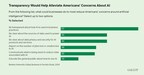
But there are steps businesses can take to alleviate these concerns. When asked to choose from a list of actions that businesses can take to most reduce concerns about AI, Americans most frequently say companies should be transparent about how AI is being used in business practices (57%). No other strategy was chosen by more than 34% of respondents.

Bottom Line

Although fewer Americans today see AI as harmful than did so a year ago, they are still firmly wary of how it is being used in a multitude of settings, including the workplace. While Americans tend to be less skeptical of AI when they know more about it, providing transparency and being clear — rather than offering education — may benefit businesses more if they are trying to convince the public that they can use AI responsibly.

Survey Methods:

Results for the 2024 Bentley-Gallup Business in Society Report are based on a Gallup Panel web survey completed by 5,835 U.S. adults, aged 18 and older, conducted April 29-May 6, 2024. For results based on this sample of adults, the margin of sampling error at the 95% confidence level is ±2.1 percentage points for response percentages around 50% and is ±1.3 percentage points for response percentages around 10% or 90%, design effect included. This report outlines preliminary findings from the survey.

2023 and 2022 results are from previous iterations of the Bentley-Gallup Business in Society Report. In 2023, the survey was conducted May 8-15, 2023. For these results, the maximum margin of sampling error is ±1.8 percentage points at the 95% confidence level. In 2022, the survey was conducted June 8-19, 2022. For these results, the maximum margin of sampling error is ±1.9 percentage points at the 95% confidence level.

In addition to sampling error, questions wording and practical difficulties in conducting surveys can introduce error or bias into the findings of public opinion polls.

View original content to download multimedia:https://www.prnewswire.com/news-releases/bentley-gallup-survey-reveals-americans-have-real-concerns-about-artificial-intelligence-302232213.html

SOURCE BENTLEY UNIVERSITY

Continue Reading
Click to comment

Leave a Reply

Your email address will not be published. Required fields are marked *

Technology

Manufacturing Category at 139th Canton Fair Presents Smarter, Lighter and More Connected Solutions

Published

on

By

GUANGZHOU, China, April 24, 2026 /PRNewswire/ — At the 139th Canton Fair, Manufacturing category presented a clear view of how industrial equipment is evolving to address efficiency, labor shortages, and sustainability goals. Across power equipment, machinery, automation systems, and industrial robots, exhibitors pointed to a common direction: smarter operation, stronger engineering performance, and deeper integration with digital manufacturing systems.

Industrial equipment is advancing towards intelligence with products emphasizing built-in sensing and automatic adjustment to enhance reliability and efficiency. Silent inverter generators, for example, can detect operating conditions and ambient temperature to regulate cooling for better fuel use and stability. Pumps and cleaning equipment with variable-frequency drives and integrated protection systems follow the same approach, prioritizing smooth operation, longer service life, and consistent output.

Lightweight, high-performance design has also become a priority across categories. Advances in materials and structural engineering are enabling major weight reductions without compromising power or durability. Aluminum-extrusion housings in three-phase asynchronous motors cut weight by up to 40% while improving heat dissipation and installation efficiency. Lightweight permanent-magnet submersible pumps delivered stronger flow stability despite smaller size and reduced weight.

AI-based visual inspection and quality control are also becoming essential. AI-powered optical inspection stations demonstrated full-process, high-speed inspection without relying on manual sampling. By turning experience-based judgment into standardized, repeatable rules, these systems help manufacturers improve scalability and consistency.

Industrial robots are taking on more active roles as well. Security patrol robot dogs and inspection robots are moving beyond monitoring to direct intervention, such as carrying fire-suppression modules for emergency response. This shift marks a broader move from passive observation to active execution in high-risk or labor-intensive environments.

Finally, more industrial devices are being designed as system nodes rather than standalone machines. Intelligent industrial gateways that combine data collection, protocol conversion, edge computing, and secure transmission show how equipment value increasingly depends on its ability to connect with enterprise-level digital systems.

The 139th Canton Fair vividly showcased the accelerated shift of industrial equipment toward intelligent and system-level development.

For pre-registration, please click: https://buyer.cantonfair.org.cn/register/buyer/email?source_type=16


View original content to download multimedia:https://www.prnewswire.com/news-releases/manufacturing-category-at-139th-canton-fair-presents-smarter-lighter-and-more-connected-solutions-302752629.html

SOURCE Canton Fair

Continue Reading

Technology

Zhejiang unicorn ranks grow to 58 as Hangzhou tightens lead, top ranking shows

Published

on

By

Province adds three unicorns, expands high-growth pipeline
Hangzhou accounts for 83% as new entrants and startups scale up

HANGZHOU, China, April 24, 2026 /PRNewswire/ — Zhejiang’s roster of unicorn companies has expanded to 58 as of April 2026, highlighting the province’s growing role as a hub for emerging technologies and industrial upgrading.

The latest rankings, released at the 10th All Blossom Conference in Hangzhou on April 23, show companies spread across seven cities, including Hangzhou, Ningbo, Jiaxing, Jinhua, Shaoxing, Taizhou and Wenzhou.

While Hangzhou, Ningbo and Jiaxing remain the top three hubs, the broader distribution points to a more geographically balanced innovation landscape. The province’s unicorn count rose by three from a year earlier.

Hangzhou continues to dominate the landscape, home to 48 of Zhejiang’s unicorns, up from 44 last year—when it already accounted for roughly four out of every five such startups.

The annual rankings also include tiered lists of “future unicorns,” valued between $100 million and $1 billion, and early-stage “seed unicorns” worth $10 million to $100 million.

Together, they map a full pipeline of high-growth companies across sectors such as artificial intelligence, embodied intelligence, life sciences, new energy, semiconductors, advanced manufacturing and aerospace, and have become a key barometer of Zhejiang’s startup ecosystem.

Among the top 100 future unicorns, integrated circuits lead with 22 companies, followed by artificial intelligence and life sciences with 19 each. Advanced manufacturing accounts for 16 firms, new energy and materials 15, and next-generation information technology nine.

In the seed unicorn category, new energy and life sciences each count 22 companies, ahead of advanced manufacturing with 19, while AI, next-generation IT and semiconductors each have 11 firms, and aerospace-related companies total four.

Against that provincial backdrop, Hangzhou remains the clear center of gravity—continuing to generate both the largest share of unicorns and the deepest pipeline of emerging startups.

The city added eight companies to its unicorn ranks on April 23, bringing the total to 48, according to the same conference ranking.

The new entrants—Hailiang Technology Services, Geener Microelectronics, Spirit AI, Geespace, Sunrise, Seepin, DEEP Robotics and Simplexity Robotics—span sectors from semiconductors and robotics to commercial aerospace.

As of April, Hangzhou accounted for 83% of Zhejiang’s unicorns, up from 80% a year earlier, underscoring its outsized role in the province’s innovation economy.

The conference also released a list of 413 quasi-unicorns—companies typically valued between $100 million and $1 billion—including 50 new additions.

Several firms, such as Diagens Biotechnology, Manycore Tech, Mirxes, Promisemed, Saint Bella, Tide Pharmaceutical, Tongshifu and ISV, exited the list after scaling into unicorn status or completing initial public offerings.

Quasi-unicorns are concentrated in sectors aligned with Hangzhou’s broader “296X” industrial strategy. Life sciences lead with 118 firms, followed by next-generation information technology with 78 and AI and embodied intelligence with 50—together accounting for about 60% of the total.

The “296X” is an industrial cluster blueprint the city introduced in October 2025 in an effort to speed up the integration of technological and industrial innovation.

More than half of both unicorns and quasi-unicorns—255 companies—are classified as nationally recognized “specialized and refined” enterprises, including 20 unicorns and 235 quasi-unicorns, reflecting a structured pipeline of high-growth firms.

Since 2018, Hangzhou’s unicorn count has risen from 26 to 48, while quasi-unicorns have expanded from 105 to 413, underscoring sustained growth in its innovation-driven economy.

View original content to download multimedia:https://www.prnewswire.com/apac/news-releases/zhejiang-unicorn-ranks-grow-to-58-as-hangzhou-tightens-lead-top-ranking-shows-302752640.html

SOURCE All Blossom Conference

Continue Reading

Technology

KUN Unveils AI Intelligent Strategy at Money20/20 Asia: Reconstructing Global Commercial Efficiency with “1-1-4-6” Layout

Published

on

By

BANGKOK, April 24, 2026 /PRNewswire/ — At the prestigious Money20/20 Asia held at QSNCC, KUN showcased its upgraded brand identity and launched the “1-1-4-6” Intelligent Strategic Blueprint. This milestone marks KUN’s comprehensive transition toward a globalized, full-stack, and intelligent ecosystem.

Dr. Louis Liu, Founder & Group CEO of KUN, stated at the launch: “While the convergence of Web2 and Web3 defines the current era, we believe the embedded ecosystem synergy of AI and Web3 is the inevitable future of commerce. Our evolution is an intelligent reconstruction of commercial efficiency. By leveraging decades of vertical payment expertise, we provide enterprise clients with full-stack, end-to-end payment and financial solutions. Through digital orchestration and operations, we deliver secure, compliant, and high-velocity transaction safeguards to empower global business growth.”

Money20/20 Roundtable: Compliance as the “Scaling Layer” for Institutional Adoption

At the “Bridging TradFi and DeFi” roundtable, Dr. Liu shared three key insights on the future of cross-border finance:

Asia as the Hub for Real-World Stablecoin Settlement: Asia has emerged as a critical hub for cross-border trade flows and stablecoin settlement, connecting high-growth emerging markets. Currently, 60% of the world’s on-chain stablecoin trade volume is centered in Asia, making it a primary corridor for capital flows between Asia, LATAM, Africa, and the Middle East.

Compliance as the “Scaling Layer”: The bottleneck for scaling digital payments is not technology or licensing, but the ability to embed jurisdictional compliance frameworks into business logic. Integrating AML and risk controls directly into the payment flow is the prerequisite for the explosion of global institutional applications.

Accelerating AI and Web3 Ecosystem Convergence: As AI agents increasingly enter commercial decision-making, payments are shifting from human-controlled to autonomous. Blockchain and stablecoins will serve as the default infrastructure for Agent-to-Agent (A2A) transactions.

Exhibition Interaction: From Platform Governance to Vertical Efficiency

At the main exhibition area, KUN demonstrated its dual-brand synergy through a new visual identity:

KUN: Positioned as the Trusted Vertical Digital Payments Platform for Real Economy, providing one-stop digital payments and scenario-based on-chain financial solutions.

YeeZ: A KUN Group brand specializing in 2B2C Global Corporate Card Issuance for global enterprises.

The “1-1-4-6” Strategic Blueprint: Driving Global Growth

KUN decoded its “1-1-4-6” strategy—an AI-powered blueprint designed for seamless asset mobility. The ecosystem integrates KUN Space™ (the digital payments & financial services platform) with KUN Nexus™ (the AI-orchestrated liquidity network). Driven by four core engines—KUN | Pay, KUN | Cards, KUN | Money, and KUN | Agent—the strategy empowers liquidity for six vertical sectors: Bulk Commodity, General Trade, B2B Cross-border E-Commerce, Service Trade, Web3 Ecosystems, and AI Applications.

Future Vision: The Era of “Driverless” Intelligent Payments

The launch highlighted KUN | Agent as the pioneer of the “driverless” era of intelligent global payments.

KUNClaw.AI: Orchestrates autonomous financial workflows to drive intelligent cost reduction and efficiency.

AI Agent Wallet: Features programmable KYC and authorization fences to ensure secure, compliant execution where “decision is payment”.

Seamless Network, Borderless Payments.

KUN remains dedicated to serving as the engine for the real economy, providing secure, compliant, and efficient one-stop cross-border payment solutions in an uncertain global environment.

About KUN

KUN is an innovative financial infrastructure company centered on digital payments and embedded finance. Built on a globally distributed licensing framework and a robust compliance and risk-management system, KUN connects Asia with high-growth emerging markets across Africa, Latin America, and the Middle East.

Positioned as a trusted vertical digital payments platform for real economies, the company operates across four core pillars—Cross-Border Digital Payments, On-Chain Finance, Card Issuing, and AI Agentic Payments. By integrating artificial intelligence and blockchain technologies, KUN delivers secure, compliant, and efficient one-stop payment and transaction services for enterprise clients across industries including commodity trade, B2B cross-border e-commerce, service trade, Web3 ecosystems, and AI applications.

Through this integrated infrastructure, KUN serves as a growth engine enabling enterprises to expand globally with speed, trust, and financial connectivity.

Learn more about KUN → www.kun.global

Contact: KUN: brandmkt@kun.global  

View original content:https://www.prnewswire.com/apac/news-releases/kun-unveils-ai-intelligent-strategy-at-money2020-asia-reconstructing-global-commercial-efficiency-with-1-1-4-6-layout-302752641.html

SOURCE KUN

Continue Reading

Trending