Connect with us

Technology

New study: Government GenAI optimism may be outpacing ability to deploy

Published

on

Despite high hopes and dedicated budgets for GenAI, government agencies need to increase guardrails, training; synthetic data could be missed opportunity

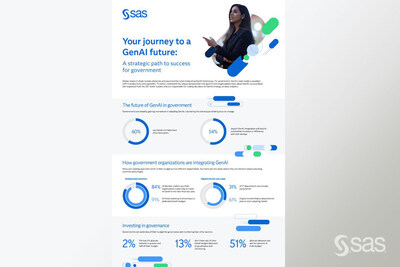
CARY, N.C., Oct. 3, 2024 /PRNewswire/ — A new global study, Your Journey to a GenAI Future: A Strategic Path to Success for Government from SAS and Coleman Parkes Research, reveals that government agencies lag well behind other sectors in the adoption of generative AI. However, 60% of government respondents believe GenAI will drive innovation, and those that have begun using it are already seeing improvements in employee satisfaction, compliance, and operational costs and time savings.

When properly planned and governed, GenAI will bring significant value to citizens and communities

Despite trailing other sectors by 10% (44% vs. 54%) in the current use of generative AI, the success of these early adopter agencies suggests enormous potential for the technology. Those benefits could arrive soon, with 84% of government decision makers saying their organizations are planning to invest in GenAI in the next fiscal year, and 91% of those respondents already having dedicated GenAI budget.

“While they haven’t been first to adopt GenAI, government agencies are poised to increase productivity and transform citizen services with this technology,” said Grant Brooks, Vice President of US Public Sector and Health Care at SAS. “Deploying AI in a measured and responsible manner is crucial, but when properly planned and governed, we can be confident that GenAI will bring significant value to our nation’s citizens and communities. We’ve partnered with government agencies through every major technological breakthrough of the last half century, and we’re excited to see what we can do together with GenAI.”

Need to overcome organizational obstacles with better governance, communication and policy

All sectors shared top concerns about data privacy, data security and AI governance. However, government respondents had larger concerns (52%) about cultural resistance to change compared to other concerns (46%) and believe compatibility with legacy systems could be a challenge.

Additionally, the promise of GenAI in government may be imperiled by inadequate regulatory preparedness and lack of understanding of GenAI, relative to other industries. While many organizations have rushed to put GenAI guidance in place, only 52% of government organizations have a policy stating how employees are and are not allowed to use GenAI at work, compared to 61% across all sectors.

The study found that government agencies set aside less of their budgets for governance and monitoring than other sectors; 64% have allotted one-tenth or less of their GenAI budgets to governance and monitoring. Additionally, 50% of public sector respondents said they either don’t have a framework or that it’s ad hoc or informal, in comparison to 39% across the board.

GenAI regulation is moving quickly, so keeping up with it while unlocking the technology’s value is a universal challenge. However, government may be less prepared than other sectors, as 51% of government leaders say they’re fully or moderately prepared to comply with current and upcoming GenAI regulations, compared to an average of 58% across all sectors.

Awareness is also a concern, as only 35% of public sector employees are familiar with their organizations’ adoption of GenAI, far less than the 46% average. These lagging indicators could be the result of a problem at the leadership level, as only 38% of senior government decision makers say they understand GenAI and its impacts on business processes well or completely, compared to 48% across all sectors.

There is good news though. Lower adoption rates in government corresponded with slightly lower policy preparedness and personal understanding, indicating that there is value in learning by doing. Government organizations that are implementing GenAI now are already seeing a range of benefits, in many cases outpacing other sectors. More government decision makers than the cross-sector average say that implementing GenAI has improved employee experience and satisfaction (94%) or created operational cost and time savings (84%).

“It’s natural that government would have some reticence to adopt GenAI, but the public sector pioneers are already showing that the more it’s used, the more confidence will grow, and innovation will accelerate,” said Jennifer Robinson, Global Government Strategic Advisor, SAS. “Large language models, digital twins and synthetic data hold tremendous potential for government agencies, once they have the processes and policies in place to maximize them.”

Low interest in synthetic data could inhibit innovation

Synthetic data is artificial data that accurately mimics real data. It reproduces the same statistical properties, probabilities, patterns and characteristics of the real-world data set from which the synthetic data is trained and has been found to be as much as 99% statistically valid.

For example, synthetic data of simulated traffic flows could help transportation departments test a road improvement with what-if scenarios even if they only have a few months of traffic data. Since it can mimic sensitive data, it can be created to train and test a system that processes health records, student records or tax information.

However, the study found that 32% of government decision makers would not consider using synthetic data. This exceeds the mere 23% of respondents across industries who are averse to its use.

“Synthetic data is particularly relevant for government agencies that must follow strict data privacy regulations,” said Robinson. “Governments can use synthetic data for various purposes, including research, testing and analysis, while mitigating risks of violating privacy regulations or exposing sensitive information.”

SAS: The past, present and future of public sector AI

Technologies like AI and generative AI are enabling fresh ideas about how public sector organizations can deliver services and are helping them rethink what services are offered. Gaze into the future of public service with a new e-book from SAS.

SAS has embedded AI capabilities into its software – from the powerful SAS® Viya® to targeted solutions for public sector organizations. With an emphasis on greater interpretability and transparency, SAS AI capabilities enable government agencies to better understand an algorithm’s outputs while better managing and protecting personal information. Learn more about how SAS analytics and AI are helping government agencies face today’s challenges at www.sas.com/en_us/industry/government/technology/ai.html.

About SAS
SAS is a global leader in data and AI. With SAS software and industry-specific solutions, organizations transform data into trusted decisions. SAS gives you THE POWER TO KNOW®.

SAS and all other SAS Institute Inc. product or service names are registered trademarks or trademarks of SAS Institute Inc. in the USA and other countries. ® indicates USA registration. Other brand and product names are trademarks of their respective companies. Copyright © 2024 SAS Institute Inc. All rights reserved. 

Editorial Contact:
Trent Smith
trent.smith@sas.com
919-531-4726
sas.com/news


View original content to download multimedia:https://www.prnewswire.com/news-releases/new-study-government-genai-optimism-may-be-outpacing-ability-to-deploy-302267084.html

SOURCE SAS

Continue Reading
Click to comment

Leave a Reply

Your email address will not be published. Required fields are marked *

Technology

Sungrow Unveils Full-Scenario Solution to Address Emerging Global Energy Challenges

Published

on

By

HEFEI, China, April 27, 2026 /PRNewswire/ — Sungrow, the globally leading PV inverter and energy storage system (ESS) provider, presented its full-scenario solution at Sungrow GRES (Global Renewable Energy Summit) 2026 on April 24th, outlining how integrated energy solutions can address the surging power demands and structural challenges facing industries worldwide.

Sectors such as mining & microgrid, hydrogen production, and EV charging are expanding at an unprecedented speed, with power supply becoming increasingly critical. According to third-party analysis, combined annual electricity demand from these sectors is expected to reach 4,000 TWh by 2030, while the power costs have already become a major operational challenge.

Despite a shared demand for reliable and affordable electricity, each industry faces unique pain points. Additionally, the wide divergence in operating environments, grid strength, load conditions, and power quality requirements underscores the need for scenario-specific energy solutions. Sungrow believes that premium, customized energy solutions are essential to addressing the diverse needs of different scenarios.

Customized Designs for Full-Scenario Applications
AIDC Scenario
In the digital era, rapid advances in AI are driving a surge in data center power demand, calling for a next-generation power supply architecture defined by high efficiency, high density, and strong resilience. Leveraging its expertise in power electronics and renewable energy, Sungrow entered the AIDC (Artificial Intelligence Data Center) sector last year with a comprehensive grid-to-chip solution. This year, Sungrow will launch a dedicated SST (Solid-State Transformers) solution for data centers, significantly reducing footprint while improving efficiency. Sungrow will also integrate grid-forming technology in AIDC ESS to mitigate grid disturbances and enhance system stability.

Mining Microgrid Scenario
Most mines are located in remote areas with limited grid access, complex loads, and strict power stability requirements, making energy supply a significant challenge. Sungrow addresses this with an integrated PV–wind–storage–EV charger–controller solution, reducing energy costs by 20–50% compared with a diesel generator. Given the variability of mining loads, Sungrow leverages advanced simulation capabilities to deliver tailored solutions with optimized equipment configurations, ensuring a reliable power supply and reduced CAPEX. Moreover, a five-level progressive protection system further safeguards stable operations under extreme conditions.

PV-ESS-EV Charging Integrated Scenario
Many EV charging projects suffer from poor coordination among system components, resulting in underperformance and reduced returns. Sungrow addresses this challenge with a one-stop, fully integrated solution that enables deep synergy across equipment and incorporates AI-driven operations, increasing overall revenue by more than 50%. Meanwhile, grid-forming technology has been extended to C&I applications to mitigate grid fluctuations caused by large-scale ultra-fast charging. In addition, Sungrow’s systems enable seamless integration with VPPs (Virtual Power Plants) through unified interfaces, unlocking greater value through diversified, future-ready revenue streams.

Hydrogen Production Scenario
In hydrogen production applications, Sungrow optimizes equipment configuration, reducing CAPEX by over 20% through PV–wind–storage–hydrogen integration and system-level simulation. In parallel, PV–storage–hydrogen DC coupling and flexible production technologies enhance energy efficiency and lower electricity costs by more than 10%.

Powering the Next Phase of Energy Transition
Renewable energy is shifting from a supplementary resource to a primary power source. This transition drives demand for premium energy solutions built on multi-energy integration for cost-efficient power, systematic grid-forming technologies for enhanced stability, and customized designs tailored to diverse scenarios. Sungrow believes that the deep integration of premium products and proven expertise is key to delivering truly scenario-adapted solutions.

Looking ahead, Sungrow will continue to build a more flexible, resilient, and sustainable energy landscape, helping industries meet growing energy demand and accelerate the transition to a low-carbon future.

About Sungrow
Sungrow, a global leader in renewable energy technology, has pioneered sustainable power solutions for over 29 years. As of Dec 2025, Sungrow has installed over 1000 GW of power electronic converters worldwide. The company is recognized as the world’s most bankable PV inverter and energy storage company (BloombergNEF). Its innovations power clean energy projects across the globe, supported by a network of 520 service outlets guaranteeing excellent customer experiences. At Sungrow, we’re committed to bridging to a sustainable future through cutting-edge technology and unparalleled service. For more information, please visit: www.sungrowpower.com/en

View original content to download multimedia:https://www.prnewswire.com/news-releases/sungrow-unveils-full-scenario-solution-to-address-emerging-global-energy-challenges-302754036.html

SOURCE Sungrow

Continue Reading

Technology

Sumsub Recognized as Leader in Chartis RiskTech Quadrant for Enterprise Fraud Solutions 2026

Published

on

By

Building on consistent Chartis recognition across fincrime, identity, and compliance reports for the third consecutive year

LONDON, April 27, 2026 /PRNewswire/ — Sumsub, a global verification and anti-fraud leader, has been recognized as a Category Leader in the Chartis RiskTech Quadrant® for Enterprise Fraud Solutions* 2026. The report evaluates vendors based on the completeness of their offering and its market potential, positioning Sumsub among the top providers addressing increasingly sophisticated fraud threats faced by enterprises worldwide.

The 2026 recognition builds on a consistent track record in Chartis research. In 2024, Sumsub was acknowledged in the same category, as well as received two further recognitions as a Category Leader in RiskTech Quadrant for AML Transaction Monitoring Solutions and for its Best-in-Class Capabilities for Application Fraud and Identity Risk. In 2025 Sumsub was named Winner in Chartis Financial Crime and Compliance 50. Together, these placements reflect Sumsub’s sustained performance across identity verification, fraud prevention, and compliance.

“Sumsub has shown itself to be a strong cross-functional player, with Category Leader, Enterprise Solution and Best of Breed positions respectively in our Enterprise, Fraud Platforms, and Payment Fraud RiskTech Quadrants,” said Phil Mackenzie, Senior Research Principal at Chartis. “Its identity-centric approach is a clear differentiator, combining identity signals with performant real-time fraud signals – making it particularly appropriate for digital-first financial institutions and cross-border use cases.”

“Being recognized again as a Category Leader by Chartis reflects our ongoing focus on delivering reliable, scalable solutions that help businesses stay ahead of evolving risks”, added Andrew Sever, CEO and co-founder of Sumsub. “As fraud is becoming more complex and AI-driven, with the share of sophisticated multi-step attacks having increased by 180% over 2024-2025, we remain committed to equipping companies with the tools they need to safeguard trust, meet regulatory requirements, and grow securely.”

Sumsub’s recognition is underpinned by its advanced Fraud Prevention solution, which combines AI-powered anomaly detection, device intelligence, and behavior monitoring to identify and stop fraud across the entire user journey in real time. Alongside its technology offering, the company invests in industry education through the Sumsub Academy: its recently-launched Fraud Prevention course equips risk and compliance professionals with practical knowledge and frameworks to combat evolving fraud threats.

To learn more about 2025-2026 fraud trends and predictions, feel free to check the latest edition of Sumsub Identity Fraud Report here: https://sumsub.com/fraud-report-2025/.

Chartis Research is a leading provider of research and analysis on the global market for risk technology. Its RiskTech Quadrant® reports are widely regarded as an industry benchmark, offering an independent assessment of vendors’ capabilities, market presence, and strategic direction across key risk and compliance categories.

To access the full Chartis RiskTech Quadrant® for Enterprise Fraud Solutions 2026 report, please go to their website.

*Enterprise Solutions Description:

The Enterprise Solutions category covers vendors that deliver scalable platforms capable of supporting fraud and financial crime risk management across large, complex financial organizations. These solutions typically cover data ingestion, analytics, and case management within a unified architecture, enabling controls across multiple business lines, geographies, and channels. Key differentiators include coverage of fraud typologies (including advanced or proprietary techniques, behavioral modelling and libraries of pre-packaged rules), modelling and testing capabilities, and the overall infrastructure of the solution including deployment options, flexible workflow and case management.

About Sumsub

Sumsub is a leading full-cycle verification platform that enables fraud-free, scalable compliance. Its adaptive, no-code solution covers everything from identity and business verification to ongoing monitoring—quickly adjusting to evolving risks, regulations, and market demands.

Recognized as a Leader by Gartner, Forrester, and IDC, Sumsub combines seamless integration with advanced fraud prevention to deliver industry-leading performance.

Over 4,000 clients—including Bitpanda, Wirex, Avis, Bybit, Vodafone, Duolingo, Kaizen Gaming, and TransferGo—trust Sumsub to streamline verification, prevent fraud, and drive growth. The platform’s methodology follows leading global AML standards and regulations, and Sumsub has extensively engaged with leading research and public institutions like the UN, Statista, and INTERPOL.

View original content to download multimedia:https://www.prnewswire.com/news-releases/sumsub-recognized-as-leader-in-chartis-risktech-quadrant-for-enterprise-fraud-solutions-2026-302753976.html

SOURCE Sumsub

Continue Reading

Technology

TeamViewer Advances Toward Autonomous Endpoint Management: Tia Now Generates Automations From Customers’ Own Proven Fixes

Published

on

By

LONDON, April 27, 2026 /CNW/ — TeamViewer today introduced AI-driven scripting for Tia (TeamViewer Intelligent Agent) at the Gartner Digital Workplace Summit 2026 in London. Building on more than one million AI session summaries produced since launch, Tia can now learn from an organization’s support history and turn resolved issues into ready-to-run automations, giving IT teams a faster, more consistent path to standardizing proven fixes. The release marks an important milestone in TeamViewer’s Autonomous Endpoint Management (AEM) roadmap.

The new capabilities address one of IT’s most persistent inefficiencies: even when issues are resolved, the applied fixes are rarely captured in a way that prevents the same problem from recurring. Tia now tackles this in two connected steps: First, it draws on AI insights from real support sessions to ground its troubleshooting recommendations in an organization’s actual support history and context, surfacing proven remediation steps from past sessions rather than relying on general knowledge. From there, IT teams can choose to turn any resolved session into a script that Tia generates based on the documented remediation steps. The automation is then ready for the team to review and refine before deploying it to selected devices or device groups.

The release reflects how TeamViewer is building out its AEM vision in stages through TeamViewer ONE, its unified digital workplace platform: from secure remote support and real-time endpoint observability to in-session AI expert augmentation and knowledge capture, and now to AI-driven automations grounded in proven fixes. Each resolved incident makes the next one easier to prevent, as AI sessions and endpoint telemetry combine to surface recurring patterns across the IT environment. Where remote support platforms, DEX tools, and RMM solutions each address parts of this challenge in isolation, Tia connects them, grounding every automation in verified remediation steps drawn from the customer’s own support history and relevant context.

“IT teams are under pressure to do more with the resources they have, and too much of their time is still spent resolving the same issues over and over,” said Mei Dent, Chief Product & Technology Officer, TeamViewer. “Tia’s new capabilities mean that every resolved incident becomes an asset: one that can be tested, deployed, and used to protect other devices from the same disruption. That is what consistent, scalable IT operations en route to AEM looks like in practice.”

TeamViewer is unveiling the innovation at the Gartner Digital Workplace Summit 2026 in London, where the company is also presenting two sessions: “Building the Autonomous Workplace with a DEX Knowledge Layer” on April 28, and “The Top 3 DEX Myths Sabotaging Your Digital Strategy” on April 27. Attendees can visit TeamViewer at Expo Booth 207 or the Engagement Zone in the foyer on Level 1.

About TeamViewer

TeamViewer provides a Digital Workplace platform that connects people with technology – enabling, improving and automating digital processes to make work work better.

In 2005, TeamViewer started with software to connect to computers from anywhere to eliminate travel and enhance productivity. It rapidly became the de facto standard for remote access and support and the preferred solution for hundreds of millions of users across the world to help others with IT issues. Today, more than 635,000 customers across industries rely on TeamViewer to optimize their digital workplaces – from small to medium sized businesses to the world’s largest enterprises – empowering both desk-based employees and frontline workers.

Organizations use TeamViewer’s solutions to prevent and resolve disruptions with digital endpoints of any kind, securely manage complex IT and industrial device landscapes, and enhance processes with augmented reality powered workflows and assistance – leveraging AI and integrating seamlessly with leading tech partners. Against the backdrop of global digital transformation and challenges like shortage of skilled labor, hybrid working, accelerated data analysis and the rise of new technologies, TeamViewer’s solutions offer a clear value add by increasing productivity, reducing machine downtime, speeding up talent onboarding, and improving customer and employee satisfaction.

The company is headquartered in Göppingen, Germany, and employs around 1,900 people globally. In 2025, TeamViewer achieved a revenue of around EUR 768 million. TeamViewer SE (TMV) is listed at Frankfurt Stock Exchange and belongs to the SDAX. Further information can be found at www.teamviewer.com.

Logo – https://mma.prnewswire.com/media/2639323/5936638/TeamViewer_Logo.jpg

View original content to download multimedia:https://www.prnewswire.com/news-releases/teamviewer-advances-toward-autonomous-endpoint-management-tia-now-generates-automations-from-customers-own-proven-fixes-302753277.html

SOURCE TeamViewer Germany GmbH

Continue Reading

Trending