Technology
Electric Vehicle (EV) Battery Market to grow by USD 65.23 Billion from 2024-2028, driven by rising EV demand, AI-powered report highlights market evolution – Technavio
Published
2 years agoon
By
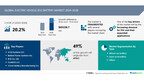
NEW YORK, Oct. 7, 2024 /PRNewswire/ — Report on how AI is driving market transformation – The Global Electric Vehicle (EV) Battery Market size is estimated to grow by USD 65.23 billion from 2024-2028, according to Technavio. The market is estimated to grow at a CAGR of over 20.2% during the forecast period. Increasing demand for EVS and their expanded applications is driving market growth, with a trend towards increasing use of software and sensors for intelligent BMS. However, growing global power crisis poses a challenge – Key market players include A123 Systems LLC, Ballard Power Systems Inc., BYD Co. Ltd., CLARIOS LLC, Crown Battery Manufacturing Co., Cummins Inc., East Penn Manufacturing Co. Inc., EnerSys, Enertech International Inc., Envision Group, Exide Industries Ltd., GS Yuasa International Ltd., Hitachi Ltd., LG Chem Ltd., OptimumNano Energy Co. Ltd., Panasonic Holdings Corp., Samsung SDI Co. Ltd., SK Innovation Co. Ltd., Solid Power Inc., Tianneng Group, and Zhejiang Narada Power Source Co. Ltd..
AI-Powered Market Evolution Insights. Our comprehensive market report ready with the latest trends, growth opportunities, and strategic analysis- View your snapshot now
Forecast period
2024-2028
Base Year
2023
Historic Data
2018 – 2022
Segment Covered
Type (Lithium-ion battery, Lead-acid battery, and Others), Vehicle Type (Battery electric vehicle, Plug-in hybrid electric vehicle, and Hybrid electric vehicle), and Geography (APAC, Europe, North America, South America, and Middle East and Africa)
Region Covered
APAC, Europe, North America, South America, and Middle East and Africa
Key companies profiled
A123 Systems LLC, Ballard Power Systems Inc., BYD Co. Ltd., CLARIOS LLC, Crown Battery Manufacturing Co., Cummins Inc., East Penn Manufacturing Co. Inc., EnerSys, Enertech International Inc., Envision Group, Exide Industries Ltd., GS Yuasa International Ltd., Hitachi Ltd., LG Chem Ltd., OptimumNano Energy Co. Ltd., Panasonic Holdings Corp., Samsung SDI Co. Ltd., SK Innovation Co. Ltd., Solid Power Inc., Tianneng Group, and Zhejiang Narada Power Source Co. Ltd.
Key Market Trends Fueling Growth
The Electric Vehicle (EV) and Plug-in Hybrid Electric Vehicle (PHEV) markets are witnessing significant growth due to the increasing adoption of advanced features such as Global Positioning Systems (GPS), power train systems, air conditioning (AC), power windows, and display drives. These features consume substantial power, leading to a higher energy demand from EV batteries. As a result, there is an increasing need for efficient and optimal battery management systems (BMS) to ensure a long battery life and minimize charging frequency. The automotive industry is focusing on developing advanced high-end BMS solutions using high-power density lithium-ion batteries. Intelligent BMS trends include the use of software and sensors for precise information, which helps design an efficient battery management system. The accuracy, fault detectability, and robustness of the BMS controller are crucial factors driving the growth of the EV battery market. These trends are expected to continue, leading to increased demand for EV batteries during the forecast period.
The Electric Vehicle (EV) battery market is surging as automakers prioritize EV technology for their fleets. Lithium-ion batteries remain the go-to choice for most EVs due to their long driving ranges and relatively quick charging times. However, new players like QuantumScape and Solid Power are developing solid-state batteries, promising even better performance and shorter charging times. Battery life is a key concern for consumers, with automakers focusing on improving it through advancements in battery technology. EV sales continue to grow, with SUVs, PHEVs, BEVs, and EREVs leading the charge. The demand for batteries is driving the need for more manufacturing capacity, with companies like Tesla and Panasonic building gigafactories. Lithium-ion battery prices have been decreasing due to increased supply and demand. However, the supply chain for lithium, cobalt, nickel, and other essential minerals can be volatile, impacting battery prices. New battery technologies, such as Lithium Iron Phosphate and graphite-manganese-phosphoric acid batteries, are being explored to reduce reliance on traditional battery materials. Energy density is a critical factor in improving EV performance and reducing costs. Companies are focusing on improving cell-to-pack and cell-to-chassis efficiency to increase energy density. The race is on to bring the next generation of EV batteries to market and stay ahead of the competition. Meanwhile, some automakers are exploring alternatives to lithium-ion batteries, such as hydrogen vehicles and ethanol vehicles, but their market penetration remains limited. The EV battery market is an exciting space to watch as companies push the boundaries of innovation to meet the growing demand for cleaner, more efficient transportation solutions.
Insights on how AI is driving innovation, efficiency, and market growth- Request Sample!
Market Challenges
The global Electric Vehicle (EV) battery market is experiencing significant growth due to the increasing demand for EVs. However, in regions with limited power generation capacity, such as developing countries like Norway, the Netherlands, and the UK, as well as underdeveloped countries like Nepal, the high sales of EVs pose challenges. For instance, Europe, which has nearly a quarter of EVs on the road, saves approximately 13 million barrels of crude oil daily. However, this shift to EVs also increases global power demand by 11%. Power crises in countries like India and Japan, which rely heavily on imports for their energy needs, further impact the EV market. Japan’s electricity consumption, driven by its EV adoption, adds to its already significant energy import dependence and cost. These power crises and the subsequent electricity cost increases hinder the sales of EVs and, consequently, EV batteries, potentially hindering market growth.The Electric Vehicle (EV) battery market is experiencing significant growth, with the Lithium-ion battery segment leading the way. Companies like Tesla and Panasonic are expanding their Gigafactories to increase manufacturing capacity. However, challenges persist, such as the reliance on limited resources like lithium, cobalt, nickel, and other materials for battery production. Mining and refining these elements can impact the supply chain and drive up battery prices. New battery technologies like Lithium Iron Phosphate and sodium-ion batteries are emerging, but manufacturing capacity and energy density remain key concerns. The Cadillac Lyriq, an all-electric SUV, uses laser bonding to improve battery performance. BEVs, EREVs, and PHEVs are driving EV sales, but the Internal Combustion Engine still dominates. Northvolt and LG Energy Solutions are investing in battery manufacturing to secure energy security. The battery pack price remains high, with cell-to-pack and cell-to-chassis technologies aiming to reduce costs. The battery chemistries continue to evolve, with graphite, manganese, and phosphoric acid playing crucial roles. The market is dynamic, with Lead acid batteries, Nickel-metal hydride batteries, and Lithium-ion batteries competing in the EV landscape.
Insights into how AI is reshaping industries and driving growth- Download a Sample Report
Segment Overview
This electric vehicle (ev) battery market report extensively covers market segmentation by
Type 1.1 Lithium-ion battery1.2 Lead-acid battery1.3 OthersVehicle Type2.1 Battery electric vehicle2.2 Plug-in hybrid electric vehicle2.3 Hybrid electric vehicleGeography 3.1 APAC3.2 Europe3.3 North America3.4 South America3.5 Middle East and Africa
1.1 Lithium-ion battery- The lithium-ion battery segment is experiencing significant growth in the Electric Vehicle (EV) market due to the increasing demand for this battery technology from the EV industry. Lithium-ion batteries, which belong to the lithium-metal chemistries family, are manufactured using various combinations of anode and cathode materials. The most common cathode combinations used in transportation applications are lithium-nickel-cobalt-aluminum oxide (NCA), lithium nickel manganese cobalt oxide (NCM), lithium-manganese spinel (LMO), lithium titanate (LTO), and lithium-ion phosphate (LFP). Each of these combinations offers distinct characteristics in terms of safety, cost, and performance. Lithium-ion batteries have a higher current density, longer power-holding capacity, and longer shelf life compared to other battery technologies. Additionally, the mass production and government incentives are driving down the cost of these batteries. Lithium-ion batteries are preferred for EVs due to their superior electrochemical performance and capacity. They are smaller and lighter than lead-acid batteries of similar capacity, reducing the weight of EVs and offering flexibility to manufacturers. Moreover, these batteries require minimal maintenance, reducing downtime in EVs. Lithium-ion batteries come in cylindrical, prismatic, and laminate shapes, with each cell having unique characteristics for creating the battery pack based on end-user requirements. Panasonic Corporation offers cylindrical lithium-ion cells, Samsung SDI CO., LTD. Provides laminate lithium-ion cells, and LG Chem offers prismatic lithium-ion cell-based battery packs. Lithium-ion batteries do not have the drawbacks of other battery chemistries, such as lead-acid batteries and NiMH batteries, making them the preferred choice for EVs. Therefore, the demand for lithium-ion batteries in the EV market is expected to continue growing, driving the market’s expansion during the forecast period.
Download complimentary Sample Report to gain insights into AI’s impact on market dynamics, emerging trends, and future opportunities- including forecast (2024-2028) and historic data (2018 – 2022)
Research Analysis
Electric Vehicles (EVs) are revolutionizing the automotive industry with their eco-friendly and cost-effective solutions. A significant component of EVs is their batteries, which store and release electricity to power the vehicles. EV batteries come in various types, with lithium-ion batteries being the most popular due to their high energy density, long life, and short charging times. They offer impressive driving ranges, making EVs a viable alternative to traditional Internal Combustion Engine (ICE) vehicles. Battery technology is continually evolving, with solid-state batteries promising even better performance and safety. Automakers are investing heavily in EV technology, with Battery Electric Vehicles (BEVs), Plug-in Hybrid Electric Vehicles (PHEVs), Electric SUVs, and Electric Sedans leading the charge. The global EV battery market is growing rapidly, with the Lithium-ion segment dominating the market due to its superior performance. The demand for EV batteries is expected to reach Gigawatt hours in the coming years, driven by energy security concerns and the need to reduce carbon emissions. Lead acid batteries and Nickel-metal hydride batteries have been the traditional choices for EVs but are being gradually replaced by lithium-ion batteries due to their advantages. The EV battery market is poised for significant growth, with companies like Northvolt leading the way in innovation and production.
Market Research Overview
The Electric Vehicle (EV) battery market is experiencing significant growth as the adoption of electric vehicles (EVs) continues to rise. EV batteries play a crucial role in powering these vehicles, offering features like longer driving ranges, faster charging times, and improved battery life. Lithium-ion batteries are currently the dominant technology, but solid-state batteries and other advanced chemistries are on the horizon. Automakers are investing heavily in EV technology, with some announcing new models like the Cadillac Lyriq. Hydrogen vehicles and ethanol vehicles are also being explored as alternatives, but EVs are currently the most viable option for reducing emissions from the transportation sector. EV battery manufacturing is a complex process involving the mining and refining of raw materials like lithium, cobalt, nickel, and manganese. Gigafactories, such as those operated by Tesla and LG Energy Solutions, are increasing manufacturing capacity to meet demand. Energy density, battery performance, and manufacturing capacity are key considerations for battery technologies like Lithium Iron Phosphate, sodium-ion batteries, and others. Battery prices are also a significant factor, with advancements in battery manufacturing techniques like cell-to-pack and cell-to-chassis helping to reduce costs. The EV market is expected to continue growing, with sales of electric cars, SUVs, PHEVs, BEVs, and EREVs projected to reach new heights in the coming years. However, the supply chain for EV batteries remains a challenge, with energy security and raw material availability being key concerns.
Table of Contents:
1 Executive Summary
2 Market Landscape
3 Market Sizing
4 Historic Market Size
5 Five Forces Analysis
6 Market Segmentation
TypeLithium-ion BatteryLead-acid BatteryOthersVehicle TypeBattery Electric VehiclePlug-in Hybrid Electric VehicleHybrid Electric VehicleGeographyAPACEuropeNorth AmericaSouth AmericaMiddle East And Africa
7 Customer Landscape
8 Geographic Landscape
9 Drivers, Challenges, and Trends
10 Company Landscape
11 Company Analysis
12 Appendix
About Technavio
Technavio is a leading global technology research and advisory company. Their research and analysis focuses on emerging market trends and provides actionable insights to help businesses identify market opportunities and develop effective strategies to optimize their market positions.
With over 500 specialized analysts, Technavio’s report library consists of more than 17,000 reports and counting, covering 800 technologies, spanning across 50 countries. Their client base consists of enterprises of all sizes, including more than 100 Fortune 500 companies. This growing client base relies on Technavio’s comprehensive coverage, extensive research, and actionable market insights to identify opportunities in existing and potential markets and assess their competitive positions within changing market scenarios.
Contacts
Technavio Research
Jesse Maida
Media & Marketing Executive
US: +1 844 364 1100
UK: +44 203 893 3200
Email: media@technavio.com
Website: www.technavio.com/
View original content to download multimedia:https://www.prnewswire.com/news-releases/electric-vehicle-ev-battery-market-to-grow-by-usd-65-23-billion-from-2024-2028–driven-by-rising-ev-demand-ai-powered-report-highlights-market-evolution—technavio-302267982.html
SOURCE Technavio
You may like
Technology
Monport MEGAS Brings Advanced LightBurn Features to Desktop CO2 Laser Engraving
Published
18 minutes agoon
July 27, 2026By
New 70W desktop CO2 laser engraver brings LightBurn’s advanced feature set — autofocus, wireless connectivity and live camera placement — directly into the software, closing a gap most “LightBurn compatible” machines leave open.
SEATTLE, July 27, 2026 /PRNewswire/ — As LightBurn continues to be the preferred software for makers, educators, and small manufacturing businesses, Monport is emphasizing the advanced workflow capabilities of its MEGAS 70W desktop CO2 laser engraver. The system enables users to perform autofocus, wireless connectivity, and live camera positioning directly inside LightBurn, creating a more streamlined production workflow than the basic compatibility offered by many desktop laser systems.
The integration allows users to complete nearly every production step directly inside LightBurn rather than switching between multiple software applications.
The announcement positions the MEGAS as a candidate for best CO2 laser engraver among software-focused buyers: makers, Etsy and Shopify sellers, and small production shops who run LightBurn daily and have grown frustrated switching between a manufacturer’s app and the software they actually use to build and send jobs. The feature announcement coincides with Monport’s Summer Sale, which drops the MEGAS to $2,799.99 for a limited time.
Why “LightBurn Compatible” Doesn’t Always Mean Full Support
LightBurn is the industry-standard control software for hobbyist and small-business laser systems, but compatibility varies widely between machines. Many desktop CO2 laser engravers can send basic cut and engrave jobs to LightBurn, yet require a separate manufacturer app for autofocus, camera alignment or wireless setup—breaking the workflow and adding extra steps every time a job changes materials or needs repositioning.
Industry buyers researching a 70W laser engraver often discover this gap only after purchase: a listing says “LightBurn compatible,” but autofocus still means picking up a manual gauge, and camera alignment means opening a second piece of software just to preview where a design will land.
Going Beyond Basic LightBurn Compatibility
Many competing desktop laser systems support basic LightBurn functions for cutting and engraving. Advanced features such as autofocus, wireless camera positioning and complete wireless workflow integration, however, are often limited, and may require proprietary software, or are unavailable inside LightBurn itself.
The Monport MEGAS was engineered to provide these advanced functions directly within LightBurn, helping users spend less time switching between applications and more time producing finished products— one of the reasons Monport designed the MEGAS specifically for LightBurn power users.
Autofocus Without Leaving LightBurn
On the MEGAS, autofocus is triggered and confirmed directly inside LightBurn, so operators can set material height and start a job without switching to a separate focusing tool or app. For a 70W laser engraver running frequent material changes—from thin acrylic sheet to thicker basswood board—that single-window workflow removes one of the more repetitive steps in a typical production day.
Wireless Connectivity Simplifies Shop Workflow
The wireless connection also enables operators to send jobs to the machine without repeatedly reconnecting USB cables, making the workflow especially useful in classrooms, shared makerspaces and production environments where multiple computers may access the laser.
The MEGAS connects to LightBurn over Wi-Fi, removing the tethered USB connection many desktop CO2 laser engravers still require. That means the machine can be positioned away from a workstation and run jobs sent wirelessly, a common request among small-shop and classroom users managing limited floor space or shared equipment.
Live Camera Placement Inside LightBurn
An onboard wireless camera streams a live view of the work surface into LightBurn, letting users position and align artwork on pre-printed or irregular material directly on screen instead of manually measuring and test-firing the laser.
From Design File to Finished Product
For many laser users, efficiency is measured by how quickly a design becomes a finished product. With the MEGAS, users can import artwork into LightBurn, position the design using the live wireless camera, activate autofocus with a single click, and begin engraving without leaving the software.
By keeping every major production step inside one interface, the workflow reduces setup time, minimizes alignment errors, and simplifies repeat production for businesses engraving dozens—or even hundreds—of personalized products each day on their desktop CO2 laser engraver.
Real-World Material Performance
To demonstrate production versatility, during internal testing, Monport evaluated the MEGAS across several materials commonly used by Etsy sellers, gift businesses and production workshops:
Plywood — crisp engraved wooden signs with clean edgesAcrylic — polished awards and plaques with sharp detailLeather — high-contrast wallet engraving with minimal scorching
The testing demonstrates that a single desktop CO2 laser engraver can handle multiple product categories without requiring significant workflow changes.
Better ROI for Small Businesses
Monport also compared estimated material costs with typical retail pricing across four popular product categories:
Engraved plywood sign: Approximately $35 retail price with about $5 in material costs.Engraved acrylic award: Approximately $45 retail price with about $8 in material costs.Engraved leather wallet: Approximately $55 retail price with about $12 in material costs.
Based on estimated material costs alone, these products show potential material-cost margins of approximately 75% to 85%, before accounting for labor, packaging, shipping, platform fees and other operating expenses. Monport says the combination of higher-margin products, intelligent batch engraving, and a streamlined LightBurn workflow can help small businesses, Etsy sellers, and Shopify merchants recover their investment more quickly as production scales.
Built for Professional LightBurn Users
While M-Design Hub, Monport’s free Windows and macOS software, offers AI-powered image processing, one-click material settings and intelligent batch engraving, Monport says the MEGAS was equally designed for experienced LightBurn users who prefer complete control over every project.
Supporting both software environments gives creators the flexibility to choose an automated workflow for everyday production or LightBurn’s advanced tools for more complex engraving jobs—a combination Monport believes makes the case for the MEGAS as a best CO2 laser engraver choice regardless of skill level.
“LightBurn has become the workflow that thousands of makers and small businesses rely on every day,” said Monport CEO.
“Our goal with the MEGAS was to eliminate unnecessary software switching by bringing advanced features like autofocus, wireless connectivity and live camera positioning directly into LightBurn. That lets users focus on production instead of setup.”
Explore Advanced LightBurn Features on the MEGAS
Monport is positioning the MEGAS as an entry point for LightBurn users who want to explore the software’s advanced feature set without adding a second app to their workflow. Full setup guides and LightBurn configuration walkthroughs for the MEGAS are available on Monport’s website.
Summer Sale Pricing
As part of Monport’s Summer Sale this July, the MEGAS desktop CO2 laser engraver is available at a special offer price of $2,799.99—the limited-time promotional price on the machine to date. The discount is applied automatically at checkout; no promo code is required. The offer runs for a limited time or while supplies last and includes two complimentary laser marking spray bottles, used to prepare bare metal surfaces such as stainless steel for laser marking.
Availability
The Monport MEGAS 70W desktop CO2 laser engraver is available through Monport’s official website.
About Monport
Founded in 2020 and headquartered in Seattle, Monport designs desktop and industrial CO2 and fiber laser engraving and cutting machines for makers, small businesses and workshops, backed by U.S.-based technical support.
Media Contact:
Monport Laser
Email: official@monportlaser.com
Website: https://monportlaser.com
View original content:https://www.prnewswire.com/news-releases/monport-megas-brings-advanced-lightburn-features-to-desktop-co2-laser-engraving-302835013.html
SOURCE Monport
Technology
Tredence Launches Domain Native Forward Deployed Engineering to Close the Last Mile of Enterprise AI
Published
18 minutes agoon
July 27, 2026By
The FDE practice builds an elite class of engineers at the intersection of domain expertise and data & AI, solving enterprises’ hardest business problems.
BENGALURU, India and SAN JOSE, Calif., July 27, 2026 /PRNewswire/ — Tredence, the world’s leading data & AI services company, today announced the launch of its Forward Deployed Engineering (FDE) practice, committing to build a dedicated pool of 200 FDEs over the next 12-18 months. Through this practice, the company intends to build the most domain-native engineering capability in the market, helping clients move faster from problem to impact.
Built to tackle high-impact challenges for Fortune 100 enterprises, Tredence’s FDEs are domain specialists first and engineers second. A Retail FDE understands markdown cycles and assortment planning. A supply chain FDE understands network constraints and demand volatility. A revenue growth management (RGM) FDE understands trade spend and price elasticity.
Each Tredence FDE brings that depth to the work of building and scaling agentic systems, applying deep engineering expertise to the business decisions that matter most, from pricing and promotions to the data and semantic foundations that power enterprise operations. They are platform agnostic by design, working across clients’ existing technology stack, including Databricks, Google Cloud, Microsoft, Snowflake, AWS, and leading frontier model providers.
Enterprise AI often struggles at the last mile, where data, systems, and business decisions must come together to create measurable value. Tredence’s Forward Deployed Engineers combine speed, powered by deep AI, data, and engineering expertise, with depth, built through years of domain experience, to turn AI into business outcomes faster.
“Enterprise AI is at an inflection point, and success now depends on combining AI-native engineering with industry depth to turn technology into real business outcomes. Our FDEs are designed to solve the hardest business problems, lead end-to-end AI transformations, and take ownership all the way from business problems to enterprise-scale deployment. That’s the level of accountability enterprise AI needs today,” said Shub Bhowmick, Co-founder and CEO, Tredence.
Why Tredence’s FDE Model Is Different-
More than a decade of deep domain expertise across industries
FDEs bring years of experience in supply chain, customer analytics, built through work with 100+ Fortune 500 clients.AI native engineering as the default way of working
FDEs build with AI from the start, reinforced by Tredence’s AI Forge program, which is centered on AI-first problem solving.Frontline ownership, powered by specialized teams
Tredence FDEs lead from the front, anchoring small, elite teams and owning everything from business problems to enterprise-scale deployment.Hands on depth across hyperscaler, frontier AI, and data platforms
Tredence FDEs help shape the very platforms they build on, with seats on the product advisory teams of leading hyperscalers and ISVs.
About Tredence
Tredence is a global AI and data science solutions provider focused on solving the last-mile problem in AI, the gap between insight creation and value realization. Tredence leverages deep domain expertise, advanced data platforms and accelerators, and strategic partnerships to provide tailored, cutting-edge solutions to its clients. The company has 4,200+ employees across the San Francisco Bay Area, Chicago, Riyadh, Dubai, London, Toronto, and Bengaluru, serving top brands in Retail, CPG, Hi-tech, Telecom, Healthcare, Travel, and Industrials. For more information, please visit www.tredence.com and follow us on LinkedIn.
View original content to download multimedia:https://www.prnewswire.com/in/news-releases/tredence-launches-domain-native-forward-deployed-engineering-to-close-the-last-mile-of-enterprise-ai-302835000.html
Technology
Fractus and Geotab settle U.S. patent litigation
Published
18 minutes agoon
July 27, 2026By
Additional agreements reinforce Fractus’ role in the IoT technologies ecosystem
BARCELONA, Spain, July 27, 2026 /PRNewswire/ — Fractus, a pioneer in antenna technology and patent licensing, today announced that it has reached a settlement with Geotab, resolving the patent infringement litigation filed in the United States District Court for the Eastern District of Texas. The terms of the agreement are confidential.
The settlement is an important milestone for Fractus in the connected fleet and transportation market. It brings an end to the dispute with Geotab and confirms the relevance of Fractus’ patented antenna technology in IoT applications where reliable wireless performance is essential.
Fractus also welcomes the growing list of its IoT licensees, which further strengthens Fractus’ position in the IoT ecosystem and demonstrates the growing value of its technology in fleet management, cargo visibility, and mobile asset monitoring.
Fleet telematics and cargo tracking are expanding quickly as transportation and logistics companies look for better visibility, safety, compliance and efficiency. According to Berg Insight, fleet management systems in active use in North America are forecast to grow from 19.2 million units at the end of 2024 to 33.2 million units by 2029. Berg Insight also expects the global installed base of tracking devices for trailers, containers and other cargo-carrying units to grow from 13.8 million units in 2024 to 26.9 million units by 2029.
In these markets, antenna performance is more than a technical specification. Connected devices must communicate across networks, frequency bands, countries and difficult operating conditions, often within space-constrained designs installed on vehicles or other mobile assets. Fractus’ patented antenna innovations help enable the compact, high-performance, multiband connectivity that these IoT devices require.
“We are very pleased to have reached this resolution with Geotab and to see Fractus’ technology gaining further recognition in the IoT market,” said Jordi Ilario, CEO of Fractus. “Fleet management, trailer monitoring and asset tracking are clear examples of how wireless connectivity is transforming transportation. These recent agreements are an important validation of our innovation, and they encourage us to keep building constructive licensing relationships with companies that value strong technology and intellectual property.”
About Fractus
Fractus is an early pioneer in the application of advanced geometry and mathematics to antenna design. The company’s patented innovations enable compact, high-performance, multiband antennas used across smartphones, IoT devices, network infrastructure, connected health and transportation applications. Fractus holds a portfolio covering more than 40 inventions and licenses its technology to leading companies across the wireless ecosystem.
Logo: https://mma.prnewswire.com/media/1896932/Fractus_Logo.jpg
View original content:https://www.prnewswire.co.uk/news-releases/fractus-and-geotab-settle-us-patent-litigation-302834075.html
Monport MEGAS Brings Advanced LightBurn Features to Desktop CO2 Laser Engraving
Tredence Launches Domain Native Forward Deployed Engineering to Close the Last Mile of Enterprise AI
Fractus and Geotab settle U.S. patent litigation
Send Rakhi to UK swiftly with UK Gifts Portal
Whiteboard Series with NEAR | Ep: 45 Joel Thorstensson from ceramic.network
New Gooseneck Omni Antennas Offer Enhanced Signals in a Durable Package
Why You Should Build on #NEAR – Co-founder Illia Polosukhin at CV Labs
Whiteboard Series with NEAR | Ep: 45 Joel Thorstensson from ceramic.network
NEAR End of Year Town Hall 2021: The Open Web World, MetaBUILD 2 Hackathon and 2021 recap
Trending
-
Technology5 days agoVision Marine Technologies Files U.S. Patent Application Covering Marine Low-Voltage Power Management
-
Technology4 days agoAcrab Unveils GΞLIX 1 SoC and Agent Box, Bringing State-of-the-Art AI to the Edge
-
Technology4 days agoAlibaba’s Amap Unveils Full-Stack ABot Upgrade for Embodied AI Robots
-
Technology5 days agoSTARTRADER Introduces 24/7 US Stock CFDs Across NVIDIA, Apple, Meta, and Leading Global Equities
-
Coin Market5 days agoBitcoin ETFs extend inflow streak to six days with $203M added
-
Coin Market5 days agoFoundry asks Bitcoin miners to vote on BIP-110 support
-
Coin Market5 days agoZilliqa Ledger app vulnerability lets attackers recover signer’s private keys
-
Coin Market5 days agoAnthropic joins UK FCA’s AI regulatory sandbox as second cohort launches